

Zois are the virtual people that players create, manage, and guide through life in inZOI. The name comes from the Greek word zoi, meaning "life." Within the game's fiction, the player takes on the role of an intern at AR Company, a virtual reality firm, and Zois are the simulated inhabitants of that virtual world. Every aspect of a Zoi's existence, from their physical appearance and personality to their moral beliefs and long-term goals, is shaped by a combination of player choices and emergent gameplay. Zois live out full lives across multiple life stages, forming relationships, pursuing careers, developing skills, and responding to the world around them with a degree of autonomy that makes each playthrough unique.
Character Creation
Zois are built from scratch in the Create a Zoi editor, which offers over 250 customization options across appearance, identity, and personality. Players set a first and last name, choose an age group, and select a gender. Gender does not restrict marriage or romance options; Zois are free to form romantic bonds regardless of gender.
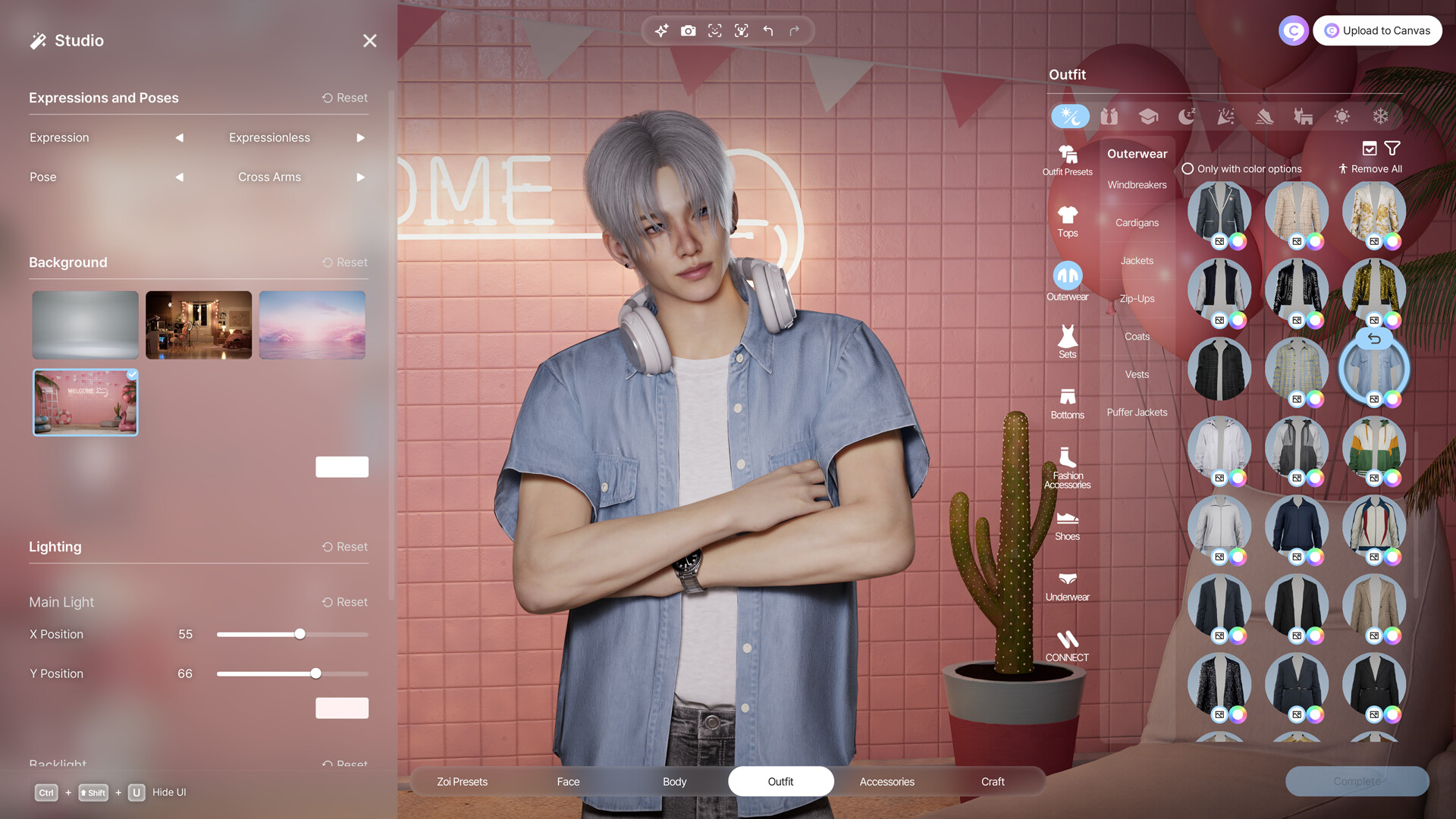
The face customization system allows fine-grained control over facial features through draggable control points. Skin tone, hair styles, eye shape, makeup, tattoos, and even dental details can all be adjusted. Body type customization includes sliders for muscle mass, body weight, height, and proportions. Players can also import real-world facial data using the Facial Capture feature, which relies on an iOS device running the Live Link app to track facial movements in real time. Finished Zois can be uploaded to Canvas, the community-sharing platform, where other players can download and use them.
The clothing editor supports nine outfit categories: Everyday, Formal, School, Sleepwear, Party, Sportswear, Swimwear, Summer, and Winter. Each category allows individual pieces for tops, outerwear, bottoms, shoes, accessories, and underwear. Colors, textures, and patterns can be modified per piece.
Household Management
Players manage households of up to 8 Zois at a time through the household management system. A household shares a single lot, communal finances tracked through the Meow and Economy system, and shared resources like food and furniture. Zois within the same household can be family members, romantic partners, or simply roommates. Managing multiple Zois means balancing each individual's needs, emotions, daily schedules, and personal goals. Players can switch control between household members at any time, and the Zois not under direct control continue to act according to their personality and current situation.
Life Stages
Every Zoi passes through nine life stages: Newborn, Toddler, Child, Adolescent, Teenager, Young Adult, Adult, Middle-Aged, and Senior. Each stage lasts a fixed number of in-game days and unlocks different activities, interactions, and responsibilities. When creating a Zoi in the editor, players can choose from six of these stages; Newborn, Toddler, and Adolescent are only available when a Zoi is born through pregnancy in-game.
Aging cannot be stopped. Once a Zoi reaches the Senior stage, they will eventually pass away from old age. The duration of each stage can be adjusted through the Aging and Life Span Settings, and the Time and Seasons settings control how quickly in-game days pass relative to real time.
Traits
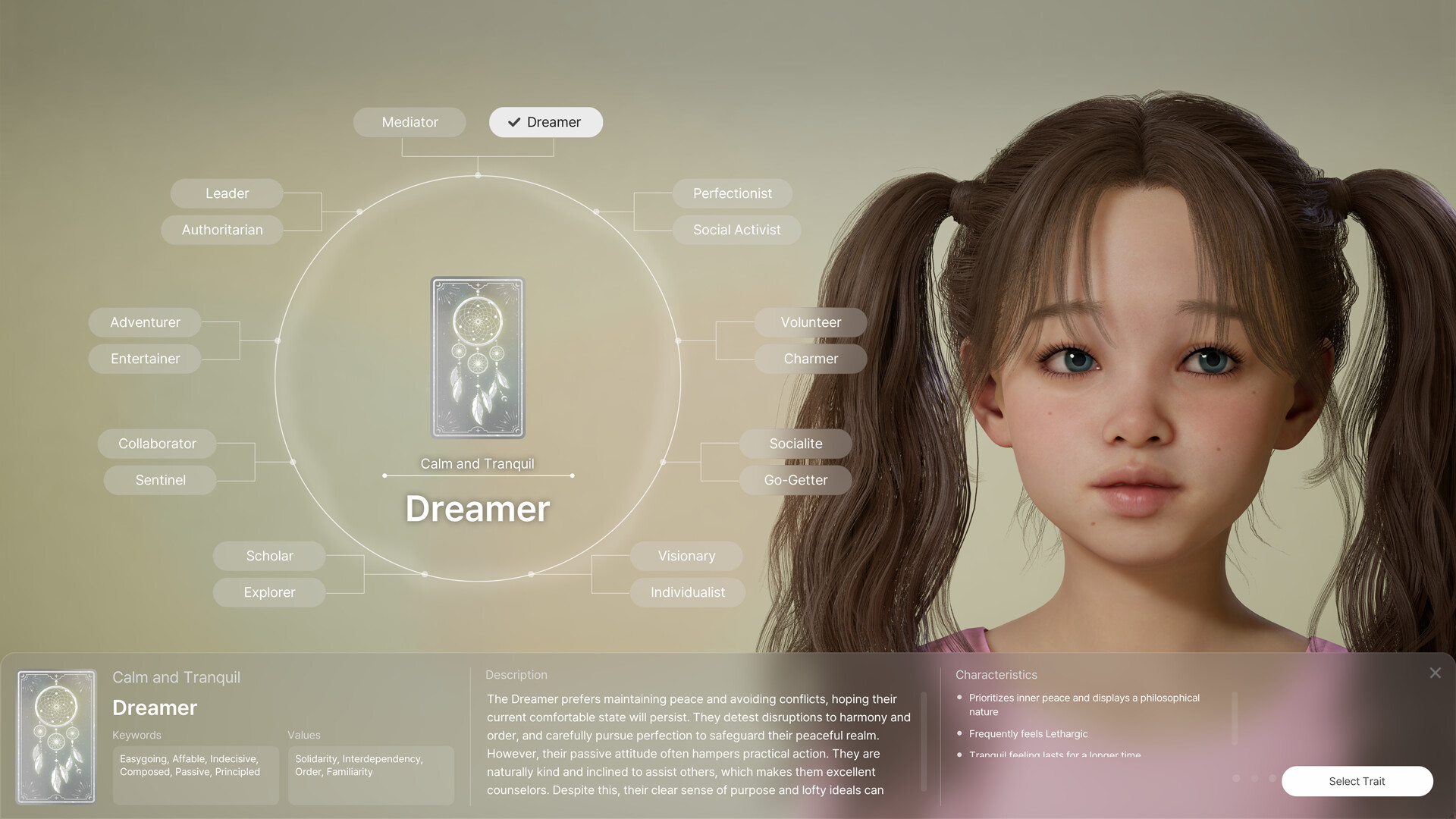
During creation, each Zoi receives one permanent trait from a pool of 18 options organized into categories. The trait system draws inspiration from the Myers-Briggs (MBTI) and Enneagram personality frameworks. Once selected, a trait cannot be changed for that Zoi. Traits affect need decay rates, skill learning speed, emotional tendencies, relationship dynamics, and which urges appear. For example, a Zoi with the Explorer trait gains discovery-related skills faster, while a Charmer trait improves social interaction outcomes. Some traits also cause certain emotions to last longer or shorter than normal.
Needs
Zois have eight needs that must be maintained: Hunger, Sleep, Bathroom, Fun, Hygiene, Social, Energy, and Recognition. Each need decays over time at a rate influenced by the Zoi's trait and current activities. If critical needs reach dangerously low levels, serious consequences follow. Starvation occurs after roughly three to four in-game days without food. Sleep deprivation can lead to death from exhaustion. Prolonged neglect of the Recognition need can cause a Zoi to run away from home permanently, vacating their spot in the household. Keeping all eight needs balanced is one of the core gameplay loops.
Emotions
Zois experience a layered system of emotions with 18 core emotional states and over 41 total variations when intensity levels are counted. Emotions range from positive states like Amused and Confident to negative ones like Annoyed and Sad. Intensity escalates over time: a mildly Annoyed Zoi can become Angry and eventually Enraged if the source of irritation persists.
Multiple emotions can overlap simultaneously, but only the most intense emotion at any moment is treated as the active one. Emotions affect skill gain rates (certain emotions accelerate learning while others slow it), shape how other Zois perceive and interact with the character, and can spread between nearby Zois. A cheerful Zoi at a party might lift the mood of everyone around them, while an angry Zoi can create tension in a room.
Values and Morals
Beyond their fixed trait, each Zoi develops a dynamic set of values through gameplay. There are 10 values in inZOI, and each is tracked on a scale from 0 to 100. Zois earn value points naturally by completing actions and social interactions that align with specific principles. For example, a Zoi who frequently helps neighbors may accumulate points in compassion-related values, while one who pursues personal gain builds a different profile.
When any value exceeds 60 points, it begins to influence the Zoi's autonomous behavior, unlocking unique interactions, conversation options, and special event opportunities. The value with the highest score becomes the Zoi's Core Value, serving as a guiding principle that shapes daily routines, major life decisions, and how the Zoi reacts to moral dilemmas. Core Values are not permanent; if a Zoi consistently acts against their current Core Value, it can shift over time to reflect new priorities.
Desired Lives and Ambitions
Zois who reach the Young Adult life stage or older can select a Desired Life, which is a long-term life goal that frames the Zoi's aspirations. There are 16 Desired Lives and 23 Ambitions spread across 10 categories. Each Desired Life recommends specific traits, ambitions, values, and hobbies and preferences that align with its theme, though none of these recommendations are mandatory. The chosen Desired Life influences which urges appear and what the Zoi gravitates toward when acting autonomously.
Smart Zoi
The Smart Zoi feature uses NVIDIA ACE technology to give Zois more autonomous and context-aware decision-making. The system runs on a compact 0.5-billion-parameter Mistral NeMo Minitron small language model that is GPU-accelerated exclusively on GeForce RTX graphics cards.
When Smart Zoi is enabled, Zois react to their surroundings, other Zois, and their own internal states with more depth than standard simulation logic. A considerate Smart Zoi might offer food to a hungry stranger or help a lost character with directions. At the end of each in-game day, Smart Zois adjust their personal schedules of activities based on the day's experiences. Players can observe a Smart Zoi's inner thoughts in real time through a thought feed, and they can influence behavior directly by typing free-form text instructions to modify the Zoi's actions and life goals. Smart Zoi is marked as an experimental feature and requires a compatible NVIDIA RTX GPU.
Autonomy and Player Control
Players can toggle Zoi autonomy with the [T] key through the Autonomy and Interaction Queue system. When autonomy is on, Zois make their own decisions about what to do based on their personality, needs, and surroundings, going about their daily lives without much player input. When autonomy is off, the Zoi waits for direct commands. This toggle lets players move freely between a hands-off simulation experience and precise micromanagement.
The Interaction Queue displays upcoming actions as icons near the Zoi. This shows what they plan to do next. Players can reorder, cancel, or add actions to the queue at any time. Pressing [R] opens the Relationships panel, which lists all known Zois and allows calling them for Social Events or direct interaction.
Urges
Urges are short-term tasks that appear randomly for each Zoi. They represent spontaneous desires or impulses tied to the Zoi's personality, current emotional state, and situation. Each urge has a 12 in-game hour expiration timer. Completing an urge before it expires earns 5 Meow Coins. Ignoring urges carries no penalty beyond the missed reward. The types of urges that appear are influenced by the Zoi's trait, active emotions, and selected Desired Life.
Skills and Careers
Zois develop 27 skills through practice and repetition. Cooking meals improves Cooking, painting raises the Art skill, chatting with others builds the Rhetoric skill, and so on. Skills progress through levels 1 through 10, with higher levels unlocking new interactions, crafting options, and career advancement opportunities.
Zois can hold jobs and careers by applying through the Smartphone Career app. Jobs come in two forms: active careers, where the player can view the workplace interior and control the Zoi's tasks directly, and rabbit hole careers, where the Zoi disappears into a building and progress updates arrive via notification. Both full-time and part-time positions are available. Raising the right skills and attending shifts consistently leads to promotions and higher pay.
Relationships and Family
Zois build connections through four relationship types: Family, Romance, Friendship, and Business. These relationship tracks progress independently, so two Zois might have a strong Business bond but barely know each other socially. Romance relationships can progress from first encounters through dating, engagement, and marriage. After marriage, the Romance track converts to a Family relationship with the level reset to Neutral. This reflects the shift to a deeper bond.
Married Zois (or committed partners) can try for a baby through the Suggest Having a Baby interaction. If successful, pregnancy lasts three in-game days and results in a Newborn that inherits physical traits from both parents, including hair color, eye color, and facial structure. Babies may also inherit personality tendencies and skill aptitudes through the genetics and inheritance system. Adoption is also available as an alternative way to grow a family.
Karma, Death, and Ghosts
Every Zoi has an individual Karma score that tracks moral standing. Positive actions like helping others and performing good deeds increase Karma, while negative actions like crime and selfish behavior decrease it. Karma influences how other Zois perceive and react to the character, and it plays a decisive role at the moment of death.
Zois can die from multiple causes: starvation, exhaustion, fire, disease, pollution, electric shock, car accidents, and emotional despair. When a Zoi dies, their Karma score determines what happens next. Zois with sufficient Karma pass on peacefully. Those with poor Karma are forced to remain as ghosts, bound to the world until they redeem themselves. Ghosts persist for three in-game days during which the player can control them and attempt to raise their Karma through positive actions. If too many ghosts accumulate in a city, new Zois cannot be born there until the spiritual balance is restored.
Psycat Companion
Psycat is a floating cat companion that acts as the player's in-game guide. Psycat provides tutorial tips, notifies the player of important events like a Zoi's birthday or a job interview, and includes an Emergency Rescue function that teleports stuck Zois back to their home lot. The rescue feature is particularly useful when pathfinding errors trap a Zoi in geometry or when a Zoi wanders somewhere unreachable.
Playback Speed
The simulation runs at adjustable playback speeds. By default, one in-game day equals 96 minutes of real time. This can be adjusted through Time and Seasons settings, ranging from 48 minutes to 24 real hours per in-game day.
Speed | Description |
|---|---|
0 | Pause (time stops completely) |
1 | Normal speed (1x) |
2 | Fast (1.5x) |
3 | Very fast (3x) |
4 | Ultra fast (5x, available via the UI) |
Daily Life Activities
Zois spend their days engaged in a wide range of activities. They can hold jobs, attend university or school, develop skills, pursue hobbies, cook meals, garden, maintain hygiene, sleep in beds, use their smartphone, drive cars, go shopping, eat at restaurants, play instruments, swim, fish, exercise at fitness facilities, and attend social events. The breadth of available activities and the way Zois autonomously choose between them based on personality, needs, and mood is one of the defining features of the simulation.