
Loading...
Crimson Desert Overview
August 26, 2026 at 01:38 PM
Restored missing spaces and commas around linked terms that displayed as run-together words
Crimson Desert is an open-world action-adventure role-playing game developed and published by Pearl Abyss. Released on March 19, 2026 for PlayStation 5, Xbox Series X|S, Windows PC, and macOS, the game takes place on the fictional continent of Pywel a sprawling medieval fantasy world shaped by centuries of conflict, political upheaval, and mysterious supernatural forces. Players follow Kliff the battle-hardened leader of the Greymane mercenary company, as he fights to rebuild his shattered band of fighters and carve out a place in a land that offers no safe harbor.
Originally conceived as a prequel to Black Desert Online, Crimson Desert evolved into a fully standalone single-player experience during its development cycle. Pearl Abyss gradually reimagined the project as a distinct IP set in a separate universe, with no multiplayer integration or connection to the Black Desert Online storyline. The game is built on the proprietary BlackSpace Engine, an upgraded iteration of the technology that powered Black Desert Online, delivering large-scale seamless environments, physics-driven interactions, and cinematic combat sequences.
Crimson Desert sold over two million copies within its first 24 hours and surpassed three million copies worldwide within four days of launch. It received generally favorable reviews from 93 critics. Critics praised its ambitious open world, varied gameplay systems, and visual fidelity, while noting areas for improvement in controls and quality-of-life features.
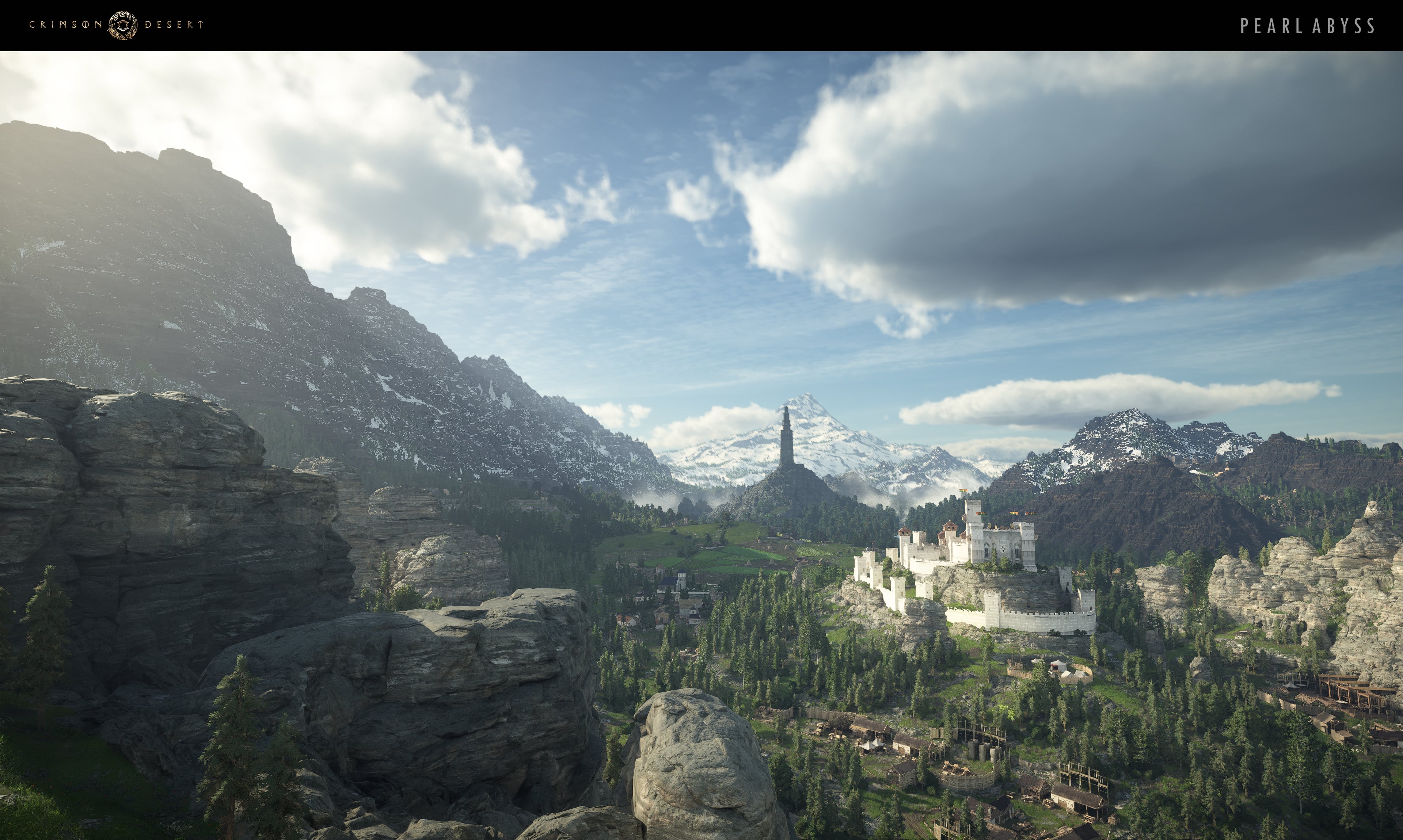
The game unfolds across the continent of Pywel a massive seamless open world spanning approximately 90 square kilometers. Pywel is divided into five distinct regions, each with its own geography, culture, and dangers. The world blends medieval European architecture with fantasy elements, featuring dense forests, arid wastelands, mountain fortresses, coastal towns, and underground ruins. A supernatural dimension known as the Abyss permeates the land, granting those who interact with it strange and powerful abilities at a cost.
Region | Description |
|---|---|
A lush region of mountains, rivers, and farmland. is the starting area and the location of the rebuilt Greymane Camp. Home to Howling Hill where Kliff establishes a new base of operations. | |
The northernmost region of Pywel and the ancestral homeland of the Greymanes. Occupied by the Black Bears after a devastating assault, it represents both what was lost and what must be reclaimed. | |
The political and military heart of Pywel. A densely populated region where major factions vie for dominance, featuring fortified cities and centers of commerce. | |
A region defined by its unique cultural identity and distinct environmental challenges. Players encounter new factions and storylines as they venture into this territory. | |
The arid, unforgiving wasteland that gives the game its name. A harsh frontier where only the most resourceful survive, hiding ancient secrets beneath its sun-scorched surface. |
Crimson Desert follows Kliff Macduff the leader of the Greymanes a ragtag mercenary company struggling to survive after a brutal attack by the Black Bears. The assault cost Kliff most of his family and scattered his companions across the continent. With his remaining allies, Kliff sets out to rebuild the Greymane company, reunite lost members, and establish a new home in the hostile lands of Pywel.
The main campaign spans 12 chapters plus a prologue, beginning with the Dead of Night prologue where the Black Bears invade the Greymane camp in Pailune. From there, the story moves through Hernand as Kliff rebuilds, eventually expanding into a continent-wide journey that involves political intrigue, faction warfare, and the mysteries of the Abyss. The narrative weaves personal stakes with larger geopolitical conflicts, and player choices in faction reputation and quest resolutions shape how the world responds to the Greymanes.
Crimson Desert features three playable characters each with a distinct combat style, weapon set, and role in the story. Players begin as Kliff and unlock the other two characters through story progression. A party system allows all three characters to fight together once unlocked, and players can switch between them using the character switching mechanic.
Character | Weapon Style | Unlocked |
|---|---|---|
One-handed sword with medium or large shield; bow for ranged combat | Available from the start | |
Rapier with small shield; pistol for ranged combat | After completing Chapter 3: Howling Hill First Step to Rebuilding | |
Great axe; hand cannon for ranged combat | At the end of Chapter 7: Incomplete Victory |
Each character brings a different approach to combat. Kliff balances offense and defense with his shield, Damiane excels at quick, precise strikes with her rapier and can use firearms at range, and Oongka delivers raw power through heavy melee attacks complemented by explosive hand cannon shots. Players can form a party with all three and switch between them freely during exploration and combat encounters.
Beyond the three playable characters, a large cast of named NPCs populates Pywel. These characters serve as faction leaders, quest givers, mentors, and rivals throughout the story.
Character | Role |
|---|---|
A major antagonist and powerful warrior. Kliff confronts Myurdin in a pivotal battle during Chapter 7. | |
A key ally of the Greymanes with her own backstory and motivations. Joins the party as a companion. | |
A Greymane companion who contributes to camp operations and the dispatch system. | |
Marquis Serkis | A nobleman who grants the Greymanes land at Howling Hill and plays a major role in establishing their new base. |
Marshal Middler | Oversees the camp operations and introduces Damiane to the player during Chapter 3. |
The combat system in Crimson Desert blends traditional melee swordplay with grappling moves, environmental interactions, and supernatural Abyss abilities. There is no class system; instead, your fighting style is determined by the weapons you equip. Available weapon categories include swords, great swords, spears, axes, rapiers, and more, each with its own moveset and combo chains.
Combat has a soft stagger system where heavy damage interrupts attack chains for both the player and enemies. Players can fight on horseback, use a radial menu to imbue weapons with elemental properties (Fire for burn damage, Frost for slowing and freezing, Shock for striking), and execute context-sensitive grappling moves that vary depending on the environment and enemy type.
The skills system supplements weapon combat. Rather than leveling up through experience points, players collect Abyss Artifacts from exploration, quests, and boss encounters to upgrade core stats (Health Stamina Spirit) and unlock new abilities. See the Skills page for a full breakdown of all unlockable abilities and the Elemental Effects page for details on elemental weapon infusions.
Pywel is a fully seamless open world with no loading screens between regions. Players explore on foot, on horseback via glider, or through climbing. Horseback combat is available during mounted exploration, and horses can be tamed and customized. A glider obtained through the Abyss allows players to cross large gaps and descend from high elevations safely.
Fast travel is handled through Abyss Nexus points scattered throughout the world. These must be discovered and activated before they can be used. The world map reveals points of interest, quest locations, and discovered Abyss Nexus nodes, though much of the map must be uncovered through exploration.
The Abyss grants Kliff special traversal and puzzle-solving abilities, including making objects weightless, lifting heavy items with a tether, and interacting with environmental puzzles that block access to hidden areas. These abilities expand as the story progresses, opening previously inaccessible locations in earlier regions and rewarding backtracking.
The Greymane Camp is the player's central hub throughout the game. Established at Howling Hill in Hernand during Chapter 3, the camp starts as a handful of tents and grows into a fully functioning settlement through player investment of materials and currency. Every building is placed and constructed by the player.
The camp houses multiple facilities that unlock gameplay systems. A smithy enables weapon and armor crafting. A kitchen supports the cooking system. Farming plots and animal pens supply ingredients. A barber shop and dyehouse allow character customization. A dispatch office sends companions on resource-gathering missions in the background. Upgrading the camp directly improves character stats, unlocks new skills, and expands the roster of available companions.
See Housing and Farming for a full guide to camp construction, furniture placement, crop cultivation, and ranch management. See the Companion Dispatch Guide for information on sending companions on gathering missions.
Crimson Desert has a deep set of non-combat systems that tie directly into progression and sustainability. These life systems create a resource loop where gathered materials feed into crafting, which in turn supports combat preparation and camp development.
System | Description | Main Article |
|---|---|---|
Prepare meals at the camp bonfire for Health Spirit and Stamina buffs. Recipes are collected throughout Pywel. | ||
Create and upgrade weapons, armor, and accessories at the camp smithy using gathered materials. | ||
Collect herbs, minerals, wood, and other materials from the open world. Includes logging and mining. | ||
Brew consumables and dyes at the alchemy station. Requires ingredients from gathering and farming. | ||
Catch fish in rivers and lakes for cooking ingredients and vendor sales. | ||
Extract ores and minerals from deposits found throughout the world for crafting and camp construction. | ||
Chop trees for lumber used in camp construction and crafting. Players physically fell trees by hand. |
Multiple factions control different territories and resources across Pywel. Players build reputation with each faction through quests, trade, and combat actions. Higher reputation unlocks discounted prices, exclusive equipment, additional quest lines, and access to faction-controlled strongholds. Negative actions against a faction lower reputation and can trigger hostile responses from their members.
The Black Bears serve as the primary antagonist faction throughout much of the story, having destroyed the Greymane homeland of Pailune. Other factions include trade guilds, noble houses, regional militias, and independent settlements, each with their own quest chains and reward structures.
Crimson Desert includes full stealth mechanics with enemy vision cones and the ability to approach encounters from a tactical perspective. Players can sneak past guards, perform stealth takedowns, and use cover to avoid detection.
A crime and bounty system governs illegal actions in the world. Stealing items, attacking NPCs, or committing acts of vandalism accumulates a bounty. Guards will pursue and engage wanted players, and bounties must be paid off or waited out. Interestingly, the game leans into player freedom here: you can interact with nearly everything in the environment, throw NPCs around, steal items from homes, and engage in various forms of mischief. The consequences are real but rarely permanent, and creative problem-solving through unorthodox means is often viable.
The main quest line spans 12 chapters plus a prologue, guiding players through the core narrative. Beyond the main storyhundreds of side quests are scattered across Pywel, ranging from simple fetch tasks to multi-step story arcs with meaningful rewards. Sealed Abyss Artifacts provide collectible challenges that test combat skill and exploration thoroughness.
See the Walkthrough for a chapter-by-chapter guide to the main story, and Main Quests for a complete list of all story missions.
Crimson Desert has a wide array of boss encounters, from story-critical antagonists to optional world bosses hidden in remote locations. Boss fights are designed as cinematic set pieces with unique mechanics, phase transitions, and environmental hazards. Consumable items such as cooked meals can be used during boss fights to restore health and maintain buffs.
Beyond combat and exploration, Pywel offers a variety of mini-games and side activities. These range from tavern games and NPC challenges to environmental puzzles and timed events. Many mini-games reward unique items, currency, or reputation that cannot be earned through other means.
Crimson Desert is powered by the BlackSpace Engine Pearl Abyss's proprietary game engine that evolved from the technology behind Black Desert Online. The engine supports fully seamless open-world streaming with no loading screens, advanced physics simulations for environmental interactions, realistic cloth and hair movement, dynamic weather and day-night cycles, and cinematic in-engine cutscenes that transition seamlessly into gameplay.
For hardware requirements on PC, see System Requirements. The game is available on PlayStation 5, Xbox Series X|S, Windows PC, and macOS.
Crimson Desert launched with multiple purchase options. For a breakdown of each edition and its contents, see Pricing and Editions. Post-launch content updates and DLC are planned to expand the game with additional regions, quests, and features.
Crimson Desert received generally favorable reviews from 93 critics. Of those, 71 were positive (73%), 25 were mixed (26%), and 1 was negative (1%). Critics praised the game's ambitious scope, dense world design, varied gameplay systems, and visual quality. Common criticisms centered on occasionally clunky controls and quality-of-life friction in some UI systems.
Player reception trended more positively over time. The user score climbed to 8.6 as players spent more time with the game and Pearl Abyss released patches addressing early concerns. The game sold over two million copies within 24 hours and surpassed three million within four days, making it one of the strongest launches of 2026.
Crimson Desert was first announced in 2019 as a prequel to Black Desert Online. Over the following years, Pearl Abyss shifted the project's direction multiple times, eventually settling on a fully standalone single-player experience. The game was showcased at multiple Game Awards presentations and industry events, generating significant anticipation. For a detailed timeline of the game's development, see Development History.
The following pages serve as starting points for diving deeper into specific aspects of Crimson Desert:
Topic | Article | Description |
|---|---|---|
Getting Started | Essential tips for new players starting their journey in Pywel. | |
Tips | Practical advice for combat, exploration, and camp management. | |
Story | Chapter-by-chapter guide through the main quest line. | |
Characters | Kliff Damiane and Oongka, abilities, weapons, and unlock conditions. | |
Combat | Melee, ranged, elemental, and Abyss combat mechanics. | |
World | Interactive map of all regions, points of interest, and Abyss Nexus locations. | |
Camp | Base building, facilities, upgrades, and companion management. | |
All weapon categories, stats, and acquisition methods. | ||
Armor sets, upgrade paths, and defense mechanics. | ||
Shields | Shield types, passive defense stats, and blocking mechanics. | |
Bosses | All boss encounters, strategies, and reward drops. | |
Factions | All factions, reputation tiers, and exclusive rewards. | |
Camp housing, crop farming, livestock ranching, and resource management. | ||
Travel | Abyss Nexus locations and how to unlock the fast travel network. | |
Companions | Recruitable companions, their skills, and dispatch missions. |
Voice Acting - Cast and performance details
Development History - Timeline of the game's creation from announcement to launch
Post-Launch Content - Planned updates, patches, and DLC
System Requirements - Minimum and recommended PC specifications
BlackSpace Engine - Technical deep-dive into the game engine