

BlackSpace Engine
Pearl Abyss's proprietary C/C++ game engine powering Crimson Desert, featuring full path tracing, per-pixel ray-traced global illumination, GPU-based cloth and hair simulation, volumetric water, and destructible environments across PC, PS5, Xbox Series X|S, and macOS.
On This Page
Overview
The BlackSpace Engine is Pearl Abyss's proprietary game engine that powers Crimson Desert. It is an upgraded and significantly expanded version of the engine originally developed for Black Desert Online in 2015. Pearl Abyss designed the engine from the ground up to support photorealistic visuals, large-scale seamless open worlds, real-time physics, and advanced lighting across multiple platforms and game genres.
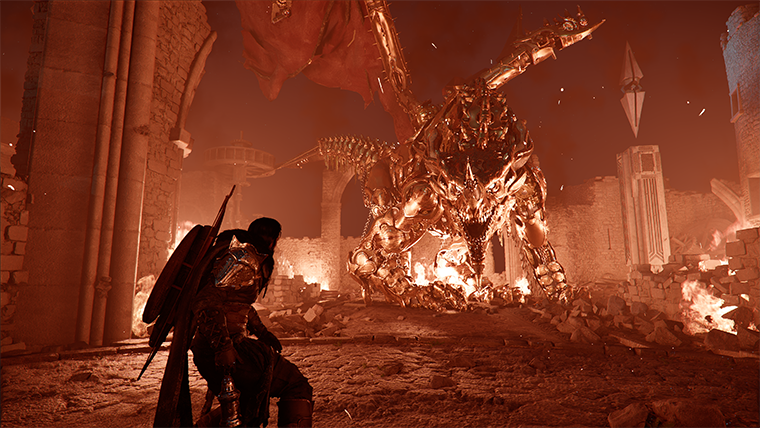
At CES 2026, Crimson Desert "CES's best game" based on the BlackSpace Engine's technical capabilities, noting that its per-pixel ray-traced global illumination "rivals or edges out Lumen" in Unreal Engine 5 titles while demanding "noticeably less GPU overhead." The engine was also showcased behind closed doors during GDC 2025 week (March 2025), where Pearl Abyss gave press and developers a closed-door look at its rendering pipeline, physics systems, and open-world streaming technology.
Beyond Crimson Desert, the BlackSpace Engine will power Pearl Abyss's future titles DokeV (an open-world creature collecting game) and Plan 8 (an exosuit shooter). The studio stated that with the engine now at a "stabilization stage," they can focus development resources on game content rather than concurrent engine work.
Engine History
Pearl Abyss was co-founded in September 2010 by Kim Daeil and Youn Jaemin. From the beginning, the company built its own proprietary engine because, in their words, they "could not build the worldview we wanted in the framework of others." The original engine was a key factor in securing the venture capital funding that kept the studio alive during its early years, and it powered Black Desert Online when that game launched on PC in 2015.
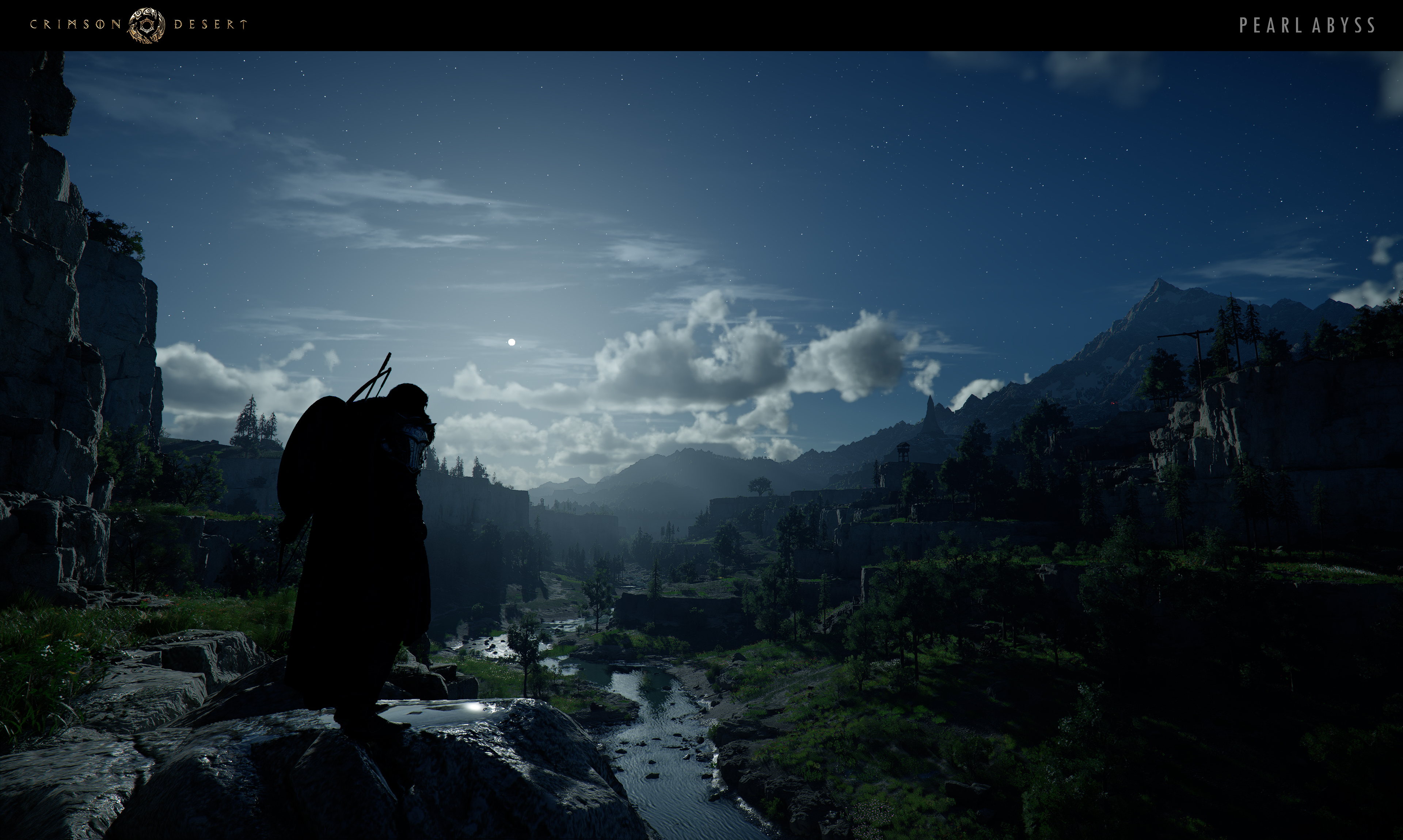
On May 10, 2019Pearl Abyss officially announced a next-generation engine designed to "respond and adapt to the rapid development of new technologies including cloud environments and game streaming." Chairman Daeil Kim confirmed development was progressing at a "rapid pace." At this point, the engine was planned for two projects: "Project K" (which became Crimson Desert) and "Project V" (which became DokeV).
The developers explained the motivation for building a new engine: "The Black Desert engine was specific for Black Desert only. A lot of features could not be implemented to any other open-world game or in general other genres of games. We wanted to make a new engine to support all the new platforms and all the new genres of games so that it could feel realistic." The BlackSpace Engine name became the public-facing brand when Pearl Abyss released an official show in 2024.
Rendering and Lighting
Full Path Tracing
The BlackSpace Engine on PC uses a completely redesigned rendering pipeline built around full path tracing rather than hybrid ray tracing. Unlike classic ray tracing that overlays shadows or reflections on rasterized images, the BlackSpace approach unifies all lighting algorithms into a single mathematical model. Every pixel is calculated based on photon behavior simulation, producing physically accurate shadows, reflections, refractions, and global illumination without the artifacts common in hybrid rendering approaches.
Per-Pixel Ray-Traced Global Illumination
All environments in Crimson Desert receive per-pixel ray-traced global illumination, applied consistently across indoor and outdoor spaces. No pre-baked shadow maps or static lightmaps are used anywhere in the game. All illumination is fully dynamic, meaning the world responds naturally to the day-night cycle, weather changes, and moving light sources without relying on pre-computed data. Interior spaces, outdoor environments, and transitional areas (such as cave entrances) all receive consistent, physically-based lighting.
Physically Based Rendering
Materials use physically based rendering (PBR), meaning they look and react like their real-world counterparts. Metal accents on armor reflect surrounding light sources accurately; torches cast light and shadows that interact correctly with nearby surfaces. Leather, stone, wood, and cloth all scatter and absorb light differently based on their physical properties.
Atmospheric Scattering
The engine simulates organic changes in air color, cloud shadows, and fog density based on the sun's position within the day-night cycle. Dawn air appears bluish, gradually turning golden with morning sunlight, and the atmosphere burns red at sunset. A volumetric sky capture system inspired by meteorological algorithms renders these transitions more credibly than typical open-world skybox solutions.
Imposter Rendering and LOD
Distant trees and foliage use "imposter" images, which are convincing 2D representations of 3D geometry, to reduce GPU load while maintaining visual density to the horizon. Level-of-detail (LOD) transitions are smooth and gradual, avoiding the harsh pop-in that is common in Unreal Engine 5 open-world titles. Far-field foliage is rendered as full geometry with real-time animation rather than billboard sprites, preserving detail at extreme viewing distances.
Water and Fluid Systems
Water technology is one of the BlackSpace Engine's most distinctive features. At GDC 2025, when a journalist asked a detailed question about the water systems, the developers reportedly "went off" with enthusiasm and provided an extended breakdown that exceeded the allotted time.
FFT Ocean Simulation
Large-scale ocean waves and water body behavior are generated using Fast Fourier Transform (FFT) ocean simulation, producing realistic wave patterns that respond to wind direction and intensity.
Shallow Water Simulation
Water flow and tides simulate collision with the environment. Rivers, streams, and shorelines respond to terrain geometry and objects placed within them. Water flows around rocks, conforms to riverbeds, and creates natural-looking eddies and ripples without scripted animations.
Volumetric Water
Water is treated as volumetric data rather than displacement mapping. This means water has actual volume: it flows around obstacles, conforms to terrain for seas and rivers, and physically interacts with characters and objects. This approach is described by analysts as "a rarity at this scale" in real-time game engines.
Partial Wetness
Water dynamically wets clothes and animal fur with partial coverage. Rather than applying a uniform wet shader across an entire character model, the system realistically determines which surfaces get wet and which remain dry based on contact and exposure.
Physics and Destruction
The BlackSpace Engine features fully physics-driven environmental interactions that go beyond scripted set pieces. described Crimson Desert as potentially having "the most realistic in-game physics" they had ever seen. Destructible environments respond systemically to player actions: trees fall when struck by swords or cannon fire with realistic physics, buildings sustain damage and can collapse during siege battles and object destruction varies depending on the type and force of impact applied.
In combat enemies dynamically collide with the environment when hit. A sword strike can send an enemy staggering into a fence, which then breaks under the impact. These interactions are emergent rather than pre-animated. Detailed hit reactions convey the weight and impact of each blow, and players are never locked into animations during combat, preserving responsiveness.
Animation and Simulation Systems
GPU-Based Cloth Simulation
Cloth simulation runs on the GPU and reacts to wind, movement, and environmental forces. Bannerscloaks and fabric on clotheslines sway naturally, with intensity and direction responding to changes in wind conditions. Clothes interact with other clothes and with horses without intersection artifacts, which is a common problem in other engines' cloth simulation systems.
GPU-Based Hair Simulation
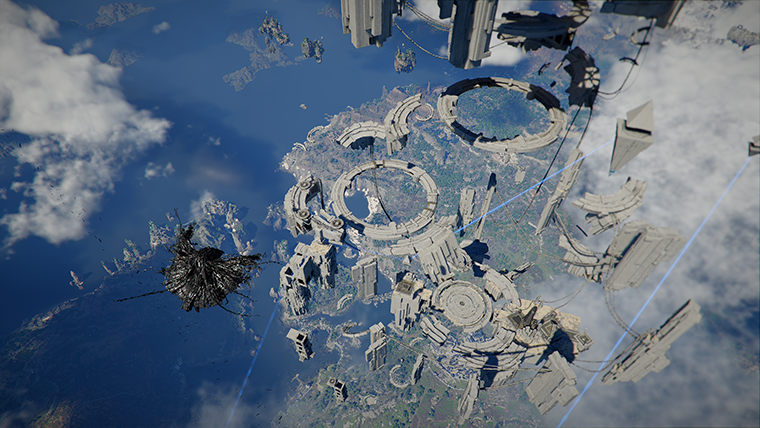
Hair behaves with realistic physics, interacting with clothing and responding to wind and character movement. Horse manes and tails move naturally in the wind. The simulation runs on the GPU to maintain performance while providing per-strand behavior.
Vegetation Simulation
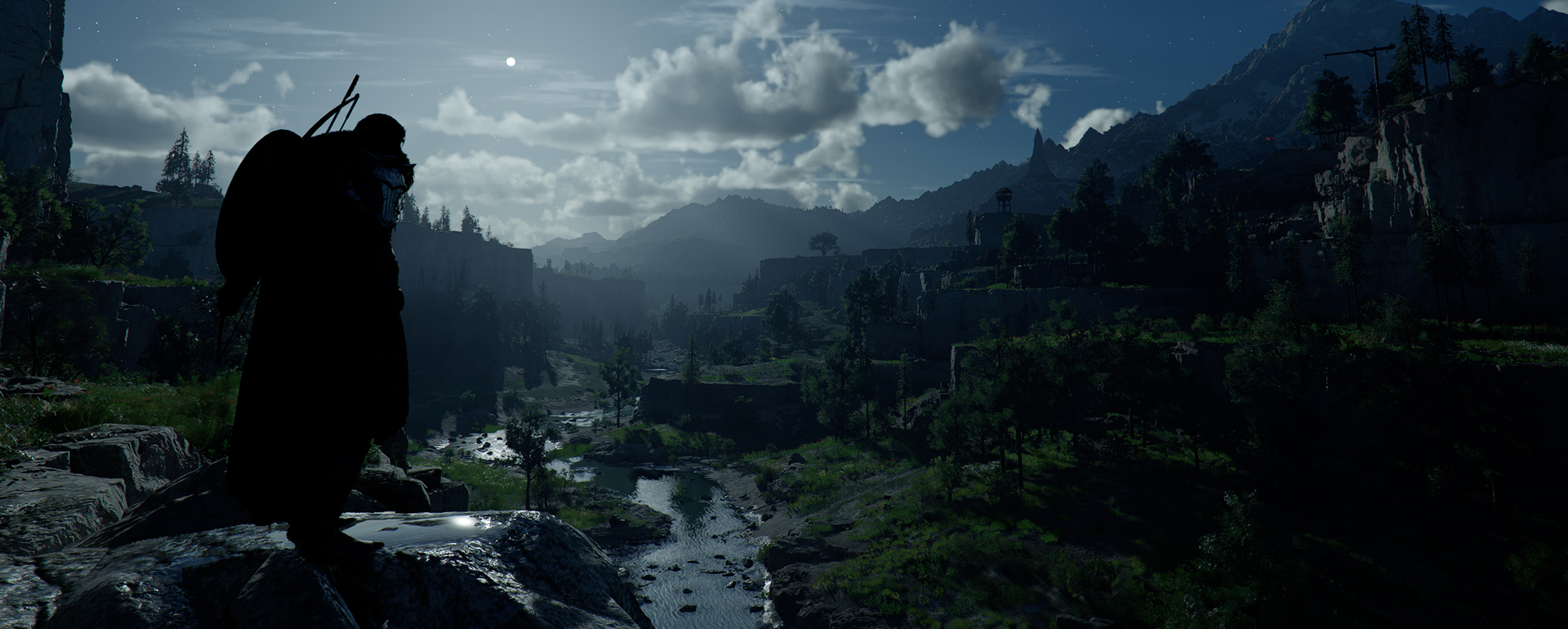
Trees and grass sway naturally in response to wind, with ramping intensity and directional changes. Wind gusts propagate visibly across fields of grass and through tree canopies, creating a sense of living weather rather than static looping animations.
Volumetric Fog
Fog, smoke, and clouds are volumetric data structures rather than flat textures. Light rays pass through them for physically accurate God Rays and volumetric shadows. Fog reacts to player movement, dispersing when walked through, and density changes dynamically with wind conditions. The engine uses froxel raymarching to create realistic fog swirling effects across Pywel's diverse biomes, from misty mountain passes to foggy marshlands.
Volumetric Clouds
Clouds are volumetric rather than static skybox textures. Characters can move through cloud layers at high altitudes, and the clouds respond to this interaction. Cloud density and coverage shift dynamically as part of the weather system.
Open World Streaming
Crimson Desert has no loading screens during open-world exploration. The BlackSpace Engine uses hierarchical level subdivision and hierarchical proxy loading to stream content continuously as the player moves through the world. Elements load sequentially as the player approaches, with the system prioritizing rendering based on distance from objects.
Pearl Abyss described their approach as using "manual geometric processing" that is "ultra-optimized, reducing memory costs and favoring massive environments without physical loading constraints." This differs from Unreal Engine 5's Nanite system, which manages geometry more automatically but carries heavier overhead.
Performance
PC
On PC, the BlackSpace Engine achieves native 4K resolution at 60 FPS with ray tracing enabled. that an AMD RX 7900 XTX achieved 4K at 60 FPS on Ultra settings without any upscaling (no DLSS or FSR required), which is a remarkable result for a game with per-pixel ray-traced global illumination. The recommended GPU class is RTX 2080 or RX 6700 XT.
NVIDIA DLSS 4 is supported at launch, including Multi-Frame Generation and DLSS Ray Reconstruction. AMD FSR Redstone is also supported, with AI-powered FSR Upscaling, ML Frame Generation, and Ray Regeneration. Crimson Desert is only the second game to support FSR Redstone. Both upscaling technologies serve as optional enhancements rather than requirements for hitting performance targets.
Console
Platform | Frame Rate | Notes | |
|---|---|---|---|
PS5 Pro | 4K | Higher frame rates | Uses PlayStation Spectral Super Resolution (PSSR 2), Geometry Shader Oversubscription, and NGG Culling |
PS5 | Upscaled 4K (1280p base) | 30 FPS Quality mode (upscaled 4K from 1440p); 40 FPS Balanced mode; 1080p/60 FPS Performance mode | Uses NGG Culling for vertex reduction pre-rasterization |
Quality | 30 FPS | 4K | |
Xbox Series X | 4K | Quality: 30 FPS, Balanced: 40 FPS, Performance: 60 FPS | Three display modes: Quality (upscaled 4K at 30 FPS with high RT), Balanced (upscaled 4K at 40 FPS with low RT), Performance (1080p at 60 FPS with low RT) |
macOS
Crimson Desert launches simultaneously on macOS on day one, March 19, 2026. The engine utilizes Apple's MetalFX Upscaling technology for performance on Apple Silicon hardware. M3 and M4 chips receive hardware-accelerated ray tracing and mesh shading support. Pearl Abyss stated that Mac receives the same technical attention as PlayStation and Xbox, treating it as a primary platform rather than a port.
Comparison to Commercial Engines
Pearl Abyss has explicitly positioned the BlackSpace Engine as an alternative to commercial engines like Unreal Engine 5, arguing that a purpose-built engine has measurable performance advantages over a generalist engine carrying its own overhead.
Feature | BlackSpace Engine | Unreal Engine 5 |
|---|---|---|
Global Illumination | Per-pixel ray-traced GI, fully unified rendering model | Lumen (software/hardware hybrid approach) |
Geometry Management | Manual optimized processing, lower memory cost | Nanite (automatic but heavier overhead) |
LOD Transitions | Smooth imposter rendering, minimal pop-in | Occasional harsh pop-in at LOD boundaries |
Volumetric water with physical terrain interaction | More static water systems | |
Cloth Simulation | GPU-based, no intersection artifacts | Prone to stuttering and clipping issues |
Native 4K RT Performance | 60 FPS on RX 7900 XTX without upscaling | Typically requires DLSS/FSR for comparable targets |
Platform Support
The BlackSpace Engine powers Crimson Desert across all target platforms: Windows PC, PlayStation 5, PlayStation 5 Pro, Xbox Series X|S, and macOS (Apple Silicon M2 Pro and later). The engine's multi-platform architecture was a core design goal from the beginning, differentiating it from the original Black Desert engine which was PC-specific. All platforms receive the same core rendering features, with platform-specific optimizations (PSSR 2 on PS5 Pro, MetalFX on macOS, DLSS/FSR on PC) layered on top.
Key Public shows
Event | Date | Details |
|---|---|---|
Next-Gen Engine Announcement | May 2019 | Pearl Abyss publicly announced development of a next-generation engine for Project K and Project V |
Official BlackSpace show | 2024 | Pearl Abyss released a public show video demonstrating the engine's rendering, physics, and world-streaming capabilities |
GDC 2025 | March 2025 (GDC week) | Behind-closed-doors technical presentation for press and developers at the Game Developers Conference |
CES 2026 | January 2026 | Crimson Desert "CES's best game" based on the engine's technical demo |
AMD FSR Redstone Support
Crimson Desert is confirmed as the second game ever to support AMD's full FSR Redstone suite (after Call of Duty: Black Ops 7). FSR Redstone includes four components:
Component | Description |
|---|---|
ML Ray Regeneration | AI-based denoising for more detailed ray-traced reflections and shadows with fewer artifacts. Can be used independently of FSR upscaling or Frame Generation. |
ML Frame Generation | AI-powered frame generation for higher perceived frame rates. |
FSR Upscaling | ML-enhanced upscaling for improved image quality at lower native resolutions. |
FSR Radiance Caching | ML-accelerated radiance caching for more efficient lighting calculations. |
The full ML-Enhanced suite is exclusive to AMD RDNA 4 (Radeon RX 9000 Series) GPUs. Pearl Abyss has stated they are not optimizing the game with upscaling in mind, focusing on native resolution performance first and treating upscaling tools as additional bonuses for players with compatible hardware.
Cinematic Graphics Preset
Crimson Desert features six graphics presets: Minimum, Low, Medium, High, Ultra, and Cinematic. The Cinematic preset sits above Ultra as the highest quality setting. The tech preview footage was captured at the Ultra preset (second-highest), meaning the game can achieve even higher visual fidelity on the Cinematic setting. Specific visual differences between Ultra and Cinematic have not yet been detailed, but the existence of a tier above Ultra indicates Pearl Abyss built additional headroom for high-end hardware.
PS5 Pro Enhanced Features
Crimson Desert supports several PS5 Pro enhancements:
Feature | Description |
|---|---|
PSSR 2 | Upgraded PlayStation Spectral Super Resolution for 4K at higher frame rates. |
High CPU Frequency Mode | Enables seamless world traversal without hitching. |
Enhanced Ray Tracing | More realistic lighting effects on PS5 Pro hardware. |
Geometry Shader Oversubscription and NGG Culling | Renders dense scenes without losing detail. |
Haptic feedback during parrying and heavy attacks; adaptive triggers simulate bowstring tension during archery. |