
Merchant Contracts are the items that turn the abstract idea of a settlement economy into a real base feature in Windrose. The current live contract pages show three contract items, and each one builds a merchant station that sells goods for Piastres inside your base.
Current Contract Items
Contract | Current Buy Source | Current Price | Builds |
|---|---|---|---|
Civilians - Level 2 | 100 Piastres | ||
Civilians - Level 2 | 100 Piastres | ||
Buccaneers - Level 2 | 100 Piastres |
What the Built Stations Need
A roof
Bonfire range
Piastres to actually buy goods once the station is built
That last point matters. Buying the contract does not stockpile resources by itself. It unlocks a merchant station, and then you still spend Piastres on the actual goods.
Current Stock by Contract
Contract | Current Stock Summary |
|---|---|
Baseline supply starts with Wood, Stone, Clay, and Plant Fiber. After local threats are cleared, the station adds Sulfur, Hardwood, and Tree Bark | |
Baseline supply starts with Coconut. After Coastal Jungle threats are cleared, the station adds Banana, Sweet Potato, Cayenne Pepper, and the seeds for those crops. After Foothills threats are cleared, it adds Lime, Aloe, Corn, Tomato, Flax, and their seeds | |
Animal Products | Baseline supply starts with Crab Meat, Dodo Egg, Feather, and a starter bird-meat entry. Later stock expands into larger meat, hide, tusk, fat, fang, horn, and bezoar materials as threats are cleared |
Community-Reported Example Prices
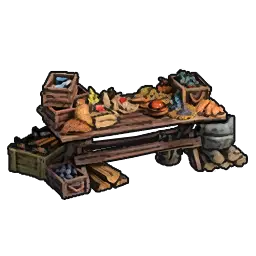
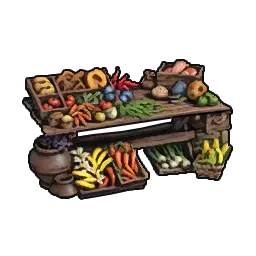
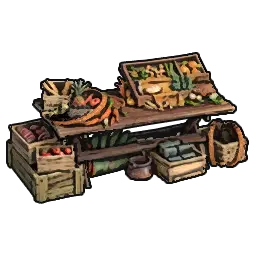
Image | Station | Item | Current Price |
|---|---|---|---|
| 25 Piastres for 1 | ||
| 25 Piastres for 1 | ||
| 40 Piastres for 1 | ||
| 50 Piastres for 1 | ||
| 10 Piastres for 1 | ||
| 20 Piastres for 1 |
Why These Contracts Matter
They smooth out shortage management once your base is established.
They reduce the pain of basic resupply on long-running worlds, especially shared worlds.
They are separate from ordinary vendor listings on raw item pages, so it is normal for a raw item page to say ordinary vendors do not trade that item while a contract station still sells a matching supply version.
See Also
Trading and Merchants - the larger money and vendor framework around contracts
Settlement Building - where merchant stations fit into a real base
Resources - the material shortages Merchant Contracts can help solve
Food and Potions - why the Food contract matters once cooking expands
Real-Time Delivery Cycles
Merchant contracts are passive logistics tools, not instant panic buttons. Once the merchant station is built at your base, each order runs on a long real-time timer. Launch-week community testing put the cycle at roughly 70 minutes (community-reported; verify in-game) per delivery, so the contract system works best when you queue it before a long exploration session and come back later to collect the crate.
Contract | What It Solves | Transcript-Backed Example |
|---|---|---|
Animal Products | Hide and leather bottlenecks for armor, bags, and base upgrades | Rough Hide orders arrive as bulk crates. Community testing reported 20 Rough Hide per crate, which is why this contract smooths the tanning chain so aggressively. |
Late basic-material shortages once chopping and mining become dead time | Hardwood crates arrive in large batches, with community testing reporting 50 Hardwood per crate after the relevant region unlocks. | |
Crop and seed stability once cooking becomes part of your regular buff routine | Seed crates can hand out planting stock such as Flax Seeds, letting one unlocked crop snowball into a self-sustaining farm. |
Why Animal Products Usually Comes First
Most players get the Animal Products contract first because rough hide sits in the middle of too many early progression chains. It feeds bags, leather crafts, armor pieces, and several station-side recipes. If your camp always feels one material short, hide is usually the culprit before hardwood or cooked food are.
The Natural Resources contract catches up once the Foothills are open and hardwood becomes a recurring tax. The Food contract matters most once you already have seedbeds, cooking ambitions, and enough garden space to turn delivered seeds into a permanent crop loop.
Buying and Building Merchant Stations
Merchant Contracts are buyable items that you pick up from a Provisioner at one of the four faction port hubs. The contract itself does not deliver any resources. What it actually unlocks is a buildable merchant station that you place inside your base, and that station is what lets you queue crates of a specific resource family directly from your camp. The full loop, from a quiet evening at port to a freshly built station feeding Hardwood into your storage, takes only a few minutes once you know the steps.
Sail to a faction port and find the Provisioner stall. Each major hub has one, and Tortuga carries the full set of currently available contracts in a single stop.
Open the Provisioner's wares and buy the contract you want. Each contract is a flat 100 Piastres at the time these notes were taken, which sounds steep on a fresh save but pays itself back across one or two productive base sessions.
Fast travel back to your base. The contract sits in your inventory as a one-time-use crafting item until the matching station is placed.
Open the build menu, find the corresponding Merchant station entry under crafting and utilities, drop it inside your buildable area, and pay the construction materials. The station also wants a roof and bonfire range to count as fully set up.
Walk up to the finished station, open its order panel, and pick a 1x, 2x, 5x, or 10x crate. The station charges the matching Piastres cost up front and starts a real-time delivery timer. Come back after a long session to collect the crate from the station.
Contracts currently buyable in the live game:
Merchant: Natural Resources - bought from the Civilians Provisioner. Builds a station that delivers wood, stone, and Hardwood once the relevant region threats are cleared. The first contract most builders prioritize because hardwood becomes a recurring tax on ship upgrades.
Merchant: Food - bought from the Civilians Provisioner. Delivers crops and seeds, including the planting stock you need for a self-sustaining garden once cooking buffs become part of your routine.
Merchant: Animal Products - bought from the Buccaneers Provisioner. Delivers hide, meat, and tanning materials in bulk crates, which is why many players grab this one first when leather bottlenecks slow down armor and bag crafting.
Funding the contract loop is where Boarding raids carry their weight. A single golden-text freighter at level 12 to 15 typically nets around 1,000 to 1,500 Piastres in coins plus consumables that you can resell at any port, which more than covers a 100-Piastre contract and several 10x crate orders. Build the contract loop on top of an existing Naval Combat routine: sail out, hit two or three freighters, dump the contraband, then queue your next crate of Hardwood or rough hide before logging off. The unlock order most settled players land on is Natural Resources first when ship-tier upgrades are the bottleneck, Food second once you have seedbeds and a kitchen, and Animal Products either last or first depending on whether hide shortages are slowing down your armor and bag chain.