
Bleeding is a damage-over-time status effect in Windrose applied by certain weapons on hit. It stacks up to 5 times and deals 25 damage per second per stack in the most widely-cited community-documented case (the Rapier of a Thousand Cuts). The chain-to-nearest-enemy behavior on kill is a WEAPON-SPECIFIC ASCENDED EPIC PERK, not a general Bleeding feature.
Base Mechanics
Attribute | Value |
|---|---|
Damage per stack | 25 per second (Rapier of a Thousand Cuts Rare; other weapons may differ) |
Max stacks | 5 |
Max damage at 5 stacks | 125 per second on target with that weapon |
Base behavior on kill | Stacks are simply removed with the target |
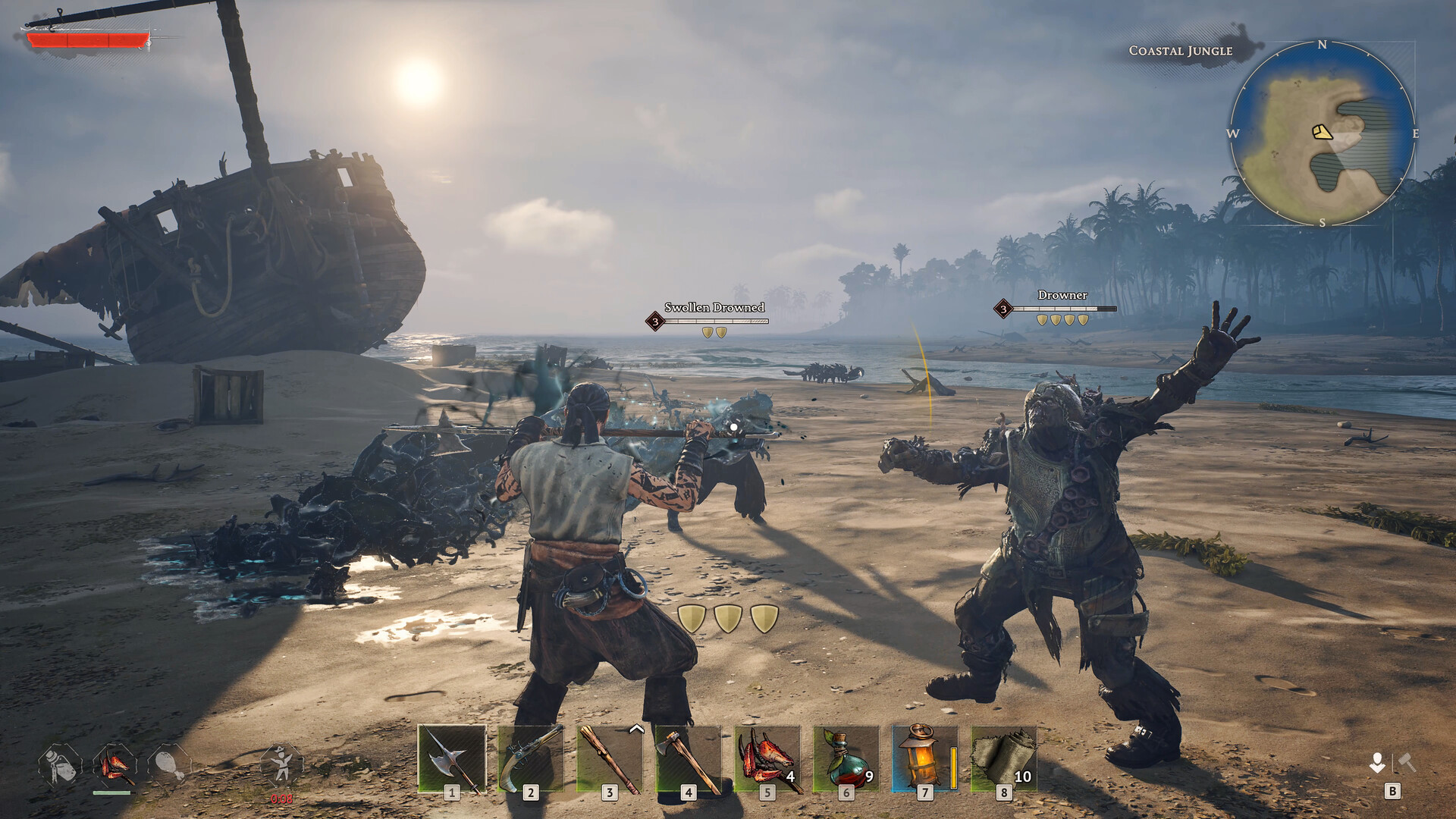
Chain-Kill: Ascended-Only Perk
The "stacks transfer to nearest enemy on kill" effect is NOT part of the base Bleeding mechanic. It is a perk unlocked only by ascending the Rapier of a Thousand Cuts from Rare to Epic at the Weaponsmith Station using Tumbaga Ingots. On the base Rare rapier, killing a bleeding target simply removes the stacks from the dead enemy; they do not transfer.
If you are running the base Rare version, Bleeding is still strong against individual tough targets, but it does not chain across groups. To get the chain behavior, ascend the weapon.
Primary Source: Rapier of a Thousand Cuts
The Rapier of a Thousand Cuts is the most notable Bleeding weapon. Found as a buried-treasure reward on the starting island via the Fifteen Men on a Dead Man's Chest quest, it has Precision scaling and 125 base Pierce damage at Rare. Every hit applies a Bleeding stack. With five hits, the target suffers 125 DPS on top of direct weapon damage.
Counter-Build Considerations
Bleeding does NOT reset Retaliation stacks on the player (those reset only when the PLAYER takes damage). But if the player is hit by an enemy applying Bleeding or a similar DoT, Retaliation stacks DO reset. Fencer builds stacking Retaliation + Bleeding from the Rapier of a Thousand Cuts need to maintain flawless defense to keep both buffs active.
Other Bleeding Sources
Rapiers and some slash weapons are the main Bleeding applicators. Specific Uncommon and Rare weapons with Bleeding effects continue to be documented. The Rapier of a Thousand Cuts is the most widely discussed because of its availability in the early game.
See Also
Rapier of a Thousand Cuts - primary Bleeding weapon
Weapons - weapon effect overview
Corruption - related status effect on Plague weapons
Combat - combat mechanics
Upgrade System - Rare-to-Epic ascension
Stats and Talents - crit and damage-over-time stacking math
Bleed Scaling Behavior
Bleed pressure looks straightforward on the tooltip, but the actual per-tick numbers behave very differently from a normal weapon swing. As observed in community testing with the Rapier of a Thousand Cuts against an armored undead target, the baseline tick was around 20 damage per stack. Investing 10 points into Precision only nudged the tick to roughly 22, and pushing the investment to 20 points only reached about 25 per stack. That is far below the leverage Precision normally gives a weapon's direct damage roll, and it is the central reason most players treat bleed as a pressure tool rather than a primary damage source.
The scaling oddity does not stop at attributes. Several rings that look like they should boost bleed (because the source weapon swings as a slashing one-handed melee strike) do not actually move the per-tick number at all. Players have tested slash damage rings, generic melee damage rings (including the Major Ring of Bravery), and one-handed weapon damage rings, and none of them changed the bleed numbers above the unmodified baseline. The bleed tick appears to read from its own scaling table rather than the same one used for the strike that applied it.
There is one reliable lever that does push bleed damage upward: the +15% damage-taken vulnerability debuff applied by Drake's Double-Barreled Pistol. Shooting the target before or during the bleed window adds the same +15% multiplier to every subsequent tick, which lines up cleanly with the boost the pistol gives to direct melee swings as well. For a build that is leaning on bleed for damage, the pistol shot is doing more work per click than any ring slot does.
Modifier | Effect on Bleed Tick Damage |
|---|---|
Precision attribute | Yes, but very weakly. Roughly +0.2 bleed per stack per Precision point in observed tests; far below the leverage Precision gives most other damage. |
Slash damage rings | No measurable change in tick numbers in community tests. |
Melee damage rings | No. The Major Ring of Bravery was confirmed to leave bleed ticks unchanged. |
One-handed weapon damage rings | No. They buff the swing that applies bleed, but not the bleed tick itself. |
Drake's Double-Barreled Pistol vulnerability debuff (+15%) | Yes. Bleed ticks against a debuffed target trend roughly 15% higher, which is the largest single-source bleed boost found in testing. |
Pierce damage rings | Boost the rapier's direct hit damage, not the bleed tick. |
The practical takeaway is that bleed should be treated as a utility lever in a hit-and-run setup rather than a stat to scale endlessly. Stacking five bleeds on a target and rotating away to recover stamina or reposition does more for the player than dumping additional rings into bleed in the hope of a multiplier that does not exist. The pistol debuff is the one piece worth slotting specifically because it does interact with the tick. Precision investment beyond the basic stat threshold needed to wield the rapier is better spent on the talents and attributes that improve the player's survivability, since bleed pressure does its job without much help.
Target Type Differences
Bleed damage is not consistent across enemy types, and that asymmetry shapes which fights it shines in. As observed in community testing, undead targets such as the armored drowned in region 3 take noticeably reduced damage per bleed tick compared with living targets. Living goats, pirates, and human-like enemies show higher tick numbers under the same setup, which lines up with a real-world reading of the effect: enemies without functioning blood respond worse to a damage-over-time that is meant to mimic blood loss. Plan accordingly. A bleed build is at its most efficient against living humanoids and beasts and notably less efficient against the drowned and other undead foes that populate the Cursed Swamps patrols.
The combination of weak ring scaling and reduced damage versus undead is what pushes most bleed users into a hit-and-run identity rather than a stand-and-trade one. Five bleed stacks deal a respectable chunk of damage over their duration, but against a tanky undead enemy that DoT will not finish the kill on its own, and the rapier's direct hit is not high enough to brute-force through. The accepted answer is to apply five stacks, peel away to recover stamina, fire the Drake's Double-Barreled Pistol shot for the +15% vulnerability multiplier, and let the bleed tick down while the player resets distance. Sustain comes from converting Temporal Health back into permanent HP rather than from killing speed, which is why the so-called Bleed Bruiser pairing with a Tracker Set healing-source bonus and a Pikeman Set two-piece HP bonus is preferred over heavier damage builds. For boss fights that involve mostly living guards, the same kit punches well above its raw DPS chart; for a wave of plague drowned, players generally swap to a different weapon.
Target Type | Bleed Behavior |
|---|---|
Living humanoids (pirates, smugglers, hunters) | Highest observed tick damage per stack. Best targets for a bleed-focused approach. |
Living beasts (goats, wolves, alpha animals) | Tick numbers similar to living humanoids. Bleed pressure works as expected. |
Undead (armored drowned, plague drowned) | Reduced tick damage compared with living targets. Bleed remains usable but is not the most efficient damage source against this group. |
Plague-tagged elites and bosses | Mixed. Living plague enemies bleed more like living humanoids; undead plague variants follow the reduced-damage pattern. |
None of this makes bleed a weak status; it makes it a situational one. When the build is tuned for the right targets and the player commits to the hit-and-run rhythm rather than facetanking, bleed remains a strong pressure tool through the late game. The trap is treating it like a normal damage stat that scales with rings and with attributes the way most weapons do. It does not, and planning a build around that assumption leads to disappointing damage numbers no matter how many ring slots are spent.