
Loading...
Loading...
Provisioner
April 25, 2026 at 09:29 AM
Add merchant contract sales and base-shopkeeper sustain pattern
Provisioner is the generic faction vendor NPC type in Windrose. Every player-facing faction has one Provisioner at its main base, stationed next to the faction's Bounty Agents. Provisioners sell reputation-gated plans, gear, ship upgrades, and crafting materials.
Each Provisioner's inventory is unique to its faction, and items are gated behind reputation tiers (Rank 1 through Rank 3 in the current launch build). The inventory typically includes:
Armor plans (2-piece starter pieces at Rank 1-2, full sets at Rank 3)
Weapon recipes
Ship designs and components
Crafting materials exclusive to the faction
Merchant contracts (delivery quests that pay in Piastres and Letters of Favor)
Decorative base pieces
Faction | Representative Rank-Gated Inventory |
|---|---|
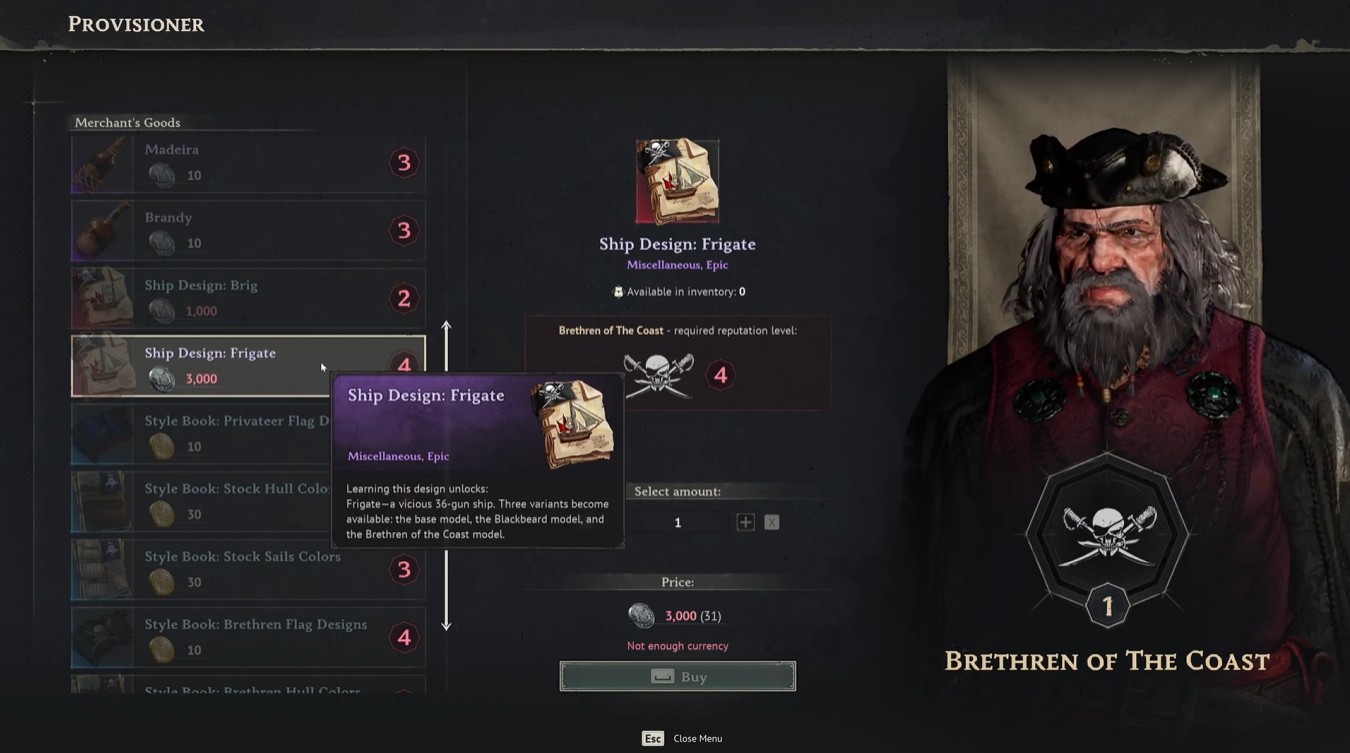
Ship designs (Brig at Rank 2, Frigate at Rank 4), Steel Nails, shipwright's tools, trade goods (Salt, Coffee Beans, Whiskey, Madeira, Brandy) | |
Flibustier's Attire and Tracker's Leathers set plans, Perfectly Ordered 12-Pounders cannon plan, 12-pounder and 24-pounder cannon plans | |
Light armor set plans, building decorations, and merchant contracts | |
Conquistador's Armor and Pikeman's Armor set plans, Hull Bracing variants, Smithing Flux, and rank-gated Windrose Naval Tactics |
Rank | Threshold | Unlocks |
|---|---|---|
Rank 0 (initial) | 0 points | Baseline inventory |
Rank 1 | ~100 points | First tier of faction-locked plans |
Rank 2 | ~250 points | Mid-tier armor plans, ship gear |
Rank 3 | ~500 points | Top-tier plans including Windrose Naval Tactics |
Check the Provisioner before any major turn-in session; seeing the Rank 3 inventory helps plan which Insignias and Letters of Favor to save
Ship designs are expensive (1,000 to 3,000 Piastres). Do not buy ship plans before you have access to the biome-appropriate building materials
Provisioner inventories refresh on a daily cadence; items sold out on one visit may restock on the next
Bounty Agents reputation turn-in NPCs
Faction Reputation how reputation is earned
Factions full faction overview
Recruitment Vendor distinct vendor type that hires workers
A Provisioner does not hand you a working cannon or a finished armor piece. Every gear item in a Provisioner's inventory is a schematic (also called a plan or blueprint): you pay Piastres or, for top-tier Smuggler items, Guineas, receive a schematic in your inventory, and then carry it back to your base to learn and craft it yourself. This detail trips up first-time Tortuga visitors who expect the Provisioner to hand over a usable item in the trade window.
The reason it matters is that the purchase price is only the first cost. Crafting the item after the schematic is learned requires its own material pile (wood, copper, plant fibers, and higher-tier ingots scaled to the item rank), and those materials often push the total investment well past the vendor's asking price.
Spend Piastres / Guineas at the Provisioner. A schematic enters your inventory.
Return to your base and open your journal.
Learn the schematic in the journal. Until it is learned, it will not appear in any crafting station menu.
Open the appropriate crafting station (the Shipwright's Workbench for ship cannons and hull armor, armor benches for wearable gear, the Alchemy Table for elixirs).
Craft the item using the listed materials.
For ship gear, carry the finished piece to the wharf and mount it on your ship. Cannons slot into cannon mounts, hull armor into plating slots, Naval Tactics into the ship's tactic slots.
Ship gear from Provisioners falls into three slots, and each slot is anchored to a specific faction:
Cannons: sold primarily by the Rogue Buccaneers Provisioner in Tortuga Market. Inventory covers 12-, 24-, and 36-pounder cannon schematics, plus the Perfectly Ordered 12-Pounders at Rank 2.
Hull armor: sold by the Brethren of the Coast Provisioner at the Tortuga waterfront and by the Smugglers of Port Royal Provisioner at their hideout. Smuggler Hull Bracing plans unlock around Rank 2.
Naval Tactics: sold only by the Smugglers of Port Royal Provisioner, at Rank 3. These are ship-wide passives (chip healing, suppress-the-enemy buffs, stored volley damage) that no other faction offers.
On-foot gear plans (armor sets, weapon plans, crafting tools) follow the same per-faction split. People of Tortuga sell building plans and light armor; Buccaneers sell the Flibustier's Attire and Tracker's Leathers plans; Smugglers sell Conquistador's and Pikeman's heavy plate plans.
Schematics bought at Rank 2 and Rank 3 produce blue-tier or better items. Blue-tier and above gear carries an additional passive roll beyond its base stats. Common ship-gear passives include flat damage increases, reload speed bonuses, damage reduction on incoming shots, and the Rank 2 Perfectly Ordered 12-Pounder's rapid-fire ramp after a hit lands within 4 seconds of reload. Wearable gear passives include stamina cost reductions, one-handed damage boosts, and set bonuses that activate at two and four pieces.
These passives are why it is worth pushing a single faction to Rank 2 or Rank 3 before spreading Insignias across factions: the first blue passive roll from a focused faction does more for your build than four green Rank 0 items from every faction combined.
If you settle on a Provisioner item you love (a particular cannon roll, a specific hull bracing variant), the rarity system lets you ascend it at the anvil: blue becomes purple, then purple becomes legendary. Each ascension unlocks an additional passive slot on the item. The catch is the material cost: ascensions require rare ingredients like Tumbaga Ingots that are gated by later-game biomes. Do not spend ascension materials on a Rank 0 or Rank 1 item; wait until you have unlocked a Rank 2 or Rank 3 schematic whose base stat roll and passive you plan to keep for the rest of the game.
Visit 1 (first Tortuga unlock): inspect every Provisioner, note Rank 0 prices, do not spend any Piastres yet.
Visit 2 (first reputation rank push): buy the single schematic you plan to build first. For most players this is a Rank 1 Buccaneers cannon schematic or a Brethren ship design if you have the biome materials.
Visit 3 (Rank 2): shop the Perfectly Ordered 12-Pounders from Buccaneers, the Brig from Brethren (if you have Foothills resources), or mid-tier Hull Bracing from Smugglers.
Visit 4 (Rank 3): spend Guineas at the Smugglers for Naval Tactics, and buy Conquistador's or Pikeman's heavy armor plans.
Beyond schematics and ship gear, every Provisioner also stocks a small but high-impact line of merchant contracts that unlock buildable shopkeeper stalls back at your base. A merchant contract is a one-time purchase: you pay Piastres at the Provisioner, the contract enters your inventory as a learnable plan, and once placed inside the campfire build radius the corresponding shopkeeper NPC sets up shop and lets you buy that category of resources directly without sailing to a port. Each Provisioner stocks slightly different contracts based on its faction's specialty, so visiting all four faction Provisioners is the only way to unlock the full set of in-base shopkeepers.
The four buildable merchant types map cleanly onto the kinds of resources you would otherwise spend hours gathering or sailing to fetch:
Merchant: Natural Resources stocks raw biome materials such as wood variants, stone, plant fibers, and ores. This is the contract most players reach for first because it covers the bulk-gather resources that drive every base upgrade. See Merchant: Natural Resources for the full per-tier price list.
Merchant: Animal Products stocks hides, leathers, feathers, eggs, and the cured-meat lines that armor and trade goods recipes burn through. Useful for builds that lean on Tracker or Flibustier hide pieces. See Merchant: Animal Products for the full inventory.
Merchant: Food stocks fruit, vegetables, seeds, and the prepared-food precursors that feed the cooking station. Pairs well with the Tortuga food-duplication NPC for a stable elixir-and-buff supply chain. See Merchant: Food.
Goods and trade lines round out the available contract types and depend on which faction's Provisioner you bought from. The Brethren of the Coast lean toward whiskey, salt, and shipwright trade goods; the Smugglers of Port Royal trend toward Smithing Flux and refined-ingot lines that feed the heavy armor recipes.
Each contract costs Piastres up front, and the buildable stall itself fits inside the standard campfire radius like any other base structure. Once placed, you spend silver per individual purchase from the shopkeeper's interface; orders fulfill on a delivery timer rather than handing over the resource instantly, which is the in-fiction reason the stalls feel like working trade hubs rather than vending machines. Stalls remain functional as long as the campfire is intact, so the same campfire-delete-and-replace trick used for placing decorations also works around stall placement awkwardness without wiping the merchant.
The honest catch with the in-base merchants is the per-purchase silver cost: it is high enough that buying every resource you need would bankrupt a player who is funding their base purely from on-foot loot. The pattern that makes the system practical is to fund the merchants from naval combat and boarding. A loop of sinking and boarding gold-text freighters in the level 12-15 range yields a steady 1,000 to 1,500 silver per raid plus consumable loot that resells at the next port. Half a dozen freighter raids per session funds an effectively unlimited natural-resources order, which is why long-haul builders treat the merchant stalls as a lever for trading sea time for land time.
The merchants also flatten the worst-feeling resource grinds in the game. Hardwood is the canonical example: it is a tier-2 wood used by mid-game ship and base recipes, but its on-foot gather rate is slow and the trees that drop it cluster in only a handful of biome pockets. Routing hardwood through the natural-resources merchant turns a multi-hour wood-cutting expedition into a silver transaction that finishes in real time on a single login. The same logic applies to any animal product or prepared-food ingredient that bottlenecks a build, and once the stalls are placed you rarely visit a port for raw materials again outside of restocking insignias and rep grinds.
The per-faction Provisioners are the canonical sources for these contracts. The Brethren of the Coast Provisioner sells the wood and shipwright-leaning natural-resources contract; the People of Tortuga Provisioner sells the food and decoration-aligned contracts; the Rogue Buccaneers Provisioner carries the animal-product contract that feeds Flibustier and Tracker leather work; and the Smugglers of Port Royal Provisioner stocks the refined-goods and trade-line contracts that pair with their heavy armor and naval tactics inventory. Because contract availability is gated by faction reputation in the same way armor and ship plans are, donating insignias to a faction Representative also progresses your access to the higher-tier contracts on that faction's Provisioner. Players planning a long base session should rep up the faction whose merchant contract is most relevant to their next big build before sailing back home.