
Loading...
Loading...
Naval Combat
April 18, 2026 at 04:42 PM
Add stern critical strike mechanic (yellow-gold damage numbers confirm the crit panel on the rear of the enemy hull)
Naval combat is one of Windrose's core systems. Ship battles take inspiration from Assassin's Creed Black Flag, with broadside cannon volleys, boarding actions, and wind-based maneuvering. Transitions between ship and shore are seamless, with no loading screens.
Action | Key |
|---|---|
Steer left / right | A / D |
Raise sails (increase speed) | W |
Lower sails (decrease speed) | S |
Aim cannons | Right Mouse Button (hold) |
Fire cannons | Left Mouse Button |
Board enemy ship | Space (when prompt appears) |
Summon ship to shore | K |
Toggle zoomed-out camera | F |
Open ship management (near wheel) | Q |
The faster you move, the harder it is to turn. Lowering speed to roughly three-quarters sail noticeably reduces your turning circle, making it easier to bring cannons to bear on the enemy. Use the F key to zoom out for better situational awareness during combat.
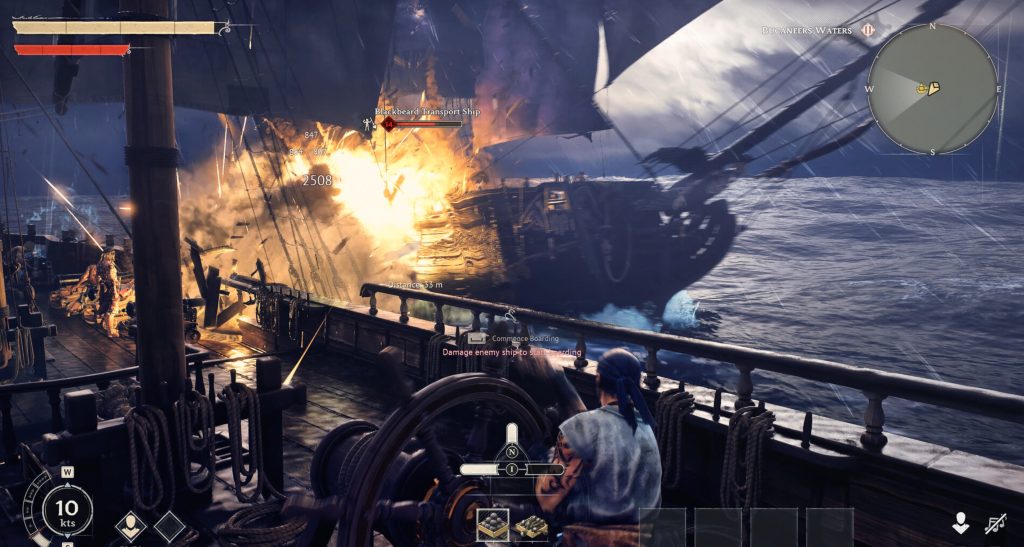
Ships carry two types of ammunition, and players can switch between them during combat:
Ammo Type | Effect | Best Used For |
|---|---|---|
Regular cannonballs | Direct hull damage to enemy ships | Sinking or weakening ships for boarding |
Bar shot (chained shots) | Targets enemy sails and rigging to slow ships down | Opening a fight to reduce enemy maneuverability |
The recommended strategy is to start a fight with bar shot. Fire five to six good shots into the enemy's rigging to slow them down, then switch to regular cannonballs and pound their hull. Once the enemy ship is slowed, you can get on their broadside and maintain a sustained barrage.
Waves physically block cannon shots. When large waves rise between your ship and the enemy, cannonballs can hit the wave crest instead of the target. Greater distance and higher tides make this worse. Players need to time shots for moments when they have a clear line of sight over the water. This adds a positioning element to combat where closing distance reduces the chance of waves interfering with your volleys.
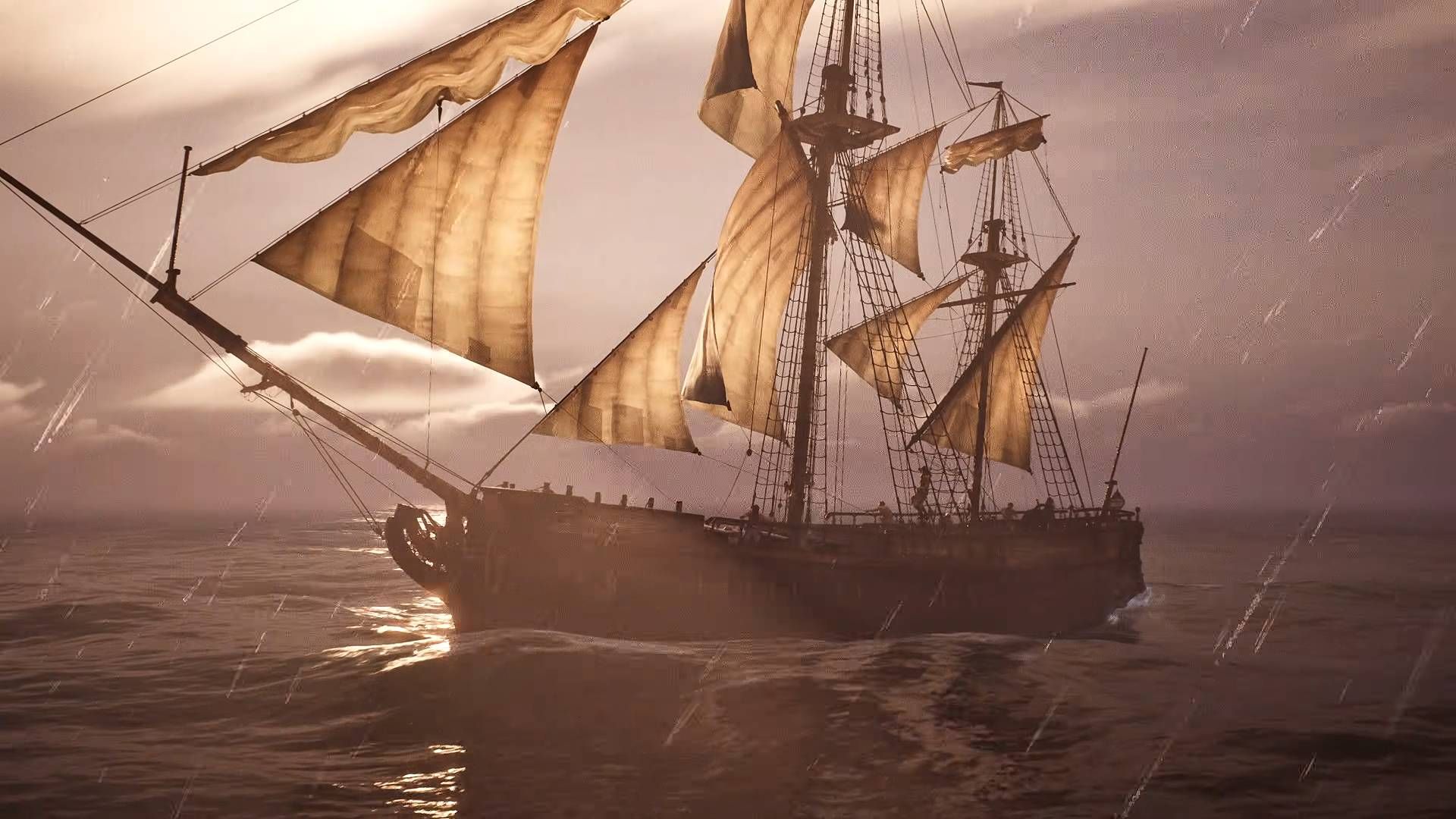
Several ship types are available, each filling a different role:
Ship Class | Description |
|---|---|
Sloops and cutters | Small, fast boats for early-game travel |
Nimble mid-size vessel with good maneuverability | |
Versatile workhorse balancing speed, durability, and firepower | |
Massive warship with heavy cannon capacity but slow turning |
Each class differs in speed, durability, maneuverability, and the number of cannons it can mount. Choosing the right ship for a situation matters, since a frigate can overpower anything in a straight fight but struggles in tight island channels.
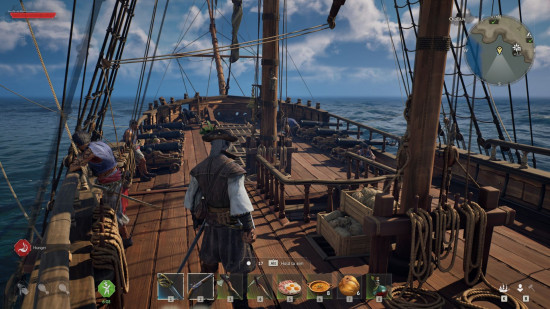
Ship equipment is crafted at the Shipwright's Workshop and equipped via the Wharf's ship management interface (drag items into Ship Gear slots):
Purpose | Recipe | |
|---|---|---|
12-Pounder Cannons | Fire at enemy ships; the only cannon type currently available | 10 Copper Ingots + 10 Wood |
Reduces damage taken, makes your ship more durable | ||
Improves NPC crew effectiveness during boarding actions | Recipe varies |
All three equipment types can be upgraded at the Shipwright's Workshop Upgrade tab with additional materials to increase their effectiveness. Fully upgraded boarding equipment makes your NPC crew significantly tankier and more effective in fights.
After damaging an enemy ship enough, you can board it. The boarding process follows specific steps:
Weaken the enemy ship. Fire cannons until the enemy health bar drops low enough to trigger the boarding option.
Position alongside. Sail close to the enemy ship, keeping it on your left or right side.
Wait for the boarding prompt. Do NOT jump onto the enemy ship before the prompt appears. Doing so is likely fatal.
Press Space to board. Your NPC crew will board alongside you and fight enemy sailors together.
Fight the enemy crew. Defeat all enemies on the deck. In the Seafarer quest, this means defeating 7 enemies.
Loot the ship. Successful boarding lets you collect the ship's cargo.
Boarding tips from experienced players:
Use ranged attacks (musket or blunderbuss) before closing to melee distance
Support your NPC crew from behind rather than charging into the front line
Enemies cannot attack you on high ground, so climb elevated positions for ranged advantage
Upgrade boarding equipment at the Shipwright's Workshop so your crew becomes more effective
Block and parry to tire enemies and reduce armor damage
Eat damage-boosting food before initiating the boarding action
Do not board ships higher level than you
Ship | Level | Notes |
|---|---|---|
Blackbeard Transport Ship | 1 | Starter/practice enemy. Recommended as first naval target. |
Blackbeard's Pirates' Ketch | Varies | Encountered during the Seafarer quest. Drops Insignia of a Blackbeard Lieutenant, Naval Supplies, Piastres, and Contraband. |
Transport Ship | 4 | Significantly higher health than level 1 ships. |
Interceptor | 4 | Second high-level variant. Tougher combat encounter. |
Engaging ships two or more levels above your current rank is strongly discouraged. The level difference makes combat extremely punishing.
Three methods exist for repairing ships:
Method | When to Use | Cost |
|---|---|---|
Mid-battle emergency repairs while under fire | Consumable item (crafted) | |
Wharf Repair | After your ship is destroyed; rebuilds the vessel | |
Shipwreck Repair | Quest-specific; repairing a found shipwreck | 100 Wood, 20 Nails, 20 Coarse Fabric, 10 Ropes |
Ship destruction is not permanent. If your ship is sunk, rebuild it at a Wharf for just 20 Wood, which is roughly three palm trees worth of materials.
Two buildings are required for naval combat:
Building | Cost | Placement |
|---|---|---|
15 Wood + 10 Coarse Fabric + 5 Copper Ingots | Within bonfire range; requires a roof | |
10 Wood + 10 Coarse Fabric | On the shoreline, within bonfire range |
The Seafarer is the second tutorial quest, unlocked after completing "I Need a Bigger Boat." It teaches naval combat through a structured sequence: building the Shipwright's Workshop, crafting 12-Pounder Cannons, constructing a Wharf, equipping cannons on your ship, and sailing to engage Blackbeard's fleet. The February 2026 demo ended here with a "To be continued..." screen, but the live Early Access build continues far beyond this point into Tortuga, faction progression, and the rest of Chapter 1.
Currently, one player commands one ship. Official FAQ messaging still frames the system around one player commanding one ship, and Kraken Express describes fuller multi-crew roles as future work rather than a settled launch feature. In co-op multiplayer (up to 8 players total, though official sources recommend closer to 4 for smoother late-game performance), each player commands their own separate ship during naval combat. Multiple players cannot crew a single ship with divided roles. NPC crew members automatically man the cannons and participate in boarding actions.
Open with bar shot into enemy sails (5 to 6 volleys) to slow them down
Switch to regular cannonballs and maintain broadside positioning
Sail in circles around the enemy, firing on each pass
Reduce speed for tighter turns when bringing cannons to bear
Watch the waves and time shots for clear line of sight
Keep combat repair kits on hand for emergencies
When the enemy is weakened, position alongside and wait for the boarding prompt
Board with full gear, food buffs, and ranged weapons ready
Once you reach Tortuga, the Smugglers of Port Royal unlock a new type of ship equipment called Naval Tactics at reputation rank 3. Tactics are expensive but slot directly into your ship alongside cannons and hull bracing, giving persistent combat passives. The Brethren of the Coast sell the higher-tier ship designs (Brig and Frig) at high rep, although actually crafting those hulls still requires Foothills resources. The Buccaneers provisioner sells faction variants of the 12-pounder at rank 2.
Examples of Naval Tactics confirmed from the Smugglers' provisioner inventory:
Tactic Effect | Trigger |
|---|---|
Restore 3% chip health every 3 seconds | While out of combat |
Apply Broken Rhythm: reload speed -20%, damage -20% for 30 seconds | On hitting an enemy ship |
Next volley deals +130% damage | If you neither deal nor take damage for 2 minutes |
Because tactics cost piastres in the hundreds per slot, plan your reputation grind around which one suits your playstyle before spending. The +130% sleeper volley tactic favors careful snipers; the Broken Rhythm debuff is strongest in 1v1 trading fights; the out-of-combat chip regen pairs well with the hit-and-run ketch style of play.
Quest chains and faction patrols routinely surround you with 2 to 5 hostile ships at once. A raw unupgraded 12-pounder loadout will not survive a 1v3. Three preparation steps close the gap. First, upgrade every single cannon at the Shipwright's Workshop using Copper Ingots and Wooden Planks; upgrades apply per-cannon and stack into a meaningful damage jump across a full broadside. Second, buy or earn a variant cannon from the Buccaneers provisioner at rep 2, such as the Perfectly Ordered 12-Pounder Roost. Third, slot at least one Naval Tactic from the Smugglers once you hit their rep 3.
Tactically, kite rather than brawl. Use bar shot to slow one target, peel away behind an island or wave crest to break line of sight on the other two, then circle back to finish the slowed ship before the rest catch up. Keep several Combat Repair Kits in your hold at all times and never engage multiple ships without at least average-item-level-4 hull bracing, which usually means upgrading blue-tier bracing a few times with copper.
White, blue, and yellow lights visible in the ocean mark floating bounty barrels. The color encodes rarity. White gives basic loot like wood, repair kits, and steel nails. Blue is uncommon and can include lost goods, piastres, and crafting materials such as nails and silver. Yellow is the rare tier and can hand out epic gear pieces. Sailing a regular trade route between your base and Tortuga lets you gather 100 to 200 wood in a single trip just by scooping barrels along the way, which is dramatically faster than chopping forests by hand.
Approach with your small boat, dismount briefly to pick up the barrel, and keep moving. Some barrels spawn inside patrol routes where pirate ships will engage if you linger. If you do not yet have a fast travel bell placed on the nearest island, either drop one before engaging or accept that a sunk ship means rowing back.
The K-key ship summon has no cooldown and works with every ship class, including the Brig and Frig, rather than only the starter boat. Whenever you reach a shoreline you can recall your current vessel to that exact spot, which removes most of the pain of exploring on foot and remembering where you docked.
If your ship sinks, the Wharf restore option rebuilds it for 20 Wood (roughly three palm trees worth of farming) and you respawn the ship at your location with K. Ship loss is therefore effectively a small wood tax rather than a catastrophic setback, but any cargo that was in the hold is lost. Offload trade goods at a merchant or into a base chest before every risky fleet engagement.
Experienced captains run through a short preparation ritual before casting off. Most Early Access players rank these steps as the minimum preparation for a serious fight.
Step 1: Build the Shipwright's Workshop first. Once you have a ship you can sail, the Shipwright's Workshop is the single most important next craft. It lets you build cannons, hull armor, boarding equipment, and upgrade every one of them. Nothing else on land matters as much until this station is placed and stocked.
Step 2: Stockpile materials. Expect to burn through a lot of wood, plant fibers (for Coarse Fabric), and copper ore. Keep upgrading each ship piece until the required materials change. That swap is the game's way of telling you the current equipment tier is topped out and you need to progress further in the story before more upgrades unlock.
Step 3: Craft Repair Kits and Grogs. Before you leave, visit the Crafting Table. Combat Repair Kits are your ship's health potions, used mid-battle to patch the hull while under fire. Grogs are drinks that buff you and your crew. Common effects are increased damage, faster reload speed, or reduced incoming damage. Pick the grog that suits the fight you are about to start.
Step 4: Visit the Wharf. Head to the Wharf and actually equip the cannons, hull armor, and boarding gear onto your ship by dragging them into the Ship Gear slots. Upgrades and ownership alone do nothing; the gear has to sit in the ship slot to apply. Then assign consumables (repair kits and grog) to your hotbar hotkeys so you can trigger them without fumbling through menus mid-combat.
Step 5: Pop the grog before the first cannon flash. Activate the grog buff right before the fighting starts, not after you take your first hit. The buff runs on a timer, so triggering it early wastes seconds, but triggering it late means the opening broadside lands without it. The sweet spot is the moment the enemy comes into firing range.
Every ship has three cannon banks: front, left (port), and right (starboard). Each bank has its own independent cooldown, so firing the front battery does not slow the reload on the port broadside. This is the foundation of the shoot-and-move rhythm that keeps your ship dealing damage every second instead of waiting for one global reload.
The early-game approach is to use only two sides, typically front + left, and simply alternate. Line up the front cannons on an approach, fire, turn left to expose the port broadside, fire again while the front bank reloads, then swing back around. Turning in the starter Ketch is slow, and in a 1v1 you usually cannot swing fully around to also bring the right side to bear before the left has finished reloading. So alternating two banks is the sustainable rhythm.
In crowded engagements with three or more enemies arranged around you, expose all three sides in sequence: front at whatever is in front, then peel left to hit one flank with the port battery, then peel right to hit another flank with the starboard battery. This only works if there are distinct targets on each arc. In a pure 1v1 against a faster-turning opponent, forcing a three-side engagement usually eats more time than it saves.
Scenario | Side Rotation | Why |
|---|---|---|
1v1, starter Ketch | Front + left, alternate | Turning circle is too wide to get the starboard side aligned before the port battery finishes reloading |
1v2 or 1v3 with enemies on different arcs | Front, port, starboard as each enters a bank's arc | Independent cooldowns mean each bank resets while you aim the next one, so full rotation keeps constant damage going out |
1v2 trading on the same side | Front + one broadside, treat the second enemy as a follow-up target on the next pass | Stacking both enemies on one side lets a single broadside volley hit both; the other bank is already primed for the next pass |
Bar shot, also called chainshot, is the secondary ammo type. On PC it is bound to 2. Aim it high at the enemy's sails (the big fabric sheets hanging from the masts), not the hull. Landing enough bar shot hits applies a visible Hindered debuff icon on the enemy ship, after which the target moves significantly slower and struggles to turn. Once Hindered, the enemy either becomes easy to stay broadside against or easy to leave behind if you want to disengage.
The numerical guideline from community testing is 5 to 6 clean bar shot volleys into the sails for the debuff to land reliably, then switch to regular cannonballs for the hull damage phase. A partial bar shot barrage still slows the enemy, but the Hindered icon is what confirms the full debuff is applied.
In fleet engagements, not every enemy ship is worth boarding. Ships that will drop a pirate chest display a small chest icon above them once they are at boarding threshold. Ships without the chest icon drop generic cargo if sunk rather than boarded, and they frequently drop Combat Repair Kits. In a drawn-out 1v3 or larger fight, deliberately sinking the non-chest ships for their repair kit drops is often more useful than trying to board them, because the kits restore hull HP mid-engagement and let you survive long enough to board the chest-carrying flagship.
This flips the usual priority: the chest-icon ship is always the primary boarding target, but the escorts are farming fuel for the rest of the fight. Sink them fast, scoop the floating crates, and keep pressure on the flagship.
The single most common mistake from new captains is hoarding repair kits for a rainy day. Use them. Combat Repair Kits restore hull HP while you remain under fire, and they stack in the ship hold. Sail with at least four or five in the hold before any serious fight, drop one the instant hull HP dips below about 60%, and keep dropping them on cooldown for the rest of the engagement. A ship that sits at 30% HP the whole fight takes every unlucky volley a lot worse than one that gets topped back up to 80% every thirty seconds.
Naval combat runs on a different control scheme than land combat. The baseline keys and mouse inputs:
Action | Input |
|---|---|
Steer left / right | A / D |
Increase / decrease speed | W / S |
Aim cannons | Right Mouse Button (hold) |
Fire cannons | Left Mouse Button |
Switch ammo type | Inventory swap to chained shot, round shot, etc. |
Board adjacent ship | Space (when prompt appears) |
Cannon ammo can swap mid-fight. The default round shot tears into hulls, but chained shot is purpose-built to shred sails and slow a fleeing enemy. Switching to chained shot for the first volley can pin a faster ship long enough for your crew to close the boarding distance. Once the enemy is boarded-pending, swap back to round shot to keep pressure on the hull.
Falling into the water during or after a naval fight is recoverable but dangerous. Swimming back to the ship is possible, but it costs stamina continuously. If stamina hits zero while still in the water, the character begins to submerge and drowns. The safe sequence is: swim straight toward the ship hull, avoid detours, and climb the boarding rope or ladder as soon as it is reachable. Avoid trying to swim to a distant island from open water; the stamina cost is almost always lethal over that distance.
Three independent firing sides: ships in Windrose fire from three separate arcs: port (left), starboard (right), and bow (front). Each arc runs its own reload cooldown, so a broadside hit from port does not lock out the bow chasers or the starboard battery. During a turning fight, the efficient rhythm is to fire port broadsides, swing the wheel to present starboard while the port crew reloads, fire again, then close the distance on the bow chasers once both broadside sides are spent. Used well, this triple-arc pattern roughly triples effective damage output over a fight that only uses one side.
Base cannon reload: standard cannons take at least 11 seconds to reload a full broadside. Missed shots therefore cost both damage and positioning because the next volley is 11 seconds of sailing away. Stack that against the player ship taking incoming fire during reload and it becomes clear why hit rate matters more than raw cannon count.
Two aiming rules apply consistently and fix the majority of whiffed volleys:
Aim lower than instinct suggests. Cannonballs arc upward over range, so aiming at the enemy's center mass usually sends the shot over the hull. Drop the crosshair toward the waterline to land hits consistently.
Watch for ocean waves between the player and the target. A rising swell physically blocks projectiles in both directions. Firing into a visible wave wastes a full 11-second reload cycle with no damage to show for it. Hold the shot until the wave passes or reposition to an angle where the wave line is not in the firing lane.
Most ships in Windrose carry no rear-facing cannons. If the player can hold position directly behind an enemy's stern, the front guns fire freely while the enemy has no clean angle to retaliate. Maintaining the stern lock is one of the highest-value positioning habits in naval combat, and it is most easily achieved at 1/4 throttle so the player ship slides in behind the enemy as they push forward.
If the flagship sinks during combat, the ship's cargo hold is preserved automatically. When the ship is later restored at the Wharf recovery menu, all cargo hold contents return intact. Personal inventory is a separate matter: if the player also dies during the sinking, personal inventory drops at the death location and requires a corpse run. The distinction means a captain outmatched in combat is almost always better off abandoning the fight (losing cargo-safe ship, personal inventory intact) than fighting to the last (losing ship plus character inventory to a corpse run).
Enemy ship hulls take critical damage from hits to the stern, the rear panel of the ship. When a cannonball lands on the stern, the damage number that floats above the hit appears in a yellow-gold color rather than the usual white, visually confirming the critical hit. The stern crit multiplier is substantially larger than a standard broadside hull hit, which makes chasing an enemy ship from behind one of the highest-value positions in naval combat.
The mechanic compounds with the stern-lock tactic already covered above. A player who holds position directly behind a target gets two overlapping advantages: the enemy has no rear-facing cannons to return fire, and every cannonball that connects lands on the critical panel. For Blackbeard Ketch captains whose 35,000 hull HP cannot survive a long broadside trade, the stern-chase crit loop is usually the fastest kill pattern available. Open with chain shot into the sails to slow the target below your own top speed, then pull in behind at roughly 1/4 throttle and keep the front cannons firing until the enemy either sinks or reaches boarding threshold.
Reading the crit number color matters. A volley that lands entirely in broadside color has drifted out of the crit panel; a volley that mixes gold and white numbers has partially connected with the stern and partially with the flank. Tightening the approach angle until every hit flashes gold is the same kind of feedback loop that aiming-for-the-waterline already provides on broadside trades. During long chase sequences, lock the camera slightly to one side so the stern panel stays in the firing arc through the target's turning.
