Loading...
How recruiting works in Fire Emblem: Fortune's Weave. Warriors met in Dagsion can be won over with gifts and shared meals once support and Renown requirements are met, and allies gained during a Hero's story bolster your forces later.
How armaments work in Fire Emblem: Fortune's Weave, covering the six weapon types and their roles, the stat schema including the new Curse column, the durability rule, forging, and the published roster.
Seteth appears in Fire Emblem: Fortune's Weave as a playable character listed with the Linaria Morning Dew clan. This page covers his appearance in this game only.
How Fire Emblem: Fortune's Weave sorts units into classes, covering the Beginner, Specialty and Advanced tiers, the starting classes, weapon proficiencies, movement values and the named class skills revealed ahead of launch.
The Pale Raven's Perch is a spot in Dagsion where a mysterious white bird rests its wings. It is where the player swaps between the four Heroes, with progress saved separately for each so all four stories can run in parallel.
How the four route campaigns work in Fire Emblem: Fortune's Weave: the Fox, Lion, Wolf and Eagle obelisks, swapping Heroes at the Pale Raven's Perch, parallel progress and the single save file.
The clans, armies and orders of Fire Emblem: Fortune's Weave, from the four Heroes' Heroic Games teams to the Temples of Dagda and the Order of Mithras.
Anatolia is a Mediator in Fire Emblem: Fortune's Weave, known as the Mystical Bride, who leads the Brides of the Pale Raven. She runs a fortune-telling shop in Dagsion and fights with the firearm Salamander, Qi-powered martial arts and uncommon magic.
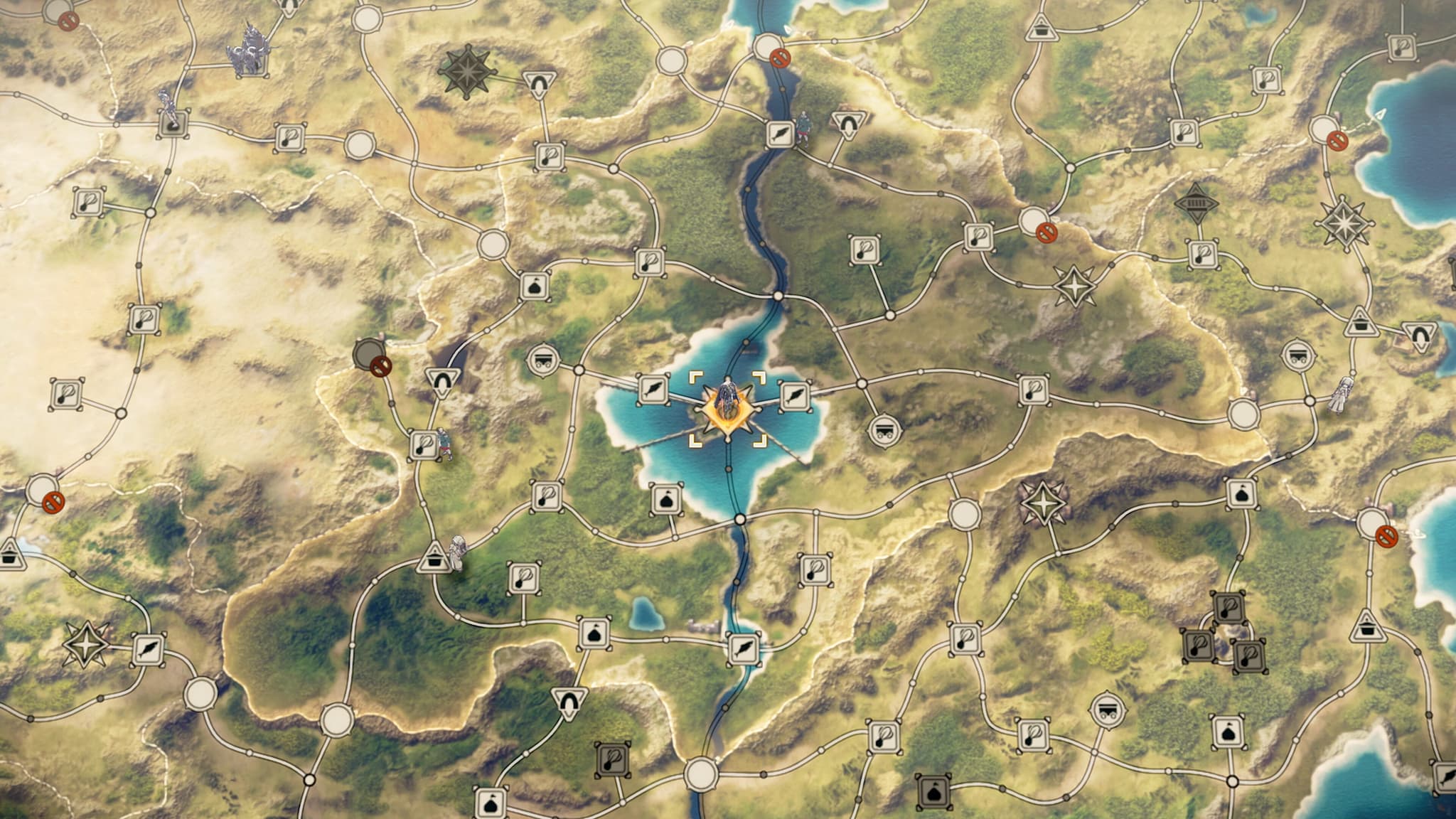
How exploration works outside Dagsion in Fire Emblem: Fortune's Weave, covering world map movement and its cost in time, town visits, random Skirmishes, and the overworld commands unique to each of the four Heroes.
Combat Arts in Fire Emblem: Fortune's Weave are attacks unleashed at the expense of weapon durability, trading Uses for extra power, longer reach or another effect. Twenty-one are named and ten carry full stat lines.
Crests are the hereditary marks carried by certain characters in Fire Emblem: Fortune's Weave, called Bloodmarks in Dagda, with each individual mark named a Diadem and tied to a god of the Dagdan pantheon.
Theodora Sergio Sabangrain is the young Queen of Saramis and one of the four Heroes of Fire Emblem: Fortune's Weave. She leads the Wolf route, commands Battalions on the world map, and fights to restore her goddess's honor.
Skills in Fire Emblem: Fortune's Weave are the passive and triggered abilities a unit carries into combat, split into personal skills unique to one character and combat skills shared across the roster.
Blaze Arts are special moves in Fire Emblem: Fortune's Weave that cost the user HP and fill a gauge. Nine characters have them. The fill grants a stat boost, and topping the gauge out triggers a Burst that halves the unit's maximum HP.
Olympia is a priestess of the Kalla temple in upper Dagsion, titled the Blue Rose of Caelus, and Leda's oldest rival. She is fought as a boss on Leda's route before she joins the team.
Every named character revealed for Fire Emblem: Fortune's Weave, grouped by clan, with role and notes. Around sixty playable units have been shown so far.
Leda, also known as Leilidahna, is a vihuela player titled Rose of Caelus and one of the four Heroes of Fire Emblem: Fortune's Weave. She leads the Eagle route, hunting her father's killer, and can summon Demonic Beasts with her songs.
How the story is framed: the world ends in 1454, Sothis calls down a single soul, and the player chooses between facing Balor directly or going back five years to change the four Heroes' fates.
The in-world dating system used on Dagda: 30 day months, the year 1449 of the Heroic Games and the year 1454 five years later. It does not map onto any other continent's calendar.
Eshmel is the player-created avatar and the true protagonist of Fire Emblem: Fortune's Weave, called down by Sothis to save Dagda from the demon god Balor. Profile, origin, the Pale Raven form and Blaze Art details as revealed ahead of launch.
Solel is the Divine Sovereign of the Dagdan Empire in Fire Emblem: Fortune's Weave, a sun god ruling as regent during Dagda's slumber and the figure who declares the Heroic Games open.
Yu Phas is the Dagdan goddess of death and night, titled the Keeper of Death and Night. Nintendo's narration calls her a goddess loathed throughout the lands, and she is the goddess the Kingdom of Saramis worships.
The Dagdan pantheon is the set of gods worshipped across Dagda. Seven of their temples stand on Dagsion's temple row under a bronze statue of the Divine Sovereign, and volunteering at one earns a blessing for battle.
Aswan is a character shown in Fire Emblem: Fortune's Weave pre-release material who knew Bertrand before the Heroic Games. Her role has not been formally announced.
Ursula is a playable character in Fire Emblem: Fortune's Weave and the manager of Vandahl Trading, second in authority to Talimun. Her business sense unlocks the Storage command, and her personal skill Merchants' Manager retrieves items from Storage mid-battle.
Talimun is a playable character in Fire Emblem: Fortune's Weave, chief manager of the merchant guild Vandahl Trading and head of the clan called The Moon's Lie. He fights with the cursed sword Long-Night Katara.
The Nameless is the spear carried by the protagonist of Fire Emblem: Fortune's Weave, a weapon that lost both its original power and its name.
Catania is a playable mercenary in Fire Emblem: Fortune's Weave, described as sterling in skill and drawn to fights against strong opponents. She starts in the Commoner class.
Magic in Fire Emblem: Fortune's Weave is a separate system from the five weapon types. Spellcasting classes attack with spells instead of a weapon, magic is effective against heavy armour, and each spell has a limited number of casts.
The ten track Special Release added to Nintendo Music on August 4, 2026, running 30:13 and including the main theme, with the full track list, Japanese titles and runtimes.
How battles work in Fire Emblem: Fortune's Weave, covering party setup, turn order, movement and attack ranges, weapon roles, positioning, terrain, and the special attack systems layered on top.
The gladiatorial tournament at the heart of Fire Emblem: Fortune's Weave, held in Dagsion in tribute to the founding king Dagda and presided over by Solel, who grants the victor any wish.
Dungeons on the world map of Fire Emblem: Fortune's Weave hold materials for strengthening weapons along with other treasures. Running into a roaming enemy inside one begins a Clash, a turn-based fight that differs from a normal battle.
Balor is the revived demon god of Fire Emblem: Fortune's Weave and the game's central antagonist. His return in the Dagdan year 1454 brings the land to its end and sets the whole story in motion.
Mars is the god of war of the Dagdan Pantheon in Fire Emblem: Fortune's Weave, titled the Bringer of War. He settles disputes through contests of strength and inspects Dietrich on Solel's behalf.
Sinza was a fisherman on the coast of Dagda and the father of Esmeralda. He died before Fire Emblem: Fortune's Weave begins, leaving her his trident and a divine mark the Dagdan temples refused to recognize.
The Dagdan Empire is the largest and most powerful nation on the continent of Dagda, a theocracy ruled by the Divine Sovereign Solel with three vassal kingdoms beneath it and its capital at Dagsion.
Dagda is the continent on which Fire Emblem: Fortune's Weave is set, holding the Dagdan Empire, its three vassal kingdoms of Saramis, Arago and Brezarant, and the unruled territory of Mosa in the far south.
Buccar is the veteran warrior nicknamed the demon bear who served Leda's father for over twenty years and follows her on her revenge, still calling her princess out of old habit.
Sofia is a playable priest in Fire Emblem: Fortune's Weave who specialises in healing magic and can raise its effect. She is known for an enormous appetite.