
Loading...
Loading...
Animals and Wildlife
October 13, 2026 at 01:56 PM
Added the 34 species from the Wildlife Update with a per-biome table, photography interaction and tip, and fixed references to only two biomes
Wildlife is one of the defining features of Outbound, Square Glade Games' cozy camper van exploration and crafting game. The world is set in a utopian near future that is largely unpopulated by human characters, and in place of traditional NPCs the environment is filled with wild animals that players can observe, feed, and befriend. Every biome has its own set of creatures, and the types you encounter shift with the weather and time of day. Animals are not targets, resources to be harvested, or threats to survive. They are companions to the journey, and part of the scenery that makes the drive worth taking.
The game treats nature as something to coexist with rather than something to dominate. This approach lines up with Outbound's broader sustainability theme, where living off-grid with solar, wind, and water power goes hand in hand with leaving the world around you unharmed. Whether you stop to watch a group of bunnies from the grass, place a hive for some bees, or cast a line from a lakeside camp, wildlife encounters are a reward in themselves.
Outbound has no combat, no enemies, and no hostile creatures. You cannot kill, hurt, or harvest animals for meat or pelts. This is a deliberate design choice, framed by the studio as cozy survival seen through a warm, family-friendly lens where the point is to relax and pet the bunnies rather than fight anything. Hands-on previews have noted that the camper van cannot run over animals, and curious players who tried to do exactly that found that the game simply does not allow it.

The developers frame Outbound as 'a survival game about trying your best to live, as opposed to one about desperately trying not to die.' There is no hunger meter that forces you to hunt, no predators that force you to defend yourself, and no mechanic that rewards aggression. Survival mechanics lean entirely on foraging, farming, and cooking. Wildlife sits alongside those activities as an ambient feature of the world, not a gameplay loop you have to grind through.
The first region players explore is The Outdoors, a mixed biome of temperate forests, open plains, wheat fields, rolling hills, and mountain foothills. This is where most players meet their first wild animals. Bunnies are the signature species of The Outdoors and they appear in meadows, along forest edges, and near clearings. Small creatures scurry through undergrowth during the day, while quieter encounters happen at dawn and dusk.
Because the weather and day-night cycle affects which animals appear, the same clearing might host different creatures on a sunny afternoon compared to a rainy evening. This gives revisited landmarks a sense of living variety and rewards players who camp in one spot long enough to watch the environment change.
The second confirmed biome The Coast introduces tropical shores, rocky cliffs, sandy beaches, redwood forests, and palm groves. The change in environment brings a different cast of wildlife suited to a warmer, wetter, salt-aired setting. Coastal stretches host their own species mix that differs from the plains and forests of The Outdoors, and the water bodies along the shore are where the fishing feature, added in the 1.1 update, lets players cast a line.
The Coast is built around scenic exploration as much as resource gathering. The old lighthouse perched on the cliffs is a navigation point for the region, and the drive out to it tends to surface wildlife encounters along the way. Rocky tidepools, beach edges, and dense coastal forests each have their own mood, and the animals you meet in one zone may not appear in another.
Bunnies are the most publicized wild animal in Outbound and they have become something of a mascot for the game's cozy identity. They can be fed, petted, and observed, and feeding them heaps of berries has a charming side effect: it attracts more bunnies. Previews have described this as amassing 'a friendly army of bunnies' that follows you around. There is no cap or reward tied to this behavior. It is pure atmosphere.
The important thing to know is that bunnies cannot be harmed. You cannot kill them with your van, with a tool, or with any other mechanic. Multiple hands-on previews tried and confirmed this. The same principle applies to every other small mammal you find in the world. Interaction is always on the animal's terms, and walking away is always an acceptable option.
Bees were added to Outbound through a successful Kickstarter stretch goal. Once the beekeeping goal was unlocked, the developers expanded their existing hive concept into a full system where players can catch wild bees and keep bee colonies inside placed beehives. Hexagonal hive models were designed specifically for the feature and can be set up at your campsite or around your camper van.
Bees in the wild are found foraging around flowering plants and meadows, which makes The Outdoors a natural first stop for would-be beekeepers. For the full production loop, placement rules, honey uses in recipes, and how bees feed into cooking and recipe ingredients, see the dedicated beekeeping article.
Outbound's rivers, ponds, lakes, and coastal waters are home to fish. Fishing was not in the 1.0 launch build: it was unlocked as a Kickstarter campaign stretch goal and arrived after release as the headline feature of the free Summer update, Version 1.1 on June 23, 2026. The update added three fishing rods, each needed for different water, and 32 collectible fish spread across all four biomes. Water bodies appear in both The Outdoors and The Coast, with coastal saltwater adding variety to what freshwater lakes offer.
Crucially, fish in Outbound are decorative collectibles rather than food. Caught fish are tracked in a journal and displayed in fish tanks, not cooked or eaten, which keeps the feature in line with the game's rule that no animal is harmed. For the confirmed details on rods, fish tanks, the journal, and the planned release window, see the main fishing article and the post-launch roadmap.
Interactions in Outbound are light-touch and optional. None of them are required, and ignoring animals has no survival cost whatsoever. The menu of things you can do is short on purpose: approach, feed, pet, observe, and move on.

Interaction | What Happens | Notes |
|---|---|---|
Approach | Walk up to the animal | There is no stealth system, and animals never flee into danger |
Feed | Offer food such as berries | Feeding bunnies heaps of berries attracts more bunnies |
Pet | Pet the animal | Bunnies and other small mammals can be petted; nothing you do can hurt them |
Observe | Stop and watch | Weather and time of day change which animals appear in the same spot |
Move on | Leave them be | Ignoring animals has no survival cost |
Photograph | Take a picture with the Photo Camera | A clear enough shot logs the species in the journal's wildlife tab; added by the Wildlife Update |
The overarching rule is that no interaction with a wild animal is harmful. You cannot scare an animal into fleeing into a danger zone, you cannot trap them for resources, and you cannot be punished for failing a stealth approach, because there is no stealth system in the first place. Animals exist as part of the landscape, and the exploration experience is richer because of them.
Animal bobbleheads are a collectible system that sits alongside the living wildlife, but they are not the same thing. Bobbleheads are small figurines shaped like animals that players find or unlock during exploration. They are decorative rewards, typically displayed on the camper van's dashboard, and they function as keepsakes tied to biomes and landmarks rather than creatures you interact with in the world.
The collection runs parallel to the hidden gnome figurines scattered across each biome. Both serve the same purpose: giving exploration-focused players something to hunt for beyond pure resource gathering. Bobbleheads and gnomes are inanimate objects. When you see references to 'animals' in Outbound, they almost always refer to living wildlife like bunnies and bees, not to these collectibles.
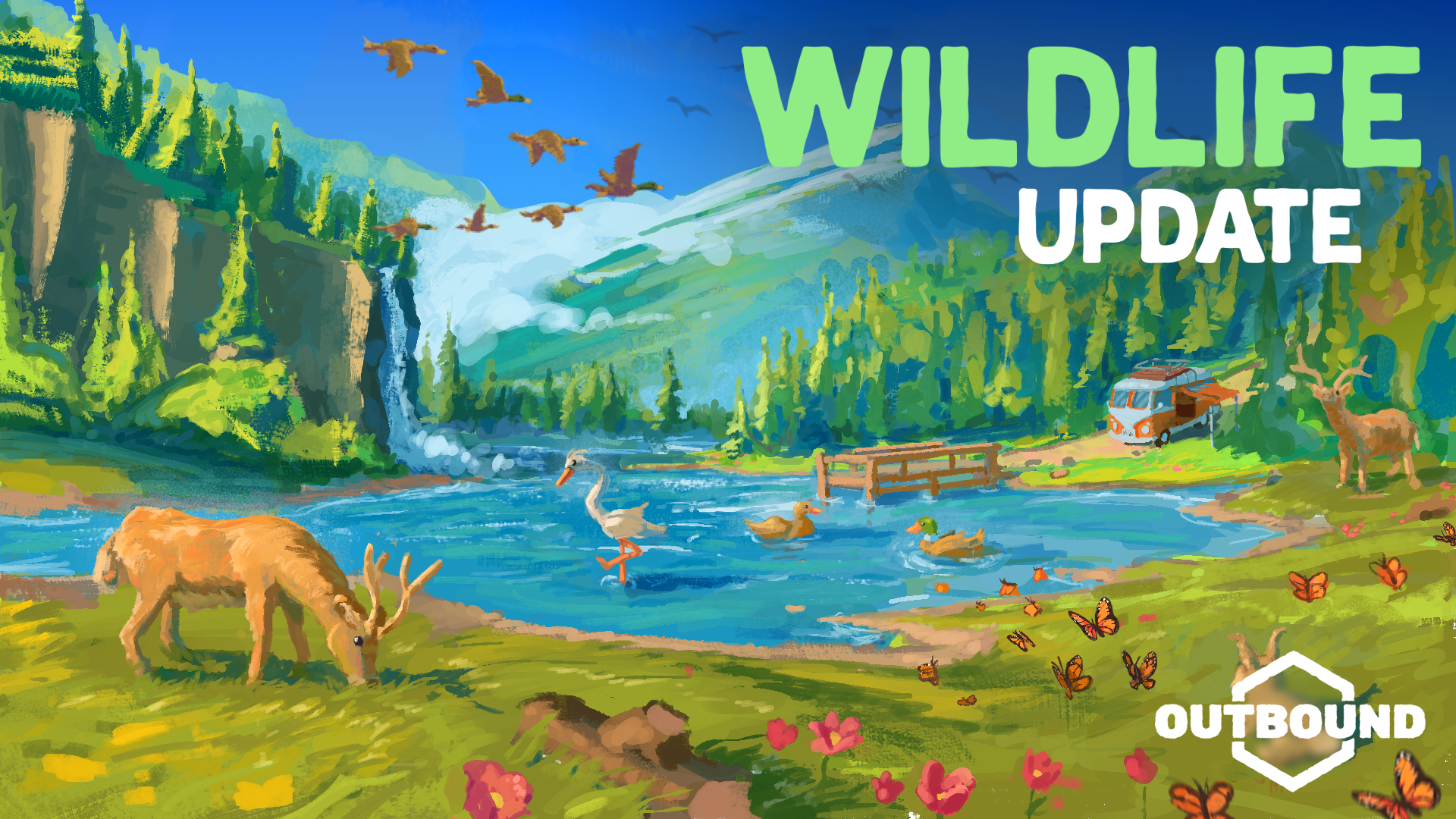
Outbound's worlds are populated by ambient fauna that contribute to the atmosphere even when they are not directly interactive. A living ecosystem runs across all four biomes, with creatures moving in and out of view as the weather changes. The 1.0 build shipped without a published species list. That changed with the Wildlife Update, released on Steam on September 22, 2026 after a teaser on September 9: it added 34 species of animals, birds and insects across the four biomes, a craftable Photo Camera, and a wildlife tab in the journal that marks each species as collected once you photograph it clearly. The post-launch roadmap covers how the drop was planned.
The journal files each species under one biome, although birds such as crows perch across the whole map. The names below are descriptive; the journal itself uses more playful names for several of them, such as Hazeldeer for the brown deer and Flametail Fox for the red fox. How to photograph them, and how much of the frame each one has to fill, is covered on the Wildlife Photography page.
Journal Biome | Species | Count |
|---|---|---|
Brown Rabbit, Brown Deer, Crow, Red Fox, Heron, Oakrobin, Blue Butterflies, Orange Butterflies, White Butterflies, Migrating Ducks, Caveglimmer, Fireflies | 12 | |
Black Rabbit, Male Duck, Female Duck, Grey Fox, Flamingo, Seagull, Crab, Dolphin | 8 | |
Canyons | Green Gecko, Red Gecko, Red Robin, Hawk, Exotic Heron, Orange Turtle, Meerkat | 7 |
Mountains | White Rabbit, Black Deer, Green Butterflies, Purple Gecko, Blue Crab, Green Turtle, Capybara | 7 |
What is already clear is that the game prioritizes variety over volume. Rather than flooding the map with a single stock creature, Square Glade Games has emphasized biome-specific fauna that makes each region feel distinct. That variety is meant to reward slow exploration and repeat visits to favorite landmarks.
Wild animals are separate from companion animals. The main companion in Outbound is a dog adopted at the Paws & Whiskers Lodge, a dedicated location where players can feed, pet, and train their new friend. The dog is a functional gameplay partner as well as a cozy travel buddy, and it can help with tasks during exploration. For full details on adoption, training, bonding, and dog-specific abilities, see the dog companion article, which is also covered in the broader pets guide.
Unlike wild bunnies, a companion dog persists across sessions, travels with you in the camper van, and has its own progression. Wild animals, by contrast, stay within their home biomes and do not join the party. The two systems are complementary: the dog is the one you bring with you, and wildlife is what you meet along the way.
Outbound supports online cooperative play for up to four players, and wildlife behavior carries over into multiplayer sessions. Because no player can harm an animal, there is no risk of a co-op partner accidentally or intentionally breaking a wildlife encounter. Feeding bunnies together is a common cozy moment in trailers and previews, and group beekeeping or fishing trips work the same way they do in solo play.
Multiple players can approach the same group of animals at once without scattering them, and wildlife encounters scale naturally to group play. If one player is feeding a group of bunnies while another is setting up a hive nearby, both activities proceed without conflict. The no-combat rule also means there is no friendly fire, no accidental kill, and no griefing angle tied to animals.
A few practical habits make wildlife encounters more rewarding, whether you are in The Outdoors, The Coast, or anywhere else you end up on the road.
Tip | Why It Helps |
|---|---|
Watch the weather and the clock | The day-night cycle and the weather change which creatures show up at the same clearing |
Carry berries | Bunnies can be fed, and feeding them draws more into view |
Camp in one place | Staying at a landmark long enough reveals the animals that pass through it |
Explore every biome | The Coast hosts a different species mix from The Outdoors |
Look for bees near flowers | Wild bees forage around flowering plants and meadows, the starting point for beekeeping |
Bring a rod for fish | Fish are decorative collectibles tracked in the journal, not food; see fishing |
Do not bother sneaking | There is no stealth system and no penalty for a clumsy approach |
Carry the Photo Camera | Every species you photograph clearly is logged in the journal; see Wildlife Photography |
For new players who are still learning the ropes, the beginners guide and tips and tricks pages cover the wider survival and exploration loop that surrounds wildlife encounters. The most important takeaway: there is no wrong way to meet the animals of Outbound. Stop when you want, feed when you want, and let the road deliver the next encounter when it is ready.