

Overview
Landmarks are notable locations found throughout Outbound's world. They are scattered across the game's biomes and serve multiple purposes: they act as visual navigation aids across the open landscape, contain environmental storytelling that hints at the world's history, and often hold unique items or blueprints not available at standard Signal Towers. The developers at Square Glade Games have described landmarks as "Points of Interest" that help players progress through the game.
The world map marks landmarks with dedicated icons, and players can track specific landmarks using the compass system. Landmarks range from large multi-structure complexes like farms to smaller rest stops like cabins. Some landmarks are visible from long distances, making them useful reference points when navigating on foot or by camper van. Visiting landmarks is rewarded with resources, lore, and collectibles.
Landmark Summary
The following table lists the confirmed landmarks across Outbound's biomes.
Name | Biome | Type | Description |
|---|---|---|---|
Observation tower | Hilltop fire lookout with a spiral staircase, living cabin, and panoramic balcony views. | ||
Elevated structure | Large tree with a platform, rocking chair, tool shed, mushroom farms, and herb plants. | ||
Farm complex | Farm with a locked farmhouse, work shed, wheat field, and carrot plot. | ||
Windmill | Windmill with a locked room, greenhouse filled with petals, mechanical ladder, and balcony. | ||
Cabin | Cabin with a kitchen, dining table, fireplace, sofa, and survival tools. | ||
Ranger station | Ranger hut with storage crates at an elevated checkpoint position. | ||
The Lighthouse | Lighthouse | Old lighthouse perched on the highest cliff, visible from long distances across the coastline. |
The Outdoors Landmarks
The Outdoors is the first biome and contains the majority of confirmed landmarks. The alpha build launched with three major Points of Interest in this biome, and additional landmarks were added during subsequent updates. These landmarks are spread across forests, plains, and mountain terrain, giving players a variety of destinations as they begin exploring.
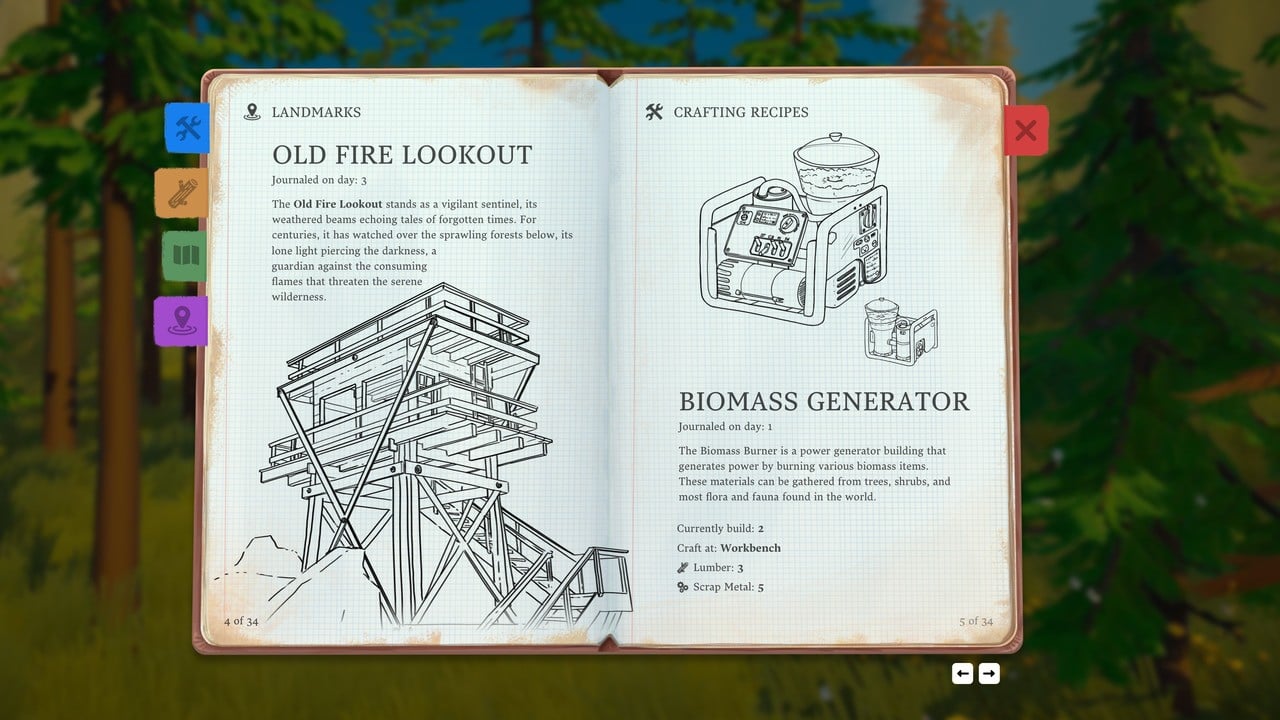
Fire Lookout
The Fire Lookout is a hilltop observation tower and one of the first Points of Interest completed by the developers. It was featured in the game's trailer and has been present since the early alpha builds. A spiral staircase wraps around the structure, leading up to a living cabin at the top. The cabin includes a balcony that provides panoramic views of the surrounding terrain, making it an excellent vantage point for spotting other landmarks and planning routes.
Inside the cabin, players find items left behind by a previous ranger. These objects provide environmental context for the world and suggest that someone once occupied the lookout before the player arrived. The Fire Lookout is situated on elevated ground, so it is often one of the first landmarks players can see from a distance when entering the biome.
Tree Hut
The Tree Hut is a large tree fitted with a wooden platform, a rocking chair, and a tool shed built into the trunk. The surrounding area includes mushroom farms (with harvestable Amber Morels and Indigo Caps), herb plants, and ladders for climbing to different levels of the structure. This makes it a practical stop for gathering resources during the early hours of the game.
The multi-level design encourages vertical exploration. Players can climb ladders to reach higher platforms and look out over the forest canopy. The tool shed at the base contains additional supplies, making the Tree Hut one of the more rewarding early-game landmarks to visit.
Sunbeam Acres Farm
Sunbeam Acres is one of the larger landmarks in The Outdoors. The farm complex includes a locked farmhouse, a work shed, a wheat field, and a carrot plot. The wheat and carrot resources growing here can supplement a player's food supply before they unlock garden beds on the van through the farming system.
The locked farmhouse suggests that its contents are gated behind progression or a specific item. The work shed provides a sheltered space with tools and storage. Sunbeam Acres is positioned in the flatter farmland area of The Outdoors, surrounded by open fields with swaying wheat, making it visible from a moderate distance.
Lilly's Windmill
Lilly's Windmill is a windmill structure with several areas to explore. The ground level has a locked room containing paint (used for van customization). A greenhouse attached to the windmill is filled with petals, which are a crafting ingredient. A mechanical ladder leads to upper levels, and a balcony overlook provides elevated views of the surrounding area.
The paint found inside the locked room connects the windmill to the van customization system. The petal greenhouse makes this a useful stop for players who need floral crafting materials. Like Sunbeam Acres, the locked room implies that a key item or progression milestone is needed to access all of the windmill's contents.
Woods Cabin
The Woods Cabin is a smaller landmark located in the forested areas of The Outdoors. Inside, players find a kitchen, a dining table, a fireplace, a sofa, and various survival tools. It functions as a cozy rest stop and provides environmental storytelling through its furnished interior.
While it does not offer the same resource bounty as Sunbeam Acres or the Tree Hut, the Woods Cabin is a charming point of interest that contributes to the world's lived-in atmosphere. The presence of a fully furnished kitchen and living area reinforces the idea that people once inhabited these spaces.
Mountain Outpost
The Mountain Outpost is a ranger hut positioned at an elevated checkpoint in the mountainous areas of The Outdoors. It includes storage crates containing supplies. Its elevated position makes it a useful navigational reference when traversing higher terrain, and the storage crates provide resources for players passing through.
The Coast Landmarks
The Coast is the second biome, added in the October 2025 beta build. Its most prominent landmark is the old lighthouse. The Coast features tropical shores, rocky cliffsides, and forests of gigantic redwood trees, and its landmarks reflect this coastal environment.
The Lighthouse
The Lighthouse is the most recognizable landmark in The Coast. It is an old lighthouse perched atop the highest cliff in the biome, visible from long distances across the shoreline and surrounding terrain. It is both a navigation reference for players and a piece of environmental storytelling. The area around the lighthouse contains resources and objects that hint at its history as a functional beacon for ships navigating nearby routes.
Because of its elevated position and visibility, the Lighthouse functions as a natural compass point when exploring The Coast. Players who can see the Lighthouse from their current position can orient themselves relative to the cliff line and the shoreline below. The surrounding clifftop area is only reachable on foot, requiring players to park the van and hike up to the structure.
Signal Towers at Landmarks
Signal Towers are frequently found near landmarks. These tall structures allow players to download blueprints in exchange for Download Vouchers earned through the recycling system. While Signal Towers are scattered throughout each biome (the full launch build ships 23 towers across the whole world map), many are placed in close proximity to landmarks, creating natural clusters of activity.
This placement encourages players to visit landmarks for their storytelling and resource value and for the nearby blueprint opportunities. When approaching a landmark, it is worth scanning the surrounding area for a Signal Tower. Each tower offers a selection of blueprints to choose from, and the available options can vary between players, so visiting towers near every landmark helps build a comprehensive set of recipes.
Collectibles at Landmarks
Landmarks are common locations for collectibles. Several types of collectibles can be found in and around landmark structures.
Collectible | Where to Look | Purpose |
|---|---|---|
Rock Cairns | Hilltops, riverbanks, and natural clearings near landmarks | Stackable stone formations; physics-based interaction tracked in the journal |
Garden Gnomes | Behind rocks, inside bushes, near abandoned structures, at scenic overlooks | Hidden figurines; finding all gnomes in a biome is a collectible challenge |
Bottle Caps | On the ground, inside containers, and in hard-to-reach spots around landmarks | Collectible currency spendable at vending machines for items |
Paint Booths | Near landmarks or at the edges of regions | Unlock van customization colors and patterns |
Garden gnomes are especially common near landmarks. They are tucked behind rocks, inside bushes, near abandoned structures, or at the edges of scenic overlooks. Finding them requires slowing down and carefully observing the area around each landmark rather than rushing through. Rock cairns tend to appear in natural, elevated positions near landmarks, such as hilltops and riverbanks. The game's map dynamically reveals collectible markers as players drive through areas, so approaching a landmark by van will often uncover nearby collectible locations on the map.
Hidden Landmarks
Not all landmarks are marked on the world map. Some locations are hidden and can only be found through thorough exploration. These hidden landmarks are tucked behind waterfalls, inside dense forests, or at the ends of unmarked paths that branch off from main roads. They sometimes contain rare resources or blueprints that are not available at standard Signal Towers or mapped landmarks.
The alpha build launched with "3 big landmarks and multiple terrain" in The Outdoors, along with hidden quests tied to some of these locations. The presence of hidden landmarks rewards players who are willing to drive slowly, leave the van behind, and explore on foot. Areas that seem like dead ends or empty stretches of forest may conceal an unmarked structure or cache of items.
Using Landmarks for Navigation
Outbound's open world has no minimap overlay during regular gameplay. Instead, players rely on visual landmarks and the compass system to navigate. Tall, distinctive structures like the Fire Lookout and the Lighthouse are visible from long distances, making them natural reference points for orienting in the world.
The compass allows players to track specific locations found on the map. Once a landmark has been discovered, its icon appears on the world map and can be set as a compass target, providing directional guidance. This system integrates directly with the landmark design: the more landmarks a player discovers, the more reference points they have for navigating across the landscape.
The level design supports this approach. The developers have described how landmarks like signal towers and fire lookouts serve as visual guides across the terrain. Recognizing a distant landmark and heading toward it is often more effective than relying solely on the map, especially in areas with winding roads or dense tree cover.
Environmental Storytelling
Landmarks in Outbound tell stories through the objects and details found at each location rather than through dialogue or cutscenes. The items left by a previous ranger at the Fire Lookout, the locked rooms at Sunbeam Acres and Lilly's Windmill, and the furnished interior of the Woods Cabin all suggest that people once lived in and used these places. These details build a picture of the world's utopian future setting without explicit exposition.
The developers have deliberately left some questions unanswered, including why the player is traveling off the grid and what happened to the previous occupants of these structures. This approach encourages players to form their own interpretations based on the clues they find at each landmark.
Tips
Landmarks with locked rooms (Sunbeam Acres farmhouse, Lilly's Windmill paint room) may require progression or specific items to access. Return to them later if you cannot enter on your first visit.
Check behind and around every landmark for hidden gnomes and rock cairns. Collectibles are frequently placed in the immediate vicinity of landmark structures.
Use tall landmarks like the Fire Lookout and the Lighthouse as visual anchors when exploring on foot in areas without clear paths.
Look for Signal Towers near landmarks. The combination of blueprints, resources, and collectibles at a single stop makes landmark visits highly efficient.
Drive slowly through new areas. The world map dynamically reveals landmark icons, collectible markers, and Signal Tower locations as you pass through, so rushing may cause you to miss nearby points of interest.
Explore off the main roads and on foot. Hidden landmarks are tucked behind waterfalls, inside dense forests, and at the ends of unmarked trails.