

Overview
Farming in Outbound lets players grow crops, mushrooms, and plants in mobile garden beds attached to the camper van. Unlike traditional farming games with fixed plots on static land, every garden in Outbound travels with you. Players can plant seeds in one biome, drive to another region, and harvest their crops when they are ready, all without returning to a permanent base. This mobile approach to agriculture is central to the game's off-grid lifestyle theme.
Farming produces the raw ingredients that feed into the cooking system, forming a self-sustaining food production loop. Harvested crops can be eaten raw for basic nourishment or prepared at cooking stations for meals with improved effects. The full recipe pipeline is documented in the recipes list article.
Setting up a Garden
Garden beds are built using the modular building system. Players craft crop plots from resources gathered in the environment and then place them on the van. Placement options include the van's interior, its rooftop, and attached greenhouse modules. The van's camper mode creates a pop-up second floor that opens up additional space for garden beds alongside workstations and storage.
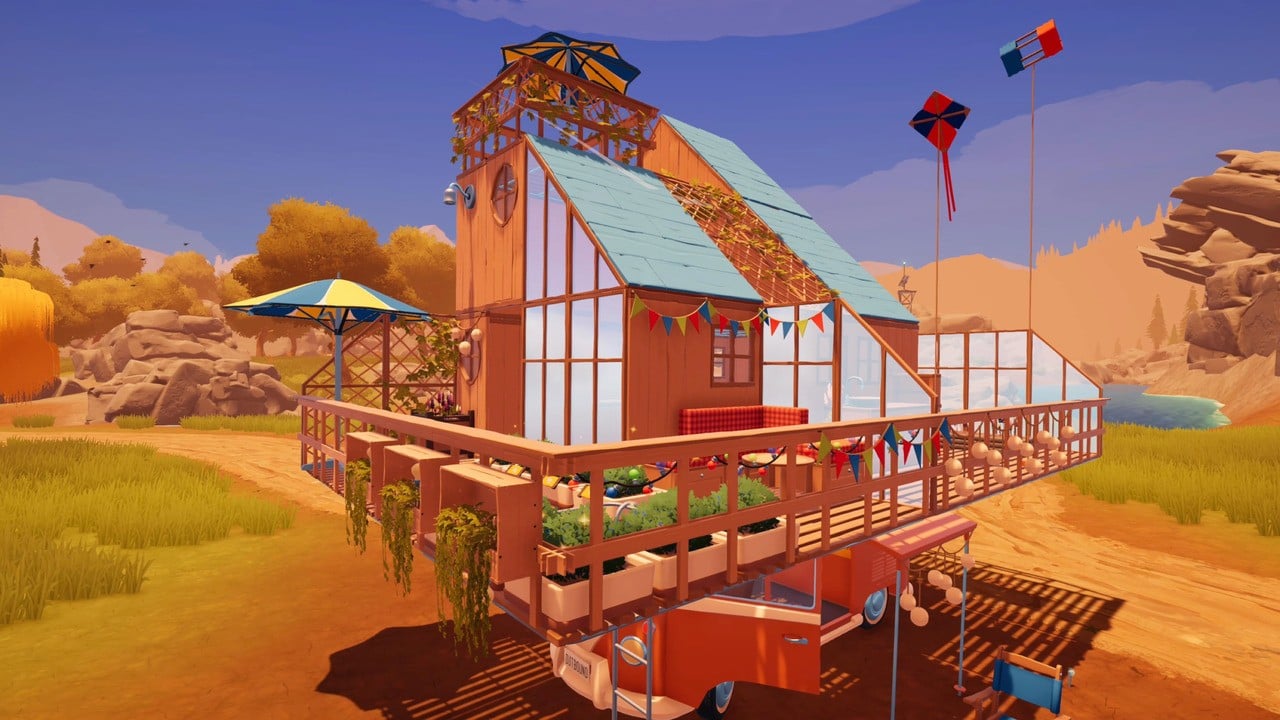
Once a crop plot is placed, players can plant seeds and wait for them to grow. The technology tree unlocks additional garden types, tools, and upgrades as players progress through the game.
Unlocking Farming
Farming is not available when you start. The Crop Plot is locked behind a gardening blueprint that you download from a Signal Tower the same way you unlock any other recipe. Once that blueprint is yours, two things become available at once: the Crop Plot in your build menu and the Watering Can at your workbench. Building the plots also depends on planks, which come from the Sawmill, so unlocking the Sawmill blueprint is a useful prerequisite if you have not already.
Item | Cost | How to Get It |
|---|---|---|
Gardening blueprint | A download at a Signal Tower | Unlocks the Crop Plot build piece and the Watering Can recipe |
Crop Plot | 2 Everwood and 2 Everwood Planks | Build menu, under Workstations then Cultivation |
Everwood Planks | Made from Everwood | Processed at the Sawmill (its own Signal Tower unlock) |
Watering Can | Crafted at your workbench once the gardening blueprint is unlocked |
Place crop plots through the build menu under Workstations, then Cultivation. They can sit on the van or at your campsite. When you position a plot, turn it so its small selector tab faces you rather than the wall, because that tab is what you interact with to choose what to plant.
To plant, walk up to a placed plot, open an empty slot, pick a crop, and confirm. You do not need separate seeds: anything you have already harvested, such as roadberries or a carrot, can be replanted to grow more of it. Different crops take different amounts of time, with quick crops like roadberries maturing in about a day and slower ones like carrots taking around two, and a mature plant returns several units when you harvest it.
A flashing red watering-can icon over a plot means the soil is dry. Equip a filled Watering Can, look directly at the soil, and interact to water it. You refill the can at the stone wells dotted along rivers and the coast, each of which holds a bucket of water, or from water bottles you pick up while exploring. If it rains, uncovered plots water themselves, so plan to lean on the weather and save your stored water for dry stretches.
Confirmed Crops
The following plants can be grown in garden beds. All have been confirmed through the demo, beta, or official sources.
Crop | Use |
|---|---|
Wheat | Processed into Grain, used to make Bread |
Tomatoes | Eaten raw or made into Tomato Sauce |
Carrots | Eaten raw or used in recipes |
Herbs | Used to brew Herbal Tea |
Berries | Eaten raw or made into Jam |
Mushrooms | Includes Amber Morel and Indigo Cap varieties; eaten raw or used in Mushroom Soup |
Seeds and starter plants can be found while exploring the environment. Mushrooms can also be foraged in the wild rather than grown in garden beds.
Watering
Crops need water to grow. A watering can must be unlocked through the technology system for manual watering. However, crop plots auto-water during rain if left uncovered, as confirmed in alpha patch v0.5.9. This creates an interesting trade-off: covering your gardens with the van's greenhouse protects them from harsh weather but prevents free rain watering.
Soil wetness visibility was improved in patch v0.5.15, making it easier to see which plots need attention. Players can check individual crop plots to gauge moisture levels before deciding whether to water manually or wait for the next rainfall.
Greenhouses
Greenhouses are vehicle upgrades that expand growing capacity. They attach to the van's rooftop or sides, creating enclosed garden spaces that protect plants from weather while keeping everything mobile. Greenhouse modules are unlocked through progression in the technology tree.
The van building guide covers strategies for fitting greenhouses alongside other features like solar panels and rooftop storage racks. Balancing garden space with power generation and storage is one of the key layout decisions when designing your van. Terraces serve a similar role, extending the van's sides to create open-air growing space without full weather protection.
Growth Mechanics
Growing crops follows a straightforward cycle: plant seeds in a crop plot, keep the soil watered, and harvest when the plant reaches maturity. Crop plots track growth progress even while the player sleeps (confirmed fix in beta v0.7.8), so crops continue growing during rest periods.
Harvesting is synchronized in multiplayer (fixed in alpha v0.5.11), meaning all players see the same crop state at all times. Grown crop loading was further refined in patch v0.5.15 to ensure plants persist correctly between play sessions.
Different crops may grow at different rates depending on conditions, though specific growth rate mechanics have not been fully documented ahead of the full release.
Automated Farming
As players progress through the technology tree, they can unlock automation upgrades for their farming setup. Automated watering removes the need to manually tend every crop plot, and automated harvesting collects mature crops without player input. These systems free players to focus on exploration or other tasks while their gardens produce food in the background.
Automation requires energy to run. Connecting automated crop systems to the van's power grid means players need to balance energy consumption between farming equipment, driving, and other powered systems. Upgrading energy capacity through solar panels, wind turbines, or water generators helps support larger automated farms.
Biome Effects on Farming
Outbound's world has a variety of biomes ranging from forests and coasts to deserts and mountains. Because the van is mobile, players can drive their gardens into different environmental conditions. Rainfall frequency varies between biomes, which affects how often uncovered crop plots receive free rain watering. Coastal and forest regions tend to see more precipitation than arid desert areas.
Foraging for new seeds is also biome-dependent. Certain plants and mushroom varieties are found more readily in specific regions, encouraging players to explore different areas to expand their crop selection.
Multiplayer Farming
In multiplayer sessions with up to four players, garden beds on the shared van are accessible to everyone. Players can divide responsibilities so that one person tends the crops while others handle driving, crafting, or exploration. Harvesting and crop states are fully synchronized across all connected players, so there is no conflict over who picks what.
Coordinating garden layout on a shared van requires communication, since garden beds compete for the same roof and interior space as workstations, storage, and decorations.
Connection to Cooking
Farming sits at the beginning of the food production chain. Players plant and grow ingredients, harvest them, and then process the harvest through the cooking system. Raw crops can be eaten for basic hunger restoration, but cooked meals provide better nourishment and additional effects.
The full list of meals and their ingredients is documented in the recipes list. Together, farming and cooking form a farm-to-table loop that is central to Outbound's self-sufficient, off-grid lifestyle. Keeping a steady supply of crops growing ensures players always have ingredients ready for their next meal.
Tips
Leave some crop plots uncovered so they benefit from rain watering. Use greenhouses only for crops you want to protect from harsh weather.
Plant a variety of crops to cover different recipe requirements rather than growing only one type.
Check soil wetness indicators (improved in v0.5.15) before using the watering can to avoid wasting time on already-moist plots.
In multiplayer, assign one player as the gardener to keep crops consistently watered and harvested while others explore.
Explore different biomes to find new seeds and mushroom varieties for your garden.
Balance greenhouse space with energy production on the roof. Solar panels and garden beds both compete for rooftop real estate.
Unlock automation upgrades as soon as possible to reduce the time spent on manual watering and harvesting.
Crop Table
Seventeen plants can be grown in a crop plot. Growth is counted in in-game days, so a two-day crop is ready after two sleeps or two full cycles of the Weather and Day Night Cycle. Yield is what a single mature plot returns per harvest.
Harvest | Plant | Days to Grow | Yield |
|---|---|---|---|
Blue Roadberries | Blue Roadberry Bush | 1 | 3x Blue Roadberries |
Pink Roadberries | Pink Roadberry Bush | 1 | 5x Pink Roadberries |
Grain | Wheat | 2 | 8x Grain |
Carrot | Carrot Plants | 2 | 4x Carrot |
Bamboo | Bamboo | 2 | 3x Bamboo |
Amber Morel | Amber Morels | 2 | 3x Amber Morel |
Indigocap | Indigocaps | 2 | 3x Indigocap |
Sunshrooms | Sunshrooms | 2 | 3x Sunshrooms |
Golden Bolete | Golden Boletes | 3 | 3x Golden Bolete |
Corn | Corn Stalks | 3 | 7x Corn |
Cotton | Cotton Plant | 3 | 4x Cotton |
Pakchoi | Pakchoi Plant | 3 | 2x Pakchoi |
Wild tomatoes | Tomato Plant | 3 | 5x Wild tomatoes |
Raw Coffee Beans | Coffee Plant | 4 | 8x Raw Coffee Beans |
Cherries | Cherry Tree | 5 | 5x Cherries |
Ginger | Ginger Plant | 5 | 2x Ginger |
Lavender | Lavender Plant | 5 | 2x Lavender |
Roadberry bushes are the fastest at one day and the Pink variety returns five berries a harvest, which makes them the cheapest way to keep the Food Processor stocked with Jam. Wheat is the best return per plot at eight Grain in two days, and Grain feeds four of the baking recipes on the Recipes List page.
Ginger, Lavender and Cherries all take five days and return only two to five units, so they are worth planting early in a trip rather than as an afterthought. Ginger and Lavender are the inputs for the two Tea Station recipes, which restore health.
Mushrooms behave like any other crop once planted. Amber Morels, Indigocaps and Sunshrooms take two days, Golden Boletes take three, and all four species make the same soup at the Cooking pot.