

Overview
The Outdoors is the first biome players explore in Outbound and the setting for the opening hours of every new campaign. It was the sole biome included in the free Steam demo released during Steam Next Fest in February 2026, and it has been playable in closed alpha for Kickstarter backers since the alpha build went live on April 14, 2025. It is the most thoroughly tested and most heavily iterated region in the game, and for most players it will be where the entire van life loop of driving, parking, foraging, crafting, cooking, and building first clicks into place.
The biome is designed as a gentle on-ramp. Its terrain is mostly flat or gently rolling, its resources are balanced across every early-game category, and its landmarks are spaced close enough together that a loaded camper van can reach the next one without much planning. At the same time it is large enough and detailed enough to carry the first several hours of play. Press previews from Steam Next Fest 2026 consistently described finishing the demo after roughly three hours and still leaving corners of the map unvisited, which gives a reasonable sense of how densely packed The Outdoors actually is.
Geography and Terrain
The Outdoors mixes four distinct terrain types that blend into each other rather than sitting in neat bands. Dense mixed forest covers much of the lowland and hillside terrain, broken up by wide open plains where the grass grows tall enough to hide collectibles and small animals. Wheat fields line the farmland around the southern settlements, swaying in the wind when the weather system produces a breeze. Rolling mountains rise along one edge of the biome and give way to exposed stone ridges that are only reachable on foot.
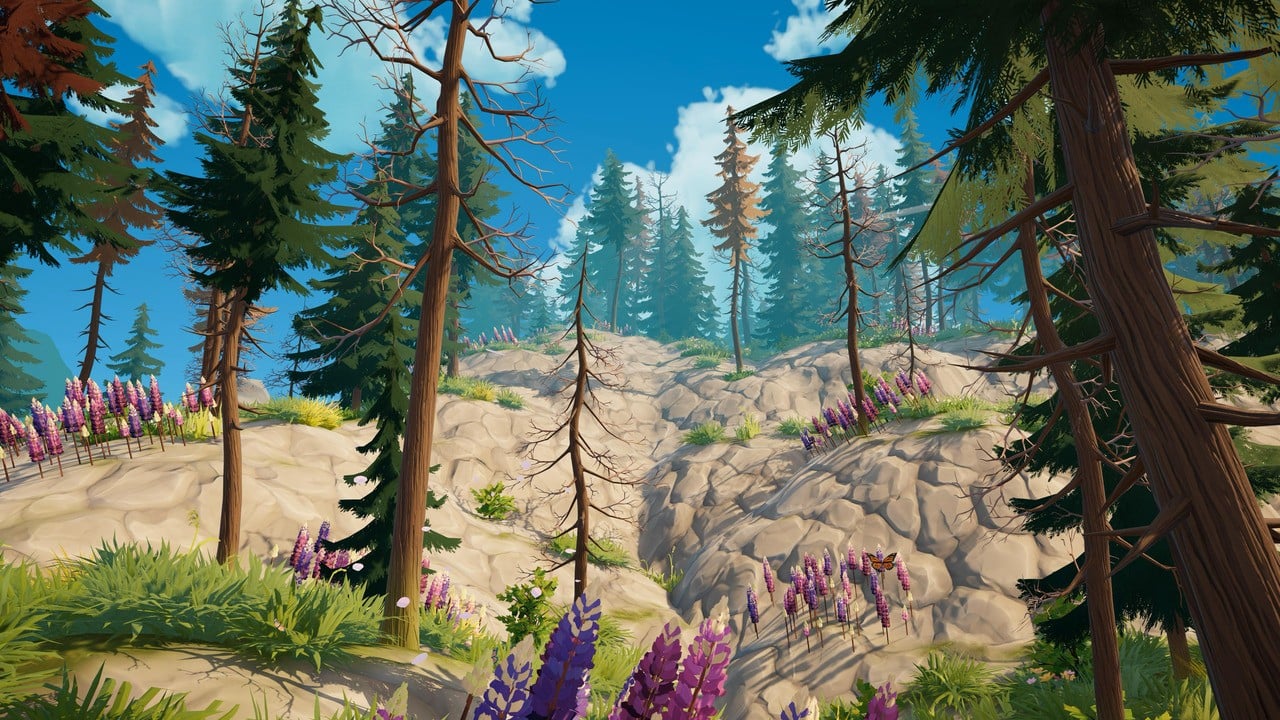
A network of dirt roads and cart tracks winds through the biome, linking each major landmark. Drivers do not have to stick to the road though. The camper van can roll across most open ground, ford shallow streams, and push through light undergrowth, which encourages off-piste detours whenever a gnome glints in the grass or a signal mast pokes above a distant tree line. Some areas are deliberately locked to foot travel. Hilltops, narrow canyons, and the dense cores of forest clusters require the player to park the van and walk in, usually along a clearly marked trail that climbs past cairns and wooden signposts.
Rivers and streams cut across the plains and forests, both as a source of fresh water and as a natural barrier. In the Steam Next Fest build a large lake marked the western edge of the playable area, and while the van could drive right up to the shore it could not enter the water. Weather effects, rain, fog, and dramatic shifts between golden hour and deep night all play out inside The Outdoors, and the day-night cycle noticeably changes both the mood of each landmark and how much power the van's energy systems generate.
Landmarks
The Outdoors contains six confirmed landmarks, each with its own interior, its own set of scavenging opportunities, and its own reward for the player who takes the time to explore every room. Finding them is usually a matter of following roads and hiking trails, though a few require off-road driving or climbing. All six have been shown in developer updates, Kickstarter posts, press previews, and demo playthroughs.
Landmark | Terrain | Key Features |
Hilltop forest | Spiral staircase, living cabin, balcony, panoramic views, previous ranger's belongings | |
Mid-forest canopy | Canopy platform, rocking chair, tool shed, mushroom farms, herb plants, ladders | |
Plains farmland | Locked farmhouse, work shed, wheat field, carrot plot | |
Open hillside | Locked paint room, greenhouse with petals, mechanical ladder, balcony overlook | |
Forest clearing | Kitchen, dining table, fireplace, sofa, survival tools | |
Mountain ridge | Ranger hut, storage crates, checkpoint |
Fire Lookout
The Fire Lookout is the single most recognizable landmark in the game and has featured in almost every trailer and store page screenshot since the Kickstarter campaign. It was also one of the first points of interest the developers completed in playable form. Press previews repeatedly pointed to it as the classic early objective in the demo, comparing it to the watchtower in Firewatch. The tower itself sits on a forested hilltop with a spiral staircase climbing to a small living cabin, a wraparound balcony, and a panoramic view of the biome that doubles as a natural spot for mapping the next leg of exploration. Inside the cabin the previous ranger left belongings behind, which gives scavengers a small pile of starter items without having to chop or forage for them.
Tree Hut
The Tree Hut is a canopy shelter built into one of the largest trees in the biome. It is reached by following a trail up a slope from the main road, and a review of the demo specifically noted that the only way to drive close was to leave the road and grind up the hillside. The platform holds a rocking chair and a tool shed, and the surrounding branches have been converted into small mushroom farms and herb plots. Ladders connect the canopy to the forest floor. The Tree Hut is the first place most players see the game's farming loop applied in the wild, and it contains a signal tower on the upper level that players can activate with Download Coupons crafted from litter.
Sunbeam Acres Farm
Sunbeam Acres is the largest of the plains landmarks. It is a working farm with a locked farmhouse, a separate work shed, a wide wheat field, and a carrot plot around the back. It is one of the best places in The Outdoors to stock up on crops without planting anything yourself, and the flat ground around the farmhouse makes it a convenient parking spot for the van. The farmhouse door stays locked during the early hours of the demo, which has been confirmed in multiple playthroughs, but exterior buildings and fields can be freely scavenged.
Lilly's Windmill
Lilly's Windmill stands on a bare hillside and is visible from a long way off across the plains. Previews describe a working windmill with sails that turn with the wind, a locked room holding paint supplies, a small greenhouse stocked with petals, and a mechanical ladder that lifts players to the upper balcony. The balcony gives one of the best overlooks in the biome, particularly at dawn when the light catches the wheat fields below. The windmill is also a useful anchor for route planning, since its silhouette can be spotted from the road long before the minimap resolves it.
Woods Cabin
The Woods Cabin is a smaller forest landmark tucked into a quiet clearing. Inside it has a kitchen, a dining table, a fireplace, a sofa, and a scatter of survival tools. It is a good place to try out the cooking system for the first time, since the kitchen is fully furnished and the surrounding woods provide berries, herbs, and mushrooms within a short walk of the door. The cabin is also a common overnight stop for players who want to sleep somewhere other than the van.
Mountain Outpost
The Mountain Outpost is a small ranger hut set on one of the higher ridges along the eastern edge of the biome. It is a checkpoint for drivers taking the mountain route and holds storage crates with scavenging loot. Because it sits high above the tree line it is one of the best places in The Outdoors to harvest wind energy, and it is often used by players as a staging point before pushing up into the rockier terrain beyond.
Signal Towers
The Outdoors contains 23 Signal Towers, which is the highest concentration of any biome confirmed so far. Each tower is a small transmission mast with an interface at its base. Activating a tower lets the player download one of several blueprints for the workbench or the building system. The offered blueprints are randomized, and developer notes have confirmed that the selection varies between playthroughs and even between different players in the same co-op session, so no two runs of The Outdoors unlock the same items in the same order.
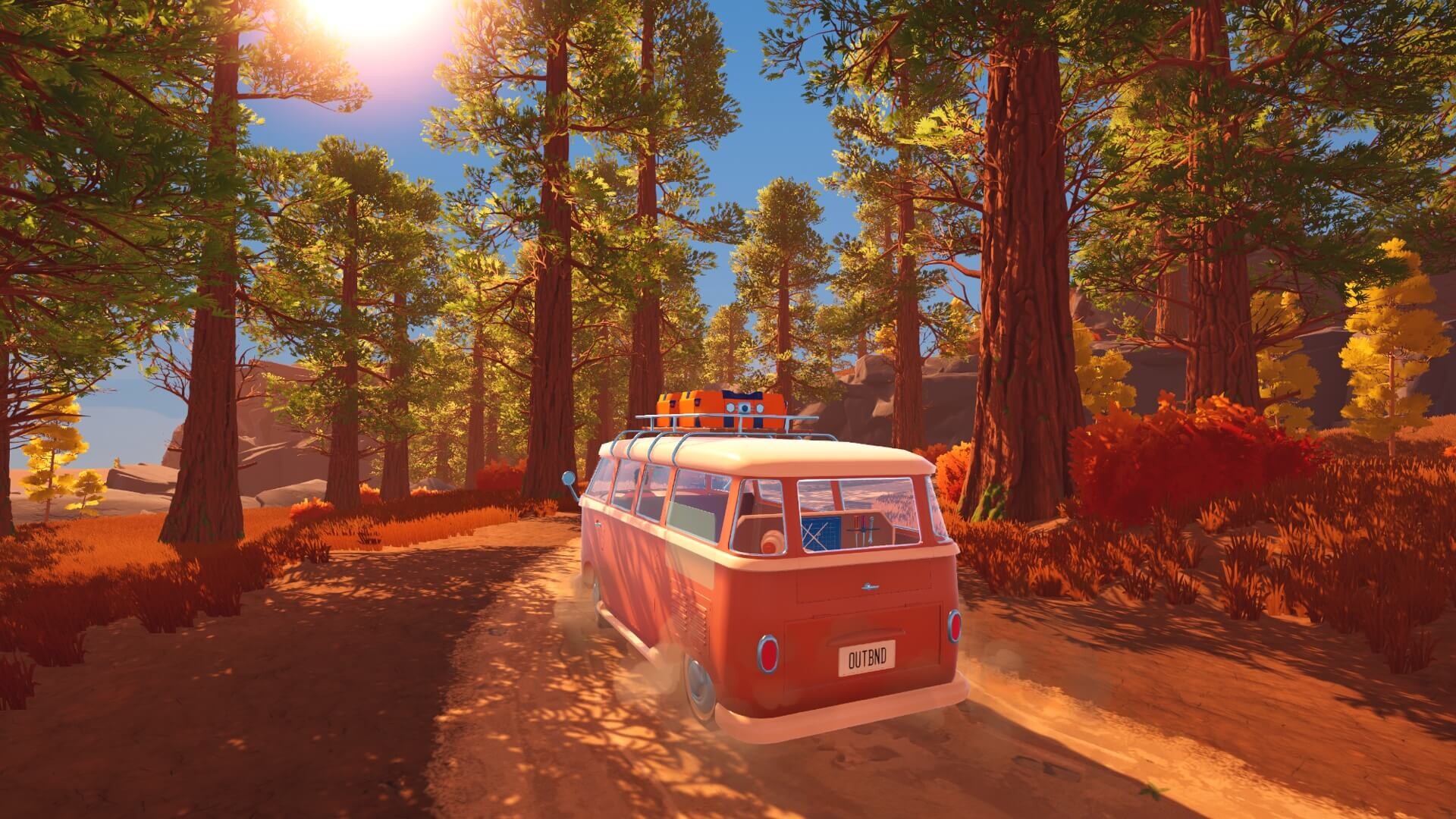
Towers require Download Coupons to activate. Coupons are not found directly in the world. Instead they are crafted by feeding litter, the cans, bottles, and scrap that lie scattered across campsites and roadsides, into the Recycler on the camper van. That loop of picking up trash, hauling it back to the van, recycling it, and then spending the resulting coupons at towers is the main progression driver of the early game, and The Outdoors is deliberately seeded with enough litter to keep that loop moving without feeling like a chore. Tower signals also refresh over time, which means players can revisit a tower that has already been used and eventually download a different blueprint from it.
Resources
The Outdoors offers a balanced selection of early-game resources covering every major crafting category. Because it is the first biome, almost every recipe the player unlocks here can be satisfied without leaving it. A scythe is required to cut large bushes for their bigger fiber yield, which creates the well-known early-game catch-22 of needing fiber to build the scythe that harvests more fiber; the solution is to pick small bushes and scavenge litter until the recipe is in range.
Resource | Description | Where to Find |
Lumber | Basic wood for crafting and building | Felled from trees across the forest zones |
Fibre | Plant fiber used in tools, cloth, and biomass | Small and large bushes throughout the biome |
Rocks | Raw stone for workstations and masonry | Surface deposits on plains and mountain ridges |
Berries | Edible forage and animal treats | Bushes at forest edges and around landmarks |
Herbs | Cooking and recipe ingredient | Plains, forest floor, Tree Hut herb plots |
Carrots | Vegetable crop | Sunbeam Acres carrot plot |
Grain | Baking and cooking staple | Wheat fields near Sunbeam Acres |
Wheat | Harvested stalks for processing | Wide wheat fields on the plains |
Amber Morel | Forest mushroom | Shaded forest floor and Tree Hut farms |
Indigo Cap | Forest mushroom | Shaded forest floor and Tree Hut farms |
Water | Drinking and cooking water | Rivers, streams, and the lake shore |
Litter | Scrap recycled into Download Coupons | Campsites, roadsides, landmark exteriors |
Flora and Fauna
The Outdoors is alive with wildlife, though nothing in it is hostile. Bunnies roam the plains and forest edges and are the most iconic species in the biome: players can feed them berries to befriend them, pet them, and even attract entire groups around their camp. They cannot be harmed by tools, by the van, or by any other means. Press previews made a point of highlighting this as one of the clearest signals that Outbound is a survival game about living, not about fighting. Other small animals wander the biome at the edges of sight and react to player proximity.
Plant life in The Outdoors is split between crops, foraging plants, and decorative flowers. Wheat fields, carrot plots, berry bushes, mushroom clusters, and herb patches are the main foraging targets, while the greenhouse at Lilly's Windmill shows off ornamental petals that feed into the paint and decoration systems. The mix is dense enough that attentive players can fill their inventory without driving anywhere, simply by walking circles around a single parking spot.
Energy Strategy
The energy system in Outbound gives the van four main power sources: solar, wind, water, and biomass. Each has pros and cons, and the weather and time of day directly affect how much power each one delivers. The Outdoors is unusually generous because it contains good terrain for three of the four energy sources, and players who plan their parking spots can keep the van fully powered without ever running short.
Source | Effectiveness in The Outdoors | Best Location |
Excellent on clear days, weakened by rain and fog | Open plains and wheat fields with unobstructed sky | |
Wind | Very strong on exposed ridges and hillsides | Mountain Outpost ridge and the slopes near Lilly's Windmill |
Reliable all-weather power, hungry for lumber and fibre | Deep forest zones with plentiful trees and bushes | |
Water | Situational, needs a flowing river or stream | Stream banks and riverbeds across the biome |
The practical rule of thumb for The Outdoors is to match the parking spot to the workload. For quick stops where the van only needs a trickle of power, any sunny plains clearing will do. For heavy crafting sessions, especially when cooking and running the Recycler at the same time, parking next to the forest edge and loading the Bio Burner with fresh lumber is the most reliable approach. At night, when solar drops to zero, wind and biomass carry the load. Players who plan to sleep through a storm should top up biomass fuel before bed so the van is still running in the morning.
The Demo (Steam Next Fest 2026)
The free Steam demo released during Steam Next Fest in February 2026 used The Outdoors as its entire playable area. It was one of the most-played demos of the event: over 50,000 testers installed the client, and it held an 85 percent positive review score throughout the festival. Press previews during the Fest were broadly positive, with the recurring framing comparing the atmosphere to Firewatch filtered through a Pixar aesthetic.
Mechanically the demo shipped the full early-game loop. Players could drive the van, park at campfires, gather resources, recycle litter, activate signal towers, cook meals, build on top of the van, feed bunnies, find gnomes, and play co-op with up to three friends on a shared vehicle. It ran roughly three hours on a focused playthrough and could comfortably stretch much longer for players who wanted to explore every landmark or set up a full home base. The demo ended at the edges of The Outdoors rather than at a story beat. Roads were blocked by signs and barriers wherever the biome connected to the rest of the world, which made the shape of the map clear while preserving the surprise of what came next.
Because so many players cut their teeth on the demo build, most of the community knowledge about The Outdoors comes from that specific version of the biome. Square Glade Games has continued to iterate on the area for the May 2026 release, so some details of landmark interiors and resource placement may shift between the demo build and the launch build. The overall shape of the biome, the six named landmarks, the 23 signal towers, the wildlife, and the energy mix have all been confirmed to carry over.
Exploration Tips
Treat The Outdoors as a place to settle in rather than a place to rush through. The biome was built to reward attention: every landmark has something locked, hidden, or scattered, and the best early rewards almost always come from circling an area twice rather than checking it off and driving on. A few tips that press previews and alpha players keep coming back to:
Drive slowly. The camper van has deliberately low acceleration and a modest top speed, and trying to rush from landmark to landmark wastes more energy than it saves. Previews flagged this repeatedly in the demo build.
Pick up every scrap of litter you can carry, even when you do not need coupons yet. It weighs almost nothing compared to lumber or rocks, and the Recycler converts it into Download Coupons on demand.
Park in sunshine by day and near a forest by night. That way the solar panels catch all the light they can while the bio burner is within a short walk of more fuel.
Check high ground first. The Fire Lookout and the balcony of Lilly's Windmill both give a clear line of sight across the biome, which makes it easier to spot distant signal towers, the outline of landmarks, and the shine of gnomes in the grass.
Save scythe-locked bushes for later. The big fibre yield from large bushes is tempting, but you do not need it until after the scythe recipe is unlocked, and small bushes already cover the early crafting needs.
Bring a friend. The Outdoors is balanced for solo play but works even better in co-op. Up to four players can share a single van, split exploration duties, and cook together at the landmarks that have full kitchens.
Hidden Collectibles
Hidden gnome figurines are scattered throughout The Outdoors as collectibles. They are tucked behind landmark walls, inside dense bushes, on rocky outcrops above the roads, and occasionally right next to a well-worn path as a reward for slowing down. Finding them all is linked to a long-term reward, and alpha players have confirmed that gnome hunting is one of the main non-combat progression goals in the demo build.
The biome also contains cairns, small stacks of rocks that players can add to or build themselves. They double as landmarks on the minimap and as a quiet form of environmental storytelling, and marking one near a favorite parking spot is a reliable way to find the same place again after a long driving session. Campfires and bridges are likewise highlighted on the world map as navigational aids, alongside the landmarks, utilities, and signal towers already discussed above. The cumulative effect is that The Outdoors can be mapped by a careful player without ever relying on a fast-travel shortcut.