

Overview
The gacha system in Neverness to Everness is called Scarborough Fair, sometimes referred to simply as The Fair. Rather than presenting a conventional pull screen where players tap a button and watch a summoning animation, NTE takes a completely different approach. The Fair uses a Monopoly-style board game where players roll dice and move a Chuppa token (a small mascot game piece) around a tiled board. Each tile the token lands on delivers a different type of reward, ranging from guaranteed character drops to minor resource bundles.
One of the most player-friendly aspects of the system is the absence of a 50/50 mechanic. In many competing gacha titles, pulling a top-rarity character from a limited banner comes with only a 50% chance of receiving the featured unit. In NTE, any S-rank character pulled from a limited banner is guaranteed to be the featured character. This removes one of the biggest frustrations in the genre and makes saving for specific characters far more predictable.
How it Works
Players use Solid Dice on the limited character banner or Fabricated Dice on the standard (permanent) banner. Each die represents a single pull. Rolling the dice moves the board piece forward by a random number of spaces, and the tile it lands on determines the reward. The board layout is not static. As a player's pity count rises and they get closer to the guaranteed threshold, the board reconfigures itself, swapping low-value tiles for higher-value ones.
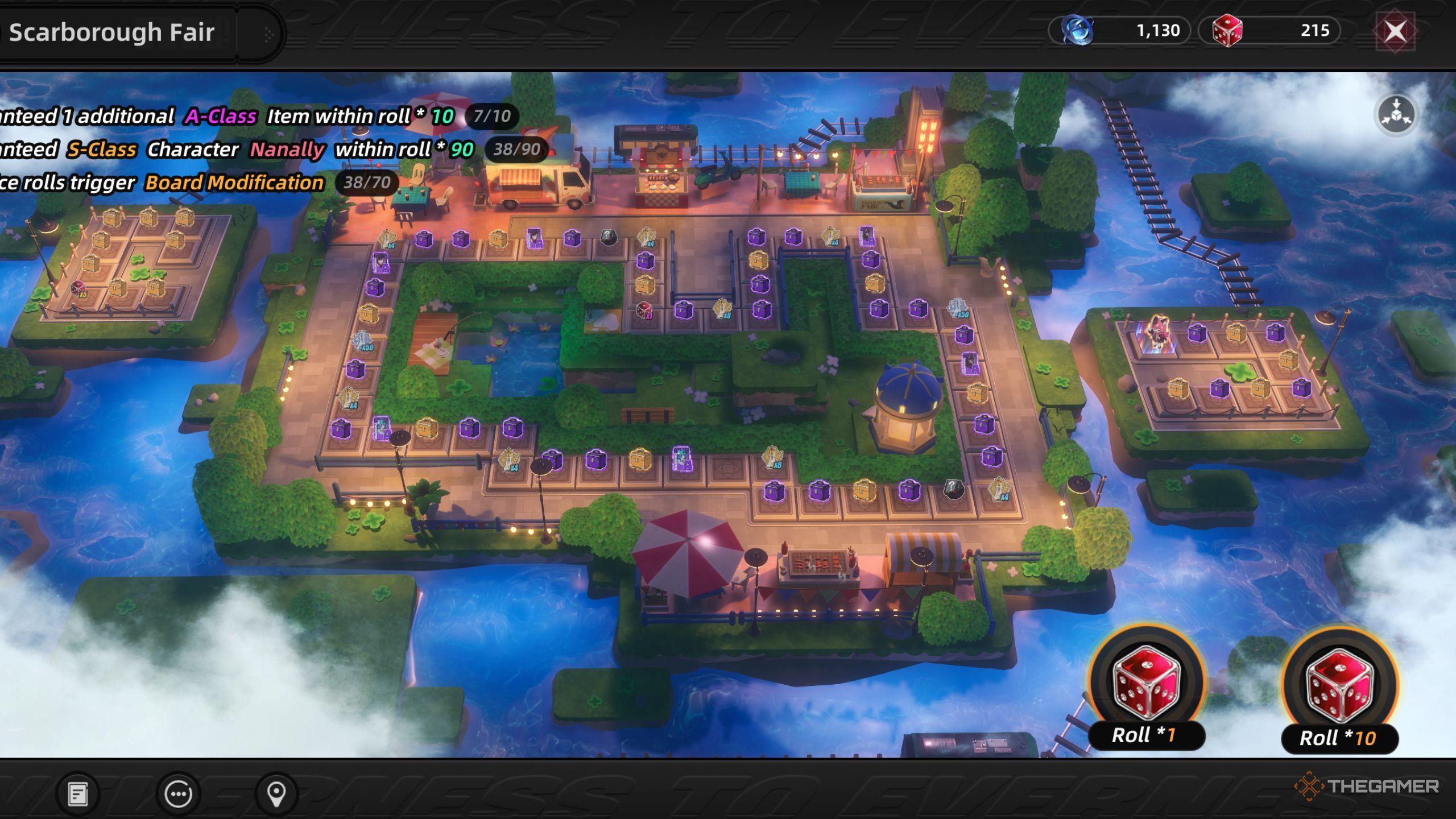
Landing on a tile instantly grants whatever reward it contains. Some tiles also give bonus effects like extra rolls or additional currency. Because the board reshuffles based on pity progression, the experience changes as you spend more dice, creating a sense of momentum that conventional pull animations lack.
Board Layout and Branching Paths
The Scarborough Fair board is arranged as a main loop with two smaller side loops branching off from the left and right sides of the path. The Chuppa token circles the main loop by default, landing on tiles as determined by the dice roll (1 to 6 spaces per roll). Most of the common tiles (Apprentice Chests, Hero Chests, and resource boxes) are distributed along the main loop.
At certain points on the main loop, arrow tiles mark the entrances to the side branches. If the Chuppa lands directly on an arrow tile, the player gains access to that branch for subsequent rolls. The side branches contain a different distribution of rewards compared to the main loop, often featuring higher concentrations of Miracle Boxes, A-class card spaces, and bonus dice tiles. After traversing a side branch, the Chuppa returns to the main loop at a designated merge point.
The Rainbow Bridge
At special convergence points on the board, the player may unlock the Rainbow Bridge. This event creates a forked path with two options. One side of the Rainbow Bridge leads to a tile that contains a guaranteed S-class card on its very first space. The other side offers 5 bonus dice, giving the player extra rolls to continue moving around the board. The Rainbow Bridge is a major moment in any pull session because it presents a direct choice between an immediate high-value reward and extended board coverage that could yield multiple smaller rewards.
Slumberland Tiles and the Guardian Mechanic
Scattered across the board are Slumberland tiles. When the Chuppa lands on a Slumberland tile, a Guardian spawns nine spaces ahead of the token's current position. The Guardian then moves forward by two spaces each turn. If the player catches up to the Guardian within three subsequent rolls, they receive 30 Warp Pieces as a bonus reward. This chase mechanic adds an element of excitement to the board game format, as players watch their dice rolls to see whether they can close the gap before the Guardian moves out of reach.
The Guardian mechanic provides a secondary source of Warp Pieces beyond the standard Warp Chess Box tiles. For players who are pulling in bulk, the accumulated Warp Pieces from successful Guardian chases can add up to meaningful purchasing power in the Warp Piece shop.
Dice Rolls and Guaranteed Thresholds
The pity threshold is tracked in total dice rolls on the current board, not in multi-pull batches. Each die consumed counts as one roll, and the board state updates after every roll.
After 70 dice rolls on a limited banner, the board itself visibly reshuffles. Low-value tiles are replaced with additional featured-character tiles, raising the overall S-rank odds to roughly 20 percent per roll for the remainder of that pity cycle. At 90 dice rolls the featured character is guaranteed outright, and the roll counter resets once the character is awarded. Because there is no 50/50 on limited banners, every S-rank obtained through these thresholds is always the featured character. Pity carries over between limited banners of the same type, so unused rolls at the end of one rotation continue to count on the next.
Outer Path Tile Outcomes
Some tiles on the main loop push the Chuppa onto an outer path rather than continuing along the inner loop. Outer paths contain a distinct reward pool that is not limited to dice rewards or chest rolls. Rewards observed on outer-path tiles include:
Dice refunds. The tile refunds a stated number of dice rolls, extending the session without consuming additional pull currency.
Character outfits. The tile unlocks a cosmetic outfit for the featured S-rank character or another eligible playable character.
Vehicle skins. The tile unlocks a cosmetic paint or livery for a vehicle usable in Hethereau.
Direct featured character award. A small number of outer-path tiles bypass the purple and gold boxes entirely and award the featured S-rank character immediately on landing, regardless of the current pity count.
Because the outer paths contain unique cosmetic rewards not available elsewhere, players who are close to reaching a side branch often prefer to chase the branch entrance rather than take the shorter route back to chest tiles on the main loop.
Pull Rates
The consolidated S-class rate in Scarborough Fair is approximately 1.88% per pull (averaged across a full pity cycle including soft pity; the base per-tile rate is approximately 1%). This is significantly higher than the standard rates in comparable titles. Wuthering Waves offers 0.8%, and Genshin Impact sits at 0.6%. The higher base rate, combined with the absence of a 50/50 system, means that NTE is notably more generous when it comes to obtaining featured characters.
A-class characters are guaranteed every 10 pulls, which ensures that even short pulling sessions produce meaningful results. B-class drops fill the remaining probability space and serve as enhancement material and collection entries.
Pity System
Soft pity begins at approximately 70 pulls. After 70 pulls without an S-class character, the board reconfigures to include significantly more Journey Together tiles (the tiles that guarantee the featured S-class unit). During this soft pity phase, the effective S-class rate climbs to roughly 19.5% per pull, making it very likely that you will receive the featured character within the next few rolls.
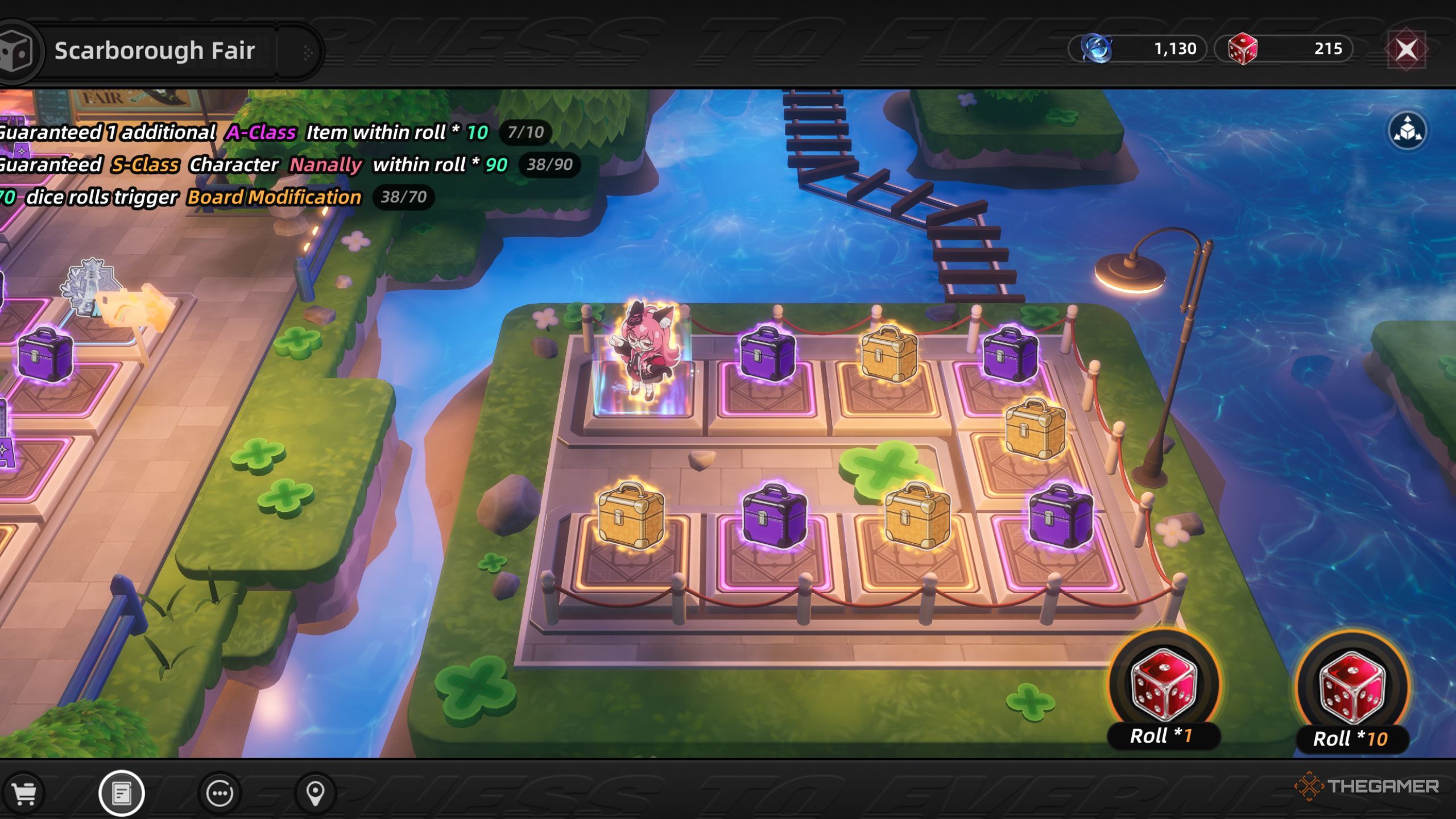
Hard pity is set at 90 pulls. If a player reaches 90 pulls without receiving an S-class character, the 90th pull is guaranteed to award one. Because there is no 50/50 mechanic on the limited banner, that guaranteed S-class will always be the featured character. Pity carries over between limited banners of the same type, so unused pity count is never wasted.
How the Board Changes at Soft Pity
When a player reaches 70 pulls without drawing an S-class character, the board undergoes a visible transformation. All Hero Chest tiles on the main loop are replaced with Journey Together tiles (guaranteed S-class). In practical terms, this means that roughly every 5 to 6 tiles on the modified board becomes an S-class guarantee. The effective per-roll S-class rate jumps from the base ~1% to approximately 19.5%, making it very likely that the player lands on an S-class tile within a handful of additional rolls.
If the player still has not landed on an S-class tile by pull 89, the game skips the dice roll entirely and automatically awards the featured S-class character. This hard pity guarantee at pull 90 ensures that no player ever needs to exceed 90 pulls per S-class acquisition. Combined with pity carryover between limited banners of the same type, this system provides a predictable ceiling on spending.
Pity Rate Summary
Pull Range | Effective S-Class Rate | Board State |
|---|---|---|
1 to 69 | ~1% per pull (base rate) | Standard board layout with normal tile distribution |
70 to 89 (soft pity) | ~19.5% per pull | Hero Chests replaced with Journey Together tiles; S-class tile every 5-6 spaces |
90 (hard pity) | 100% guaranteed | Dice roll skipped; featured S-class awarded automatically |
Board Tiles
Each tile on the Scarborough Fair board provides a specific category of reward. The table below lists the tile types that appear during the gacha board game.
Tile | Effect |
|---|---|
Journey Together | Guarantees the featured S-class character. More of these tiles appear as pity increases. |
Apprentice Chest | Contains a pull with a estimated ~0.2% S-class rate. Most common outcome is B-class Arcs. |
Hero Chest | Contains a pull with a estimated ~3% S-class rate. Also awards 2 Warp Pieces on landing. |
Roll Again | Refunds a stated number of pulls (usually 1 or 2), effectively giving free extra rolls. |
Miracle Box | Awards a random A-class Arc. |
Warp Chess Box | Awards Warp Pieces, used for purchasing standard banner characters and extra pulls. |
Lost Chess Box | Awards Lost Pieces, used for purchasing upgrade items and monthly pull allotments. |
Slumberland | Spawns a Guardian nine spaces ahead. Catch it within three rolls to earn 30 Warp Pieces. |
A-Class Card | Guarantees a specific A-class character featured on the tile. Landing here awards the character directly. |
Tile Colors and Box Identification
On the board itself, the two reward chests are distinguished visually by colour before you land on them. Apprentice Chests display as purple boxes with an estimated 0.2 percent chance to drop the featured S-rank character on landing. Hero Chests display as gold boxes with an estimated 3 percent chance to drop the featured S-rank character. Because the colour is visible on the tile before your Chuppa arrives, you can gauge the expected value of a given roll at a glance.
A handful of tiles on the loop are neither purple nor gold and instead grant cosmetic or convenience rewards. The glider skin tile awards a free cosmetic skin for the glider, and is a one-off reward rather than a repeatable pull. Lost piece tiles award Lost Pieces, a gacha byproduct currency that funds both monthly limited pull allotments and character or Arc upgrade materials from the Lost Piece shop.
Standard vs. Limited Banner Differences
Scarborough Fair features two main banner types, each with its own dice currency, reward pool, and pity counter. Understanding the differences is essential for efficient resource allocation.
Feature | Limited Banner | Standard (Permanent) Banner |
|---|---|---|
Currency | ||
S-Class Guarantee | Always the featured character (no 50/50) | Random S-class from the permanent pool |
Pity Counter | Carries over between limited banners of the same type | Separate counter; carries over indefinitely on the standard banner |
Soft Pity | 70 pulls (~19.5% S-class rate) | 70 pulls (~19.5% S-class rate) |
Hard Pity | 90 pulls | 90 pulls |
Rotation | Changes with each banner period; featured character announced in advance | Permanent; pool expands as characters are added over time |
New Player Bonus | None specific | Free S-Rank Selector after 50 pulls without an S-Rank |
The limited banner is the recommended destination for Solid Dice because it guarantees the specific featured character on S-class trigger. The standard banner is best treated as a passive income target, pulling only with Fabricated Dice earned from daily activities and events rather than converting premium currency into standard pulls.
Banner Rotation and Expectations
Limited banners typically run for two to three weeks, with the featured character and any associated event content announced several days before the banner launches. Hotta Studio has followed a pattern of alternating between new character debuts and reruns of previously released characters. Players who are saving for a specific character should monitor official announcements and community channels for upcoming banner schedules.
Because pity carries over between limited banners, there is no penalty for skipping a banner entirely. A player who pulls 40 times on one limited banner and then stops will start the next limited banner at 40/90 toward hard pity. This carryover removes the pressure to pull on every banner and rewards patient saving.
Currencies
The Scarborough Fair system involves several interconnected currencies. Understanding each one helps with long-term resource planning.
Currency | Purpose |
|---|---|
Limited banner pull currency. 1 Solid Die equals 1 pull on the currently featured character banner. | |
Standard (permanent) banner pull currency. Cannot be used on limited banners. | |
Premium currency that can be purchased or earned in-game. Used to buy Solid Dice or Fabricated Dice. | |
Rare exchange currency. 25 Tri-Keys can be traded for any available S-class Arc from the exchange shop. | |
Warp Piece | Obtained from duplicate pulls and certain board tiles. Can be spent on extra pulls or used to purchase standard banner characters. |
Lost Piece | Awarded from gacha activity. Used to buy upgrade items and monthly pull allotments from the Lost Piece shop. |
Lunaria | Secondary premium currency used for stamina refills, cosmetic skins, and battle pass progression. Earned from events and purchasable with real money. |
Per-Pull Costs and Duplicate Payouts
Two related cost details fill out the Currencies picture above: the Annulith conversion rate that turns the premium currency into pull dice, and the duplicate payout schedule that converts every extra character or Arc copy into Warp Pieces or Lost Pieces.
Conversion Rate
Annulith converts to pull dice at a fixed rate of 160 Annulith per Solid Dice or Fabricated Dice. A multi on either character banner therefore costs 1,600 Annulith for ten pulls. The Arc banner runs only as 10-pulls and lands at the same 1,600 Annulith per multi, although the in-game ticket cost shown in the Currencies table above is denominated as 25 Tri-Keys per 10-pull because the Arc banner uses Tri-Keys rather than Solid Dice as its native currency. In practical planning terms, every block of 1,600 Annulith equals one 10-pull regardless of which banner the player targets.
Duplicate Payouts
Pulling extra copies of a character or Arc you already own does not waste the pull. Every duplicate generates Warp Pieces or Lost Pieces on a fixed schedule, which can then be spent in the Warp Piece shop on standard banner characters or in the Lost Piece shop on monthly dice and ascension materials. The schedule below applies to both the Limited and Standard banners; the Arc banner uses the same Warp Piece scale for character duplicates pulled through it.
Pull Outcome | Per-Duplicate Payout |
|---|---|
S-Class Character duplicate (2nd through 7th copy) | 40 Warp Pieces |
S-Class Character duplicate (8th copy onward) | 80 Warp Pieces |
A-Class Character duplicate (2nd through 7th copy) | |
A-Class Character duplicate (8th copy onward) | 12 Warp Pieces |
A-Class Arc duplicate | |
B-Class Arc duplicate | 20 Lost Pieces |
A standard-pool S-Class character can be purchased outright in the Warp Piece shop for the equivalent of roughly 30 pulls' worth of Warp Pieces. Combined with the duplicate payout schedule, this means a player who pulls consistently on the Standard Banner accumulates enough Warp Pieces over time to backfill specific roster gaps without ever touching the Limited Banner.
Character Shop
Alongside the banner boards, there is a separate shop where players can trade accumulated roll currency directly for standard (non-limited) playable characters. The shop is distinct from pulling: characters bought through the shop do not consume dice, and the exchange does not advance pity on any banner.
The shop is stocked primarily from the standard character pool. Limited characters from currently active rotations are not available here, but older limited characters may cycle into the shop once their banner period has ended. The shop uses Warp Pieces as the primary exchange currency, with stock refreshing on a schedule rather than per transaction.
Because standard-banner pity is shared with Warp Piece accumulation (duplicates convert into Warp Pieces on each pull), players who pull consistently on the standard banner often find the shop covers any standard characters they missed through luck. Saving pieces for targeted character purchases is a practical strategy for filling out an elemental roster without pulling the standard banner repeatedly.
Weapon Acquisition Outside the Gacha
Weapons in Neverness to Everness are called Arcs. A deliberate design choice of the economy is that the Arc banner is not the only route, nor even the primary route, for obtaining usable weapons. Most players can build a functional weapon collection without pulling the weapon banner at all.
The three main non-gacha sources for Arcs are:
B-class Arcs from exploration. B-Class Arcs drop as loot across the open world, from chests, side quests, and general exploration. Players encounter multiple B-class Arcs during a normal playthrough without needing to seek them out.
A-class Arcs from exploration. A-Class Arcs are rarer open-world loot. They drop from tougher side content and specific world events rather than common chests, so collecting them requires more deliberate exploration.
S-class Arcs from open-world boss first clears. Every open-world boss in the game awards an S-Class Arc on first clear. Because the first clear of each boss is guaranteed to drop an S-rank weapon, players who clear the open-world boss roster steadily accumulate S-rank Arcs without spending any pull currency.
The practical effect is that the character gacha and the weapon gacha are largely decoupled from each other in the early and mid game. Most of a player's pull budget can be spent on characters, with S-rank weapons filled in from boss clears and A-class fallbacks pulled from exploration. The weapon banner becomes most attractive when chasing a specific featured Arc that a character depends on for their signature passive.
Direct Weapon Purchase with Keys
In addition to banner pulls and first-clear boss rewards, the weapon exchange shop lets players spend pull currency directly to purchase an Arc of their choice from the non-limited pool. The direct purchase cost is 25 keys (the Arc banner pull currency, also called Tri-Keys) for any single non-limited weapon. Featured limited-banner weapons are not available through the direct purchase path, so this option is mainly used to top up specific standard-pool Arcs that never rotated into the shop through normal pulling.
Combined with the open-world boss guarantees above, the direct purchase option ensures that no specific S-rank weapon is ever permanently out of reach, even for players who never hit pity on the weapon banner.
Weapon Banner Pity at a Glance
The Arc banner is pulled in sets of 10 rather than single pulls. The pity thresholds are expressed in how many of those 10-pull sets you have performed on the current banner:
Completed 10-Pull Sets | Featured Arc Outcome |
|---|---|
1 to 5 | Base rates per pull (roughly 3 percent S-class, 7 percent A-class, 90 percent B-class). |
6 (60 pulls, soft pity) | Guaranteed S-class Arc on the next S-class trigger; 25 percent chance that the triggering S-class is the featured weapon, 75 percent chance it is a random standard-pool S-class. |
8 (80 pulls, hard pity) | The featured Arc is guaranteed outright on the next S-class trigger. |
Because pulls are batched into sets of 10, the practical planning unit is 25 keys per set. A worst-case guaranteed featured Arc costs 200 keys spread across eight 10-pull sets. Pity carries over between weapon banner rotations, so unused pull count is preserved when a new featured Arc takes over.
Arc Pulls
In addition to character banners, Scarborough Fair includes a separate banner for Arcs (weapons). Arc pulls use Tri-Keys as their currency rather than Solid Dice or Fabricated Dice. A key distinction is that Arc banners only support 10-pulls; single pulls are not available. Each 10-pull costs 25 Tri-Keys and guarantees at least one A-class Arc, with an S-class Arc available at the same pity thresholds as the character banner.
This 10-pull-only restriction means players need to save Tri-Keys in batches of 25 before pulling. The trade-off is that every pull session on the Arc banner is guaranteed to deliver meaningful results through the minimum A-class guarantee.
Arc Banner Pity
The Arc banner runs on its own pity counter independent of the character banners. Soft pity triggers at 60 pulls (six 10-pulls): the next S-class Arc is guaranteed, with a 25 percent chance of being the current featured Arc and a 75 percent chance of being a random S-class Arc from the standard weapon pool. Hard pity at 80 pulls (eight 10-pulls) guarantees the featured Arc outright. Pity carries over between Arc banner rotations, so unused pull count is never lost when a new weapon headliner takes over.
Pull Count | Outcome | Featured Chance |
|---|---|---|
1 to 59 | Base rates (roughly 3% S-class, 7% A-class, 90% B-class) | 25% of any S-class pulled |
60 (soft pity) | Guaranteed S-class Arc | 25% featured, 75% random S-class |
80 (hard pity) | Guaranteed featured Arc | 100% featured |
Because Arc banners support only 10-pulls at 25 Tri-Keys each, plan Tri-Key saving in multiples of 25. A complete soft pity run costs 150 Tri-Keys and a worst-case hard pity costs 200 Tri-Keys to guarantee the featured weapon.
Free S-Rank Selector
New players receive a special safety net on the standard banner. If a player completes 50 pulls on the standard banner without receiving any S-Rank character, the game awards a free S-Rank character selector. This selector allows the player to choose from the pool of available standard-banner S-Rank characters, providing a guaranteed starting point for building a roster.
This mechanic is separate from the normal pity system. It acts as an additional safety net specifically for new players who may have unusually poor luck during their first batch of pulls. Combined with the pre-registration rewards and early-game free pulls, this selector ensures that every player has at least one S-Rank character early in their progression regardless of RNG outcomes.
Beginner Bonus: First 50 Standard Pulls
A separate discount stacks with the Free S-Rank Selector on the standard banner. The first five 10-pulls on the standard banner cost 8 Fabricated Dice each instead of the normal 10, a 20 percent discount that brings the total cost of reaching the selector from 50 Fabricated Dice to roughly 40. The discount applies automatically during the first 50 standard banner pulls and is consumed once those 50 rolls are completed, regardless of whether an S-class dropped naturally during the run.
The discount works in tandem with the 20-pull guaranteed S-class on the standard banner. Most new players will either pull a random standard S-class within their first 20 rolls or reach the selector at 50 pulls, meaning the effective cost of obtaining the first guaranteed S-class character is usually somewhere between 16 and 40 Fabricated Dice rather than a full 50 rolls at standard price.
Cosmetic Milestones
Every Limited Board includes three exclusive cosmetics as milestone rewards tied to the pull counter on that specific board. They are not three outfits: the set is a glider livery, a vehicle livery, and one outfit for the featured character. Each unlocks when the player reaches the required roll count on that board, and they can also be landed on at random before the milestone is reached. Nothing beyond the rolls themselves is spent.
Pull Milestone | Reward |
|---|---|
50 pulls | First board cosmetic. On the Version 1.3 "Alluring Shadows" board this is the "Scarlet Sash" glider livery. |
120 pulls | Second board cosmetic, usually a vehicle livery. On "Alluring Shadows" this is the "Sandy Mirage" Sirocco livery. |
200 pulls | Third board cosmetic, an outfit for the featured character. On "Alluring Shadows" this is the "Autumn Vignette" outfit for Zankou. |
Important: the cosmetic milestone counter does not carry over between different Limited Boards. Each new banner resets the outfit counter to zero, even if character pity from the previous banner is still active. The counter is retained, however, when a specific banner reruns, so players can pick up where they left off if they only reached 50 or 120 pulls during the original rotation.
F2P Expectations
New players can expect approximately 80 to 90 free pulls from the combination of pre-registration rewards, tutorial completion, and early-game event distributions. Since hard pity sits at 90, this means a free-to-play player entering at launch should be able to guarantee at least one S-class character from the limited banner without spending any real money. Additional pulls accumulate from daily activities, weekly missions, and seasonal events.
The generous pull income early on is clearly designed to help new players build a functional roster quickly. After the initial burst of free resources, the pull income settles into a steadier drip from daily commissions, event participation, and exploration rewards.
Tips and Strategies
Focus Solid Dice on limited banners. Because there is no 50/50 risk, every limited banner pull has a direct path to the featured character. Spending Solid Dice on the limited banner is always the optimal strategy.
Save pity for characters that fit your team. Since pity carries between limited banners, there is no urgency to spend. Wait for a character whose element and role complement your existing roster. Consult the team building guide for composition advice.
Let Fabricated Dice accumulate naturally. The standard banner uses Fabricated Dice, which you earn from daily activities and events. There is no need to rush these; pull on the standard banner whenever you have a comfortable surplus.
Track your pity count. The game displays your current pity count on the banner screen. Keep an eye on it so you know when soft pity (around 70) and hard pity (90) are approaching.
Consider the reroll guide if starting fresh. Rerolling in NTE is relatively painless thanks to the high base rates and generous starting resources.
For more information on character rarity, see Esper Ranks. For details on weapons obtained through gacha, see Arcs and Weapons.
Cosmetic Drop Rates Per Pull
Each pull on a Limited Board also rolls separately for three cosmetic items beyond the regular pity-tracked outfit milestones described above. The drop chances apply per pull, while the existing 50, 120, and 200 pull guarantees act as hard pity if the random roll never connects.
Cosmetic | Base Drop Rate Per Pull | Hard Pity |
|---|---|---|
Glider skin | ~1.71% | 50 pulls on the Limited Board |
Vehicle livery | ~0.33% | 120 pulls on the Limited Board |
Character outfit | ~0.33% | 200 pulls on the Limited Board |
Because the random drop and the hard pity feed into the same counter, players who roll a glider skin on the way to 50 pulls still receive the milestone reward; the rolling is additive rather than competitive. The cosmetic counter resets between different limited banners but is preserved across reruns of the same character's banner, so a player who reached 180 pulls toward a character outfit on the original run only needs 20 more pulls on that character's rerun banner to claim the outfit guarantee.
This makes the Limited Board the only route to the headline glider, vehicle, and character cosmetics for the featured S-rank, since the same items do not appear on the standard banner board or in the regular shops.
Version 1.0 Launch Pull Pool
The April 29, 2026 global launch (Version 1.0) ships with one of the largest pull pools the project has ever offered up front, totaling 470+ guaranteed pulls when the four currency lanes are summed together. The breakdown below treats each currency at its standard conversion rate so you can see what the launch reward bundle looks like in pull-equivalent terms.
Currency | Quantity | Pull Equivalent | Banner Lane |
|---|---|---|---|
28,565 | ~178 pulls | Convertible into Solid Dice or Fabricated Dice | |
32 | 32 limited pulls | Limited character banner only | |
169 | 169 standard pulls | Standard (permanent) character banner | |
Tri-Keys | 105 | ~42 weapon pulls (25 Tri-Keys per 10-pull, four sets plus change) | Arc (weapon) banner |
Grand Total | 470+ pulls | Across all banner lanes |
Combined Limited Pull Guarantee
Annulith and Solid Dice both flow into the limited character lane: Annulith converts at the showroom rate to top up the Solid Dice budget, and Solid Dice are spent directly on the featured limited banner. Summed together, the launch grant produces the 210+ Combined Limited Pulls figure that Hotta Studio surfaces in patch communications.
Because the limited banner removes the 50/50 mechanic, the 210+ Combined Limited budget guarantees at least two limited S-Rank characters before any further income arrives. Soft pity at 70 pulls and hard pity at 90 pulls both carry over between limited banners of the same type, so unused dice from the first limited rotation still count on the second one.
Riftcrystal Conversion
Riftcrystal, the paid premium currency, converts 1:1 into Annulith and feeds the same banners as the free Annulith stockpile. Players who buy Riftcrystals during the launch window enter the same pull lanes as free-to-play accounts; the only difference is the ceiling on the Annulith pool, since every Riftcrystal can be converted before any banner roll is committed.
Free S-Rank Tracks Inside the Launch Window
Two of the launch S-Rank characters are reserved through guaranteed paths that do not draw on the 470+ pull pool at all:
Free S-Rank Chiz: unlocked through the City Tycoon progression track. The full track culminates in Chiz at her A6 Awakening node and her Signature Arc fully refined, with no Solid Dice spend.
Free A-Rank Aurelia: delivered on Day 3 of the 14-Day Launch Login event in the in-game mailbox. The same login sequence hands out the Stellar Veil Arc on Day 10 and 12 Solid Dice spread across the full window.
Because Aurelia's first copy is reserved through logins and Chiz's full progression is locked to City Tycoon levels, the 470+ pull budget is effectively reserved for the limited featured banner targets and weapon banner Tri-Key spends rather than spent topping up these two characters.
Version 1.3 Banner Cycle
Version 1.3 "Rising from the Moonlit Fog" went live on August 19, 2026 and runs two Limited Boards in Phase 1, both closing on September 9, 2026 at 05:59 (UTC+8). Both carry the same unlock requirement as every board before them: clear the main story quest "Prologue - A New Destination - Head to Eibon Antique Shop". Each board runs its own Perks page, and each Perks page pays out at 50, 120, and 200 cumulative rolls on that board.
Board | Featured S-Class | A-Class Rate-Ups | Perks Track | Cosmetics |
|---|---|---|---|---|
"Alluring Shadows" | Zankou (new) | Alluring Perks | "Scarlet Sash" glider livery, "Sandy Mirage" Sirocco livery, "Autumn Vignette" outfit | |
"The Ichi-daime" | Nanally (rerun) | Tiger Perks | "Underboss-of-the-Underboss" glider livery, "Tiger Incoming!" M1000 livery, "Phoenix Kick" outfit |
Board Rules Confirmed for Version 1.3
The Version 1.3 board notice restates the mechanics in full, which makes it the cleanest confirmation of how the pity model actually works across boards.
Rule | Detail |
|---|---|
Dice | The "Alluring Shadows" board takes Solid Dice or Alluring Dice. A roll moves the piece 1 to 6 tiles with equal chance, and the tile landed on pays out its displayed reward. |
Shared across boards | All Limited Boards share one S-Class pity counter, one Points Gift progress track, and one Board Modification progress track. Skipping a board therefore costs nothing in pity terms. |
Not shared across boards | Skin Perks are time-limited and exclusive to the board that runs them, and their progress does not transfer. Progress does carry over between boards that share a name, which is what makes a rerun board like "The Ichi-daime" continue an earlier Tiger Perks track. |
Soft pity at 70 | Every board starts at Baseline. If the featured S-Class character has not dropped within 70 consecutive rolls, the board upgrades to Modified, which is the rate-up state. Obtaining the featured character resets the board to Baseline. |
Hard pity at 90 | If the featured S-Class character has not been obtained after 89 rolls, the 90th roll grants them automatically and the piece does not move. The featured character is guaranteed within 90 rolls. |
No alternate route | Zankou is obtainable only from "Alluring Shadows" for the duration of the version, with no other acquisition method planned at this time. |
Version 1.3 Arc Research Programs
Arcs run on their own programs rather than the character boards. Phase 1 runs two: "Spellbound Special" for the limited S-Class Arc Ravenous Blade, paid with Tri-Keys or Spellbound Keys, and "Tiger Special" for the returning Ready-Ready, paid with Tri-Keys or Tiger Keys. Both close with Phase 1 on September 9, and each Arc is available nowhere else while its program runs. See Arcs Database for the stat lines.
Version 1.3 Phase 2
The second phase opened on September 9, 2026 after maintenance and closes on September 30, 2026 at 05:59 (UTC+8). It runs the "Surfing All Channels!" board featuring the S-Class Anima Esper Linko (rolled with Solid Dice or Sync Dice, with the "Super Specter" glider livery, the "Turbo Linko" Yesteryear livery set and the "Surfing Among Stars" outfit on the Sync Perks track) alongside a "Misty Tipsy Style" rerun featuring Hotori with the "Orchid Breeze" glider livery, the "Autumn Haze" Blizzard-V4 livery and the "Priceless Orchid" outfit on the Hourglass Perks track. Both boards feature Haniel, Aurelia and Skia as the A-Class rate-ups. On the Arc side, "Soundscape Special" carries Voice of the Voyager (Tri-Keys or Soundscape Keys) and "Bright Moon Special" carries the returning Marching Beyond Time (Tri-Keys or Bright Moon Keys). The next rotation, Version 1.4, opens on September 30, 2026 with Blackbird as the first featured character.
Mystery Boxes Are Not Part of Scarborough Fair
Version 1.3 also runs a Mystery Box event called "Lucent Tides", from August 19 at 17:00 to September 30 at 05:59 (UTC+8). It sits outside the board system entirely: boxes are opened with Fons or Annulith rather than dice, the cost rises with each box, there are fifteen boxes, and opening all fifteen unlocks the full pool. Nothing spent there feeds the Scarborough Fair pity counter. The pool is the only route to the Tide, the first watercraft in the game, which is worth knowing before budgeting a version.