
Loading...
Pywel
October 29, 2026 at 02:42 PM
Separate earlier map and Knowledge estimates from current counts, and clarify bell, worker and Flight progression.
Pywel is the continent where Crimson Desert takes place. It is a vast, war-torn landmass stretching from snow-blasted mountains and frozen tundra in the north to crimson sand deserts in the east, with green highlands, dense forests, medieval cities, and steampunk industrial zones filling the space between. Earlier preview notes described a fully seamless continent with no loading screens between regions, cities, interiors or the floating Abyss islands above the surface. That earlier universal claim, including unrestricted walking, riding, climbing, gliding or flying between any two points, is not independently established for every current location and travel method.
Earlier preview notes attributed the following comparisons to Director of Marketing and PR Will Powers at the January 2026 New Game+ show: the playable area was "at least twice as big as the open world, the playable area, of Skyrim" and "larger than the map of Red Dead Redemption 2." These retained preview quotations and their attribution are not a new official measurement. The same earlier notes say he followed this up by noting that "size doesn't really matter if there's nothing to do," stressing that the team focused on density of content rather than raw acreage.
Earlier estimates put Pywel's playable area at 80 to 110 square kilometers (30 to 42 square miles) and a full horseback crossing at roughly two hours. Those remain unverified range and travel-time estimates rather than a measured current route. A launch-era map measurement separately reports a 9,500-by-9,500-meter surface footprint, about 90 square kilometers, and roughly 100 square kilometers when underground areas and sky islands are considered. These are approximate guide measurements, not interchangeable definitions of traversable surface or an official exact area.
Earlier preview notes about the Knowledge System reported 2,921 entries and the following Knowledge Library counts. They are retained as historical figures, not confirmed current totals:
Category | Count |
|---|---|
Territories | 573 |
People | 467 |
401 | |
355 | |
110 | |
76 | |
Mount Types | 29 |
The seven quoted categories sum to 2,011 entries, leaving 910 relative to the old 2,921 total. Earlier notes assigned that remainder to items, lore and other world information. See the dedicated Knowledge System article for the acquisition system; the arithmetic does not independently confirm the old total or category allocation. Version 1.18.00 added a Quests knowledge category with eight subcategories and retroactive credit for certain completed quests, so the preview list is not a complete current category inventory.
The added Quests subcategories are Main Quests, Faction Quests, Investigation Quests, Research Quests, Daily Life Quests, Guide, Archive Records and Constellations. The same Version 1.18.00 patch distinguishes map areas revealed by bells from areas explored directly. The launch-era bell route lists eight bells, with Calphade temporarily unavailable during Chapter 6 and Pailune available after Chapter 7 Resolution; those are bell conditions, not a requirement to complete the entire story before exploring those regions.
Pywel's history is defined by cycles of unification and fragmentation. The King of Demeniss, known as the Unifier of Lands, once brought the diverse peoples and territories of the continent under a single banner through military conquest and political maneuvering. Under his rule, Demeniss became the seat of imperial power and the political capital of all Pywel. Regions that resisted were subjugated by force; Hernand, formerly an independent kingdom, was reduced to a duchy after losing a war with Demeniss.
With the king now lying in a coma, the political order he built has fractured. Regional lords, mercenary bands, and opportunistic factions are racing to fill the power vacuum. Some who suffered under his conquests seek only independence, while others dream of seizing absolutist rule for themselves. This instability ripples across every region of Pywel: noble houses compete for dominance in Demeniss, the Black Bears have seized control of Pailune, Hernand's feudal lords struggle to maintain order, and even the technologically advanced Delesyia faces its own internal power struggles. The continent stands at a tipping point, and the player's actions through faction quests and story choices determine which powers rise and which fall.
Pywel has five major regions with distinct environments, cultures and factions. These are not five equivalent unified countries: the desert faction descriptions explicitly distinguish its unclaimed lands from unified Hernand and Demeniss. Earlier preview notes attributed the phrase "the variety of our reality, in which some countries feel much more futuristic than others" to Will Powers. The main story has region-specific progression, while the bell walkthrough describes exploration across all regions from Chapter 1. Particular quests and bells still have their own gates.
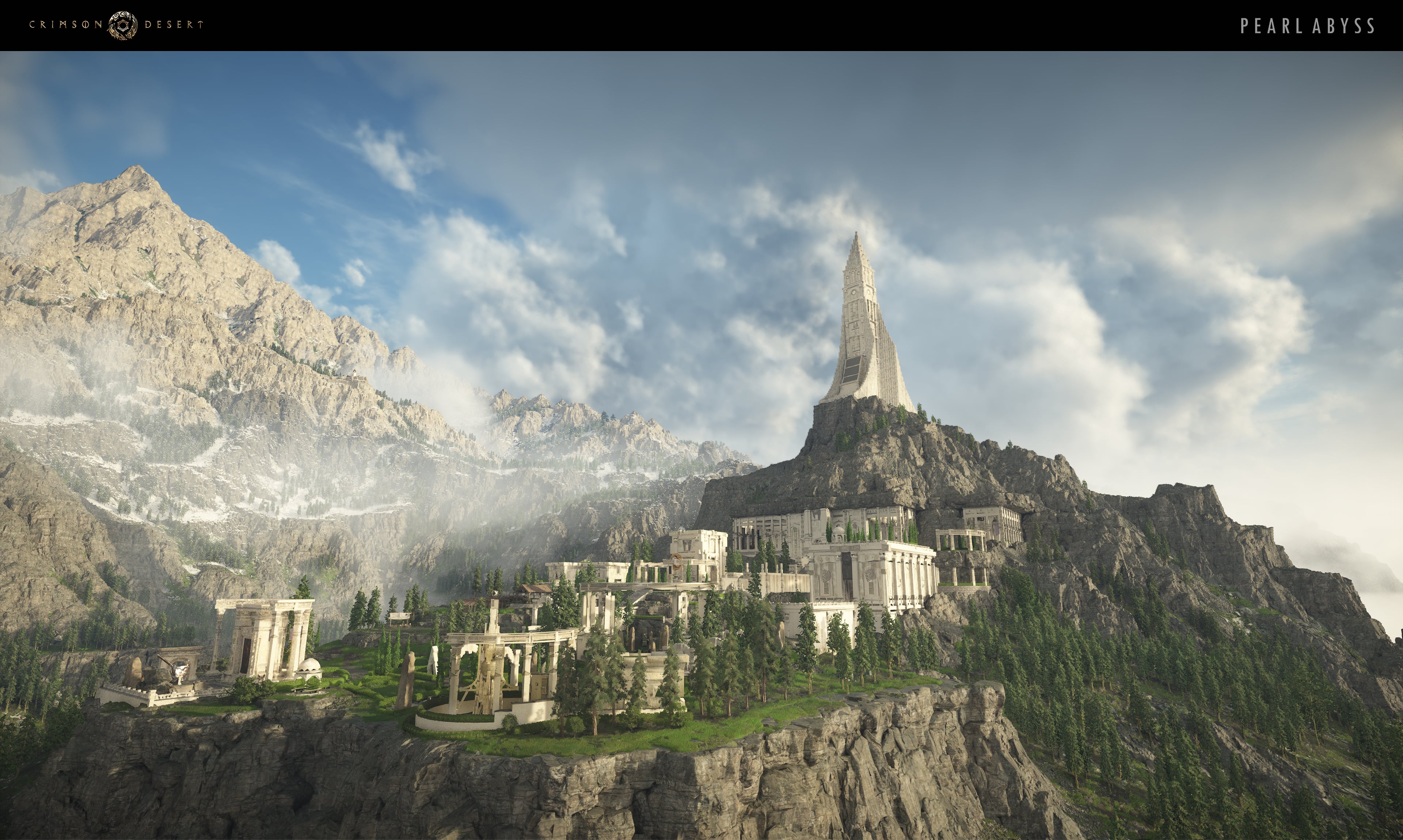
Hernand is the starting region; the earlier most-content-dense comparison is not an independently measured ranking. Its lands include rich mountains and rivers, covering the south-western portions of Pywel from the northern city of Calphade to the coastal village of Vellua. The landscape features green highlands, rugged terrain, open grasslands where wild horses graze, dense forests providing lumber and shelter, and rolling farmland.
Hernand is governed by a feudal system. It was once an independent kingdom, but after losing a war with Demeniss it was reduced to a duchy. The ducal house that governs Hernand are distant descendants of the wandering knight Canta, who bear the heavy responsibility of defending the duchy and protecting its people. The marquis' house of Calphade has for generations overseen the defense and governance of the Calphade region bordering Pailune on behalf of the Duchy of Hernand.
Key locations include Hernand Castle, where Kliff infiltrates using Hernandian Banquet Attire to access the Abyss. The Reed Devil terrorizes the citizens as the bogeyman called "The Devil of the Reed Fields." The city streets are populated by a mix of fantasy races including giants and antlered elf-like beings. Hernand is also home to the Greymane Camp, a settlement established by Kliff and his fellow Greymanes after losing their homeland to the Black Bears.
Climate: Earlier overview notes describe a temperate climate with mild seasons, farming, ranching, fishing, foraging, consistent forest rainfall and moderate year-round temperatures. Those year-round and seasonal regularities are not a verified weather schedule.
Pailune is the northernmost region of the continent and the ancestral homeland of the Greymanes, once unified under the great leader Gian. With Gian's death, the region has been plunged into chaos. The Greymanes were nearly wiped out in a single night by the Black Bears under Myurdin's command, and Pailune has fallen under Black Bears control. Rival factions in the area were either subjugated or driven out.
The region is defined by heavy snowfall, freezing temperatures, and treacherous mountain passes. Blizzards can reduce visibility to near zero, and the terrain forces players to navigate narrow paths between sheer cliffs. Despite the harsh conditions, Pailune holds its own beauty with snow-capped peaks, frozen lakes, and hardy alpine forests. Pailune liberation is part of the Chapter 7 storyline; that does not make the chapter a universal physical-entry gate. The bell walkthrough specifically places ringing the town bell after the Resolution mission. This region features the main story's central conflict as Kliff fights to reclaim the Greymanes' homeland.
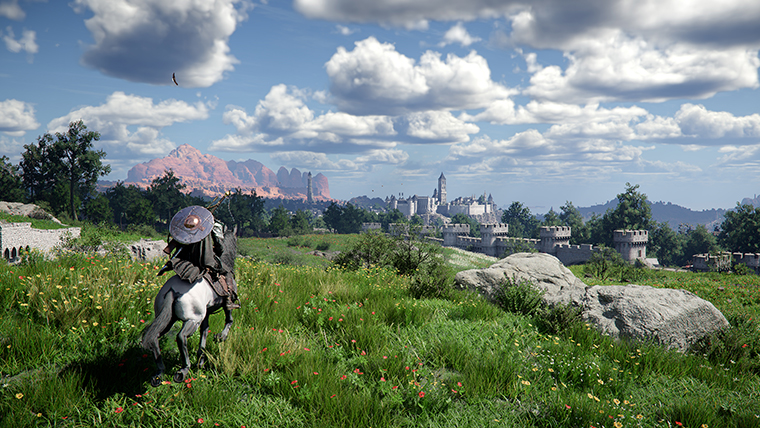
Climate: Earlier climate notes describe arctic or subarctic conditions, heavy snow, blizzards, freezing temperatures and reduced visibility. Cold exposure and regional story progression are separate mechanics; do not infer an exact universal Stamina drain or a region-entry gate from that description.
Demeniss is the political and military capital of Pywel. As the seat of imperial power, it features grand fortified cities, military installations, imposing castles, ancient temples, and sweeping golden plains. The King of Demeniss, known as the Unifier of Lands, once brought much of the continent under his banner through conquest. Now, with the king lying in a coma, the kingdom has fractured.
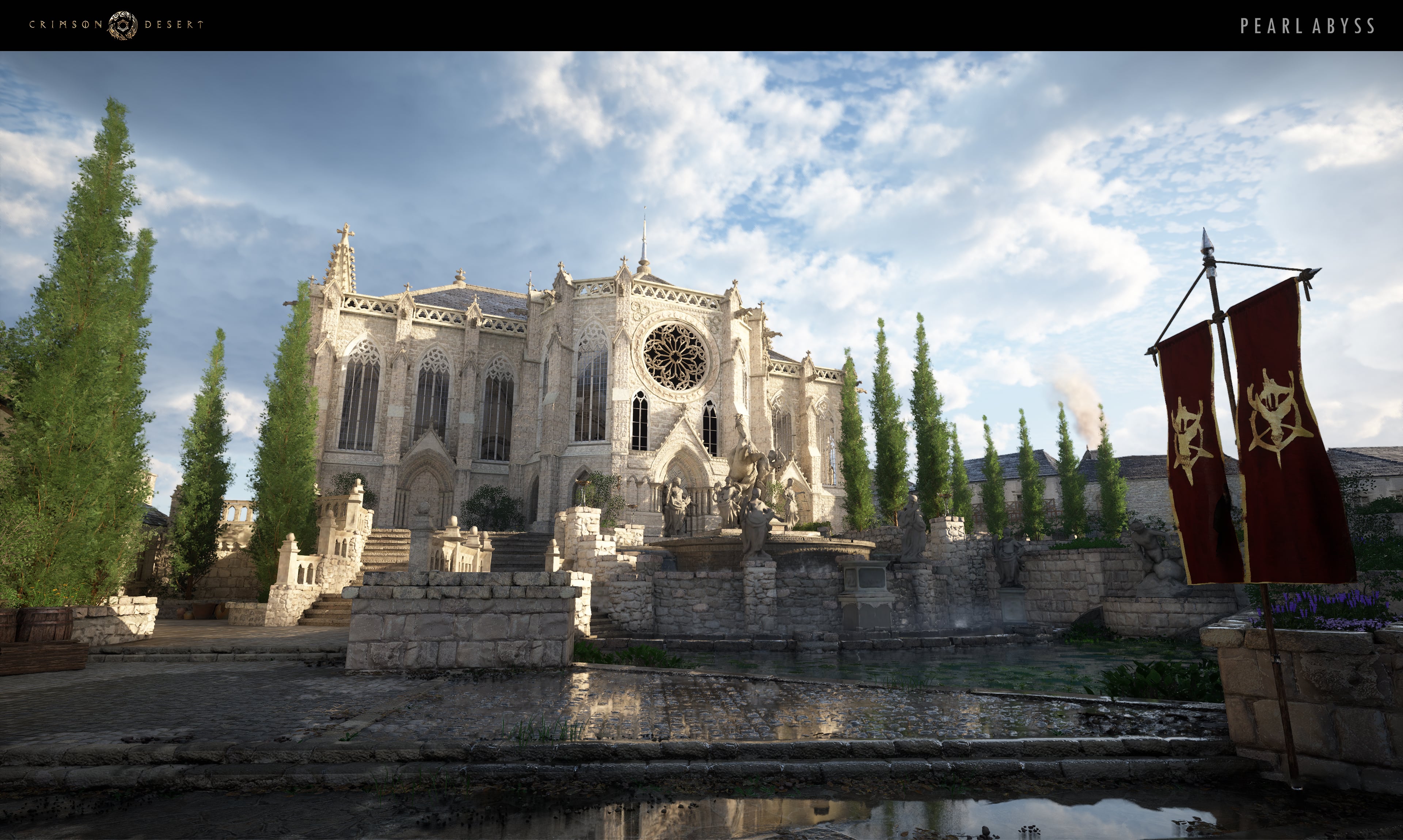
The power vacuum drives much of the game's central narrative in this region. Multiple noble houses compete for control, and players encounter these struggles through faction quests and the rumor system. Will Powers described Demeniss as the region where geopolitical tensions run highest. Siege-style battles, fortress assaults, and large-scale military engagements are common here. The House Azerian faction route includes Flame Knights, whose first mission, Letter of Silence, has objectives to defeat the castle enemies and Tristan and obtain the artifact. Its reward list includes the Seal of Devotion, used for hiring Contribution Workers. This is a specific mission reward, rather than a requirement to finish every House Azerian quest. The hiring guide uses regional Contribution Points for temporary workers assigned to activities.
Climate: Temperate continental. Broad golden plains, rolling hills, and fortified highlands. The climate is drier and more exposed than Hernand, with wide-open terrain suited to cavalry engagements and large-scale warfare.
Delesyia breaks from the rest of Pywel entirely. Will Powers described it on Save State Plus: "They've really adopted technology. So they have mechs, they have flying robots. This is not your typical fantasy. This is almost leaning a little bit more towards steampunk when you're in this region." Dwarven engineers have created combat mechs armed with machine guns, rockets, and EMP pulses. Flying battle robots patrol the skies, and the architecture looks nothing like the rest of the continent.
Delesyia is the wealthiest region in Pywel, owing to its strategically advantageous location as a trade crossroads. Merchants and travelers from across the world converge in Delesyia's markets, making it a hub of commerce and culture. Unlike Hernand's stone castles or Pailune's rugged camps, Delesyia features factories, workshops, mechanical structures, and industrial piping across its skyline. The inventor Marni's creations populate the entirety of the region, from autonomous patrol robots to the colossal mechanical dragon Golden Star. Earlier notes placed Delesyia fourth in a regional narrative sequence. That remains an unverified ordering shortcut, not a fixed fourth-region exploration requirement.
Climate: Temperate to warm. The region has a milder climate than Pailune or the Crimson Desert, with enough rainfall to support its industrial infrastructure and trade economy. Smog from factories occasionally hangs over the larger cities.
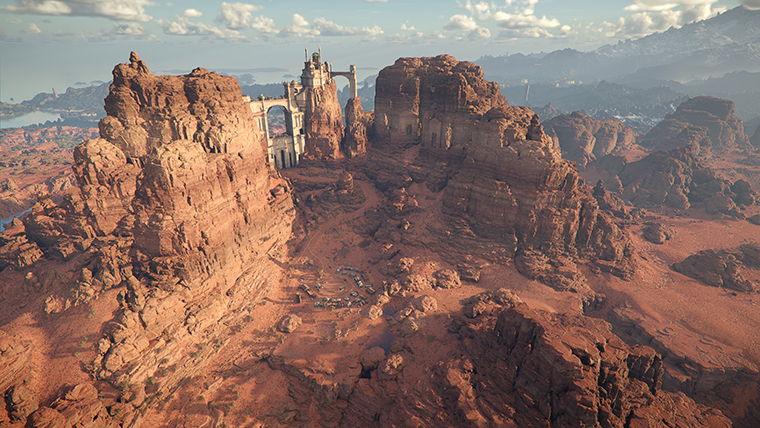
The Crimson Desert is the titular region: a vast expanse of crimson sands stretching across the eastern portion of the continent. Red-orange sand and towering rock formations contrast sharply with the frozen north and green heartlands. The regional faction account describes no unified nation claiming the whole desert. That does not mean every settlement lacks its own organization or authority: Varnia has religious institutions and the Redwind Merchant Guild operates trade routes. Multiple bandit groups and outlaw factions compete for control of territory and trade routes.
The region is divided into several named sub-areas, each with distinct terrain and points of interest. Towering ridges, barren wastelands, and extreme heat make it the harshest environment on Pywel. Despite its hostility, the desert holds a handful of settlements built around water sources that serve as supply points, quest hubs, and centers of commerce. The official description says the region demands "strength, cunning, and an iron will. Only the most resilient can endure the desert's merciless trials." The Crimson Desert is believed to hold the continent's deepest secrets.
Climate: Arid desert. Extreme heat during the day, sharp temperature drops at night. Sandstorms can reduce visibility and pose environmental hazards. Water is scarce, and the terrain itself is as much an enemy as any bandit.
High above Pywel float the Abyss Islands, a mysterious supernatural realm composed of floating landmasses suspended in an infinite void of deep violet and black. These islands are connected by luminous arcane bridges and chains of crystallized energy, with structures of impossible architecture: towers that spiral without logic and plazas where gravity shifts underfoot.
Surface gates lead to Abyss routes, while fast-travel activation depends on the actual Nexus or Cresset. The fast-travel guide distinguishes standing on a Nexus from completing a Cresset puzzle; it does not establish that every Trace is a portal. Abyss Artifacts are magical items associated with the Abyss. Earlier notes counted 141 Sealed Abyss Artifacts across the continent; that is an unverified earlier census, not an exhaustive current count. Completing island puzzles can provide additional Artifacts.
The Library of Providence, the Abyss's grandest structure, contains ancient texts offering lore revelations about Pywel's creation, the origins of the Crimson Desert itself, and the nature of the Abyss. The White Crow is a supernatural guide associated in earlier notes with the name Crow Wings. The skill guide records Kliff learning Flight after speaking to the Woman in White during Chapter 1: Traces. The earlier name and the table below should not be treated as a separate later chapter unlock.
Fragments of the Abyss are falling to the lands below, scattering dangerous power across Pywel. Dark forces seek to exploit these fragments, and restoring the Abyss's broken balance is central to the story.
The five regions and the Abyss create dramatic environmental variety across the continent. Each biome has its own weather patterns, wildlife, resources, and gameplay challenges.
Biome | Location | Description |
|---|---|---|
Green highlands and grasslands | Rolling fields where wild horses graze and farms dot the landscape | |
Dense forests | Thick woodlands providing lumber and shelter for wildlife | |
Frozen peaks and tundra | Snow-covered mountains, blizzards, and freezing conditions | |
Arid desert | Red sands, towering rock formations, extreme heat, and punishing sandstorms | |
Wide-open terrain suited to large-scale military engagements | ||
Medieval cities | Castles, fortifications, temples, and walled towns | |
Industrial zones | Steampunk architecture, workshops, factories, and mechanical infrastructure | |
Floating islands | Supernatural landmasses suspended in a void of violet and black, connected by arcane bridges |
The table summarizes earlier political background rather than tracking the player's current liberated territories. Earlier notes describe different regional systems and relationships ranging from truces to warfare; the specific government labels below are not all independently confirmed here.
Region | Government Type | Opening political background |
|---|---|---|
Feudal duchy | Reduced from kingdom after losing a war with Demeniss; governed by descendants of the knight Canta | |
Tribal / clan-based | Formerly held by the Greymanes; now occupied by the Black Bears under Myurdin | |
Imperial monarchy | King in a coma; power vacuum with rival noble houses vying for control | |
Earlier unverified label: mercantile republic | Wealthy trade hub governed by merchant guilds and industrial interests | |
Lawless / no government | No central authority; bandit groups and outlaw factions compete for territory |
The Knowledge System was described in older notes as recording over 110 factions, including noble houses, military organizations, mercenaries, outlaw groups and guilds. That remains an earlier count rather than a current census. Faction reputation determines how each region reacts to the player. At war with a faction, their guards attack on sight. Building relationships through quests and story progression opens regions up.
Travel modes have individual unlocks and restrictions. The older claim that every method works anywhere without transition screens is not a verified universal rule; check the relevant mount, skill and fast-travel conditions.
Method | Description |
|---|---|
On foot | Walking, running, climbing cliff faces, swimming |
Horseback | The primary travel method. Wild horses can be tamed or purchased. A horse sliding mechanic lets you power-slide around corners. |
Crow Wings | Earlier preview terminology for a gliding ability associated with the White Crow in the Abyss. The documented skill is Flight, learned by Kliff in Chapter 1: Traces; its old name does not establish another unlock. |
Mechs | Pilotable combat mechs in Delesyia, usable for both traversal and combat |
Flight above the continent on the back of a dragon mount | |
Traces of the Abyss are associated with exploration and fast-travel sites. Activate a Nexus by standing on it, or complete a Cresset puzzle. Earlier notes said The Crimson Desert had 13 Abyss Nexus nodes; that earlier subset is not independently confirmed as the complete current regional total. |
Pywel's technology level is primarily medieval, but new advancements are pushing into a new age. Pistols, cannons, and hand-mounted cannons have been invented, and players can use these firearms alongside traditional weapons. Alchemy allows practitioners to imbue weapons with additional abilities. The technological gap between regions is stark: Delesyia has combat mechs and flying robots while Pailune still relies on swords and shields. This variance creates political tension explored through faction quests.
Many of Pywel's quests revolve around factions, houses, and organizations. Some are grand: reclaiming fortresses, defeating formidable foes, shifting the balance of power. Others are quieter, asking you to help residents with everyday problems. The two most significant factions in the main story are the Greymanes, the player's mercenary company with deep roots in Pailune, and the Black Bears, the ruthless force led by Myurdin that destroyed the Greymanes and seized control of Pailune.
Beyond these two, earlier notes counted over 110 factions; that number is not a verified current total. Each region has its own faction ecosystem, from the noble houses of Demeniss competing for the throne to Hernand's feudal lords and Delesyia's merchant guilds. Faction reputation determines how regions react to the player, and building or burning relationships through quests and story choices has lasting consequences.
Pywel is full of knowledge waiting to be found. Information about inhabitants, wildlife, skills, items, and history can be acquired by talking to NPCs, exploring new areas, reading books, and observing from afar. Knowledge entries provide clues for quests, open paths to new skills, and reveal hidden opportunities. The older 2,921 figure and hundreds-of-hours completion estimate are not current measured totals or a guaranteed playtime.
Beyond combat and questing, Pywel has a full set of life skills: farming, fishing, logging, mining, ranching, cooking, alchemy, and smithing. You can fish in rivers, tend crops, carry pigs to pens, stir ingredients at camp cauldrons, and mine ore from rock faces. None are mandatory, but all provide tangible benefits that feed into crafting, camp upgrades, and character progression.
The Greymane Camp is a living hub that grows as you invest resources into its construction. Upgrading facilities at camp unlocks new vendors, crafting stations, training dummies, and quality-of-life improvements. The camp visually transforms as it develops. This reflects the player's investment in rebuilding the Greymanes.