Loading...
Loading...
Law System
March 16, 2026 at 03:14 AM
Add wikilinks to table cells (4 new links)
Crimson Desert has a law system that tracks criminal behavior across Pywel's towns and cities. Harmful actions toward residents and their property have real consequences, ranging from fines to imprisonment. Pearl Abyss has described the system as "another piece of the combat and progression puzzle" rather than a simple morality meter. Criminal behavior offers temporary strategic advantages but generates escalating risks.
Before committing crimes against NPCs, players must first equip a criminal mask. This mask serves as a gameplay gate: pickpocketing, attacking civilians, and other criminal actions are only available while wearing it. The mask must be acquired during gameplay, though the specific method of obtaining it has not been detailed. Removing the mask returns the player to normal NPC interactions.
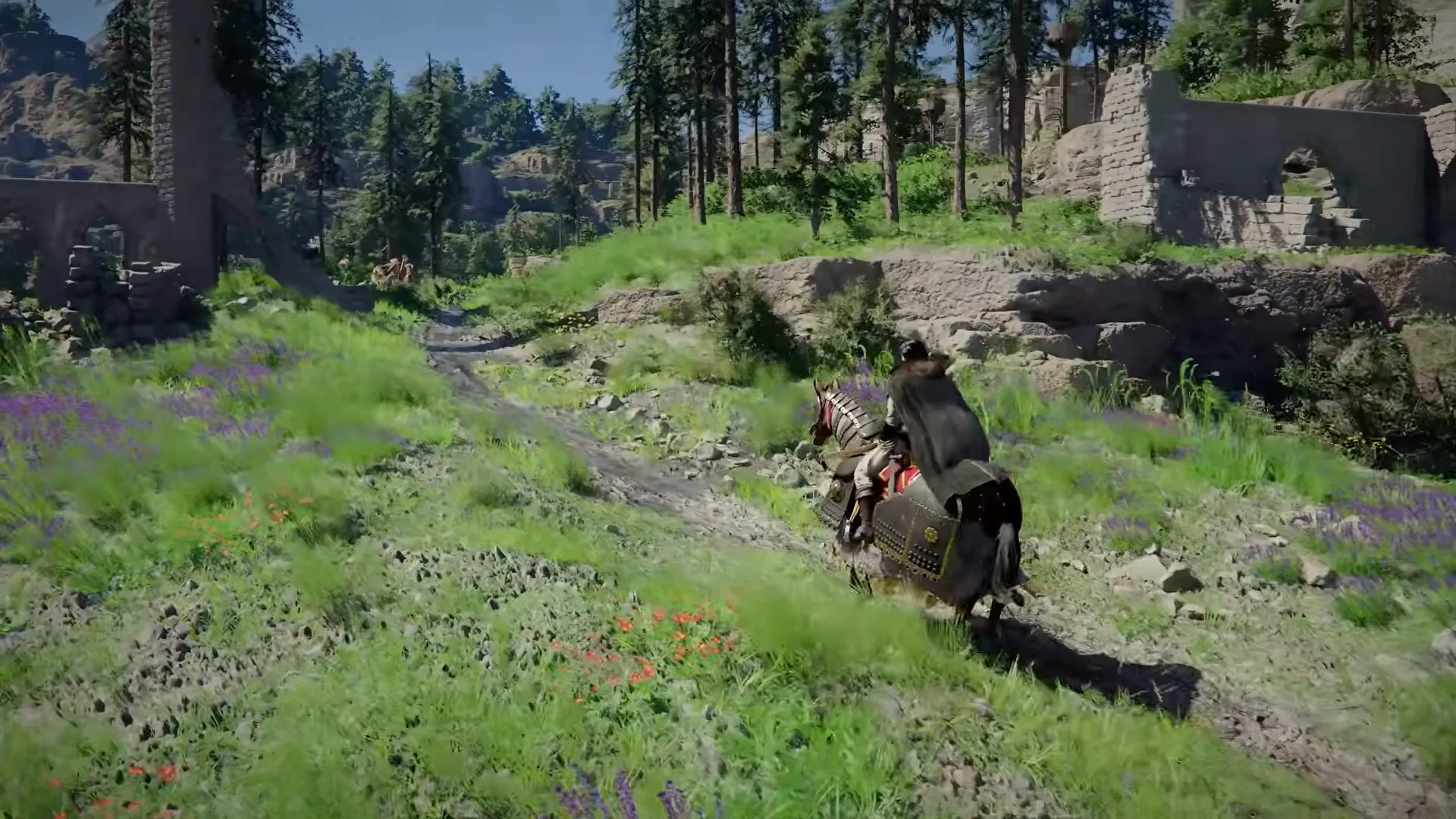
The following actions are recognized as crimes. Criminal activity escalates from petty theft through intimidation to full-fledged violence.
Crime | Description | Contribution Penalty |
|---|---|---|
Pickpocketing | Stealing directly from NPCs while wearing the criminal mask. Awards stolen goods such as coin pouches. | -5 Contribution EXP (minor) |
Theft | Stealing items from the world, including goods from vendor stalls. Even taking something as small as a piece of dropped fruit triggers a red "Crime: Theft" overlay on screen. | -5 Contribution EXP (minor) |
Threatening | A "Threaten" option exists under the NPC interaction menu, allowing players to intimidate NPCs for information or compliance. | Varies |
Bullying | An escalation step between petty theft and violence. Includes shoving and intimidation of civilians. | Moderate |
Assault | Attacking NPCs and civilians while wearing the criminal mask. Requires the mask to initiate. | -30 Contribution EXP (serious) |
Horse theft | Kicking someone off a carriage and stealing horses. Shown in pre-release footage as an available criminal action. | Moderate to serious |
The escalation path typically follows: pickpocketing and stealing, then bullying and intimidation, then full-fledged conflict. Each step increases the severity of guard response and reputation penalties.
Crimes reduce Hernandian Contribution, a reputation metric that tracks the player's standing with regional factions. The HUD displays two metrics: Contribution (current standing level) and Contribution EXP (progress toward the next tier). Penalties range from -5 Contribution EXP for minor offenses like petty theft to -30 Contribution EXP for serious crimes like assault.
Low Contribution in a region restricts NPC interactions and limits access to certain towns or services. Vendor prices increase, quest availability changes, and some NPCs refuse to deal with the player entirely. Positive actions like completing quests, paying alms, and helping NPCs rebuild the Contribution over time.
Committing a crime places a bounty on Kliff's head. A wanted poster appears on screen showing the character's face and the current bounty amount. The wanted posters are rendered as individual sheets with full paper physics when inspected. Repeated offenses raise the bounty value, making guards and residents progressively more aggressive.
A "Bounty Notice" marked "Arrested" appears in the top-right corner of the screen when crimes are committed. Bounty status persists until cleared through arrest, paying fines, or other means. While wanted, active bounty status affects NPC interactions and restricts access to certain towns and services.
When crimes are committed, guards and patrols become hostile. The system deliberately creates overwhelming opposition: players face dozens of enemies simultaneously when wanted, making escape difficult without serious preparation. Guards have sophisticated detection capabilities beyond standard vision cones, described in hands-on previews as possessing impressive awareness at range.
With a high enough bounty, an entire town can turn hostile. Both civilians and guards refuse to deal with the player, and guards actively attempt to arrest or fight the player. The number of guards that respond is deliberately overwhelming, so fighting through a wanted situation is rarely viable.
If guards take Kliff down, the player is arrested and placed in a wooden holding cell. Serving jail time clears the current bounty, though the player loses time in the process. Getting arrested is one of the primary ways to clear wanted status for players who cannot afford to pay fines. Specific details about sentence duration, inventory impact, and escape mechanics have not been fully detailed in pre-release coverage.
Several methods exist for dealing with an active bounty.
Method | Details |
|---|---|
Pay the fine | The simplest approach. Pay off the bounty to clear wanted status immediately. The amount depends on the severity of accumulated crimes. |
Serve jail time | Being arrested and serving time in a holding cell clears the bounty. You lose time but keep your progress. |
Leave the area | Leaving the affected region and returning later may allow the situation to cool down, though this is less reliable than paying or serving time. |
Unlike a simple morality system, Crimson Desert's crime mechanics can be used strategically. Pearl Abyss has confirmed that players can gain additional attack power based on negative notoriety. Specific gear pieces have attack bonuses tied to the player's wanted level, meaning that notoriety "can contribute to raising your damage if you have the right gear equipped."
The developers rejected a traditional good/bad path system. Instead, criminal behavior offers temporary combat advantages but generates escalating risks from guards, bounties, and restricted access. Pearl Abyss has confirmed that the main story is built around Kliff and the Greymanes as central figures. Since the Greymanes "aren't inherently villains," there is no long-term story impact from pursuing a criminal playstyle. When asked about a full evil playthrough, developer Will Powers commented: "Would I recommend a full playthrough in that playstyle? Eh, I don't know."
The game features full stealth mechanics with enemy vision cones visible on the minimap and silent takedowns. Stealth allows players to approach crime more carefully, though hands-on previews noted that guards proved difficult to avoid due to their detection range. Players can also hogtie and deliver captured criminals or enemies for bounty rewards, serving as bounty hunters themselves.
Players can participate in the law system from the other side by accepting bounties from wanted posters on notice boards in towns. Bounty hunting involves tracking down the target, knocking them out, and carrying them to a guard to turn them in. Finding a guard while carrying an unconscious bounty target can be tricky, adding a practical challenge to the process.
The villages and cities feel alive with NPCs reacting to unlawful behavior. Harmful actions against innocents turn residents and guards hostile, while accumulated criminal history affects how NPCs interact with the player over time. Notably, some NPCs can pickpocket the player as part of the living world simulation, turning the crime mechanic in both directions.
Save before experimenting with crime. The consequences are real and can lock you out of vendor access in a town you need.
Guards are numerous and tough. Trying to fight your way out of a wanted situation is rarely worth it unless you have specific notoriety-boosting gear.
The regional reputation hit from crimes affects vendor prices, quest availability, and NPC willingness to interact.
If you accidentally commit a crime, paying the fine immediately is usually the cheapest option before the bounty escalates.
Consider keeping notoriety-scaling gear in your inventory if you plan to use the crime system strategically for combat bonuses.
The game tracks several categories of criminal behavior. Each type adds to the player's bounty and reduces regional Contribution at different rates.
Offense | Description | Severity | Contribution Penalty |
|---|---|---|---|
Pickpocketing | Stealing items from NPC pockets or bags. Requires wearing a criminal mask. | Minor | minor penalty |
Theft | Taking dropped fruit from vendors, looting unattended goods, or stealing from market stalls. | Minor | minor penalty |
Bullying | Intimidating or harassing NPCs without direct combat. | Moderate | moderate penalty |
Assault | Attacking civilian NPCs or friendly characters. | Serious | significant penalty |
Murder | Killing civilian NPCs. | Severe | severe penalty |
When a crime occurs, a red "Crime: Theft" (or similar) notification appears on screen. Successful pickpocketing awards stolen goods like coin pouches.
Certain criminal activities like pickpocketing require the player to equip a criminal mask. The mask serves as a game mechanic that gates access to petty crime, preventing accidental activation. Wearing the mask signals criminal intent and unlocks the pickpocketing interaction prompt when near NPCs. Without the mask equipped, the option to pickpocket does not appear.
Each crime contributes to a cumulative bounty value displayed in the player's HUD. A "Bounty Notice" marker appears in the top-right corner of the screen. As the bounty increases, consequences escalate:
Bounty Level | Consequence |
|---|---|
Low | NPCs become wary. Some refuse to trade or offer services. Guards watch the player more closely. |
Medium | A wanted poster appears on-screen showing the player character's face and bounty amount. Guards actively patrol for the player. |
High | Guards become hostile on sight. Dozens of heavily armed guards converge simultaneously, making open combat extremely dangerous. |
The system is designed to discourage crime through overwhelming force rather than making it impossible. Pearl Abyss has noted that players face dozens of enemies at once when wanted, making escape difficult without careful preparation.
Getting caught by guards or losing a fight against law enforcement results in arrest. Kliff is placed in a wooden holding cell. The imprisonment mechanic serves as the primary punishment for criminal behavior, along with any bounty gold that must be paid as a fine. After release, the player's bounty is reduced.
Criminal behavior causes the player's Hernandian Contribution reputation to drop in the affected region. Lower Contribution means reduced access to regional benefits like vendor discounts, faction services, and NPC interactions. Positive actions (completing quests, helping NPCs, paying alms) increase Contribution, but rebuilding it after criminal activity takes time and effort.
Beyond guards, civilian NPCs in the affected area become hostile or fearful. Quest-givers may refuse to interact with a wanted player, merchants may close their shops, and townspeople may flee or alert guards. An entire town can become hostile based on criminal actions. This social consequence makes extended crime sprees increasingly impractical as the player loses access to essential services.
In an interesting twist, Will Powers confirmed during a Dropped Frames podcast interview that certain gear can boost attack power based on the player's wanted level. Players could strategically raise their bounty before a tough boss fight to spike their damage output. However, Powers cautioned against sustaining an "evil playthrough," stating: "Would I recommend a full playthrough in that playstyle? Eh, I don't know." The crime system is designed more as a reactive consequence framework than as an alternative playstyle.
The crime system works in reverse as well. Notice boards in settlements display wanted posters for criminals and bandits. Players can accept these bounty contracts and track down targets in the open world. Fugitives may attempt to flee, requiring the player to chase and tackle them.
After defeating a target, players can hogtie them and physically carry or transport the bound prisoner back to town authorities for bounty rewards. This creates a gameplay loop where the player acts as a bounty hunter, earning currency and reputation by clearing the world of criminal NPCs.
The game recognizes several categories of criminal behavior. These were demonstrated in the Features Overview #3: Life in Pywel trailer, which showed Kliff pickpocketing NPCs, stealing vendor goods, and escalating to violence.
Crime | Description | Severity | Contribution Penalty |
|---|---|---|---|
Pickpocketing | Stealing items directly from NPC residents. Triggers a "Crime - Theft" notification on screen. | Low | ~-5 Contribution EXP |
Vendor Theft | Taking items from vendor stalls, such as fruit from a food stand | Low | ~-5 Contribution EXP |
Bullying NPCs | Intimidating or pushing civilians without lethal force | Medium | Moderate penalty |
Assaulting Townspeople | Engaging in open combat with non-hostile NPCs | High | ~-30 Contribution EXP |
Attacking Guards | Fighting law enforcement or military patrols directly | Very High | ~-30 Contribution EXP |
Each criminal action adds to a running bounty value tracked in the UI. The more severe the crime, the larger the bounty increase. Repeated offenses in a short period cause the bounty to rise rapidly.
Interestingly, NPCs can also pickpocket the player, suggesting a two-way interaction where the streets of Pywel's settlements are not entirely safe even for the protagonist.
As the bounty value increases, the system creates a visible Wanted Poster that displays the player character's face along with the current bounty amount. This poster appears on-screen as both a gameplay indicator and a narrative touch, reinforcing that Kliff's criminal behavior is noticed and documented by the communities he moves through.
The bounty operates on a sliding scale rather than a simple toggle between "wanted" and "not wanted." Different thresholds trigger different levels of response from the world. A small bounty from a single act of theft might result in wary NPCs and the occasional patrol keeping an eye on the player. A large bounty accumulated through sustained violence will turn entire settlements hostile.
Once the bounty exceeds certain thresholds, guards and military patrols become actively hostile. They pursue Kliff on sight, engaging in combat to subdue or arrest him. The response scales with the bounty level:
At lower wanted levels, guards may issue warnings or attempt to detain the player
At higher levels, guards attack with lethal intent and call for reinforcements
Players face dozens of enemies simultaneously when wanted, making escape difficult without preparation
Bounty hunters appear and actively pursue the player across the region
Townsfolk, residents, and guards all become aggressive toward the player
Guards are not omniscient. The system appears to use line-of-sight and proximity detection, meaning players can potentially evade pursuit by breaking line of sight and putting distance between themselves and their pursuers. However, returning to the scene of a recent crime while the bounty is still active immediately re-engages the authorities.
Depending on the severity of committed crimes, players may need to pay fines to resolve their wanted status. Red94 reported that players may need to "fight their way out of the city, pay large fines, or even serve time in prison," indicating that fines are one of several options for dealing with criminal consequences.
One of the most significant long-term consequences of criminal activity is the loss of regional faction contribution. Criminal actions reduce Contribution and Contribution EXP for the regional faction (e.g., "Hernandian Contribution"), with penalties ranging from -5 for minor offenses to -30 for serious crimes. This same Contribution currency is earned through the liberation system and positive faction engagement, meaning criminal behavior directly undermines liberation progress.
Losing faction contribution means losing access to location-specific benefits:
Vendor discounts and merchant access in the affected region
Access to certain NPC services and quest lines
Resource nodes tied to that faction's territory
Deeper faction relationships and story branches
A player who has built up favorable standing through quests and liberation can see that progress eroded by a crime spree in the same region.
In a distinctive risk-reward design, certain gear provides an ATK+ bonus based on the player's Wanted level. Will Powers (Pearl Abyss Director of Marketing) confirmed this mechanic during the Dropped Frames podcast interview: players can "make evil decisions and be rewarded for those playstyles with additional attack level based on your negative notoriety."
The strategic implication is significant: players may want to intentionally raise their notoriety to gain a spike in power before challenging a tough boss. This creates a calculated trade-off between the increased attack power and the consequences of being wanted: hostile guards, bounty hunters, faction contribution loss, and restricted access to settlement services.
The specific gear pieces that provide this notoriety-scaling ATK bonus have not been detailed in pre-launch materials. The exact scaling formula (how much ATK per notoriety level) is also unknown.
The bounty persists until cleared through one of several methods:
Method | Description |
|---|---|
Arrest and Imprisonment | Getting caught by guards results in a brief jail sequence; bounty resets after serving time |
Paying Fines | Depending on crime severity, players can pay monetary fines to clear their status |
Other Methods | Additional bounty clearance options exist but have not been fully detailed in pre-launch materials |
The system is designed to ensure that players cannot simply wait out their wanted status without consequence. The bounty remains active until actively resolved.
System | Interaction |
|---|---|
Criminal behavior reduces the same Contribution currency earned through liberation, directly undermining territorial progress | |
Faction Standing | Each region has its own faction contribution tracker; crime in one region does not affect standing in others |
Resources obtained through theft may not offset the lost benefits of good regional standing | |
Factions do not affect the main story ending, meaning criminal behavior has no narrative consequence beyond side content |
Will Powers (Pearl Abyss Director of Marketing) acknowledged that the system allows for an "evil playthrough" where the player commits crimes freely. However, he commented: "Would I recommend a full playthrough in that playstyle? Eh, I don't know." This suggests that while the system supports full criminal agency, the accumulated penalties make a purely villainous approach significantly more challenging than a balanced or lawful playstyle.
Multiple outlets have compared the system to Red Dead Redemption 2's crime and bounty mechanics, though Pearl Abyss has not explicitly made this comparison. The game is "not Grand Theft Auto" in terms of lawless freedom; the wanted system is designed as one component of a broader world that rewards engagement over destruction.
Petty crimes like pickpocketing can provide quick resources but risk compounding bounties if guards notice
Attacking guards dramatically escalates the wanted level, making escape much harder
Regional reputation loss can lock players out of vendor discounts and NPC quest lines
The notoriety ATK bonus creates a legitimate reason to maintain wanted status before tough boss fights
Imprisonment clears the bounty but costs time
Fines offer a monetary alternative to jail for resolving criminal status
Crime in one region does not affect standing in other regions, allowing targeted criminal activity
The system interacts with the liberation system, as both share the faction Contribution currency
Topic | Connection |
|---|---|
Shares the faction Contribution currency with the wanted system | |
Guards and bounty hunters engage in full combat when pursuing wanted players | |
Greymane Camp | Camp management interacts with resources obtained through criminal means |
Settlements discovered through exploration become crime-capable locations | |
Stolen materials can potentially be used in crafting |