

Multiplayer and Co-Op
Group play in the live build: six player parties, twelve player raids, uncapped world bosses, orders and clubs, the oath system with its September 2026 matchmaking and tasks, cross-server chat, and a first class solo mode with AI teammates. Includes how account progression carries across devices.
On This Page
Overview
Lord of Mysteries is a true MMORPG: maps are shared among players on the same shard, and most mid to late game content depends on parties of friends, AI companions or matchmade strangers. The game sets that expectation early, with the introductory sequence in Tingen grouping the player at least twice, including one cooperative anomaly investigation.
The studio's own framing is that the content types are not exclusive: "PVP, PVE, PVX, these are not three options. You can sink into a side story and cry today, take it out on a guild battlefield tomorrow, and invite three friends to a raid the day after."
Party Play
Standard party size is six players, built around one tank, one healer and four damage or hybrid roles. AI companions can fill any empty slot. Public matchmaking runs through a looking for group panel that surfaces parties already in progress, parties forming for a specific objective, and AI fill options for players who do not want to wait.
Parties share quest objectives, treasure rolls and ability synergies, and Pathway interplay is mechanically meaningful. A Seer's ranged control sets up a Spectator's mental damage on the same target; a Bard's purification unlocks ground the party could not otherwise hold while a Warrior holds the front. Mixed Pathway compositions outperform identical Pathway stacks.
Holy Trinity Composition
Instanced content uses the classic three role structure. Each of the six launch Pathways carries a primary role.
Role | Pathway | Secondary capability |
|---|---|---|
Tank | Melee greatsword damage and scene obstacle destruction | |
Healer | Mental damage, dream weaving and crowd control | |
Melee damage and support | Purification for the party and a brief purification effect granted to allies | |
Melee damage, mobility | Portal based repositioning and burst | |
Ranged damage and control | Divination that marks wrong answers at puzzle gates | |
Ranged damage and control | Detection that reveals hidden runes, footprints and paths |
Pathway choice at character creation is therefore also a role choice. See Pathway Roles for the full breakdown.
Raids and World Bosses
Raid size is twelve players, running one main tank, one off tank, two healers and eight damage or hybrid roles, on a Normal, Hard and Nightmare ladder. The named launch raid is May Manor: Garden at level 63. See Dungeons and Raids for the instance roster.
World bosses sit outside that structure. They are open world encounters with no fixed party cap: anyone in the zone can join and rewards go to contributors. They have been run with over a hundred players engaging the same target while performance held. Because they are not instanced, they act as a rally point for a whole server and as one of the cap tier targets alongside twelve player raids.
Orders, Clubs and Divination Clubs
Two group layers unlock in sequence. An 教团 (Order) is joinable at level 19 and is the first organisational tier; ranking one to level 2 grants a limited time exclusive appearance. A 俱乐部 (Club) is joinable at level 28 and is the competitive body, running a daily contribution task, a daily brawl and the league that feeds the Strategy Server.
Player guilds are styled in game as Divination Clubs in homage to the Tarot Club. Each has a hall, a member roster cap, a shared ritual chamber and a bank, and leaders assign Tarot deck codenames to members. Codenames are aesthetic but unlock specific role bonuses inside guild rituals.
Duo and Pair Play
Group content ships at four scales: solo, duo, party dungeon and thousand player guild warfare. The duo tier has its own systems, including a 誓约 (pledge) bond and shared mount riding.
A friendship based oath system (誓约), described in coverage as the game's marriage system, sits on top of that. Reporting from official previews describes an oath formed at 1,000 friendship points, a launch limited Seven Day Oath event that automatically matches registered players, couple photographs, shared progression rewards, a conversion path from the limited oath to a standard one, and paid dissolution rules. The system itself and the September 2026 additions below are documented first party. As of September 27, 2026, the 1,000 point threshold, the Seven Day Oath matching event, the shared progression rewards, the conversion path and the dissolution rules still come only from that preview reporting, so treat those specifics as reported.
Oath Changes in the September 2026 Update
The studio's update notice published on September 16, 2026, for the version that went live the next day, describes three additions to the oath.
Addition | What it does |
|---|---|
祈誓 (oath matchmaking) | Players who have unlocked the oath can upload a personal oath profile. A divination from the 祈誓 screen then recommends a highly matched player of the opposite sex. Each player can divine up to 20 times a day. |
Oath moment animation | Partners who form an oath after the update see an animation of their own oath moment. Pairs who were already bound can replay it by speaking to 萨默尔太太 in the flower field. |
Oath tasks | Eight new shared tasks, each completed while in a party with your oath partner (listed below). |
Calm (安魂) each other once.
Complete a charm (魅惑) with each other once.
Take a photo together in the same scene.
Ride together for 30 seconds.
Perform together once in the Art School (艺术学派).
Perform a two-person social emote once.
Solve a world puzzle together once.
Play one match of Fool's Chessboard together.
Connections
Alongside real players, the Connections system (人脉) populates the game with historical projections of past era characters that the player collects and interacts with daily through strolls, invitations and dances. It is a progression and social system in its own right rather than a multiplayer feature, and it is documented on its own page.
The September 17, 2026 update added Klein Moretti to Connections affinity, so players who obtain him can take him on strolls, invitations and dances. It also lets players invite a Connection at affinity level 4 onto their personal display stand, sharing the slot limit with invited friends. The mechanics are on the Connections page.
Shared Activities Added in September 2026
Beyond the oath, the September 17, 2026 update touched several activities that are played with or for other people.
Activity | What changed |
|---|---|
Ritual Offering (秘仪奉献) | Helping another player complete their Ritual Offering now pays the helper a reward. |
Art School (艺术学派) | A new co-performance mode lets several players perform together in the same troupe. |
Fool's Chessboard (愚者棋局) | A new eight-player auto-battler. Solo and party queues are both allowed, but a party of six or more earns no win points from a match. |
竞技之约 custom rooms | From level 39, create or join cross-server PvP rooms for five modes, from 1v1 duels to the 240-player Four Way League (四方联赛). See Faction Warfare and PvP. |
New instances | The Tree of Abundance (丰饶之树) six-player dungeon opened on September 18, 2026. The Emperor's Second Advent (大帝重临) twelve-player raid is scheduled to open on October 2, 2026. See Dungeons and Raids. |
Club member list | You can invite a club member to your party, or ask to join theirs, straight from the member list. |
Solo Play
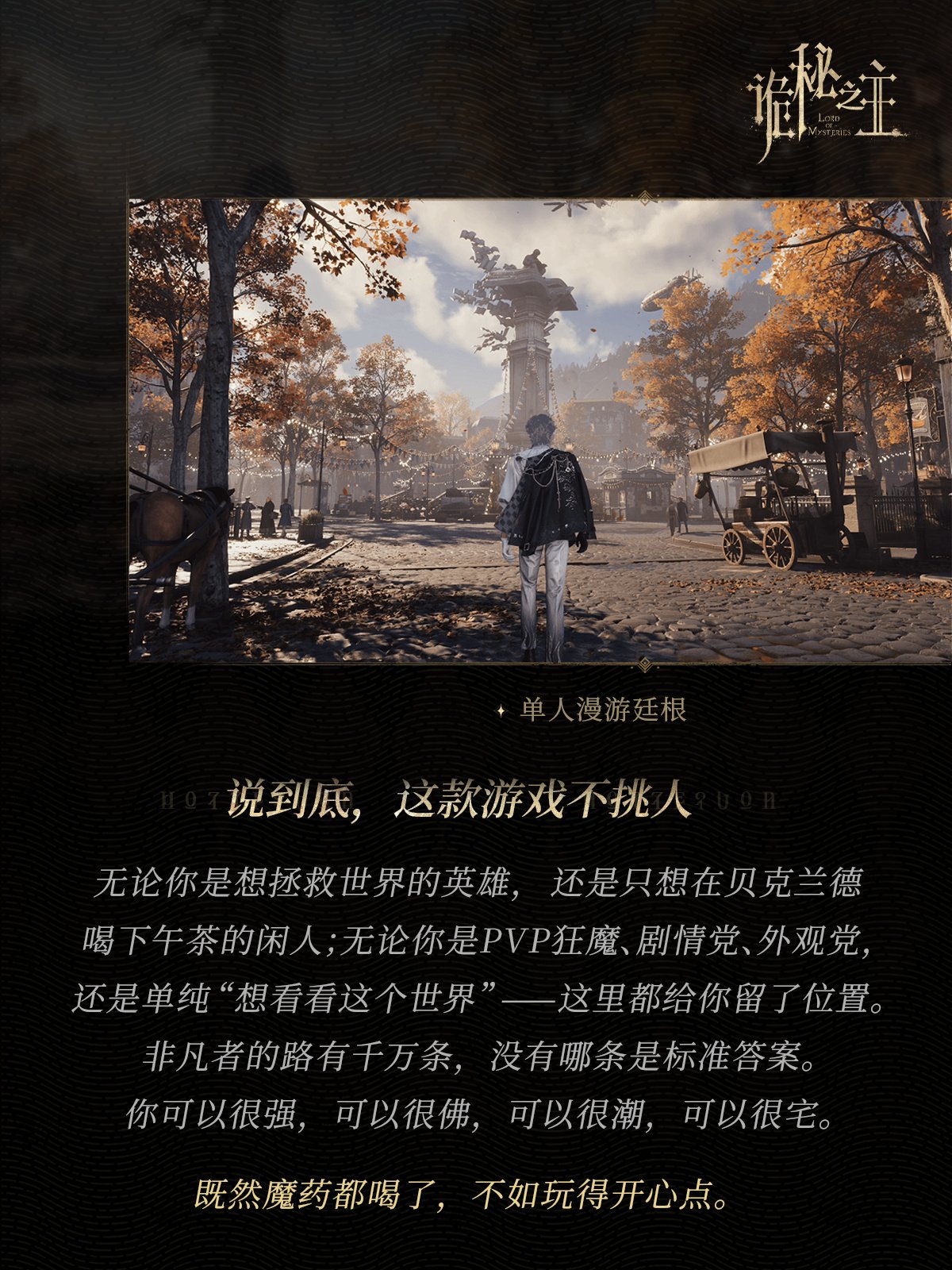
Solo play is a first class studio positioned playstyle, not a stripped fallback. The complete main campaign, every story scene and every story locked location can be experienced without sharing the world with other human players. A single toggle hides every other player from the local render, so traffic in Tingen's streets becomes NPC only and the rendered crowd drops to the cast the campaign needs.
Inside solo play the trinity is preserved through AI teammates, which can fill tank, healer and damage slots for every instanced encounter the campaign surfaces. The studio has described an AI backed NPC friend system that lets solo players reach activities that would normally need a group. AI companions follow the same priority rules described above and are competent through Normal tier content; Hard and Nightmare instances remain available but reward human party scaling more strongly.
The studio's own framing is that solo play supports the complete storyline with AI teammates accompanying the player throughout, and that one click hides all other players so the player can immerse themselves in their own world. It is the recommended path for players arriving from single player roleplaying games who want the story, the Acting Method loop and sanity discipline at their own pace.
Public Anomalies
Open world anomalies surface dynamically and any nearby player can join. Larger ones need multiple parties and pay shared loot to all participants, which encourages spontaneous cooperation. Anomaly density is tuned per district and per time of day.
Voice and Chat
In game voice rooms (语音房) were named by the studio among the systems live on launch day. Party voice chat is opt in and cross party voice exists for raid groups. Text chat supports global, district, party, raid, guild and direct message channels, with region specific moderation on each server cluster.
The September 17, 2026 update added two chat channels: a cross-server channel for talking with players on other servers, and a battlefield faction channel that, in some modes, reaches every player on your faction in the current scene.
Playing Across Devices
This is the point the wiki previously got half right in two directions at once, so it is worth stating precisely. There are two separate account systems, and they behave differently.
Account type | Platforms | Progression sharing |
|---|---|---|
Official account | PC, Android, iOS and HarmonyOS | Full sharing across all four platforms: the same account on any device with synced progress |
Third party channel account | Android and PC packages downloaded through that channel | Shares progress only between those two, and does not interoperate with the official account system at all |
So cross device progression is real, but it is a property of the account you registered with rather than a blanket platform feature. An official account started on PC continues on a phone; a channel account cannot move to the official client. Performance scaling adapts the rendering load to the device, and a cloud gaming route also exists for the Chinese service. See CN vs Global and Release and Platforms for the platform detail.
Thousand player same screen combat runs on mobile as well as PC. The studio has said plainly that when the project started, nobody thought running a thousand players on one screen in Unreal Engine 5 on a phone would work.
Historical: Multiplayer in the Closed Tests
The Crimson Test of February 2026 was PC only, so cross device play was not exercised in it. The Gray Fog Test in June and July 2026 was the first cross platform test and the first to run world boss fights with over a hundred players at once. Neither test's data carried into the launch client.