Loading...
Loading...
Development History
April 11, 2026 at 02:00 PM
Expand development history with studio background, beta timeline, launch announcement, and technology decisions
The development of Neverness to Everness represents Hotta Studio's second major project following the global release of Tower of Fantasy in 2022. As a subsidiary of Perfect World Games, Hotta Studio applied lessons learned from their debut title to create an ambitious supernatural urban open-world action RPG built on Unreal Engine 5.
Hotta Studio was formed as a subsidiary of Perfect World Games, one of China's largest game publishers. The studio's first major release was Tower of Fantasy, an open-world action RPG that launched globally in August 2022. Tower of Fantasy achieved significant commercial success, establishing Hotta Studio as a competitive developer in the live-service gacha space.
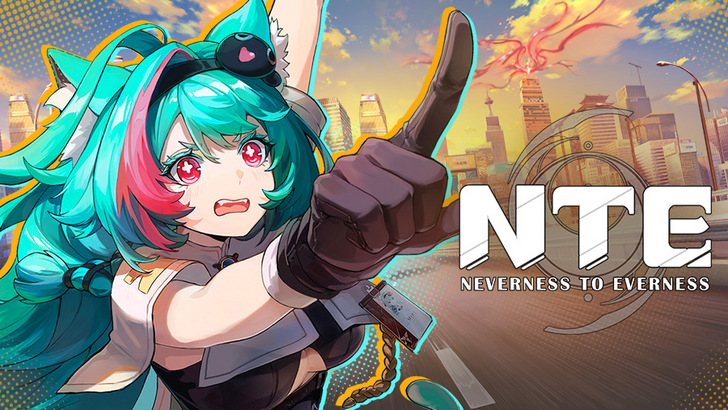
Drawing on their experience with Tower of Fantasy's open-world systems, combat design, and live-service operations, Hotta Studio began developing Neverness to Everness as a more ambitious follow-up. The new project shifted from a fantasy setting to a modern urban environment, representing a significant creative departure.
Neverness to Everness was first revealed to the public through initial teaser materials and promotional announcements. The game's supernatural urban setting and action RPG gameplay immediately drew comparisons to other open-world gacha titles, but the modern city environment set it apart from the fantasy and sci-fi settings common in the genre.
Early development focused on building the city of Hethereau as a believable metropolitan environment. The team prioritized density and interactivity, filling the city with reactive NPCs, drivable vehicles, public transit systems, and a wide variety of shops and landmarks. The decision to use Unreal Engine 5 gave the team access to advanced rendering features including Lumen global illumination and hardware ray tracing.
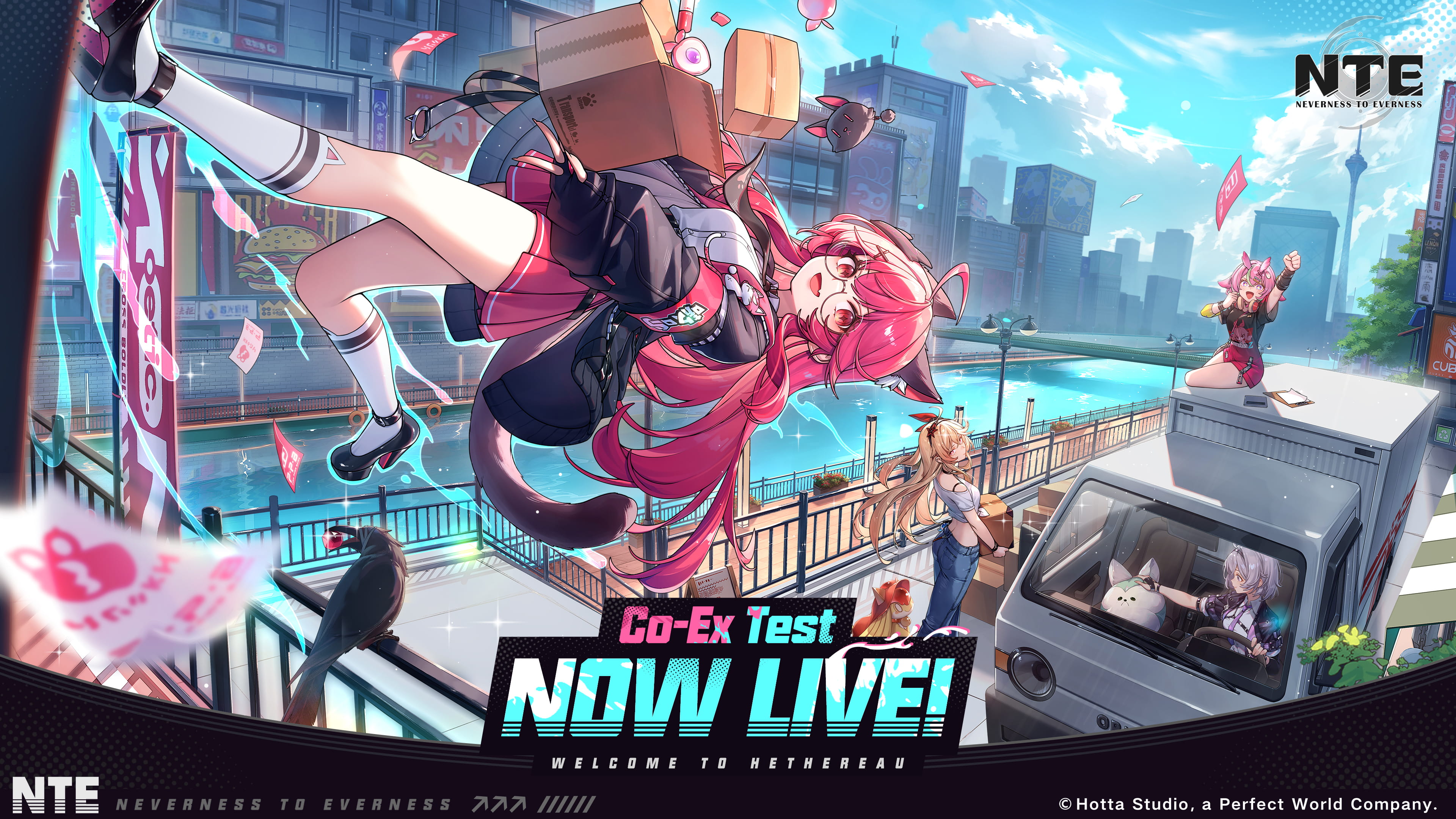
The game went through three rounds of beta testing between November 2024 and February 2026. The first closed beta in November 2024 was China-exclusive, the Containment Test in July 2025 brought the game to global audiences for the first time, and the Co-Ex Test in February 2026 served as the final pre-launch test across PC, PS5, and mobile.
Neverness to Everness had a significant presence at Gamescom 2025 in Cologne, Germany. The event marked the official confirmation of the PlayStation 5 release, expanding the game beyond its initially announced PC and mobile platforms. Hotta Studio showcased a dedicated trailer called "Hethereau Exclusive Feature" that highlighted the game's ray tracing and path tracing capabilities, powered by NVIDIA GeForce RTX 50 Series GPUs.
The Gamescom booth featured a Racing Championship event where attendees could experience the game's vehicle mechanics firsthand. The presentation demonstrated the studio's confidence in the game's graphical fidelity and the breadth of its gameplay systems.
At TGS 2025, Hotta Studio presented a new gameplay trailer that prominently featured the game's racing mechanics. The Tokyo Game Show appearance helped build awareness in the Japanese market, an important audience for gacha-based games.
On February 26, 2026, Hotta Studio officially announced the global launch date of April 29, 2026. The announcement confirmed that the game would release simultaneously across all supported platforms: PC (Windows and Mac), PlayStation 5, iOS, and Android. The simultaneous global launch, rather than a staggered regional rollout, reflected the publisher's commitment to a unified international player base.
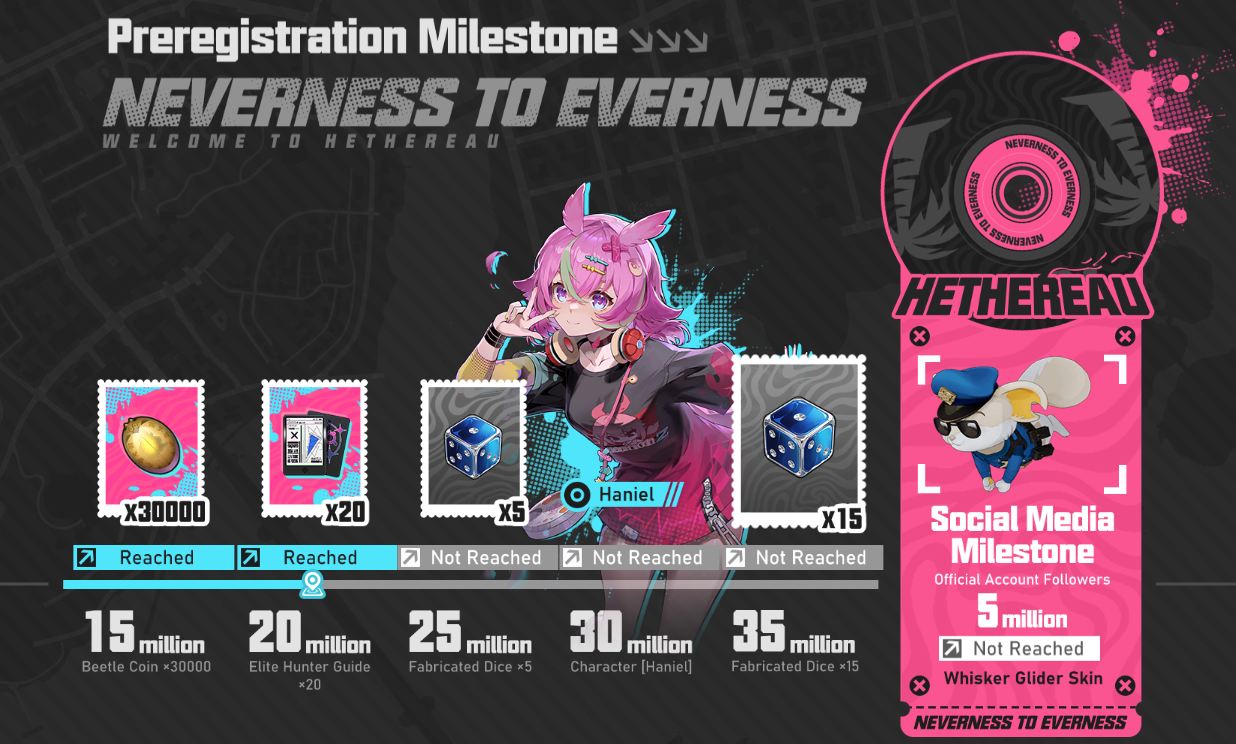
The pre-registration campaign for Neverness to Everness proved remarkably successful, surpassing 30 million registrations by late February 2026. This figure placed it among the most anticipated free-to-play game launches. The campaign offered escalating milestone rewards, culminating in a free A-Class character (Haniel) at the 30 million mark.
Date | Event |
|---|---|
2022 | Tower of Fantasy launches globally, establishing Hotta Studio |
2023-2024 | Neverness to Everness in active development; early reveals and teasers |
November 2024 | CBT1 launches in China; first public hands-on |
July 2025 | Containment Test (CBT2); first global beta with parry system and expanded map |
August 2025 | Gamescom 2025: PS5 confirmed, ray tracing showcase, Racing Championship booth |
September 2025 | TGS 2025: new gameplay trailer featuring racing mechanics |
February 6-20, 2026 | Co-Ex Test (CBT3); final global beta with multiplayer focus |
February 26, 2026 | Global launch date announced as April 29, 2026 |
Late February 2026 | Pre-registrations surpass 25 million |
April 29, 2026 | Global launch on PC, PS5, iOS, Android, and Mac |
Hotta Studio was founded in November 2018 in Suzhou, China as a subsidiary of Perfect World Games. Perfect World is one of the longest-running publishers in Chinese gaming, with a catalogue spanning MMORPGs, mobile titles, and international licensing deals. Hotta was set up as a dedicated console-and-PC studio focused on open-world action games with live-service ambitions, a direction that pulled the parent company away from its traditional MMORPG roots and closer to the global gacha market.
The studio's debut project was Tower of Fantasy, which launched in mainland China on December 16, 2021 and received a global release on August 11, 2022. Tower of Fantasy was built on Unreal Engine 4 and established the core pillars that Hotta would later refine for Neverness to Everness: a seamless open world, action combat with character-swap mechanics, online co-op, and a gacha-driven progression economy. The game shipped on PC, iOS, and Android, with a PlayStation port following later in its lifecycle.
Tower of Fantasy gave the team production experience with a live-service release on multiple storefronts, and it also exposed the pain points that a follow-up project would have to solve: engine limitations on mobile, rendering ceilings on Unreal Engine 4, and a fantasy setting that looked increasingly crowded next to competing titles. The lessons from that first project shaped the more technically ambitious direction of Neverness to Everness.
Hotta Studio first teased its second project publicly in 2023, presenting Neverness to Everness as a supernatural urban open-world action RPG set in a modern city. The shift from Tower of Fantasy's science-fantasy planet to a contemporary metropolis with hidden paranormal elements was the clearest creative break from the studio's debut. Early promotional materials emphasised the density of the city, reactive pedestrians, drivable vehicles, and a soft horror undertone that later became the Hypervortex narrative thread.
Through 2023 and 2024 the project was shown in short trailers, character reveals, and developer diaries rather than extended gameplay demonstrations. The game was confirmed to be running on Unreal Engine 5, a significant jump from Tower of Fantasy's Unreal Engine 4 base and the technical foundation that would later enable the Lumen lighting and hardware ray tracing features demonstrated at Gamescom.
The project went through multiple rounds of beta testing before launch, each one progressively larger in scope, platform coverage, and region. The table below summarises the public test phases in chronological order.
Test Phase | Window | Region / Platforms | Focus |
|---|---|---|---|
CBT1 (China-only closed beta) | Late 2024 | Mainland China, PC | First public hands-on; early combat, Hethereau city fragment, baseline character roster |
Containment Test (CBT2) | July 3 to July 16, 2025 | Global, PC and mobile | First international beta; expanded map, new parry mechanics, revised progression tuning |
February 6 to February 20, 2026 | Global, PC, PS5, iOS, Android | Final pre-launch test; first public cross-platform play build, multiplayer focus, near-final content |
Each beta served a distinct purpose. CBT1 validated the core loop with a domestic audience. The Containment Test stress-tested the servers outside China for the first time and gathered feedback on combat feel, with the parry system being one of the headline additions between CBT1 and CBT2. The Co-Ex Test was the first beta to run on every target platform simultaneously, making it the real dress rehearsal for the global launch.
On June 25, 2025, Hotta Studio released Hypervortex: Before the Storm, an animated short that serves as the official opening cinematic for the game. The release was timed roughly one week before the Containment Test opened on July 3, positioning the animation as a narrative primer for the beta audience. It introduces the paranormal Hypervortex phenomenon, the looming threat that reframes the otherwise ordinary streets of Hethereau as a city where something very strange is bleeding through.
The animation was produced in a hand-drawn anime style that contrasts with the 3D Unreal Engine 5 in-game visuals, a deliberate marketing move that let the studio front-load atmosphere and character introductions without spoiling systems still being polished for the upcoming tests.
On February 26, 2026, six days after the Co-Ex Test closed, Hotta Studio confirmed the global launch date. Neverness to Everness would release worldwide on April 29, 2026, on PC, PlayStation 5, iOS, Android, and Mac, with cross-platform play and cross-progression supported on day one. The announcement was coordinated across the game's official website, social channels, and partner publications, and it was paired with the final pre-launch trailer.
The launch communication emphasised that the release would be simultaneous across every supported platform, which is unusual for a live-service title of this scope. Pre-registration numbers had already been tracked publicly through the beta windows; in the days following the announcement, Hotta reported that global pre-registrations crossed the 25 million mark, triggering the highest reward tier on the pre-registration milestone chart.
Alongside the date reveal, Hotta Studio published a detailed launch roadmap covering the run-up to April 29, 2026 and the first post-launch content windows. The roadmap broke the timeline into three blocks: the March build lock and marketing ramp, the early April pre-download and final QA pass, and the week-of-launch events including creator previews and influencer embargo lifts.
Post-launch, the roadmap committed to a regular content cadence built around character banners, story chapters, and seasonal events, following the pattern established by Tower of Fantasy but with a faster update rhythm aimed at matching the current generation of gacha action RPGs. Specific post-launch character reveals beyond version 1.0 were not pinned to exact dates in the public roadmap and are tracked separately on the release date and launch article.
One of the defining engineering challenges for the project was delivering a single build of the game that could run credibly on high-end PCs, the PlayStation 5, iOS, Android, and Mac. The platforms list is considerably wider than Tower of Fantasy's launch footprint, and supporting every target required substantial work on the renderer, input handling, and account infrastructure.
On PC, the team targeted the full feature set of Unreal Engine 5, including Lumen global illumination and hardware ray tracing. On the PlayStation 5, the studio worked directly with Sony on platform certification and controller support, a first for Hotta. The mobile versions use an adaptive rendering path that scales shader quality, draw distance, and crowd density based on device class, while keeping the gameplay code identical to the PC and console builds so that cross-platform play and account sync stay consistent.
The inclusion of a native Mac build was announced as part of the final platform lineup. Mac support makes Neverness to Everness one of the few large-scale gacha action RPGs to ship day one on Apple silicon, and the team confirmed the Mac build would share the same account, progression, and matchmaking pool as every other platform.
Tower of Fantasy's influence on Neverness to Everness is visible across almost every system. The character-swap combat rhythm, the stamina-driven traversal, the banner-based gacha economy, and the emphasis on cooperative world activities all carry forward from the 2022 game. At the same time, the follow-up has consciously reworked several areas where the debut was criticised, most notably open-world density, the pacing of story content, and the look of the city environments.
The jump from Unreal Engine 4 to Unreal Engine 5 is the clearest technical marker of that generational step. Where Tower of Fantasy's world tended to favour open vistas and low-detail interiors, Hethereau leans into street-level density, reactive NPCs, interior spaces, and a much higher volume of readable signage and props. The supernatural urban setting is also a deliberate move away from the sci-fi fantasy aesthetic of the first game, giving the studio a clean canvas for a new art direction and a new cast of characters.
Hotta Studio: developer profile and studio history.
Perfect World: parent company overview.
Beta Test History: full breakdown of every closed beta.
Co-Ex Test: the final pre-launch global beta in February 2026.
Hypervortex: Before the Storm: official opening animation released June 25, 2025.
Launch Roadmap: the official pre- and post-launch content roadmap.
Release Date and Launch: launch day details and post-launch plans.
Unreal Engine 5: the rendering technology powering the game.
Platforms: full list of supported platforms.
Cross-Platform Play: how accounts and matchmaking work across devices.
Mac Support: native Mac build details.
Neverness to Everness: main game overview article.