Loading...
Loading...
Eshmel
September 23, 2026 at 07:21 AM
Added the prologue's character creator options, the Purifying Flash Blaze Art name, prologue replay details and Eshmel's role in Parts II and III
Eshmel is the player-created avatar of Fire Emblem: Fortune's Weave and, in Nintendo's own narration during the game's dedicated presentation, the story's true protagonist. Eshmel is the default name and the player may change it. The role is officially called the Savior, and two titles attach to the character in Nintendo's own material: the Promised One and the Herald of the Pale Raven. The story opens in 1454 of the Dagdan Calendar, with Dagda collapsing under the revived demon god Balor and the four Heroes of the Heroic Games vanished. The progenitor god Sothis calls down a single soul to confront the situation, and that soul is Eshmel.
Eshmel is not one of the four Heroes. Cai, Dietrich, Theodora and Leda each lead a route set five years earlier; Eshmel leads the prologue and the present-day thread, and travels into the past with the goddess of fate Fortuna to change what happened to them.
Field | Detail |
|---|---|
Default name | Eshmel (the player may rename them) |
Role | The Savior |
Titles | Promised One, Herald of the Pale Raven |
Age | Unknown |
Homeland | The Forbidden Land |
Starting class | Reported as Guardian |
Blaze type | Celestial Wells |
Faction | |
Route | None of the four animal routes; Eshmel carries the prologue and the present-day chapters |
Personal weapon | The Nameless, a spear |
Appearance | Chosen by the player: body type, skin tone, hairstyle, hair colour and name |
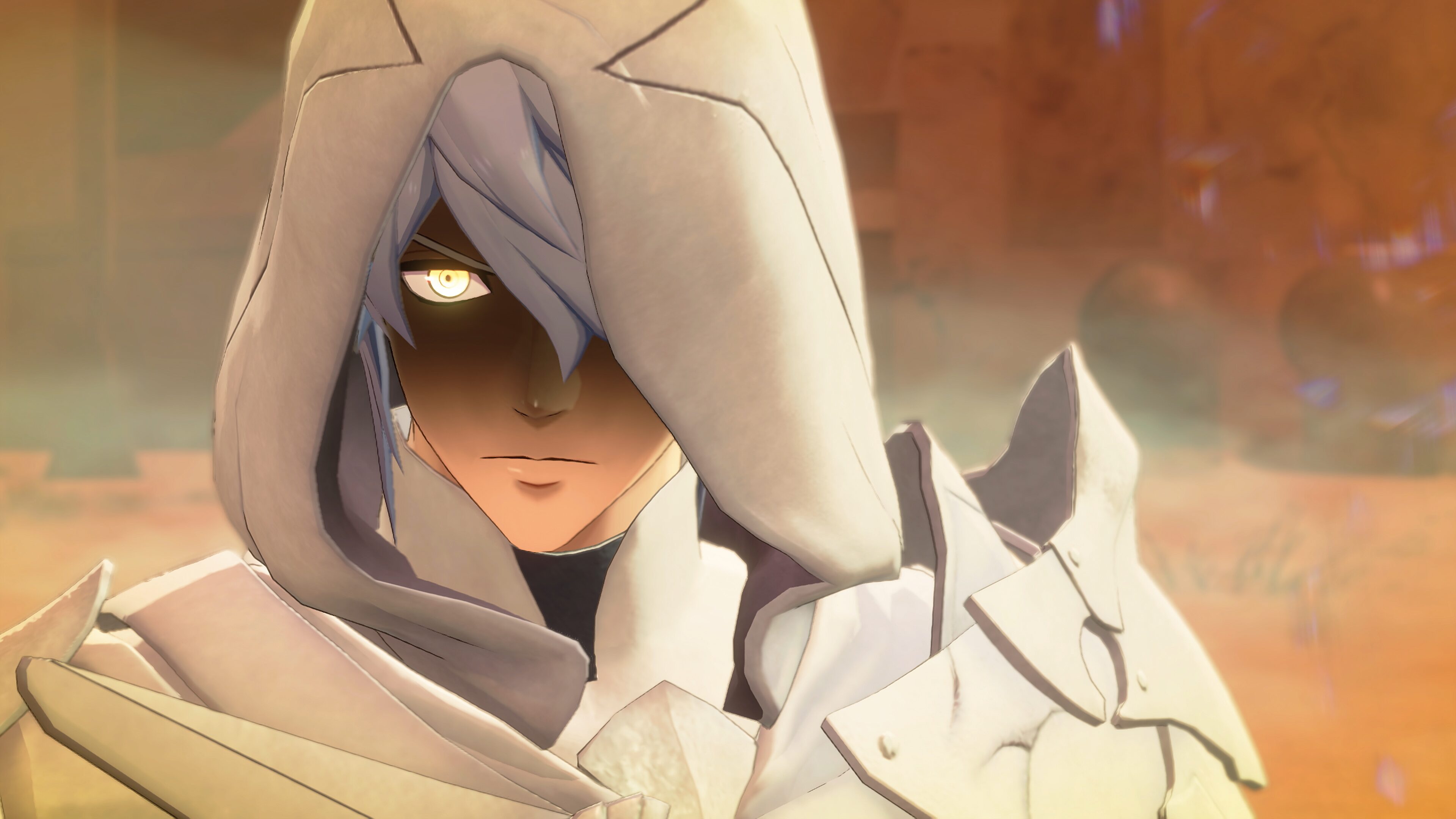
Both forms are fully voiced, with a separate cast for each. See Voice Cast for the wider roster.
Form | English | Japanese |
|---|---|---|
Male Eshmel | Joshua Waters | Yoshitsugu Matsuoka |
Female Eshmel | Virginia Lee | Marina Inoue |
The player picks Eshmel's body type, skin tone, hairstyle, hair colour and name. One hands-on account counts the options as two body types, twelve skin tones, four hairstyles, sixteen hair colours and five outfits, which is a preview reading rather than a published figure. The character is built during the opening chapter, and the same accounts describe the customisation sequence as part of the story rather than a menu bolted on before it: Fortuna states that Eshmel has already died and that only the heart remains, and the sequence is framed as giving that heart a new body.
The retail prologue confirms the shape of it. After choosing Normal or Hard difficulty and the Casual or Classic setting, the player picks a Type A (male) or Type B (female) form, then sets skin tone, hairstyle, hair colour and one of five outfits, and can change the name. Fortuna then asks how the player feels about insects, and the answer switches an arachnophobia option on or off; it can be changed later in the settings.
That framing matches the rest of the prologue, which is openly science-fictional. Preview coverage of the opening describes a post-apocalyptic landscape under a synthesiser-led score, giant laser batteries defending a holdout, an ally putting down a risen corpse with close-range gunshots, and Eshmel's new body being grown in a tube. A separate character profile refers to "the person who prepared Eshmel's body", which is how Troy is drawn into the Promised One's Army.
Official profile material describes Eshmel as a being created in a place known as the Forbidden Land in order to bring light back to the world, possessing a strange body unlike that of a human and immense power. Nintendo's English blurb reads: "A true hero born to shed light upon the world. Similar to the Herald of the Pale Raven mentioned in a poem long ago. Travels to the past with Fortuna, Goddess of Fayte, at the behest of the progenitor god Sothis to gather allies and defeat the demon god Balor." The Herald of the Pale Raven is therefore a comparison drawn in-world, out of an old poem, rather than a rank Eshmel is handed.
Preview coverage puts a category on that description. Eshmel's soul was placed inside the body of a Mediator, which hands-on accounts describe as a genetically engineered servant of the gods. Anatolia's own profile calls her a Mediator too, and Troy is a possible third case. That gloss comes from preview coverage rather than from published profile copy, so Mediator reads as a term the game uses rather than one it has explained.
Sothis is the one who wakes Eshmel and sends them down to Dagda, and she frames it as a chance to make amends: "I woke you up this once so you can make amends." As of September 2026, this wiki has not documented what Eshmel is meant to atone for. Hong Hua's profile states that she guided someone to Fortuna in the Forbidden Land and helped bring about Eshmel's creation, and that she carries a crime of her own.
In 1454, five years after the Games, Dagda faces its end and the four Heroes have vanished. Eshmel is given two explicit choices: face Balor's forces alone, knowing it is no easy task, or use Fortuna's time-travelling powers to change the fates of the four Heroes. Allies recruited in the past strengthen the forces Eshmel commands in the present. Nintendo's store copy calls the result a time-travelling saga, and the four Hero stories are described as key to it. See Story and Plot Structure and Routes for how the branches fit together.
Fortuna's line in the reveal footage sets the terms plainly: "We'll never win the battles ahead without them. We need as many as we can recruit." Two survivors of ruined Dagsion are pulled out of 1454 in the prologue itself, Hong Hua and Troy, and both join the Promised One's Army.
Inside a Hero's route the player controls that Hero, not Eshmel. Preview accounts describe Eshmel's presence in the past as usually taking the form of the white bird, with direct intervention reserved for key moments. Progress is tracked per Hero, so all four stories can be run in parallel.
Eshmel transforms into the Pale Raven. The Pale Raven's Perch is introduced in the Direct as "a spot where a mysterious white bird rests its wings", and it is where the player swaps to a different Hero. That white bird is Eshmel.
The Perch is also a conversation venue. Preview accounts describe characters interacting with Eshmel in bird form once per week, a Feed Pale Raven mini-game played entirely in bird-like responses, a Notable Deeds board that awards karma shards for achievements, and Boons of Salvation, which spends those shards on experience and proficiency bonuses that carry across all four routes. See Between-Match Preparation for the wider weekly loop.
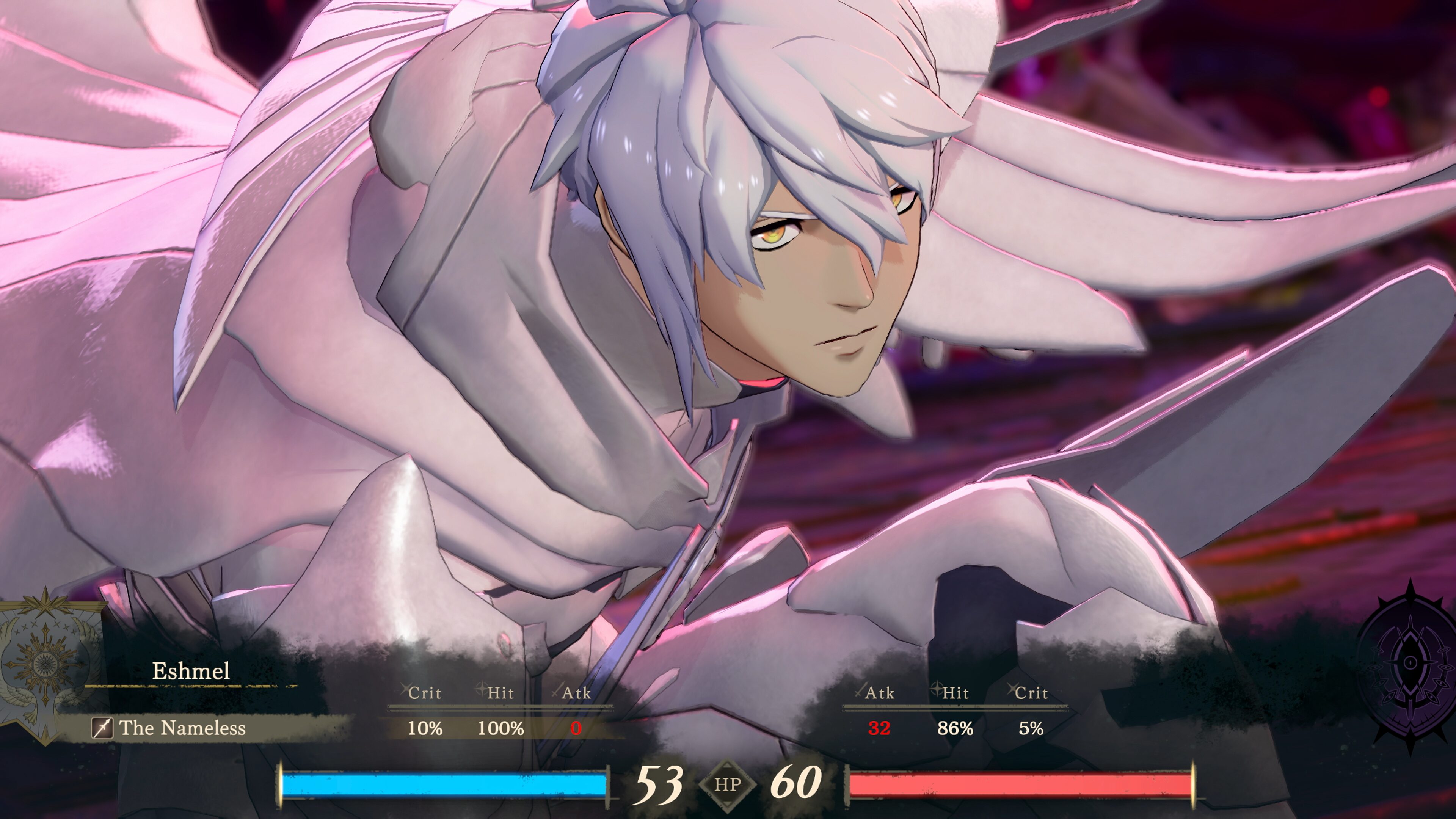
Eshmel fights with a spear, the Nameless, flagged in the weapon data as usable by Eshmel alone. Its flavour text explains the name: it is a spear that has lost its original power and its name. Preview footage shows it reassembling during a Blaze Art into the shape of the spear held by the statue of Solel. Class listings give Eshmel's starting class as Guardian, an Advanced-tier class the Direct describes as skilled with both spears and White Magic; see Classes.
Like the four Heroes, Eshmel has a Blaze Art, the class of special move the Direct introduces as consuming your soul in exchange for power. Hands-on accounts put its cost at 11 HP. It strikes up to five targets in a cross shape centred anywhere within three range, deals slightly increased damage, and is effective against undead. Those figures come from preview play rather than published data, so treat them as provisional.
The prologue's tutorial battle names Eshmel's Blaze Art Purifying Flash and prompts the player to use it against enemies standing in cross formations, which matches the cross-shaped area described above. The same tutorial explains that Blaze Arts are special Combat Arts only certain characters can use, and that they cost HP.
Eshmel's Blaze gauge is a named type rather than the standard meter. Eshmel and Anatolia both use Celestial Wells, and it inverts the usual rule: ordinary attacks raise the gauge, while using cursed weapons or items lowers it, where the standard gauge is filled by cursed gear. Previewers describe it as a four-pointed star inside a ring, rendered in a gentle blue, against the plain circular meter the four Heroes carry.
What filling it does is the same either way: a helpful boost up to the halfway mark, and a Burst at the top that ends the bonuses and halves the unit's maximum HP. Orchel uses a third type, Automata, which fills only from Blaze Arts and ignores cursed gear entirely.
Eshmel bears a Crest, reported in preview footage as the Crest of Noa, which the game also gives a Dagdan name rendered as the Diadem of the Auger. As of September 2026, no Crest effect has been published for this game, so nothing is written here about what it does.
The rewind power itself, Fortuna's Blessing, is granted to Eshmel by Fortuna as part of the mission into the past, and it is the in-fiction explanation for turning back time after a mistake in battle.
Eshmel stays out of the Heroes' matches in Part I but becomes central later. In the fifth chapter of Part II, Divine Emperor Dagda, the boss is effectively invulnerable until Eshmel appears in an event to disable his shield. In Part III every battle is lost if Eshmel falls, and Eshmel does not join one of the squads that move on the world map; instead Eshmel can join any battle while staying in Dagsion.
Two systems pay off there. Feeding the Pale Raven once per in-game week raises a character's Support with Eshmel, and that Support takes effect in Part III. After Credna's temple is repaired in Part III, Credna can upgrade Eshmel's spear from the Nameless Spear to the Shining Spear.
The English narration in the dedicated presentation never speaks the name. It calls the character "a single soul" and "the story's true protagonist", and addresses the player as "you". The name Eshmel comes from official character profiles, in-game menus and Nintendo's own video metadata, where it sits alongside Cai, Dietrich, Theodora, Leda, Sothis, Fortuna and Dagda as a tag on the August 2026 presentation. The Japanese name is イシュマール, and the localised forms include 이스마르 in Korean and 伊修瑪爾 in Traditional Chinese.
Eshmel's listed likes are small unnamed flowers, ambitious people, people of great talent, and things that exceed their expectations. The profile also notes an interest in board games.
Replaying the prologue from the Obelisk Chamber lets the player change the difficulty, the Casual or Classic setting and Eshmel's appearance without losing progress on any path, at the cost of playing the two prologue battles again. Preview coverage called the option Descend Again. On a Clear Save, replaying the prologue also unlocks two extra scenes that add to what is known about Fortuna's plan. One preview reports that Eshmel has no personal skill.
Eshmel was not in the design from the start. The four Heroes came first, and the development team has said the character was added halfway through development, as a figure who could take a broad view of all four of them at once. The same account describes the project beginning with eight story perspectives and cutting down to four, on the grounds that eight risked making the game feel complicated.
Two published accounts frame the role differently, and this page does not choose between them. One presents Eshmel as the story's true hero, positioned above the four campaigns and overseeing them. The other presents Eshmel as a fifth protagonist and as the character the player begins the game as. The same two accounts also attach the remark about cutting eight perspectives down to four to different speakers. The substance is consistent across both; the framing and the attribution are not, so both readings are recorded here and neither is stated as settled.
For the god who wakes Eshmel and sends them down to Dagda, see Sothis, and for the goddess who carries them into the past and grants the rewind, see Fortuna. Routes sets out the four branches Eshmel travels into without leading any of them, and The Nameless covers the spear the weapon data flags for Eshmel alone.