
Loading...
Loading...
Kuku Pot
April 12, 2026 at 10:39 AM
Add shared storage with Enhanced Kuku Pot, three crafting branches, and material sourcing
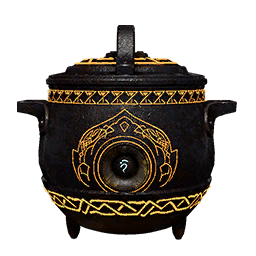
The Kuku Pot is a craftable collectible in Crimson Desert. It is a ceramic container that can be displayed as a decoration at the Greymane Camp or given as a gift to NPCs to raise their trust level. The pot is tied to the lore of Grimnir, the engineer at the Kilnden Workshop in the Hernand region, who restored an ancient Kuku Pot from nothing but a fragment of a memory image.
The Kuku Pot requires a crafting manual to unlock. Once the manual is in your possession, the recipe becomes available:
Material | Quantity | Source |
|---|---|---|
5 | ||
5 |
The pot is crafted at a smithy or workshop station. The crafting manual for the Kuku Pot appears in the special items section of the crafting manual list. Look for it in vendor shops or as a reward from quests connected to Grimnir and the Kilnden Workshop quest line.
Place the Kuku Pot in the Greymane Camp to add it to your home area. Collectible decorations contribute to the visual customization of your camp, and some NPCs react positively when the camp is furnished with particular items.
The Kuku Pot can be given to various NPCs as a trust gift. Gifting raises the NPC's trust level, which can unlock new dialogue, side quests, and discounts at vendor shops. Because the crafting materials are relatively common, the Kuku Pot is a cost-effective gift option in the early game.
The Kuku Pot is connected to Grimnir, a brilliant but arrogant engineer who operates the Kilnden Workshop in the Hernand region. Grimnir wears a visione, a rare device in the region, and is known for his restoration work on ancient artifacts. His most notable achievement was successfully restoring an original Kuku Pot using only a memory fragment as reference. The pot's design originates from an older civilization, and Grimnir's recreation makes it available for the player to craft as well.
Iron Ore and Timber are both abundant in the Hernand starting area, so you can craft multiple Kuku Pots early on without much effort.
Keep a few Kuku Pots in your inventory as cheap NPC gifts. They are lighter on material costs than most other craftable collectibles.
Visit the Kilnden Workshop main quest to learn more about Grimnir and the history behind this item.
The Kuku Pot is obtained during Chapter 4: The Price of Knowledge as part of the Mysterious Pot main quest. Travel to the Kilnden Workshop, located west of Hernand, where the dwarf Grimnir tasks you with repairing a furnace and three kilns before he hands over the pot.
The quest requires solving a furnace alignment puzzle and repairing three separate kilns. Each repair tests a different game mechanic.
The furnace has three rotating rows of runes. Move the dial to the left, middle, or right position and pull the lever to rotate each row. The goal is to align every rune with the golden reference rune at the bottom. Listen for a click sound that confirms correct alignment. When all rows match, every rune glows blue and the furnace activates.
The first kiln has disconnected pipes on its left side. Reconnect the pipe, then activate the yellow levers to restore power. This is the most straightforward of the three repairs.
The second kiln is broken into three pieces. Use the Axiom Force ability (L3) to lift each piece near the kiln, then rotate it to fit into the damaged section. Once all pieces are positioned correctly, jump above the structure and perform an aerial Force Palm strike to fuse the parts together.
The third kiln requires five electrified fuel orbs scattered around the workshop. Their locations are:
Two orbs on the ground directly in front of the kiln, near clay jars
One orb below the kiln near a pond
One orb inside a stone bird statue's eye socket in the pond
One orb in a small cave along the pond's shoreline
Use Axiom Force to lift each orb and deposit it into one of the five open sockets on the kiln.
After all three kilns are repaired, return to Grimnir and pull the yellow lever at the stone pillar to receive the Kuku Pot.
The Kuku Pot provides 230 dedicated storage slots for Abyss-type objects, machine parts, and contraptions. It cannot hold regular items such as weapons, armor, food, or recipes. To store an object, use Axiom Force on a valid target (large metallic orbs, power cores, etc.). If the "Seal" action prompt appears, the item can be sealed into the pot. To retrieve a stored item, examine the Kuku Pot in your inventory and select "Discard" on the item you want to release.
The Kuku Pot serves as the foundation for the ATAG mech system. When a Kuku Pot is used to build a Small Kuku ATAG, any objects stored inside carry over into the mech's internal inventory. To access the stored items while an ATAG is active, dismiss the mech first, then examine the objects within.
Additional Kuku Pots can be obtained by sending recruits on dispatch missions from the camp. Grimnir himself offers further crafting options once you return to the Kilnden Workshop. In Chapter 5 and beyond, Witch characters unlock new crafting recipes that use the Kuku Pot, and in Chapter 10 the Ironflame Orcs expand the available crafting tree even further, including components for the Abyssal Fusion dragon armor.
Storage is shared between the standard Kuku Pot and the Enhanced Kuku Pot. Opening either menu shows the exact same inventory of power cores and related Kuku materials. Crafting a second pot does not multiply how many cores can be stored, so there is no benefit to hoarding multiple pots for stash space. Treat the pot less as a container that can be duplicated and more as a fixed personal stash that travels with the build.
The system is a little confusing at first because the pot is handed out very early in the main story, long before most players start engaging with Kuku crafting. Until the Witches quest line opens up more blueprints, the pot mostly just sits there collecting stray power cores from abyss enemies.
Once Grimnir's workshop menu is open, the Kuku Pot itself becomes a material that feeds one of three directions. Each branch has its own flavor of utility.
The left side of the tree produces temporary elemental weapons, primarily spears. These are powerful but consumable rather than permanent build pieces. Crafting a spear requires batteries, which drop from mechanical enemies. Mechanical enemies are concentrated in Felicia, so this branch naturally lines up with late game content even though the blueprints unlock earlier. The weapons lean on elemental damage, which makes them situational picks for specific bosses or enemy resistances rather than everyday gear.
The right side turns armor pieces into elemental resistance gear. A Scorch Flame Plate Armor, for example, converts into a variant that grants Fire Resistance +10. Each elemental variant trades general stats for specialized protection, so the branch shines when new content forces a specific resistance check rather than as a default swap for endgame builds.
The backpack branch is the most broadly useful of the three. It produces a catalog of utility packs for Kliff, including:
Kuku Transmission 999K Pack, a mobile vendor that spawns a traveling Kuku merchant wherever the player is standing so inventory can be emptied in the field.
Elemental Spitters, handheld flamethrower-style tools that project fire, ice, or other elements. The ice spitter can freeze water, letting players create improvised ice paths across rivers and ponds.
Disruptor Pack, a dedicated counter to mechanical enemies that temporarily disables them, useful against mech-heavy packs and certain bosses.
Kuku Watcher Pack, the turret-drone pack that deploys invincible hovering robot companions for passive fire support.
Jetpack (the Kuku Rocket Pack), which is exclusive to Oongka and grants powered flight.
Kuku Gardening Pack, which passively collects random herbs from the surrounding area over time.
Kuku Insect Gatherer's Pack, which does the same thing but for bugs rather than herbs.
Most Kuku recipes pull from a short list of materials. Knowing where each one farms best turns Kuku crafting from an intimidating wall of requirements into a short shopping list.
Abyssal Cells are easy to farm in bulk. The most reliable spot, assuming it has not been taken over by rival factions, is Drakefull Castle, where bismuth crabs drop them consistently. Abyssal Cells also show up as secondary drops while farming other Kuku materials, so stockpile is rarely an issue once the castle is accessible.
Power Cores drop from any enemy classed as an Abyss enemy. A fast, low-pressure farming route is to fast travel to the Ironwood fast travel point (where the tree man NPC normally stands) and run off the south side of the mountain. Just below the cliff is a cluster of small mounds that spawn stone worms, which are easy to defeat and drop Power Cores reliably. Players can either melee the worms for the drop or try to yank the orb out of their core with an axiom grab, though the grab is risky without practice.
If this is the first time approaching Kuku crafting, check in with the provisions manager at the Greymane Camp. He automatically stores Power Cores that the player picked up before the Kuku Pot menu was properly unlocked, so there is often a free stockpile waiting on arrival.
The second kind of core is labeled "Core of" followed by a name, for example Core of Expiation. These are unrelated to Power Cores despite the similar naming, and they are rewarded for completing a Sanctum of the matching name. To earn a specific core, visit the matching sanctum. For Core of Expiation, travel to the Sanctum of Expiation on King's Shield Mountain. After the sanctum is cleared, interact with the light panel at the front, draw the sword, and sweep the light beam across the ring of small panels on the structure. Release the light on each panel individually rather than holding across them, treating it like a short rhythm press rather than a continuous trace.
Once every panel is lit, the crafting item pops out of the top of the sanctum. Pick it up and bank it in the Kuku Pot immediately. Sanctum cores may not reset on a given playthrough, so losing one can mean permanently losing access to a recipe it unlocks. Be deliberate about which core is traded into which craft.
The trickiest material for the Kuku Transmission 999K Pack chain is the Peddler's Pack. It does not strictly have to be the Peddler's Pack specifically, any roadside merchant backpack will do, but the Peddler's variant is the easiest to farm. Travel to Hernand and position on the bridge where merchants regularly cross. When a merchant carrying a visible backpack walks past, draw the sword. The merchant will drop the pack out of fear without taking any damage. Do not actually attack the merchant, as that counts as a crime. Picking the dropped pack up technically counts as theft, so equipping the thief gloves beforehand avoids the criminal flag.
Once a backpack craft is completed, equip it as a Tools item in the inventory. Activation uses the same left trigger + right trigger combo as the master dodge circle, so players who run the dodge circle should unequip it first to avoid conflicting inputs. With the pack equipped and no circle interfering, the trigger combo summons the pack's effect, whether that is the Mysterious Shop, a turret drone, an elemental spitter, or an inventory cleanse via the 999K merchant.
