
Loading...
Loading...
Rarity System
April 19, 2026 at 11:00 AM
Softened Legendary/Mythic tier claim to acknowledge non-gear collectibles (artifacts, keys, diary) that use those tiers
Windrose's rarity system classifies every weapon, armor piece, and equippable item by tier. Higher rarities grant better base stats and unlock passive effects that the lower tiers do not have. The live Early Access build ships with four active tiers for craftable and lootable gear, plus two additional tiers referenced in game data that are not accessible to players at launch.
Tier | Displayed Color (Community-Reported) | Role |
|---|---|---|
Common | Grey | Starter gear (Broken Blade, Worn-Out Pistol, Torn Doublet). No passive effects. Cannot be ascended |
Uncommon | Green | Crafted base-tier gear (Saber, Rapier, Club, Halberd). No passive effects. Cannot be ascended |
Rare | Blue | Has one passive effect. Can be ascended to Epic at the Weaponsmith Workshop using one Tumbaga Ingot |
Epic | Purple | Has the Rare passive plus a second passive unlocked at ascension. The highest rarity accessible in the current live build |
Ascension is performed at the Weaponsmith Workshop (not the Upgrading Station) and requires a Rare weapon that has already been leveled to level 8 at the Upgrading Station, plus one Tumbaga Ingot. The ascension permanently upgrades the weapon to Epic, adds a second passive effect on top of the existing Rare passive, and increases its base stats.
Ascension is permanent. The Disassembly Table will not refund the Tumbaga Ingot. The new Epic passive is locked to that specific weapon and cannot be swapped or rerolled. Plan carefully: many players wait until they have tested a Rare weapon in several combat encounters before committing a Tumbaga Ingot.
Weapon and armor databases reference Legendary and Mythic tiers, but no equippable gear at those tiers is accessible in the current Early Access launch build. A handful of non-equippable collectible and quest items are tagged Legendary by the item system (the rarest Senkamati artifacts such as the Gold Mask of the Priest, Gold Temple Jug, and Gold Vase of the Chief; the ancient region chest keys; and Robinson's Diary fragments), but these do not participate in the ascension and upgrade loop. No craftable, lootable, or vendor-sold gear currently exists at Legendary or Mythic tier as of the April 2026 launch; those tiers are reserved for later Early Access content drops or the 1.0 release.
Every character starts the game with a small Common-tier kit: Broken Blade (a rusted saber), Worn-Out Pistol (a pistol with no initial ammunition until gunpowder is crafted), and Torn Doublet (a Common chest piece at 90 defense). These items serve their role during the Islander tutorial and are typically replaced within the first hour of play. Because they cannot be upgraded or ascended, the Common tier functions as a tutorial skin on the gear loop, not a long-term option.
Uncommon-tier weapons are the first reliable gear players craft. The Saber, Rapier, Club, Halberd, Two-Handed Sword, Musket, Pistol, and Blunderbuss all occupy the Uncommon tier. They have no special passive effects but can still be upgraded through level 8 at the Upgrading Station for raw stat gains. They cannot, however, be ascended to higher rarities.
Rare weapons carry a single passive effect tied to their theme. Examples: the Rapier of a Thousand Cuts applies stacking Bleed, Razor grants +10% base Crit Chance, and Bonebreaker scales damage with current Stamina. Ascending to Epic adds a second passive: the Rapier of a Thousand Cuts additionally restores Temporal Health when applying Bleed damage, for example.
Every build conversation in the community eventually revolves around which Rare weapons deserve Tumbaga Ingots for ascension. The four most commonly recommended targets are the Rapier of a Thousand Cuts, Soul Eater greatsword, the Executioner halberd-class weapon, and the Bonebreaker club. Players typically stockpile 2 to 4 Tumbaga Ingots before committing any of them.
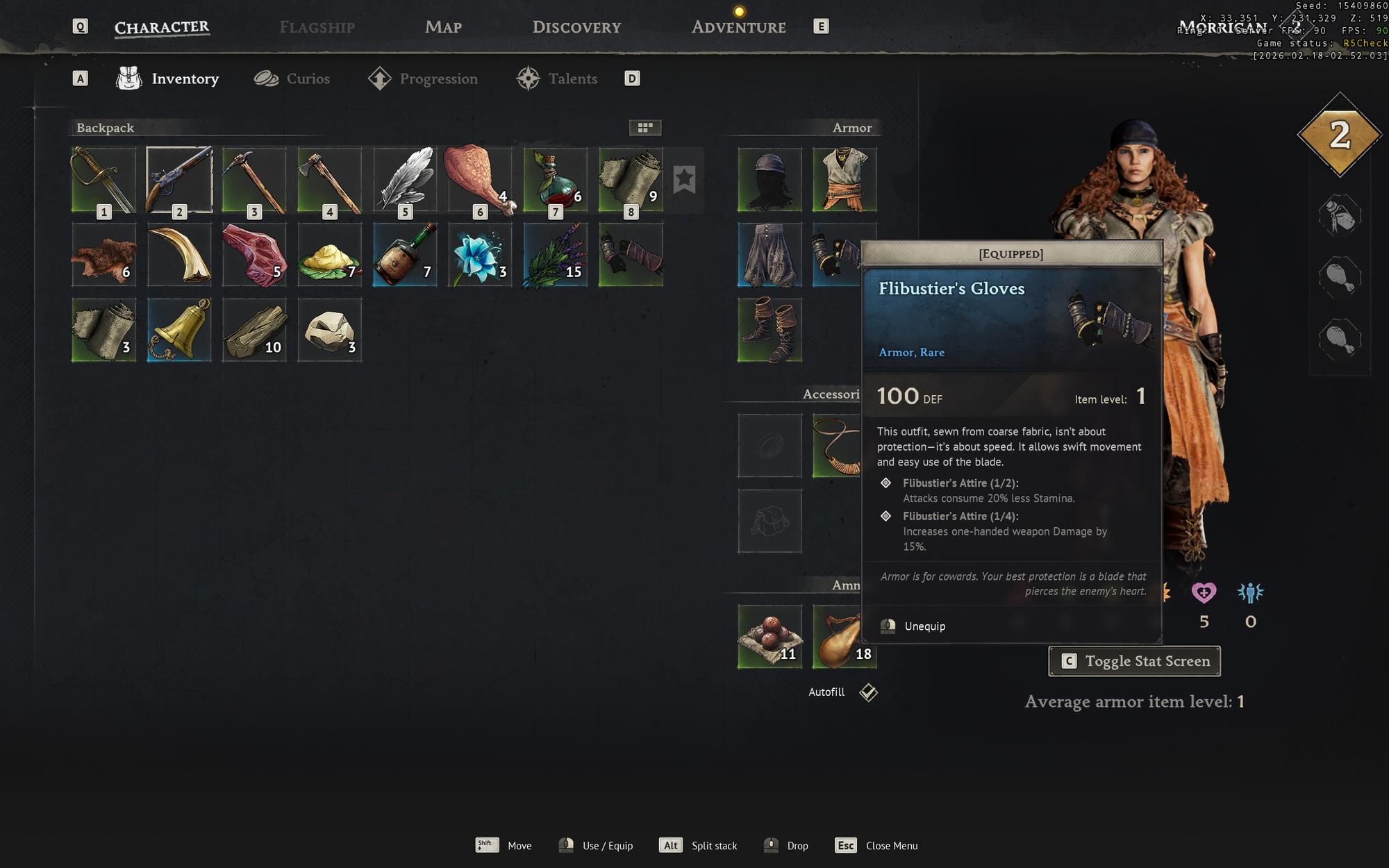
Armor follows a similar structure. Common and Uncommon armor pieces provide flat defense with no set bonuses. Rare armor sets grant 2-piece and 4-piece bonuses that stack as more pieces of the set are equipped. Notable Rare sets include Flibustier's Attire (Buccaneers), Privateer's Regalia (Tortuga People), Marksman's Rig (Tortuga People), Conquistador's Armor (Smugglers), Pikeman's Armor (Smugglers), and Tracker's Leathers (Buccaneers).
Upgrade System — how levels stack on top of rarity
Upgrading Station — the level 1 to 8 building
Weaponsmith Workshop — where ascension happens
Tumbaga Ingot — the ascension material
Disassembly Table — 100% material refund, does not refund Tumbaga
Weapons — weapon overview by type
Before the Ascend tab will appear inside the Weaponsmith Workshop, the item itself needs to be carried through the standard upgrade path at an Upgrading Station first. In particular the weapon has to reach the iron stage of the upgrade track, which is the tier that requires an Anvil to unlock. Only once the weapon has been upgraded through that iron-stage threshold does the workshop interface expose a separate ascension tab; attempting to ascend a weapon that has not been upgraded at all, or that is still sitting at a pre-iron stage, simply will not show the option.
The practical sequence every player follows is the same. Craft the Rare weapon, feed it into the Upgrading Station with the correct tier of ingot (including an Iron Ingot to cross the iron threshold), continue upgrading to level 8 if the goal is maximum stats, then return to the weapon workshop and use the Ascend tab that is now visible to consume a Tumbaga Ingot and push the rarity up. Skipping the iron-stage upgrade in an attempt to save materials is not possible; the game hides ascension behind the upgrade track on purpose so that ingots are not wasted on un-upgraded weapons.
Rare and Epic items differ from Common and Uncommon items in exactly one way: they roll passive effects. Community data on the current build confirms three broad passive categories that show up across weapons and armor at blue-and-above rarity:
Damage-oriented passives: flat damage bonuses, stacking Bleed, scaling off a current stat (Stamina, Corruption), or bumping a combat stat like Critical Hit Chance or Critical Damage.
Reload and handling passives: faster reload speed on firearms, shorter wind-up on heavy attacks, or faster swing recovery on melee weapons. These show up most often on Musket, Pistol, and Blunderbuss rolls.
Damage-reduction and survivability passives: flat defense bonuses, percentage damage reduction from specific sources, or self-heal triggers that fire on a condition (Corruption stacks, Bleed damage applied, kill-transfer).
Ascending from Rare to Epic does not replace the existing passive. The Rare passive persists and a second passive is added on top, which means the Epic version of a weapon always carries at least two distinct effects. That two-passive stack is the entire reason ascension is worth chasing: a strong Rare weapon typically gains a second stat line that complements the first (for example, reload speed on the Rare roll plus Critical Damage on the Epic roll of the same musket), and the compounded effect is what turns a workable Rare into a genuine end-game weapon.
Ascension is not limited to weapons. Rare armor pieces can also be pushed to Epic, and the station used for armor ascension is the Armor Bench rather than the Weaponsmith Workshop. The prerequisites and costs mirror the weapon flow exactly: the armor piece must have been upgraded through the iron stage at the Upgrading Station (requiring an Anvil for that threshold), and ascension itself consumes a Tumbaga Ingot per attempt.
Armor ascension is where Tumbaga economics get interesting. Because Rare armor is the tier that grants 2-piece and 4-piece set bonuses, players generally prioritise weapons over armor for the first few Tumbaga drops. The exception is armor pieces with especially strong themed passives that scale with the build (for example, a chest piece that boosts firearm reload on a gunner character). Most veteran write-ups recommend finishing at least one full Rare set before spending any Tumbaga on armor ascensions, then cherry-picking the single armor piece whose Epic passive lines up best with the active weapon.
The ascension bottleneck is always Tumbaga Ingot supply. Community reporting on the launch build places Tumbaga drops in two overlapping sources. The first is Ruins and dig spots scattered across the archipelago: ingots occasionally appear inside the rare-resource chests that spawn at these sites, which makes exploration loops and map-marker sweeps a slow but reliable supply. The second is Blackbeard Treasure Map chests, which typically contain a small cluster of Tumbaga Ingots per chest and are the fastest way to stockpile ascension materials once the player is strong enough to clear the named encounters that drop the maps.
Either path reinforces the same planning rule. Save Tumbaga for the two or three weapons (and at most one or two armor pieces) that the build will actually carry into the late game. Because ascension cannot be undone and the Disassembly Table does not refund Tumbaga, spending an ingot on a weapon that gets shelved a few hours later is a straight loss. Most community tier discussions settle on a conservative stockpile target of three to four Tumbaga before the first ascension commitment, specifically so that a single unlucky roll or a late-game pivot does not leave the player short.