

A Fictional Ancient China
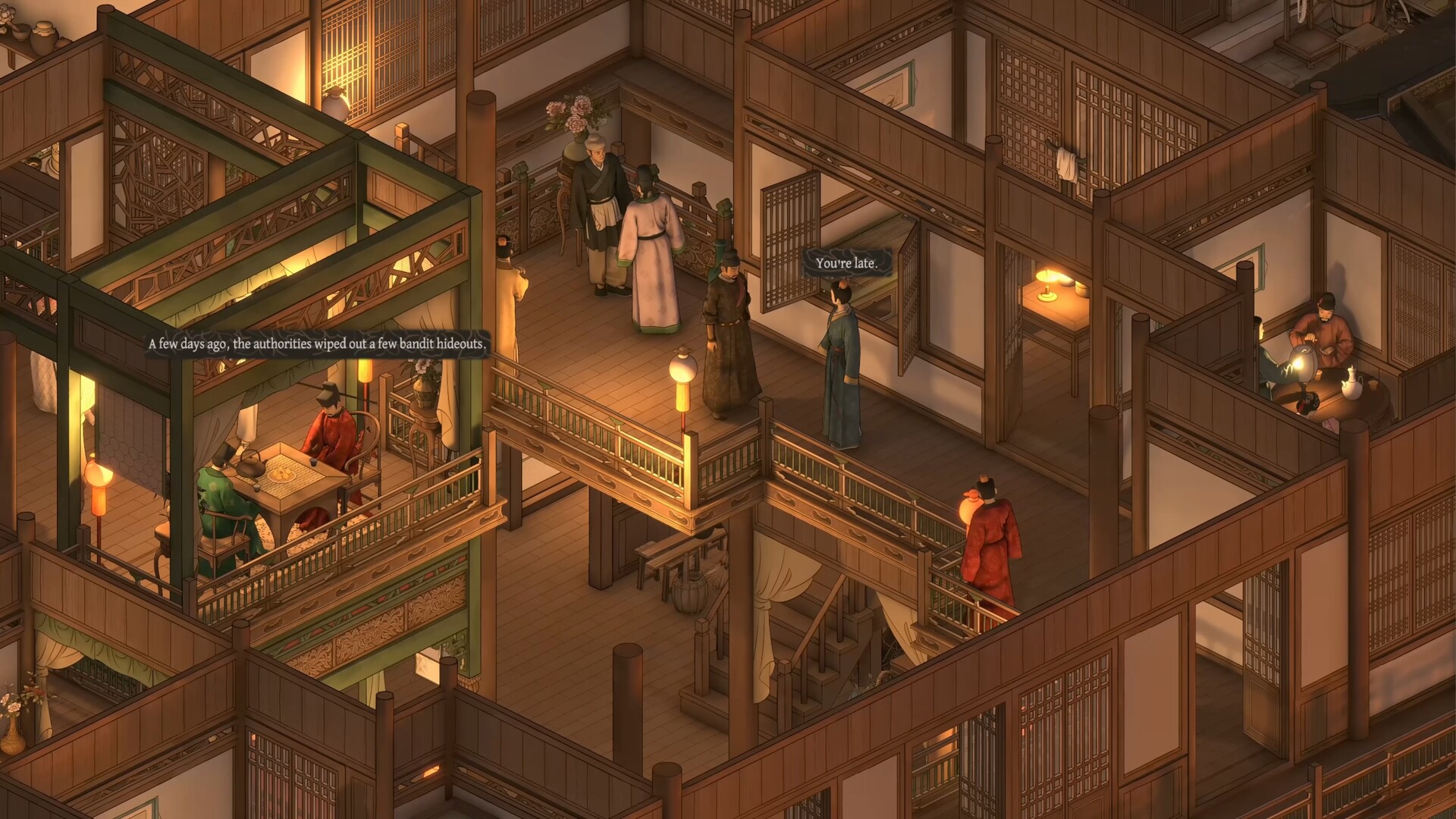
The Bustling World is set in a fictional version of ancient China. It is not a recreation of any specific historical period or dynasty. Instead, the developers draw from multiple eras, primarily the Tang Dynasty (618-907 CE) and Song Dynasty (960-1279 CE), while also incorporating elements from the Ming and Qing periods. The architecture, clothing, customs, social structures, and daily life reflect a blend of these historical eras rather than strict accuracy to any single one.
The game's official Chinese title is 烽火与炊烟 (烽火與炊煙 in traditional characters), which translates roughly to "beacon-fires and cooking smoke." The pairing captures the game's two poles: the beacon-fires of war and conflict, and the cooking smoke of everyday domestic life. That tension between turmoil and a peaceful life runs through the whole sandbox.
This approach gives the developers creative freedom. Tang Dynasty buildings can sit next to Song Dynasty gardens. Martial arts traditions from different centuries coexist in the same Jianghu. Fashion and technology from different periods appear side by side. The world feels historically grounded in Chinese culture and aesthetics without being constrained by the specific details of what existed when. It is ancient China as a setting, not ancient China as a history lesson.
The fictional framing also allows the inclusion of supernatural and mythological elements that would not fit a strict historical recreation. The game's world encompasses both the mundane reality of farming, trade, and politics and the mythic realm of legendary locations and martial arts powers that define wuxia fiction.
Regional Diversity
The game world spans multiple regions with distinct geography, climate, architecture, and culture. Northern areas feature cities with imposing walls, dry landscapes, and cold winters. Southern regions contain water towns built around canals and bridges, with lush vegetation and mild weather. Border regions house military installations and frontier settlements. Remote mountain areas hide outlaw strongholds, secluded sects, and ancient ruins. The developers have shown Yong'an City as the central settlement that grows over the course of play, the place where the city management layer takes shape as the player gains influence.
The developers have named four regional archetypes that the world is built around. Each carries its own architecture, climate, and economic character:
Region type | Character |
|---|---|
Northern cities | Walled settlements in dry country with cold winters, the most fortified of the four types |
Southern water towns | Settlements built around canals and bridges, with dense vegetation and a mild climate |
Southwestern border areas | Frontier country at the edge of settled territory, where central authority is thinnest |
Northwestern fortresses | Strongpoints holding the approaches, oriented around defence rather than commerce |
Whichever type a settlement belongs to, the developers have said it is populated with the same working parts: villages and farmed fields, ordinary residences, shops, schools, government offices, and taverns. The government office is the same building that posts wanted notices under the crime and wanted system, which is why it matters mechanically rather than only as scenery.
Two claims about access follow from this. The developers have stated that any of these locations can be entered, leaving the method up to the player, and that none of this content is locked behind main-story progress. A player can walk into a settlement and start using it immediately rather than unlocking it. Alongside the four grounded archetypes, the developers have also said they are working in rebel-held cities and locations drawn from myth, which is where the fantastical sites below fit.
Economic and Strategic Impact
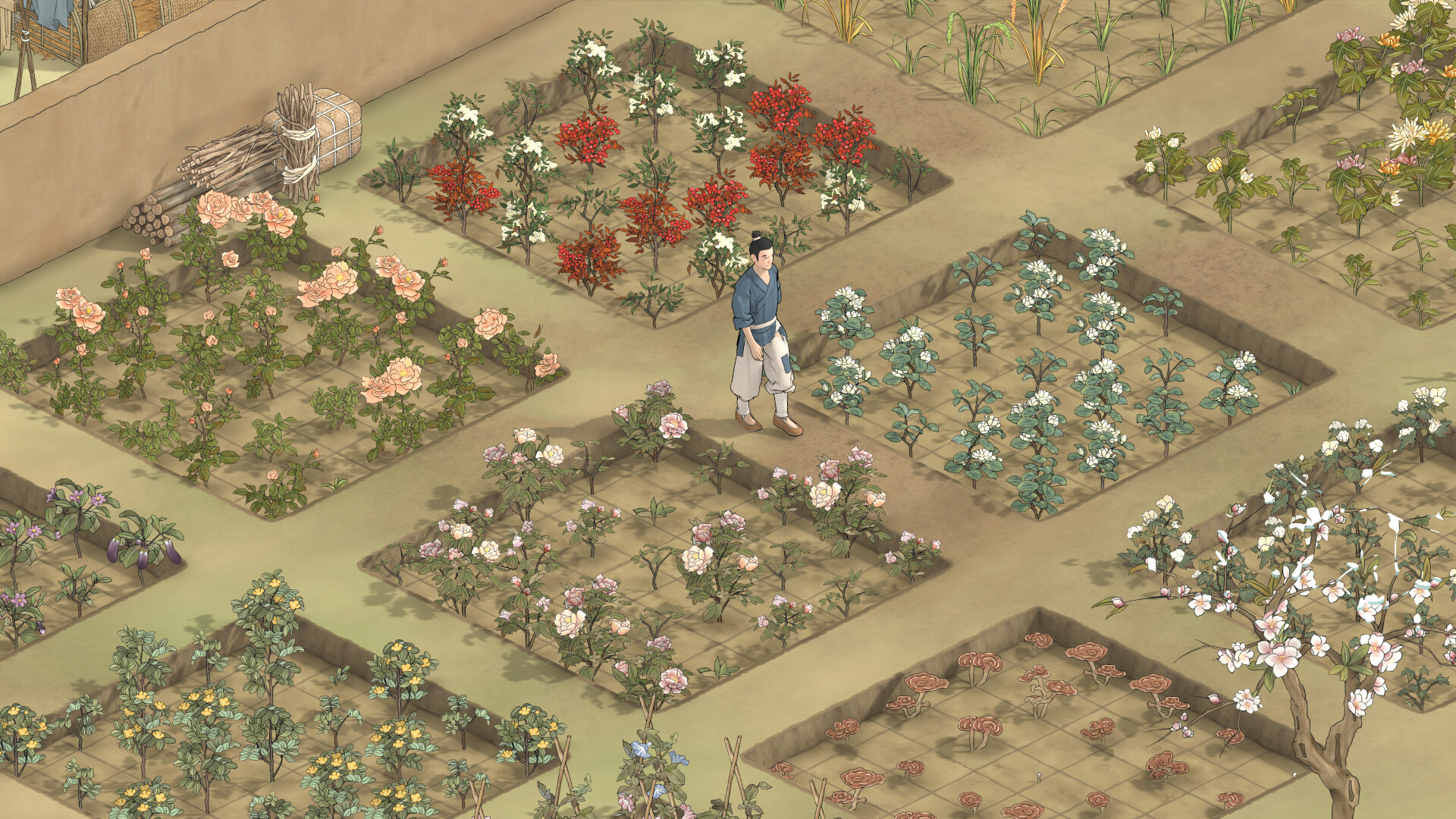
Regional differences are not just visual. Climate affects which crops grow, determining what farming is viable in each area. Geography shapes military strategy, since defending a mountain pass requires different tactics than protecting open plains. Economic conditions vary by region, with coastal and riverside towns benefiting from trade routes while inland areas depend more on agriculture and mining. These material differences make business decisions genuinely region-specific. A restaurant that thrives in a prosperous southern trade city may struggle in a remote northern garrison town.
The variety of regions also creates natural travel motivation. A player who wants to learn southern martial arts styles needs to go south. One who wants northern iron needs to visit the mining towns. Rare animals may only appear in specific biomes. The world rewards exploration by distributing its resources and opportunities across geography rather than concentrating everything in one location.
Mythical Locations
Xiao Xi Tian references Buddhist cosmology, specifically the concept of a "Lesser Western Paradise." In Chinese Buddhist tradition, the Western Paradise (Sukhavati) is the pure land of the Amitabha Buddha. Xiao Xi Tian, a "lesser" version, suggests a location with spiritual significance that may be accessible through gameplay, though its exact role has not been fully detailed.
Yam King Difu refers to the realm of the King of the Underworld. In Chinese folk religion, Yama (Yan Wang) is the judge who evaluates the dead and determines their fate in the afterlife. The Difu is his court, where souls are weighed and judged. Including this location in the game suggests an underworld or afterlife dimension that players may visit or interact with.
The presence of these mythical locations indicates that the game's fiction extends beyond the purely mundane. Both have since been presented as special locations that blend real historical landmarks with mythology, and Xiao Xi Tian has been shown rendered in engine as a temple landscape, so they are more than lore references. What players can actually do once inside, and whether the supernatural figures attached to them appear as characters, still has not been detailed. Their inclusion tells us that the world encompasses both the earthly Jianghu and the spiritual realms of Chinese mythology, which is consistent with the wuxia fiction tradition the game draws from.
Seasonal Changes
The world experiences seasonal changes that affect both appearance and gameplay. Snow covers northern areas in winter. Flowers bloom across southern landscapes in spring. Autumn brings harvest time and changing foliage. Summer brings heat that affects NPC behavior and agricultural output. These visual changes make the passage of time visible in the game world.
Beyond cosmetics, seasons influence game systems in practical ways. Farming is directly affected since certain crops can only be planted or harvested during specific seasons. A spring planting window missed means waiting until the following year. NPC behavior shifts with the seasons. Characters dress differently, change their daily routines, participate in seasonal festivals, and adjust their economic activity. Military campaigns may also be season-dependent, since waging war in winter presents different logistical challenges than fighting in summer.
Seasonal changes also trigger specific events and festivals. These events provide opportunities for participation, social interaction, and activities like lion dancing and iron flower launching that are tied to specific times of year. The rhythm of the seasons gives the game world a natural pulse that organizes gameplay into cycles.
Dynamic Urban Evolution
Cities in The Bustling World are not static. They evolve over time as NPCs make independent decisions about where to live and what businesses to establish. A small town can grow into a prosperous city if conditions are right: available housing, economic opportunity, safety from bandits and invaders, good governance, and access to trade routes. A thriving city can decline if war destroys infrastructure, famine drives residents away, disease spreads through crowded districts, or poor management chokes economic growth.
Player Impact on City Development
This dynamic development means the game world at hour 100 looks different from hour 1, not because of scripted progression events but because of accumulated NPC decisions and player actions. Two players making different choices will see different cities develop in different ways, even though they started with the same map. A player who stabilizes a region and invests in infrastructure may see a village grow into a bustling trade hub. Another player who ignores that same village may find it abandoned after bandits drive the residents away.
Urban evolution is one of the features that makes the game's sandbox feel alive rather than static. The cities are not fixed entities waiting for the player to interact with them. They are growing, changing, and sometimes dying based on the sum total of every NPC's individual decisions about where to live and what to do.
Day/Night Cycle and Crime
A full day/night cycle affects the game world. Different activities and NPCs become available at different times of day. Shops operate during business hours. Entertainment venues come alive at night. Some NPCs are active during the day and sleep at night. Others operate on reversed schedules. Nighttime is particularly relevant for criminal activities, since stealth operations are easier under cover of darkness and fewer witnesses are around.
Crime consequences scale with severity. Petty theft triggers a different response than assault, and assault triggers a different response than murder. The system tracks offenses and escalates the response accordingly, from local guards investigating to full bounties being placed on the player's head. This graduated approach means players can dabble in minor crime without immediately becoming the most wanted person in the region. The consequences are proportional to the offense.
Dynamic Economy
The economy runs on supply and demand across the entire game world. Prices for goods depend on region, local demand, supply availability, and the broader state of the world. Nearly 1,000 items can be traded, ranging from raw agricultural products to finished crafted goods to rare artifacts and martial arts manuals.
Economic dynamics respond to world events. A surplus of grain in agricultural regions drives prices down in those areas while grain remains expensive in regions that cannot grow their own food. A mining town that gets raided by bandits sees iron prices spike as supply drops. A trade route disrupted by war redirects commerce through alternative paths, enriching some regions while impoverishing others.
Players who understand the economy can profit from trade, buying goods where they are cheap and selling where demand is high. This trading system connects to business management since shop owners need to price their goods competitively while maintaining profit margins. It also connects to faction diplomacy since trade agreements between regions affect the flow and pricing of goods across borders.
Leisure Activities
The game includes a wide variety of leisure activities drawn from Chinese cultural traditions:
Fishing in rivers, lakes, and ponds across different regions
Painting and calligraphy as creative pursuits with sellable output
Playing music with traditional Chinese instruments
Pet fighting card games as a competitive pastime
Cooking competitions against NPC chefs, tied to the crafting system
Horse racing as both entertainment and a test of animal breeding quality
Lion dancing during festivals and seasonal celebrations
Iron flower launching (打铁花), a traditional practice of throwing molten iron into the air to create showers of sparks, performed at festivals since the Song Dynasty
These activities serve multiple purposes. Some are purely recreational, providing a break from the intensity of combat and commerce. Others offer competitive rewards or improve skills. Horse racing doubles as a way to evaluate the quality of horses bred through the animal husbandry system. Cooking competitions test recipe knowledge accumulated through the cooking profession. Even fishing yields materials that can be sold or used in recipes.
The tonal range is part of the design. You can spend an afternoon painting by a river, then walk down the road and get into a fight with bandits. You can watch a lion dance during a festival, then go home and plan a military campaign. The activities exist alongside the heavier gameplay systems like combat and faction politics, and the game does not force you to choose one mood over another.
Visual Style and Art Direction
The game renders its world in fully 3D with a hand-painted aesthetic. The art team created over 5,000 hand-drawn textures without using AI generation tools at any point. The visual style draws from traditional Chinese painting techniques, placing the game's appearance somewhere between photorealism and artistic illustration. Colors are warm and muted. Light falls softly. The whole world has the quality of a scroll painting that you can move through.
Clothing physics simulate ancient-Chinese-styled garments. Flowing robes, layered fabrics, long sleeves, and accessories all react to character movement and environmental conditions. The developers describe this garment simulation as a first in gaming. The attention to how textiles behave is consistent with the broader focus on cultural authenticity in the visual presentation.
For more on the art production process and the studio's focus on hand-drawn work, see the development history article.
City Management
For territories under player control, a city management layer allows direct governance over settlements. Players can build housing to attract new residents, designate zones for different purposes (residential, commercial, agricultural, military), apply policy cards that affect taxation, public services, and development priorities, and coordinate across multiple cities when controlling more than one settlement.
City management connects to virtually every other system. Housing construction uses building components. Zoning decisions affect which businesses can operate and where NPCs choose to live. Policy choices influence NPC migration patterns, with well-governed cities attracting settlers and poorly governed ones losing population. Military infrastructure determines how effectively the city can be defended during warfare. The overall prosperity of a city affects its standing in faction diplomacy.
Multi-city coordination is available for players who control multiple settlements. Each city can be specialized to fill a role in a larger network: one city as a military garrison, another as a farming center, a third as a trade port. How these cities support each other, moving food from farms to garrisons, routing trade profits to fund military spending, transferring population to where workers are needed, determines the overall strength and resilience of the player's territory.
Narrative Structure
The game does not follow a traditional linear storyline. Instead, there is a loose narrative framework involving helping refugees who have been displaced by conflict, building a base of operations in the world, and eventually confronting rebellious forces that threaten stability. This main storyline provides direction for players who want it, but following it is not mandatory.
Side adventures, faction questlines, and emergent stories from the NPC simulation provide alternative narrative content. The game's systems are designed to generate stories on their own. When thousands of autonomous NPCs are making independent decisions in a changing world, narrative emerges naturally from the interactions between player actions and NPC responses.
For a broader look at everything the game offers, see the overview. For help getting into the game, check the getting started guide.