

Overview
Skills are a core gameplay mechanic in Paralives' Live Mode that determine how proficient a Parafolk is at performing various activities. A Para builds skills by doing: practicing guitar improves the Guitar Skill, jogging develops the Exercising Skill, and writing code advances the Programming Skill. Skills factor into job applications, career performance, creative output quality, and everyday interactions. The maximum level for each skill is 20, and there is no limit to how many skills a single Parafolk can learn.
Underpinning the individual skills is a broader Knowledge system. Knowledge categories represent general domains of understanding, and every skill belongs to one of these categories. As a Para levels up a specific skill, they also accumulate Knowledge in the parent category. This accumulated Knowledge then makes it easier to pick up related skills in the same domain. The interplay between Skills and Knowledge creates a natural learning curve where expertise in one area helps with adjacent ones.
Knowledge Categories
Knowledge categories are broad domains that group related skills together. Based on development previews and gameplay demonstrations, the following Knowledge categories have been identified. The launch build includes 8 Knowledge categories, confirmed at the Early Access launch.
Knowledge Category | Description | Example Skills |
|---|---|---|
Music | Covers musical instruments, composition, and performance. | Guitar, Piano |
Fitness | Encompasses physical exercise, sports, and athletic ability. | Exercising |
Science | Relates to scientific research, experimentation, and analytical thinking. | Research-related skills |
Technology | Covers computing, software, and technical problem-solving. | Programming |
Food | Encompasses cooking, baking, food preparation, and culinary arts. | Cooking |
Art | Relates to painting, drawing, sculpture, and other visual creative pursuits. | Painting |
Outdoorsiness | Covers nature-related activities such as gardening, fishing, and outdoor exploration. The domain is present at launch, but its key sub-skills (Gardening, Fishing) are planned post-launch and marked Soon. | Gardening, Fishing |
Repair | Encompasses fixing, building, and maintaining objects and structures. | Handiness-related skills |
How Knowledge Accelerates Learning
The relationship between Skills and Knowledge is one of the most distinctive aspects of Paralives' progression system. When a Parafolk practices a specific skill, they simultaneously build Knowledge in the parent category. For example, playing the guitar develops both the Guitar Skill and Music Knowledge. Once a Para has accumulated Music Knowledge, picking up the Piano becomes easier because the foundational understanding of music is already there.
This design rewards players who let their Paras explore multiple skills within a domain. A Parafolk who has deep Music Knowledge will find that every new musical instrument they try feels less daunting, with faster initial progress and smoother leveling. Conversely, jumping into a completely unfamiliar Knowledge category always starts from zero regardless of how skilled the Para is in other areas.
Cross-Training Examples
The Knowledge system creates natural cross-training opportunities. Playing the guitar develops the Guitar Skill while simultaneously building Music Knowledge. Once enough Music Knowledge has accumulated, picking up the Piano becomes noticeably easier because the foundational understanding of music carries over. Similarly, a Para who jogs regularly builds the Exercising Skill and gains Fitness Knowledge, which would then help when learning other physical activities within the Fitness category.
This design means that players who focus their Parafolk on a single Knowledge domain will see compounding returns. A Para dedicated to Technology, for example, would find that progress in Programming makes subsequent tech-related skills faster to level. Conversely, switching to an entirely unrelated domain like Music starts from zero Knowledge, making the initial learning curve steeper.
Individual Skills
The launch build includes 23 individual skills at the Early Access launch, organized as 8 Knowledge domains and 15 Practical activities, with more expected to be added during the Early Access period and through community mods. The following skills have been confirmed or demonstrated in development previews:
Skill | Knowledge Category | Lifestage | Max Level | How to Practice |
|---|---|---|---|---|
Guitar | Music | Child to Elder | 20 | Play a guitar object. Improves with each practice session. |
Piano | Music | Child to Elder | 20 | Play a piano or keyboard object. |
Triangle | Music | Child to Elder | 20 | Play a triangle instrument. A simple Music-domain skill. |
Cooking | Food | Child to Elder | 20 | Prepare meals at a stove or kitchen counter. Underage Paras need supervision for stove use. |
Exercise | Fitness | Teen to Elder | 20 | Use fitness equipment, jog, or perform physical activities. Even running downstairs can contribute. Listed in some menus as Exercising. |
Dance | Fitness | Child to Elder | 20 | Dance to music or at social venues. A Fitness-domain activity. |
Graphic Design | Art | Child to Elder | 20 | Use a computer to create digital art. Boosted by the Technology Talent. |
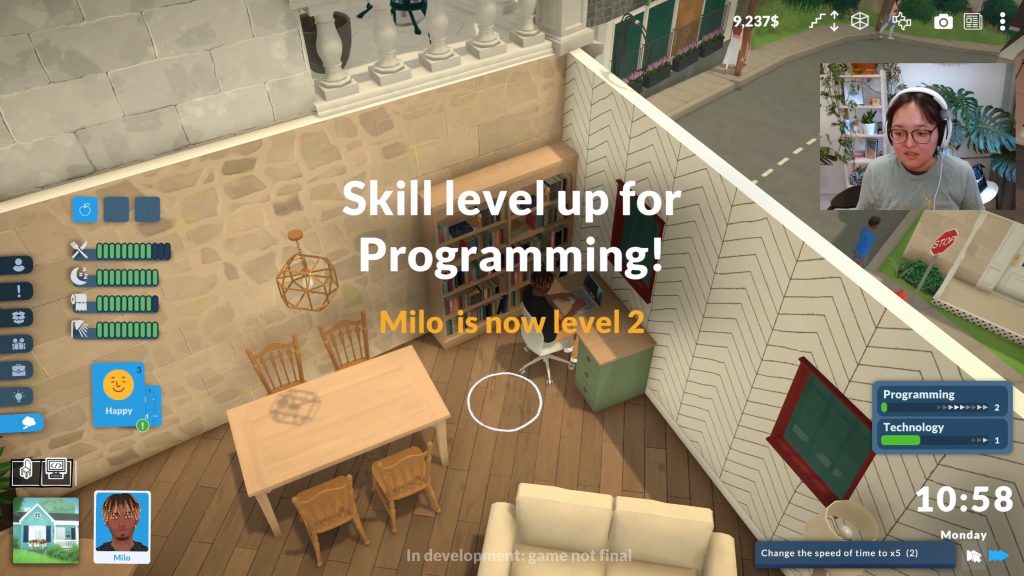
Programming | Technology | Child to Elder | 20 | Use a computer to write code. |
Painting | Art | Child to Elder | 20 | Use an easel or art supplies to create artwork. |
Astronomy | Science | Teen to Elder | 20 | Present in build 1. Its direct level path is partly unimplemented: a telescope may not currently grant experience, so levels mainly come from computer study and occupation perks. |
Biology | Science | Teen to Elder | 20 | Present in build 1 with a partly unimplemented level path. Primary leveling comes from occupation perks and computer study. |
Surgery | Science | Teen to Elder | 20 | Present in build 1 with a partly unimplemented level path. Levels mainly through occupation perks in the Healthcare domain. |
Language | None (standalone) | Baby to Toddler | 10 | A standalone early-childhood skill. Built by communicating and learning words. Maximum level 10. |
Potty | None (standalone) | Toddler only | 2 | A toddler-only skill for potty training. Maximum level 2. |
Additional skills have been hinted at but not demonstrated, and no patch through Hotfix 0.1.8b as of September 21, 2026 has added one to the roster above. The developers have confirmed the skill list will expand over time, both through official updates and through community modding.
Talents
Talents are personality attributes chosen during character creation in the Paramaker that bias how quickly a Parafolk learns within a given area. A Para can have one Talent. Six of the seven Talents give a domain advantage, while one, Good at Nothing, is a deliberate challenge option. The launch build includes seven Talents.
Talent | Effect |
|---|---|
Jack-of-All-Trades | Balanced, versatile growth across many skills with no specialized bonus or penalty. Suits players who want a broad, well-rounded Para rather than deep expertise in one area. |
Music | Learns musical instruments and music theory faster. Often starts with a higher base level in the Music domain. |
Fitness | Loves exercise: Hygiene need decays more slowly, and the Para gains exercise-related Wants that can relieve sadness. |
Food | A natural cook: starts knowing more recipes than others and is less likely to fail when cooking a dish. |
Technology | Happiest at a computer and excels in technology-focused careers. Starts at level 3 instead of 1 in the technology skill, and learns Programming and Graphic Design faster. |
Art | Paints and creates faster, and the resulting artwork sells for a higher value. Often starts with a higher base art level. |
Good at Nothing | A challenge talent: the Para fails at tasks more often, and as the talent is upgraded with Personality Points its incompetence can spill over to affect the skill gains and mood of the Parafolk around them. |
Skill Progression
Leveling Mechanics
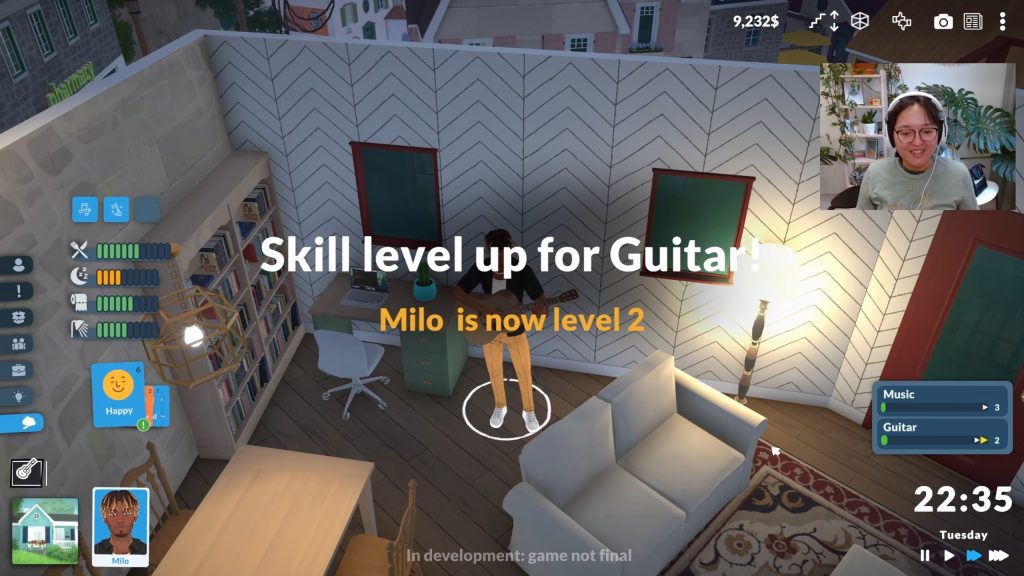
Skills advance through practice. Each time a Parafolk performs an action related to a skill, a progress bar fills. When the bar is full, the Para levels up in that skill. The maximum level for any skill is 20. Not every level unlocks new content or abilities; some levels simply represent increased proficiency that makes the Para faster, more efficient, or more likely to succeed at tasks in that domain.
Factors That Affect Progression Speed
Several factors influence how quickly a Para builds skill experience:
Knowledge: Higher Knowledge in the parent category speeds up skill leveling for all related skills.
Talents: Talents are attributes selected during character creation in the Paramaker that modify skill progression rates. For example, a Para with an Art Talent will paint faster and gain painting experience more efficiently. The "Good at Nothing" talent has complex interactions with the skill system.
Emotions: Emotions directly affect learning speed. Being in an Inspired state may accelerate skill gains, while being Stressed, Sad, or experiencing other negative emotions can slow progress.
Needs: Unfulfilled needs (Hunger, Sleep, Bathroom, Hygiene) slow down skill advancement. Making sure a Para is well-rested and fed before a practice session is advisable for optimal progress.
Lifestage Restrictions
Skills are not uniform across all lifestages. The ability to start learning a new skill and the maximum achievable level evolve as a Parafolk ages. Toddlers have different capabilities than Adults, particularly where physical abilities are involved (such as the Exercising Skill). Underage Parafolk can only practice certain dangerous activities, like cooking with stoves, under adult supervision or in a group setting. This lifestage system ensures that character development feels natural and age-appropriate.
Skills and Careers
Skills play a central role in the career system. When a Parafolk applies for a job, their relevant skill levels contribute to their Application Points total. Higher skill levels make it easier to qualify for advanced positions. During the workday, skill proficiency affects job performance, which in turn determines whether the Para earns upgrade points at the end of their shift. Some career upgrade paths involve further skill development, creating a positive feedback loop between working and learning.
Application Points
The career system uses Application Points to determine job qualifications. When a Parafolk applies for a position, their relevant Skill levels, Stats, and domain experience each contribute points toward a total score. Each job posting has a minimum Application Points threshold that candidates must meet or exceed. Some positions require a minimum number of points in a specific Skill that is fundamental to the role.
Prior work experience in the same career domain can partially compensate for skill gaps, and relevant personality Stats can provide additional points. This flexible system means that Parafolk with different strengths can qualify for the same job through different combinations of Skills, experience, and personality. For example, an Office Administrator position requiring 28 Application Points could be approached through a mix of Charisma, relationship levels, and personality traits like being an effective communicator.
Modding Support
Skills are moddable via the Steam Workshop. Community creators can design new skills and share them with other players. However, modded skills must fall within an existing Knowledge category; the modding system does not currently allow creation of entirely new Knowledge categories. This constraint ensures that custom skills integrate smoothly into the existing progression framework while still giving modders creative freedom.
Skill Count at Launch
The Early Access launch build ships with 23 learnable skills, structured as two complementary tracks: 8 Knowledge domains (broad academic umbrellas) and 15 Practical activities (hands-on actions). Knowledge skills group related Practical skills under a single theme; leveling a Knowledge skill can unlock new career opportunities or advanced interactions in the related Practical skills.
Knowledge Domains (8)
Knowledge skills are leveled through study (reading books, using computers, attending classes, conversing with subject-matter experts). Each Knowledge domain may gate or boost Practical skills associated with it, and many careers require minimum Knowledge levels for promotion or job application.
Practical Skills (15)
Practical skills are leveled through the activity itself. Examples include Cooking (leveled by preparing dishes), Painting (leveled at an easel), Guitar, Piano, Triangle (leveled by practicing the instrument), Fitness (leveled at home or at the gym), Gardening (leveled by tending plants), and more. Each Practical skill caps at a maximum level that unlocks new interactions, recipes, social options, and career perks at successive milestones.
Two further practical skills, Fishing and Gardening, sit in the Outdoorsiness domain and are planned for a post-launch update rather than the initial Early Access build. Early-childhood Paras have their own short skills: Language (maximum level 10) for babies and toddlers, and Potty (maximum level 2) for toddlers.
Skill Progression Pace
Skills level faster when a Parafolk's mood, needs, and emotions are favorable, when surrounding traits and Vibes align with the activity, and when the Parafolk uses higher-tier equipment (a better easel, a better guitar, a better stove). Many career perks include passive bonuses to skill-gain rate; reaching specific Knowledge thresholds can also unlock advanced Practical actions.
Patch 0.1.6 Changes (July 16, 2026)
Patch 0.1.6 restored the town event skill bonus: a Para taking part in a town event now learns skills faster for the duration of the event.
The same patch removed a want that asked Paras to level an Outdoorsiness skill. No such skill exists in the game, so the want could never be completed. Adults also stopped receiving wants to level the speech and potty skills, which belong to the toddler and child stages.