

Pregnancy and Birth
Pregnancy in Paralives is a temporary state that results in the birth of a Baby. The ability to become pregnant is configured independently of gender in the Paramaker, and offspring appearance is determined by a genetics system based on dominant and recessive alleles.
On This Page
Overview
Pregnancy in Paralives is a temporary state experienced by some Parafolk that results in the arrival of a new Baby. It is one of the primary ways to expand a household during Live Mode gameplay. The system is designed to be inclusive and customizable: the ability to become pregnant is configured through the Paramaker's gender options and operates independently of a character's chosen gender identity. Pregnancy lasts several in-game days and concludes with a birth event that introduces a new Parafolk into the household.
How Pregnancy Occurs
A Parafolk can become pregnant after getting intimate with another Parafolk, provided that one character has the "can get pregnant" option enabled and the other has the "can get others pregnant" option enabled. These options are set in the Paramaker during character creation and are part of the custom gender settings accessible through the three-dot menu in the gender configuration panel. The pregnancy capability toggle is independent of the three default gender presets (Female, Male, and Non-Binary), meaning players have full control over which characters can participate in reproduction regardless of their gender presentation.
Once gender options are locked in at the start of gameplay, they cannot be changed during Live Mode. This means the reproductive configuration of each Parafolk is permanent after household creation. For NPCs that spawn in the world, these settings are likely predetermined, though the exact details of how NPC gender options are assigned have not been fully confirmed.
Pregnancy Duration
Pregnancy lasts several in-game days. During this period, the pregnant Parafolk goes through visible physical changes as the pregnancy progresses. Pregnancy animations were first previewed during development by an animator on the team in August 2024. This shows the visual progression of a pregnant character's body and movement patterns.
Birth
At the end of the pregnancy period, the Parafolk gives birth. In the Early Access version of the game, birth is simplified and does not require any medical intervention. The birth event results in the arrival of a new Baby Parafolk who immediately enters the Baby lifestage. Babies can also be added to a household directly through the Paramaker during character creation, but pregnancy is the only way to gain a new baby during gameplay.
Adoption as an Alternative
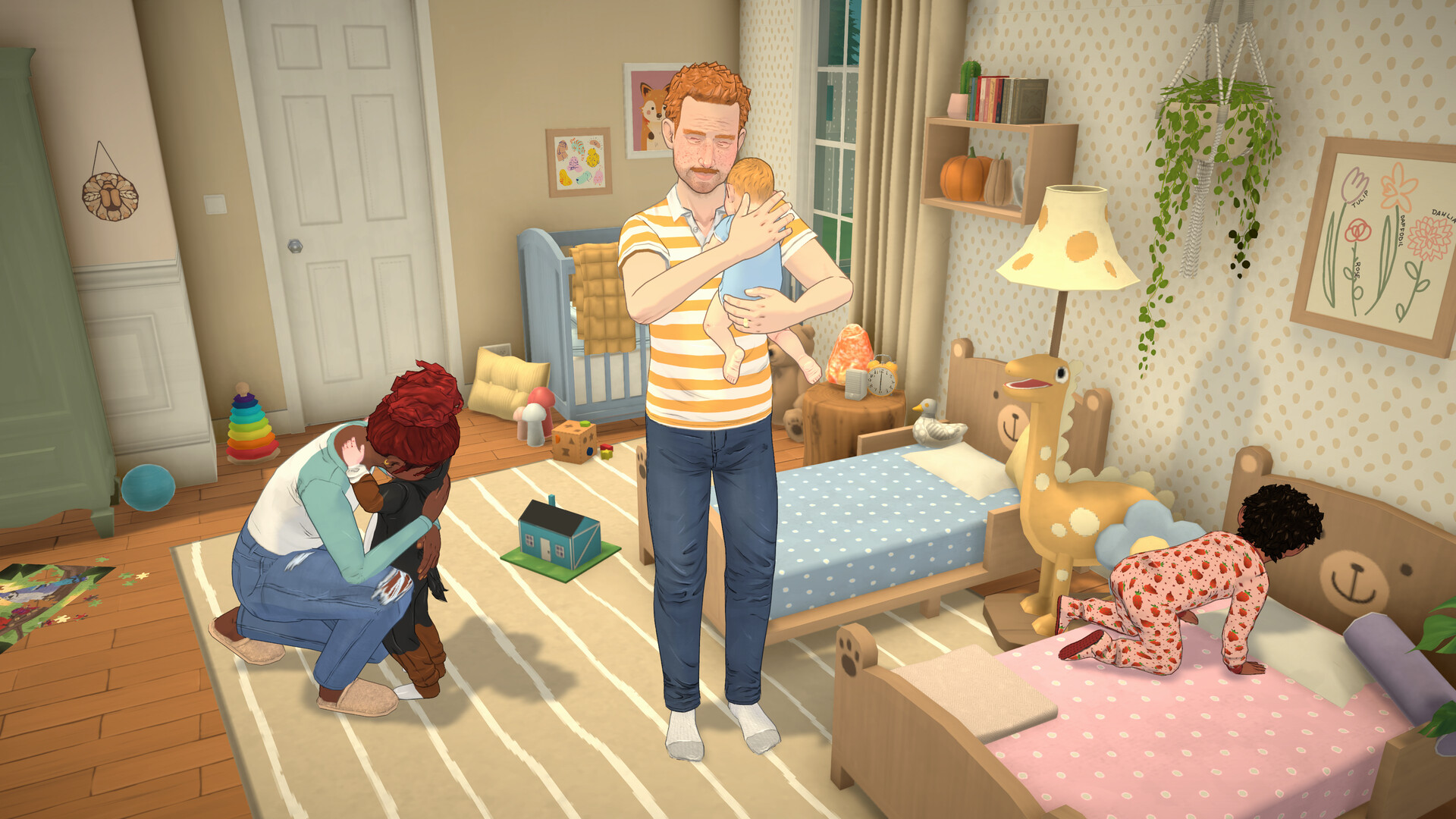
Pregnancy is not the only way to add a child to a household. A Young-Adult-or-older Para can instead adopt a baby by visiting a town health center and choosing the "Adopt a baby" interaction, returning home a few in-game hours later with a newly generated Baby. Adoption needs no reproductive options set in the Paramaker, so it is open to any household, and an adopted baby is generated by the game rather than inheriting traits through the Genetics System. For the full process, see Adoption.
Newborn Characteristics
Baby Parafolk are born without inheriting any personality-related characteristics from their parents. Traits such as Vibes, Lifestyles, Talents, and Social Perks are not genetically determined; instead, a baby's personality develops entirely over time through gameplay. Physically, all babies have fairly round faces and very short hair, and they typically wear only diapers. All babies share the same height at birth.
While personality is not inherited, physical appearance is governed by the genetics system. The appearance of a newborn is determined by the genetic traits of both parents, following a system of dominant and recessive alleles for certain features and direct inheritance for others.
Genetics System
The genetics system in Paralives was developed by Anna Thibert, who has a background in bioinformatics. It is based on simplified real-world heredity principles and determines how physical traits are passed from parents to children. Once a character is created, their genetic code is permanent. Even if a player modifies a Parafolk's appearance later in the Paramaker, the original genetic information remains unchanged and is what gets passed to offspring.
Facial Features and Height
Facial features use a slider-based inheritance system with direct parent-to-child transmission. Rather than blending sliders from both parents (which could produce unusual combinations), children inherit complete slider sets from one parent per facial region. For example, a child might inherit their entire nose shape from one parent and their cheek structure from the other. The selection is a purely random 50/50 chance for each feature group.
Height follows a similar direct inheritance model but with added variation. Parafolk fall into short, medium, or tall categories. A child randomly inherits one parent's height category, then receives a randomized height within that range. This means siblings can end up with noticeably different heights, and a child can even grow taller than both parents. Gender also influences the final height randomization.
Eye, Hair, and Skin Color
Color-based traits (eyes, hair, and skin) use an indirect inheritance model with dominant and recessive alleles. This means traits can skip generations: a child might display a grandparent's eye color that neither parent visibly has. Only base colors are transmitted genetically; root color, highlight color, and tip color do not affect inheritance. If a Parafolk has an unnatural color (such as neon green hair), the system converts it to the closest natural color and records that as the heritable genetic code.
Heterochromia (two different eye colors) has a specific limitation: only one eye color is passed on genetically, so heterochromia itself cannot be inherited by offspring. Skin color brightness is inherited from one parent's range, with the child's exact brightness randomized within that range.
Hair Texture
Hair texture uses a recessive/dominant allele system with four possible alleles: straight (most recessive), wavy, curly, and coily (most dominant). The rule of thumb is that more textured hair types are more likely to be expressed when alleles are mixed. A child born to one parent with straight hair and another with coily hair is more likely to have coily or curly hair. Children receive randomized hairstyles that are filtered to match their genetically appropriate texture.
Traits Not Inherited
Several traits are not part of the genetic system and are not passed from parent to child:
Trait | Inheritance Status |
|---|---|
Personality (Vibes, Lifestyles, Talents, Social Perks) | Not inherited; develops over time through gameplay |
Eyesight and glasses needs | Not inherited |
Voice pitch | Not inherited |
Lifespan and life expectancy | Not inherited |
Weight | Not inherited (current implementation) |
Same-Sex Parents
The Paramaker allows players to generate a genetic child from two same-sex parents during character creation. However, during gameplay, pregnancy always requires one Parafolk that can get pregnant and one that can get others pregnant. These options can be freely assigned to any character regardless of gender, making same-sex couples fully capable of having biological children when the appropriate reproductive toggles are configured.
Modding
The genetics system is fully moddable. Modders can implement alternative genetic inheritance rules, create inheritable custom hairstyle textures, establish genetic rules for custom accessories, and even add occult species with their own genetic systems and cross-species traits. For example, a modder could make vampire fangs a dominant trait over regular teeth. The basic genetics system launches with Early Access on May 25, 2026, with an advanced genetic editing system planned for updates during the Early Access period.