

Kite Flying
Kite flying is a leisure activity in Outbound funded as the Cozy Kites Kickstarter stretch goal. Players craft kites and fly them in open areas, with wind and weather dynamically affecting kite behavior. The feature has no gameplay benefit and exists purely for relaxation.
On This Page
Overview
Kite Flying is a leisure activity in Outbound that lets players craft and fly kites across the game's open world. It was funded as the Cozy Kites stretch goal during the 2024 Kickstarter campaign, the third stretch goal unlocked after the campaign surpassed 350% of its original EUR 30,000 funding target. Square Glade Games described the feature as letting players "let a variety of kites fly high in the sky above" their camper van and camping spot.
Kite flying has no direct gameplay benefit. It does not provide experience, resources, or progression rewards. The activity exists purely for relaxation and atmosphere, fitting Outbound's identity as a cozy exploration and crafting game. Players who enjoy the slower pace of vanlife can use kite flying as a way to unwind between sessions of building, crafting, and resource gathering.
How it Works
To fly a kite, the player first crafts one at a workstation using resources gathered from the world. Once a kite is in the player's inventory, it can be deployed in any open area with sufficient wind. The player holds the kite string while the kite rises into the air, responding to wind currents in real time.
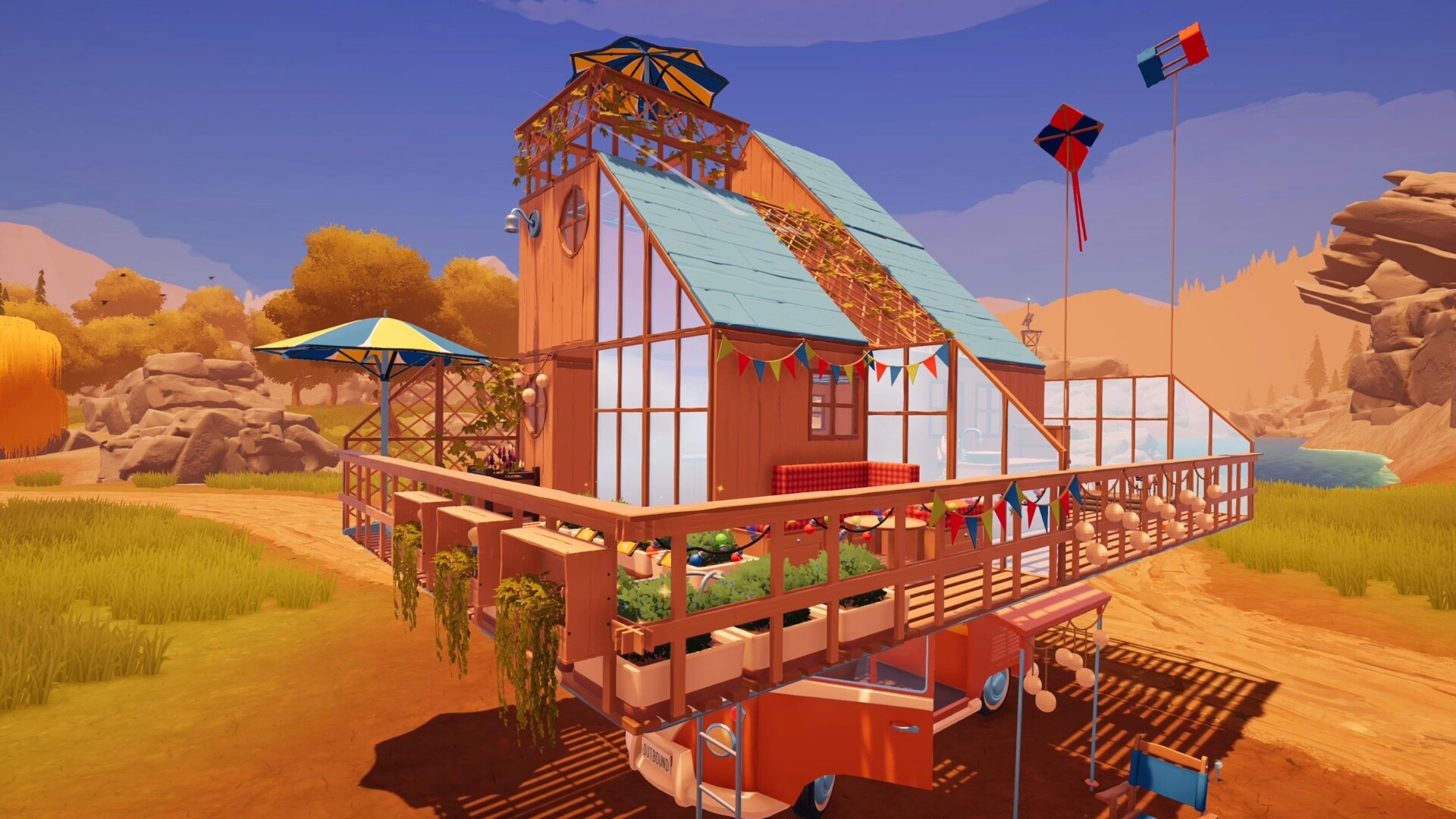
The interaction is physics-based rather than score-driven. There is no fail state, timer, or competition element. The kite simply reacts to the wind: it climbs, dips, and sways depending on conditions. Stronger gusts push the kite higher and make it more responsive, while calm air causes the kite to drift lower and requires more effort to keep aloft. Players can adjust their position on the ground to find better wind angles, turning kite flying into a gentle, hands-on experience.
Because Outbound's world uses a dynamic weather system, conditions can shift while a kite is in the air. A light breeze might pick up into a steady wind, giving the kite more lift, or the wind might die down, causing the kite to slowly descend. This creates a natural, unscripted feel to each session.
Crafting Kites
Kites are crafted at a workstation inside or near the camper van. The Kickstarter campaign promised "a variety of kites," and different kite designs are available, each with a distinct visual style. Crafting a kite requires common natural resources such as fabric, sticks, and string, all of which can be gathered while exploring.
Some kite designs may require specific materials found only in certain biomes. For example, kites that use dyed fabrics or patterned materials could call for resources native to particular regions, encouraging players to explore beyond their usual routes. Additional kite blueprints may also be discovered through Signal Towers, which unlock new crafting recipes as players progress through the technology tree. Other designs might be found at landmarks scattered across the map, rewarding thorough exploration with cosmetic variety.
Each kite design is purely cosmetic. There are no stat differences between kite types; a simple diamond kite catches the wind just as well as a more elaborate design. The variety is meant to give players creative expression and a reason to experiment with different crafting materials.
Weather and Wind
Outbound's dynamic weather system plays a central role in kite flying. The game tracks wind direction and strength as part of its broader environmental simulation, which also governs wind energy generation for the camper van. Kite flying taps into this same wind model, so the kite's behavior reflects actual in-game weather conditions rather than a separate mini-game system.
Ideal kite flying conditions include steady breezes and overcast or partly cloudy skies. Light to moderate wind provides the best balance of lift and control. Strong winds make the kite more dramatic and exciting to watch but harder to steer. Very calm conditions make it difficult to keep the kite airborne at all, and the kite will slowly sink if there is not enough wind to sustain it.
Rain and storms generally make kite flying impractical. While the game does not explicitly forbid flying a kite during bad weather, heavy rain and extreme wind gusts create conditions where the kite becomes difficult to manage. Players looking for the best kite flying sessions should pay attention to the weather forecast and choose moments when conditions are favorable.
Because wind patterns can vary between biomes, some regions may be naturally better suited for kite flying than others. Coastal areas and open plains tend to have more consistent wind, while dense forests or sheltered valleys may block airflow. This gives players a reason to seek out scenic, windswept locations for their kite flying sessions.
Best Locations
Kite flying requires open space above the player. Dense tree canopy and narrow valleys limit how high a kite can climb, so the best locations are open fields, hilltops, coastal cliffs, and wide plains. Outbound's world has a range of biomes from forests to deserts, coastlines to mountains, and each offers different kite flying opportunities.
Open plains and grasslands provide wide, unobstructed space with consistent wind. These are the most straightforward spots for kite flying.
Hilltops and ridgelines tend to catch stronger winds due to elevation, making them ideal for getting a kite high into the air.
Coastal areas often have steady sea breezes. Flying a kite near the shore with ocean views makes for a particularly scenic experience.
Campsite clearings next to the van offer a convenient option. Players can set up camp in an open area and fly a kite without wandering far from their vehicle.
Desert biomes offer flat, open terrain with few obstructions, though wind conditions may vary.
Part of the appeal is finding a personally meaningful spot. A ridge overlooking a valley at sunset, a cliffside above crashing waves, or a quiet meadow near a landmark can all serve as memorable kite flying locations. The activity pairs naturally with the game's emphasis on scenic discovery and slow-paced exploration.
Multiplayer Kite Flying
Outbound supports co-op play with up to four players, and kite flying works as a shared group activity. Multiple players can fly kites at the same time in the same area, each controlling their own kite independently. There is no competitive scoring or racing element; it is a cooperative, low-pressure leisure experience.
In multiplayer sessions, kite flying provides a natural downtime activity. After a long stretch of driving, gathering resources, or working on the van together, players can pull over at a scenic overlook and spend a few minutes flying kites before continuing their journey. The activity gives groups something relaxing to do together that does not require coordination or division of labor.
Flying kites during golden hour or at sunset is a popular choice for players who enjoy the game's visual atmosphere. The combination of multiple colorful kites against a dynamic sky, with the camper van parked nearby, captures the road-trip spirit that defines Outbound's identity.
Connection to Cozy Design
Kite flying is one of several leisure activities in Outbound that exist outside the core gameplay loop of building, crafting, and resource management. Along with fishing, beekeeping, camping, and other mini-games and activities, kite flying contributes to the game's identity as a cozy experience rather than a survival challenge. Square Glade Games has described Outbound as a game about living sustainably off-grid in a utopian near future, and activities like kite flying reinforce the idea that not every moment needs to be productive.
The feature reflects a broader design philosophy in Outbound where the world is meant to be enjoyed, not just optimized. Players are free to ignore kite flying entirely if they prefer to focus on van upgrades and technology progression, but its presence gives the game texture and variety. For many players, these low-stakes activities are what distinguish Outbound from more traditional survival-crafting games.
Kickstarter Context
The Cozy Kites stretch goal was the third goal unlocked during Outbound's Kickstarter campaign, which ran from August 13 to September 12, 2024. The campaign set an initial funding target of EUR 30,000 and ultimately raised EUR 265,679 from 5,197 backers, reaching 885% of its goal. Cozy Kites was announced as a "surprise goal" and was achieved when funding crossed the 350% threshold.
The full list of stretch goals unlocked during the campaign included Upgrade Units, Camping, Cozy Kites, Fishing, Beekeeping, Modular Sofas, More Mini Games, Building Plus, Character Editor, and a Dog Companion. All ten goals were achieved over the campaign's 30-day run. The breadth of stretch goals reflected strong community enthusiasm, with the campaign reaching its base funding target in under two hours after launch.
Square Glade Games positioned Cozy Kites as a feature that would add atmosphere and personality to the game without introducing new systems or complexity. By keeping it simple, a cosmetic activity with physics-based wind interaction, the studio ensured it could deliver the feature alongside the more mechanically involved stretch goals like fishing, beekeeping, and the character editor.
Tips
Check the weather before deploying a kite. Steady breezes give the most enjoyable flying experience.
Head for high ground or coastal areas if wind is weak in your current location.
Kite designs are cosmetic only, so craft whichever style you find most appealing.
In co-op, flying kites together at a scenic spot makes for a great group photo opportunity.
Kite flying pairs well with camping. Set up a campsite in an open field and enjoy the view while your kite soars overhead.
Explore different biomes to discover new kite blueprints at landmarks and Signal Towers.