
Loading...
Loading...
Quests and Story
May 31, 2026 at 12:20 PM
Added dual-storyline structure, planned timeline framing, study image, and expanded side-character storyline confirmation
The campaign runs two main storylines in parallel. One is a faithful adaptation of the original novel, following the canonical arcs as they unfold; the other is an original personal storyline built around the player's own Beyonder. The player progresses both tracks at once, experiencing Klein Moretti's legend through their own journey rather than playing as Klein. The studio has described the original storyline as set roughly two years after the events of the novel's first book, and the full novel adaptation is planned to span roughly four years of content updates.
Lord of Mysteries' main story follows the player's original Beyonder character through the early arcs of the source material from a fresh perspective. The player is not Klein Moretti; the player walks the streets of Tingen alongside Klein, occasionally crossing paths with him as an NPC, and unlocks 'Mr. Fool's history' visions that show Klein's canonical events from inside the Beyonder world.
The campaign is divided into Acts. Act 1 (the Crimson Test build) covers the player's induction as a Sequence 9 Beyonder in Tingen, the first dungeon investigation, the introduction of the Seven Orthodox Churches and the Nighthawks, and the player's first promotion ritual to Sequence 8.
Subsequent Acts move the player to Backlund, introduce the Mandated Punishers and the Machinery Hivemind, and surface the long-tail faction warfare and raid arcs.
Each Act ends with a story-locked encounter that adapts a setpiece from the novel. The encounters are reframed for the player's perspective: events Klein causes in the novel are events the player witnesses, helps with, or attempts to investigate from the outside.
Throughout the main campaign, the player periodically receives a 'Mr. Fool' vision: a cinematic flashback to a scene from Klein's canonical journey, narrated by Klein in his Mr. Fool persona. The vision triggers when the player crosses geography or encounters NPCs that overlap Klein's history. Mr. Fool visions are non-skippable on first encounter and become rewatchable from the player's home journal afterward.
Visions serve a meta purpose. They reward novel-reading players with on-screen recognition of canonical scenes; they educate non-novel-reading players about the world's mythology in small digestible chunks; and they provide narrative cover for why a brand-new Beyonder's journey winds through the same landmarks Klein walked.
Side quests cluster into Pathway-themed lines. A Seer character finds divination booths to staff, runaway puzzle-novel manuscripts to read, and tarot-decks to bless. An Apprentice character finds locked doors to pick, rumours to chase, and old workshops to inventory. A Spectator character finds public spaces to monitor, tutoring jobs to take, and dream patients to soothe.
Completion of side quests scores Acting Method meters in addition to standard XP and currency. Side-quest density is highest in Tingen; later cities surface fewer but longer side quests.
Many quests are investigations rather than fights. The player examines crime scenes, cross-references Beyonder lore in the player's home journal, conducts divinations, and decides which suspect to confront. Outcomes branch: a Seer player who divines correctly may identify a culprit and arrest them through a Beyonder-only mechanism; an Apprentice player may find a hidden passage and ambush them; a Spectator player may infiltrate the suspect's mind and extract a confession.
Investigations have multiple solutions. The same case can be solved differently by different Pathways, and the rewards are flavoured to match: a Seer earns a divination prop, an Apprentice earns a key cosmetic, a Spectator earns a hypnosis trinket.
Story scenes are presented through real-time cinematics rather than pre-rendered FMVs. Lighting, weather, and player-character clothing carry over from gameplay into cinematics. Voice-acted lines play in the player's selected voice language; subtitles cover the rest.
Major story choices feed faction reputation, Acting Method meters, and dialogue branches downstream. Choices are not 'good vs. evil'; they are 'how does your character process this situation?' decisions framed by the Pathway Archetype.
Branching can affect which NPCs survive a given Act, which faction extends a hand to the player at a key meeting, and which Sequence-advancement potions the player can craft cheaply later. Branches converge on Act endings to keep narrative coherence; the path to the ending is what changes.
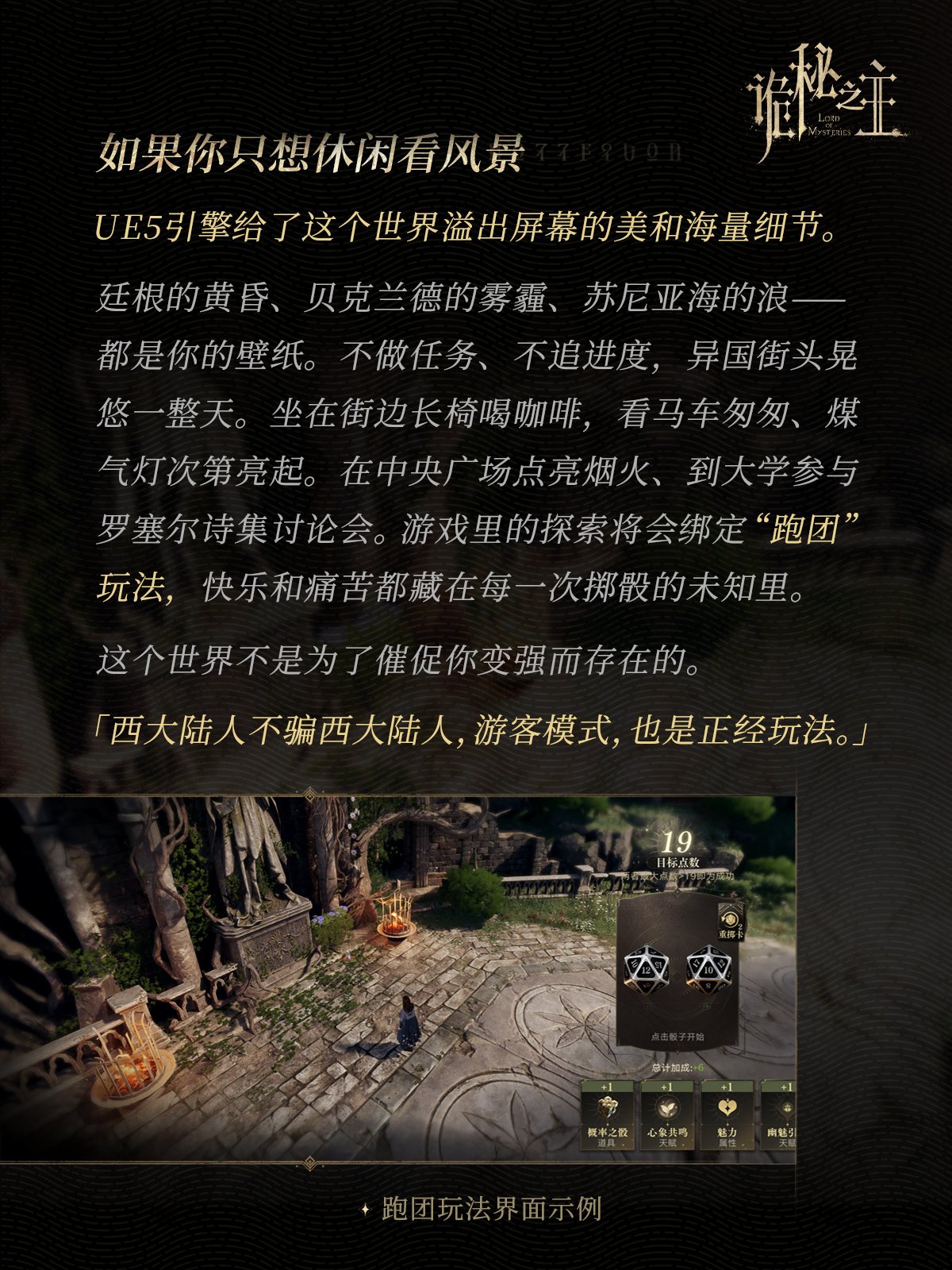
In addition to the Investigation and Detective Work loop described above, the game ships a tabletop-flavoured dice-roll exploration layer. Many in-world map interactions, hidden doors, sealed shrines, statues that block passages, mysterious manuscripts, and certain NPC persuasion attempts, resolve through a dice check rather than a combat encounter. The player rolls two dice against a target value displayed on screen, with modifier rows feeding the result.
Modifier sources include carried items (an example surfaced in dev materials is a 'Dice of Probability' item that grants +1 to the roll result), pathway-aligned talents (such as a 'Mental Resonance' talent on certain pathways for +1), the character's attributes (a Charisma Bonus of +1 when persuading a hostile statue, for example), and pathway-specific skills.
A worked example of the system is as follows: a Seer character facing a statue that blocks a hidden path can attempt a Charisma 19 check to charm the statue into opening. On a successful roll the path opens; on a failure the player still has alternatives, such as blowing up the statue with environmental tools or finding a different way around. The dev framing was, 'all of your fun and suffering at the mercy of destiny,' with the explicit comparison to dice-checked exploration in tabletop-style RPGs. Players coming from comparable single-player roleplaying games will recognize the structure: a roll, a modifier stack, a binary pass-or-fail outcome, and multiple fallback solutions for failed checks.
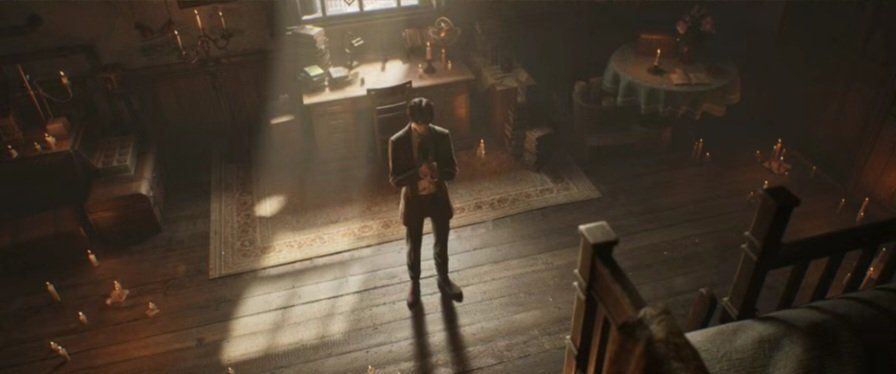
Players who join the Tingen Nighthawks under captain Dunn Smith take on a sub-track of investigative gameplay framed around the city's gas-lit nights. The interactive surface is: walk crime scenes, examine fingerprints and ritual residues, interrogate witnesses (most witness interviews are dice-checked persuasion attempts under the system above), cross-reference evidence in the player's home journal, and bring a suspect to Beyonder court. The dev framing positions this as a true first-person investigative loop, not a button-mash gate: 'you can personally act as a Nighthawk, interrogating witnesses under the gaslights of Tingen.'
Roselle Gustav's diary, the fragmented occult journal passed down from the source material's most famous transmigrator, is treated as an active gameplay artefact. The player can read fragments and crack the diary's secret codes themselves, with the deduction surfaced through journal interactivity rather than a cutscene. Cracked codes feed into main-storyline progression, brewing recipes, and Mr. Fool vision unlocks.
A second category of investigative gameplay takes the player into the Gray Fog to witness past events. Certain main-campaign beats project the player's consciousness into recreations of events that occurred in the eight years before the campaign's start date, including the closing arcs of the original source material's first book. Inside those recreations the player can make different choices, sometimes resolving regrets that were left unresolved in the original narrative.
The studio is explicit about the framing: outcomes inside Gray Fog projections do not retroactively change the game's main-world present. Past tragedies that played out in the source material remain played out; the player's projection-side choices feed pathway progression, Acting checks, and side-character story unlocks, but the game's calendar moves forward on the canonical track. The framing is, 'this time, you are not a reader, you are the one experiencing it.'
Beyond the main plot, the game expands side-plots that the original novel only sketched, giving multiple side characters their own storylines. The framing for this investigative and story content is that this time you are not a reader, you are the one experiencing it: the player can personally act as a Nighthawk interrogating witnesses under the gaslights of Tingen, open Roselle's Diary and decode its ciphers by hand, and verify long-hidden foreshadowing from the original work for themselves.
The studio has signposted that future updates may add original side-character storylines beyond a faithful retelling, treating faithful recreation as the minimum standard and leaving room for characters who passed through the source material only in fragments to receive expanded arcs. Specific titles and characters have not been officially confirmed, and no in-game implementation of a named side-character storyline has been shown for the current build.
