

Overview
The continent of Pywel has endured centuries of conflict, political upheaval, and supernatural disruption. From the earliest recorded settlements to the current power vacuum caused by the comatose King of Demeniss, the history of Pywel is defined by cycles of unification and fracture. Understanding this history is essential for grasping the forces at play in Crimson Desert's narrative, where mercenary bands, noble houses, and otherworldly threats collide across a war-torn landscape.
Ancient History and Early Settlements
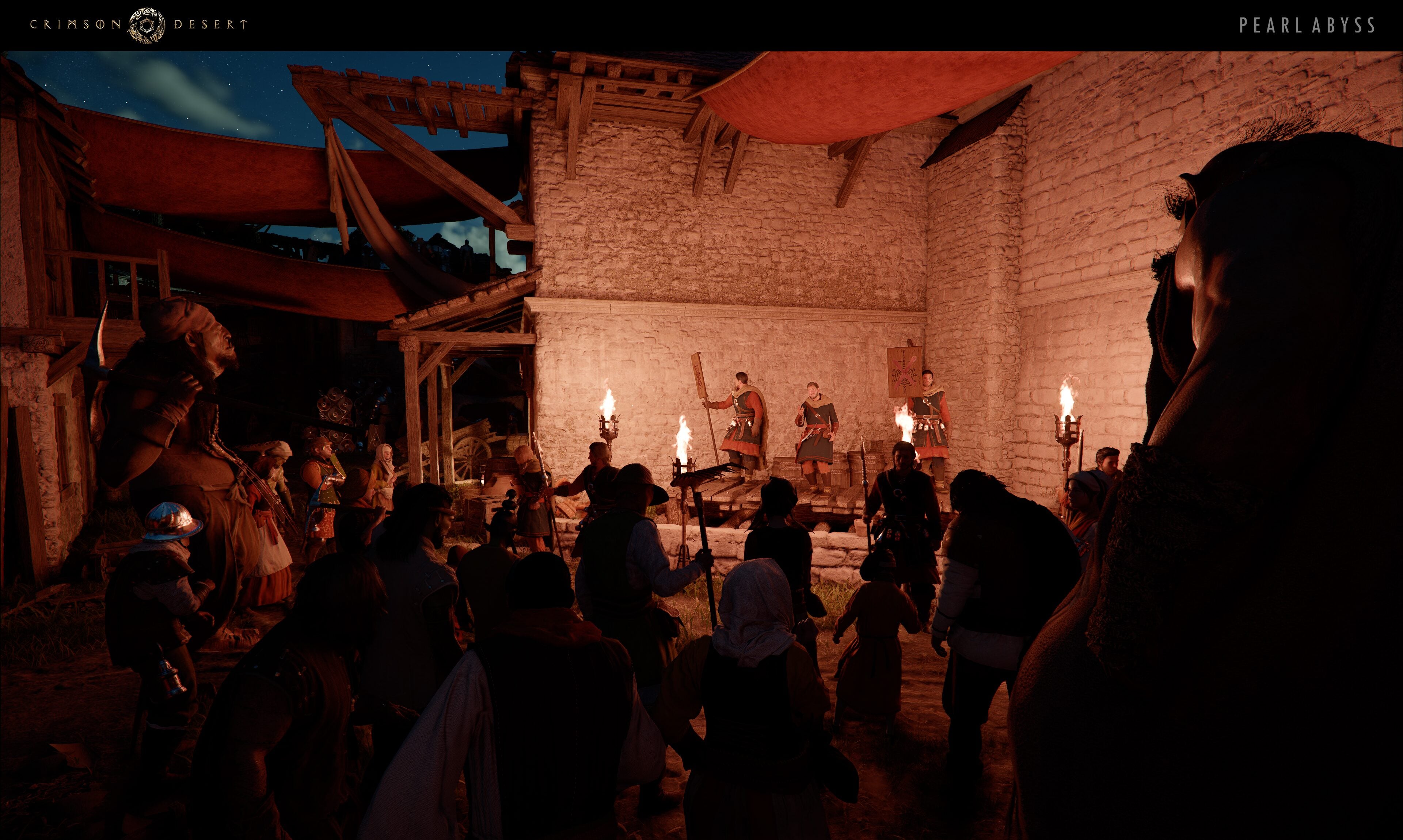
Pywel's earliest history is shrouded in myth and fragmented records. The continent's diverse geography, stretching from the frozen peaks of Pailune in the north to the scorching wastelands of the Crimson Desert in the south, supported the emergence of multiple distinct civilizations. Humans, Orcs, Goblins, and Dwarves each carved out territories and developed their own cultures over the ages.
Ancient ruins scattered across Pywel, particularly in Delesyia and the Abyss sky islands, point to civilizations far more advanced than anything seen on the surface today. The Scholastone Institute, founded by troll scholars, has dedicated significant resources to interpreting the texts and artifacts recovered from these sites. Their research suggests that Pywel's earliest inhabitants may have had a closer relationship with the Abyss than modern scholars initially believed.
Rise of the Great Houses
As populations grew and territories solidified, Pywel's political landscape became dominated by noble houses. The Duchy of Hernand emerged as one of the most stable political entities on the continent, founded and governed by House Celeste. House Celeste traces its lineage to the wandering knight Canta, a figure of near-legendary status whose descendants took on the responsibility of defending the duchy and its people.
Alongside House Celeste, several other houses rose to prominence within the Hernand region. House Serkis, a marquis house, became the right hand of House Celeste, managing internal affairs and administrative governance from the duchy's founding. House Lanford, another marquis house, was entrusted with the defense and governance of the Calphade region along the border with Pailune. The count houses of House Roberts, House Grace, and House Felix each established their own spheres of influence within Hernand, with Roberts building a merchant fortune and Grace investing heavily in technological development.
Further south, the Kingdom of Demeniss consolidated power as the central political and military authority of Pywel. Demeniss became the seat of the king who would eventually be known as the "Unifier of Lands," a ruler who brought the diverse peoples and territories of the continent under a single banner. Great houses such as House Byron and House Thorel established themselves in the capital, positioning themselves close to the throne.
The Unification of Pywel
The King of Demeniss, titled the "Unifier of Lands," represents the most significant political achievement in Pywel's recorded history. Through a combination of military conquest, diplomatic alliance, and strategic marriages, the king brought the fractured territories of Pywel under a centralized authority. The Kingdom of Demeniss became the administrative and military center of this unified state, with the capital city of Demeniss serving as its seat of power.
Under the king's rule, the various duchies and regions were granted a degree of autonomy in exchange for fealty and military support. Hernand maintained its ducal governance under House Celeste, while the frontier regions like Pailune and the Calphade border zone fell under the protection of designated houses. Trade routes were established and protected, with the Goldleaf Merchant Guild, a goblin-run enterprise, expanding its influence across the continent.
The unification was never absolute, however. Pailune's highland clans maintained their own traditions and warrior culture, and the Crimson Desert region remained a lawless expanse that resisted centralized control. Delesyia, the most scientifically advanced region of Pywel, pursued its own technological path, producing mechanical constructs and innovations that set it apart from the rest of the continent.
The King's Coma and the Power Vacuum
The turning point in Pywel's modern history came when the King of Demeniss fell into a coma. With the Unifier of Lands physically present but incapacitated and unable to rule, the fragile political balance that had held the continent together began to unravel. Those who had suffered under the king's iron rule saw an opportunity to exploit the power vacuum, while loyalist factions scrambled to maintain order.
The consequences have been catastrophic. Over 110 factions now compete for influence across Pywel, ranging from noble houses and military organizations to mercenary bands, outlaw groups, merchant guilds, and religious orders. The Factions page provides a comprehensive overview of these competing groups. Regional conflicts have erupted, trade routes have become dangerous, and the common people of Pywel find themselves caught between warring powers.
The Calphade Rebellion
One of the most dramatic consequences of the political instability was the Calphade Rebellion. Cassius Morten, once a loyal officer serving Marquis Stefan Lanford of House Lanford, betrayed his lord and allied with the Black Bears in a violent uprising against the established order. The rebellion engulfed the Calphade region in open warfare, with siege battles, cannon fire, and widespread destruction.
The rebellion was eventually suppressed, and Cassius Morten was executed. However, the conflict revealed a far deeper conspiracy. Morten did not act alone; his loyalty belonged to Bastier, the Grand General of Demeniss. The connection between Morten's betrayal, the Black Bears, and Bastier pointed to a coordinated effort to destabilize Pywel's political order from within. For full details on this conflict, see the dedicated Calphade Rebellion article.
The Fall of the Greymanes and the Struggle for Pailune
In the north, the Greymanes, an honorable warband based in Pailune, suffered their own devastating blow. The Black Bears, led by the ruthless Myurdin, launched a surprise attack that killed many Greymane members and scattered the survivors across Pywel. Kliff, one of the surviving warriors, was thrown into a river and presumed dead.
Kliff's survival and subsequent journey to reunite his scattered companions forms the central narrative of Crimson Desert. His experience in the Abyss, where he awakened with supernatural abilities channeled through the Axiom Bracelet, granted him powers unlike anything seen on the surface of Pywel. His quest for revenge against Myurdin and the Black Bears gradually expands into a larger struggle involving noble houses, continental politics, and the growing influence of the Abyss.
The Growing Influence of the Abyss
Throughout Pywel's history, the Abyss has been an ever-present mystery. This realm of floating sky islands, suspended high above the continent, contains ancient structures, lost knowledge, and raw supernatural power. Abyss fragments and artifacts have been falling to the surface for as long as anyone can remember, and those who study or exploit these artifacts gain access to extraordinary abilities.
In recent times, the Abyss's influence has intensified. The Scholastone Institute has escalated its research, the Antumbra Order (a dark religious group that profanes light and life) has grown bolder, and fragments of the Abyss crash into Pywel with increasing frequency. Whether this escalation is connected to the king's coma, the political chaos on the surface, or some deeper cosmic event remains one of the continent's greatest unanswered questions.
Timeline of Major Events
Era / Period | Event | Significance |
|---|---|---|
Ancient Era | Earliest civilizations emerge across Pywel | Humans, Orcs, Goblins, and Dwarves establish distinct territories and cultures |
Ancient Era | Construction of Abyss structures | Sky islands contain ruins predating all known surface civilizations |
Founding Era | Canta the wandering knight founds House Celeste | Establishes the Duchy of Hernand as a stable political entity |
Founding Era | Houses Serkis, Lanford, Roberts, Grace, Felix, Alfonso, Byron, and Thorel rise to prominence | |
Unification Era | The King of Demeniss unifies Pywel | Continent brought under centralized authority for the first time |
Unification Era | Goldleaf Merchant Guild expands across Pywel | Goblin-run trade network becomes the continent's largest commercial force |
Current Crisis | King of Demeniss falls into a coma | Power vacuum triggers continent-wide instability; 110+ factions vie for control |
Current Crisis | Black Bears attack the Greymanes in Pailune | |
Current Crisis | Cassius Morten betrays House Lanford; rebellion linked to Grand General Bastier | |
Current Crisis | Gains supernatural powers via the Axiom Bracelet; begins quest to reunite the Greymanes |
The Current Political Landscape
Pywel today is a continent fractured along every conceivable line. In Hernand, House Celeste struggles to maintain ducal authority against internal threats and external pressures. The City of Hernand remains a center of commerce and culture, but the surrounding countryside is plagued by bandits, hostile factions, and displaced refugees.
In Demeniss, the noble houses jockey for position in the absence of the king. House Byron and House Thorel both hold significant influence, but neither can claim the throne without igniting further conflict. The military infrastructure of Demeniss remains strong, yet without clear leadership it serves competing interests rather than a unified purpose.
Pailune, the Greymanes' homeland, fell into chaos after the Black Bears' assault. The harsh northern landscape, already difficult to inhabit, became even more dangerous as rival factions moved to fill the void left by the Greymanes' collapse. Meanwhile, the Crimson Desert region remains a lawless expanse, and Delesyia, with its mechanical wonders and advanced technology, pursues its own interests largely independent of the political conflicts consuming the rest of the continent.
It is into this world that Kliff and the surviving Greymanes must navigate, forging alliances, confronting enemies, and uncovering the deeper mysteries that connect the political turmoil on the surface to the supernatural forces of the Abyss above.