Loading...
Loading...
Astronomy
September 27, 2026 at 05:35 AM
Updated the constellation sections with how the released game uses them: 13 observation points, the Constellation Helm, the quest chain and the reward
Astronomy is a gameplay feature in Crimson Desert connected to the game's dynamic night sky and constellation observations. Pearl Abyss kept details about this system under wraps before launch, with marketing lead Will Powers stating that unrevealed information "likely has a plan to talk about it later." What was shown before release suggested a system tied to exploration and the world's environmental simulation. The astronomy feature sits within a broader framework of environmental systems including the dynamic weather and day-night cycle that governs NPC behavior, boss encounters, and world atmosphere.
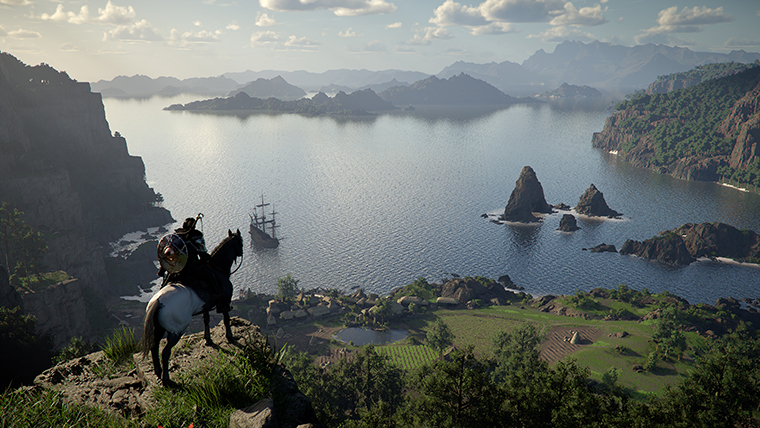
Crimson Desert has a fully realized, dynamic star field rendered by the BlackSpace Engine. When players stop during the night and look upward, they can see an entire unique network of stars that moves and shifts as the planet rotates. The night sky changes based on both the time of night and the player's position in Pywel, meaning different constellations may be visible from different regions. This matches the game's focus on environmental simulation, where altitude, wind, precipitation, and temperature all interact to create dynamic, location-specific conditions.
The astronomy system is inseparable from Crimson Desert's global day-night cycle, which affects far more than just the sky.
Aspect | Effect |
|---|---|
NPCs follow full daily schedules: waking up, performing tasks like farming or fishing during the day, then going to bed at night. The time of day governs which NPCs and threats players encounter | |
Boss Encounters | The weather and time of day can completely change the perception of boss fights and cutscenes. The same fight may look and feel different at night versus during the day |
Environmental Conditions | Weather patterns are generated based on temperature, altitude, and time of day. Everything happens in real time, with clear weather potentially giving way to rain or fog as conditions change |
Star Visibility | The star field is only visible at night, and weather conditions like cloud cover may affect visibility. Clear nights at high altitude provide the best conditions for observation |
In Pearl Abyss's Features Overview trailers, a sequence titled "The Constellations in Your Eyes" reveals that a strange constellation can be discovered when observing a tower in the Steel Mountains. During daytime at this location, the starry sky becomes visible despite the sunlight, suggesting the player needs to align this constellation with its real-world counterpart to trigger some kind of interaction.
In the released game, constellations are a collectible system rather than a single scripted event. There are 13 observation points across Pywel, registered with the Constellation Helm, which is given during the Scholastone Institute faction chain What the Stars Left Behind. Finding every constellation unlocks the Navigator of the Stars achievement and counts toward the Expert Explorer achievement. Registering all 13 opens Maps of the Night Unveiled, which leads to Where Starlight Converges and the Sword of Starlight. See All 13 Constellations for every location.
Crimson Desert's world is filled with environmental puzzles involving ancient mechanisms, light-reflection crystals, and lever-powered gates in ruins. The constellation alignment at the Steel Mountains tower may share mechanical DNA with these puzzle systems. The game also features puzzle-solving on floating Abyss islands, where players use tools to align fragments and manipulate objects. Whether constellation observation feeds into the same reward structure as these puzzles (granting Abyss Artifacts, lore entries, or unique items) has not been confirmed.
The game's core progression system revolves around Abyss Artifacts that can unlock skills and artifacts when collected. Whether the constellation observation system connects to the Abyss or the Artifact collection mechanic has not been confirmed. The Abyss itself is described as a supernatural dimension that influences Pywel, and the idea of celestial alignments connecting to this otherworldly force would be thematically consistent, though this is speculation rather than confirmed fact.
Crimson Desert has a knowledge library with 2,921 pieces of knowledge to discover, tracked across categories including 573 territories, 110 factions, 355 crafting manuals, and 29 mounts. Astronomy observations may contribute entries to this knowledge library. The game's knowledge system rewards exploration and world interaction; entering a region and performing an observation scan grants knowledge, and watching NPCs perform activities can unlock new skills. Constellation discoveries could function as a subset of this knowledge accumulation system.
Before launch, Pearl Abyss said little about astronomy, and this page listed open questions about it. The released game settles the main ones: constellation observation is a progression system with 13 points spread over several regions, it runs through a faction quest chain and two achievements, and it ends in a unique weapon reward. How weather or region affects the wider star field outside the constellation points is not covered here.