
Autonomy and Interaction Queue
Autonomy (also called Free Will) determines whether Zois act on their own or wait for player commands. When autonomy is enabled, Zois go about their daily lives without constant direction, eating when hungry, sleeping when tired, going to work on schedule, and following urges driven by their personality. When autonomy is disabled, Zois do absolutely nothing unless the player tells them to.
The Interaction Queue is the visual interface at the bottom of the screen that shows what a Zoi is currently doing and what they plan to do next.
Toggling Autonomy
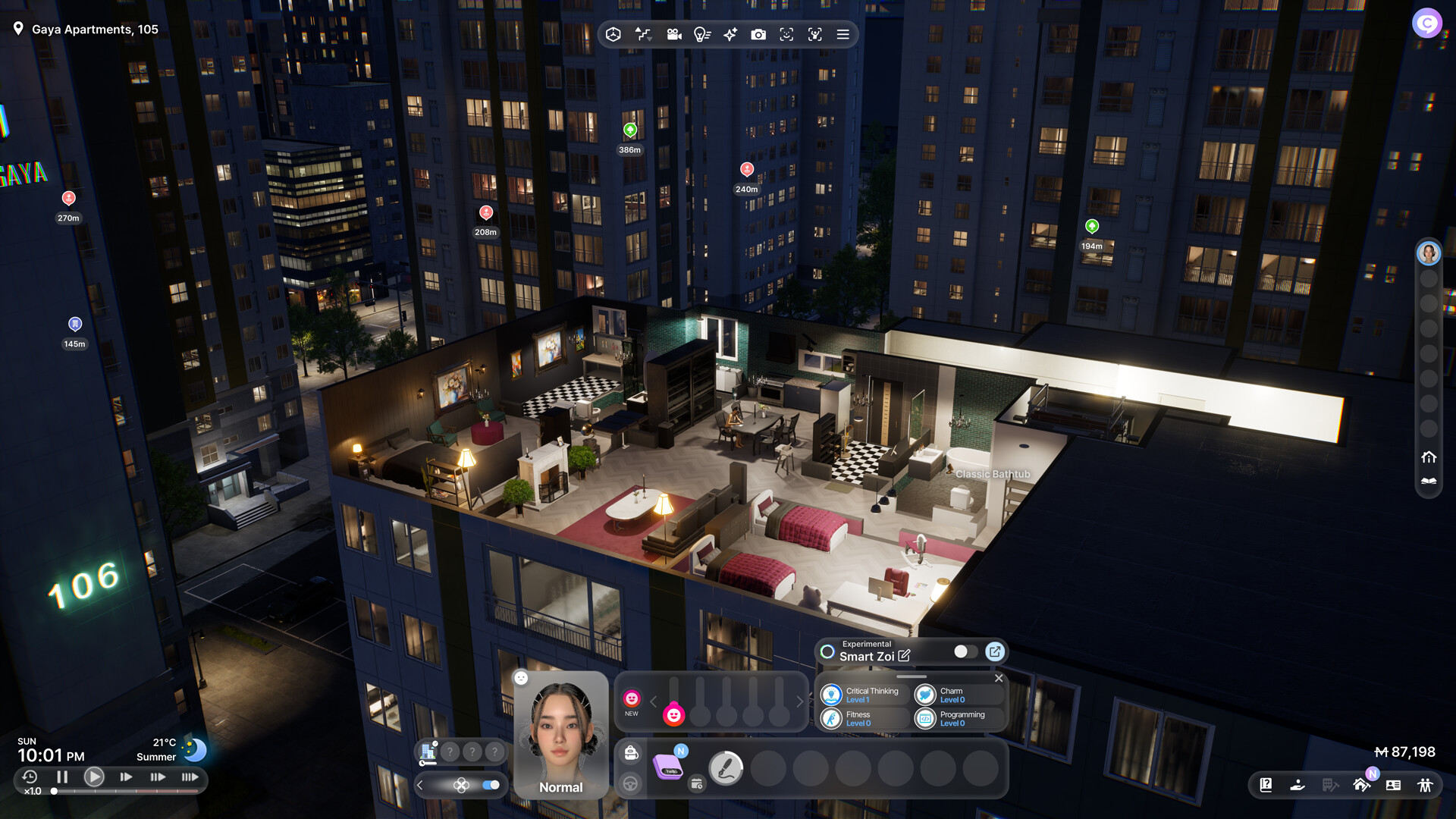
Each Zoi's autonomy is controlled individually. There are two ways to toggle it:
Keyboard: Press T while the Zoi is selected.
UI Button: Click the flower-like toggle icon next to the Needs display at the bottom of the screen.
A visual indicator appears above each Zoi's head to show their current state: a white, open cat's eye means autonomy is ON; an orange, closed cat's eye means autonomy is OFF.
There is also an "Enable by Default" option in Settings > Gameplay > Free Will, though some players report this setting does not reliably apply to existing Zois. Autonomy is a binary toggle; there is no slider or intensity setting. Your Zoi either manages themselves entirely or does nothing at all. The community has requested granular controls (adjust autonomy for flirting, cheating, routines separately), and these are planned for a future 2026 update.
What Autonomous Zois Do
When autonomy is enabled, a Zoi handles their own survival and daily activities:
Need Fulfillment
Autonomous Zois address their eight needs as they decline. Physical needs (Hunger, Sleep, Hygiene, Bathroom) and mental needs (Fun, Social, Recognition, Energy) each deplete at rates influenced by the Zoi's trait. An Adventurer's Energy drains slowly, while a Dreamer's Sleep gauge drops fast.
Need | Autonomous Behavior |
|---|---|
Hunger | Zois cook a random available recipe or use the microwave for a quick meal. Before v0.4.0, autonomous Zois always cooked Bibimbap. The October 2025 update fixed this so they now choose from a wider variety of recipes. |
Sleep | Zois go to bed, sit to rest, or nap on couches when tired. |
Hygiene | Zois shower, bathe, or wash hands. |
Bathroom | Zois use toilets or public washrooms. |
Fun | Zois seek enjoyable activities like watching TV, playing games, or pursuing hobbies. |
Social | Zois initiate brief conversations with nearby Zois. |
Recognition | Earned through work accomplishments, school performance, and discussing achievements with others. |
Energy | Replenished by performing preferred tasks and tackling new activities. |
Need severity is shown by gauge color: white means safe, yellow means significant decline, and red means severe shortage. Autonomous Zois tend to wait until needs reach the yellow or red range before acting, rather than proactively maintaining green levels.
Schedules and Work
Autonomous Zois attend work and school on schedule. When it is time for a shift, the Zoi travels to the workplace and performs their duties. Zois leave home approximately 1 hour before their shift starts (e.g., leaving at 8 AM for a 9 AM shift). However, if the Zoi is in the middle of another action when the work hour arrives, they may stay home and miss the shift. Three unexcused absences result in termination. Scheduling conflicts between queued actions and work obligations are a known inconsistency.
Urges
Urges are temporary impulses driven by personality, preferences, and values. When autonomy is on, Zois attempt to fulfill active urges alongside their needs. Up to four urges can be active at once. Fulfilling an urge rewards Meow Coins and a mood buff. Unfulfilled urges expire after 12 in-game hours. The v0.4.0 update added over 140 new urges and redesigned approximately 120 existing ones to be personality-based. The v0.5.0 update added 77 situation-based urges plus special relationship-triggered and fear-based urges.
Social Behavior
Autonomous Zois can initiate conversations with other Zois, though these interactions tend to be brief (lasting only a few seconds before the Zois walk away). Building meaningful relationships autonomously is slow and shallow. Players who want deep social connections typically need to direct conversations manually. The "Call Over" feature in the relationship panel lets you summon other Zois to your location for directed socialization.
The Interaction Queue
The Interaction Queue is the row of action icons displayed at the bottom of the screen. It shows the Zoi's current action and any upcoming queued actions in order.
Queue Controls
Action | How To |
|---|---|
Add an action | Left-click on an object, the ground, or another Zoi to open the interaction menu, then select an action. |
View details | Hover over an action icon in the queue to see what it is. |
Reorder actions | Click and drag action icons within the queue to change their order. |
Cancel an action | Click the X icon on the action to remove it from the queue. |
The queue can hold up to seven actions. For Smart Zoi, a separate Queue Limit setting (recommended value: 8) controls how far ahead the AI plans tasks.
Interaction Types
Actions are queued through a context-sensitive menu system. What you click determines what options appear:
Target | Available Actions |
|---|---|
Ground | Walk Here, Run Here, Go Home, Call Over |
Objects | Context-specific options (refrigerator shows cooking, computer shows browsing/working, TV shows watching, etc.) |
Other Zois | Conversation categories: Daily Life, Romance, Affection, Humor, Conflict |
Own Zoi (self) | Personal actions: change clothes, take selfie, return home, check phone |
Activity objects | Join option for group activities |
A white circle appears on every interactable object or person in the game world. Using WASD keys for direct movement cancels any queued autonomous action, while left-click movement commands preserve the queue.
How a Zoi Picks Its Next Action
Director Hyungjun "Kjun" Kim described the live selection loop in a July 17, 2026 development letter. Each Zoi scans nearby interaction targets within roughly a 40 metre radius, evaluates each one against its needs, traits, personality, and preferences, calculates a score for every possible action, then chooses the highest-scoring one. Once a target is selected the Zoi moves to it and performs the action.
That scoring model is the reason autonomous Zois can look repetitive: when the same action keeps winning on score, it keeps being chosen. Kjun said the team has become aware of the approach's limits and has decided to redesign the autonomy system itself rather than keep tuning the weights.
How Traits and Values Drive Behavior
The 18 traits (based on the Enneagram personality framework) are the primary drivers of autonomous behavior. Each trait sets:
Trait | Effect |
|---|---|
Need decay rates | Different traits make specific needs drain faster or slower. |
Urge triggers | Each trait generates personality-appropriate urges. |
Skill affinities | Traits push Zois toward activities that level certain skills. |
Social style | Some traits (Explorer, Go-Getter, Individualist, Visionary) make Zois avoid conversation. Others (Entertainer, Charmer, Socialite, Volunteer) make them seek it out. |
Values add a second layer. There are 10 values (Accomplishment, Authority, Autonomy, Challenger, Coexistence, Love, Pleasure, Rule-Abiding, Safety, Traditionalist), each scaling from 0 to 100. Values develop dynamically through gameplay rather than being locked at creation. Once a value reaches 60 or higher, it begins actively influencing the Zoi's autonomous decisions. The highest-scoring value becomes the Core Value, which provides gameplay rewards and shapes daily routines, career choices, and life decisions.
Smart Zoi and Advanced Autonomy
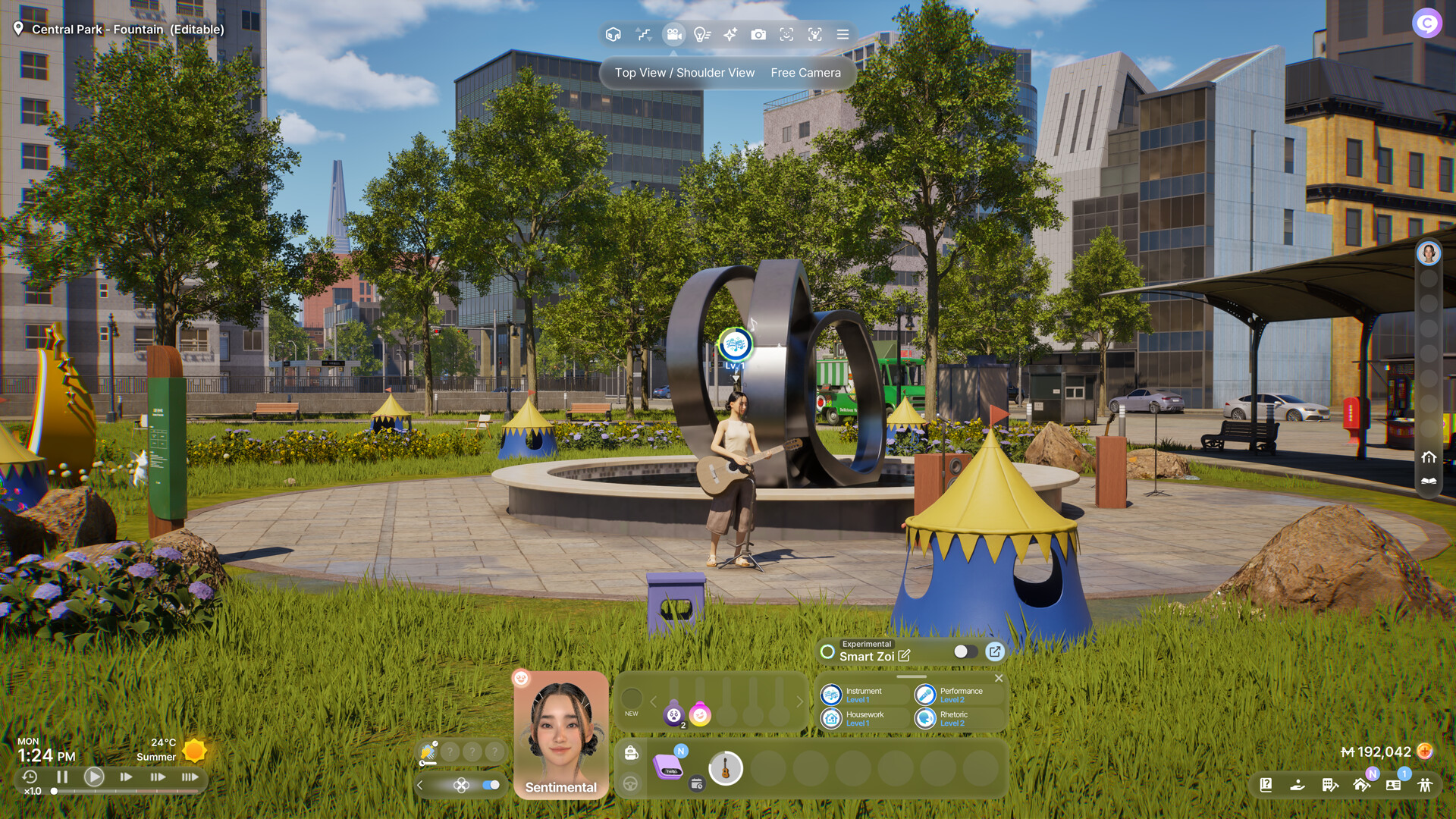
Smart Zoi is an experimental AI feature that adds a more sophisticated autonomy layer on top of the standard Free Will system. Powered by NVIDIA ACE technology (a 0.5 billion parameter Mistral NeMo Minitron small language model running on-device), Smart Zoi gives Zois the ability to:
Generate Inner Thoughts throughout the day, revealing their reasoning and feelings.
Write diary entries at the end of each day that influence the next day's schedule.
Make personality-driven decisions (e.g., a compassionate Zoi buying food for a stranger).
Accept player suggestions through the Zoi Pen (100-word text input tool).
Without Smart Zoi, autonomous Zois use traditional AI and queue somewhat random tasks. With Smart Zoi enabled, behavior becomes learning-based and personality evolves daily. Smart Zoi essentially turns NPCs into co-playable characters (CPCs) that simulate human behavior.
Smart Zoi requires an NVIDIA RTX GPU (minimum RTX 3060 with 8 GB VRAM) and 12 GB RAM. Activating Smart Zoi automatically lowers graphics settings by one level when active. Players can adjust the application range (how many Zois in the city use Smart Zoi) and the queue limit for AI-planned tasks.
Multitasking
The v0.5.0 update (December 2025) introduced limited multitasking. Zois can now perform certain action combinations simultaneously:
Talking while eating
Talking while using computers
Eating while watching TV
Checking smartphones during other activities
Multitasking is currently limited to these specific combinations. Zois cannot perform unrelated complex actions at the same time (e.g., cooking while exercising). Autonomous multitasking is primarily limited to talking or checking smartphones alongside another activity.
Grouped Zoi Behavior
The v0.5.0 update also introduced group mechanics. When multiple Zois are grouped together (via the group button in the HUD), they prioritize interacting with each other over other Zois. Grouped Zois are more likely to eat together, travel together, and engage in shared activities. This makes managing families and friend groups significantly easier, as grouped Zois naturally gravitate toward the same locations and activities.
Employee Autonomy
For Zois who own a small business, the v0.5.0 update added employee autonomy. Hired employees at your business perform their assigned tasks independently, serving customers, stocking shelves, and managing their own needs during shifts. The business owner does not need to micromanage each employee's actions; they handle their responsibilities based on their assigned role.
Leaving Zois Unattended
What happens when you step away depends on the autonomy setting:
Setting | Consequence |
|---|---|
Autonomy ON | Zois handle basic survival but make suboptimal decisions. They eat when hungry, sleep when tired, and use the bathroom. However, they tend to reach critical need levels before acting rather than maintaining needs proactively. Relationships with household members can deteriorate from neglect. In extreme cases, Zois have been reported to nearly starve or collapse from exhaustion. |
Autonomy OFF | Zois do absolutely nothing. Needs drain continuously without action. Approximately 3 to 4 in-game days of neglect leads to starvation death. Prolonged sleep deprivation is also fatal. |
When all household members are asleep, the game clock automatically advances at 30x speed (added in v0.3.0), fast-forwarding through the night.
Known Issues
The autonomy system is actively being developed, and several issues have been reported by the community:
Issue | Description |
|---|---|
Queue wipe bug | Adding a new action to the queue sometimes cancels all previously queued actions instead of appending. This has been reported since v0.2.0 and remains inconsistent. |
Autonomy re-enables itself | The autonomy toggle turns back on after being disabled, especially after switching families, during sleep, or when using speeds above 5x. |
Repetitive behavior | Autonomous Zois default to the same limited activities (cleaning, sweeping, tidying appearance) without variety. Smart Zoi users report excessive mirror-checking and street cleaning. |
Conversation interruptions | Autonomous conversations frequently interrupt eating, bathing, painting, and other activities mid-action. |
Poor self-care timing | Zois wait until needs reach critical levels before addressing them, rather than acting when needs first start declining. |
Business abandonment | Zois leave their business during operating hours to go home for unrelated actions. |
Shallow social AI | Autonomous Zoi-to-Zoi interactions last only a few seconds. No meaningful relationships form without player direction. |
Patch History
Version | Changes |
|---|---|
v0.1.0 (March 2025) | Base autonomy system launched with toggle (T key). Smart Zoi experimental feature introduced. |
v0.1.x Hotfixes | Sleep duration reduced (was too realistic). Karma change rate from autonomous actions slowed. Zois now eat food immediately after cooking. |
v0.2.0 (June 2025) | Emotional rewards added to personal interactions. Conversations better reflect Zoi relationships. |
v0.3.0 (August 2025) | Inner thoughts expanded. Conversation results branch into 2 to 3 possible paths. New group actions (eating together, playing games). Auto-advance clock at 30x when household sleeps. |
v0.4.0 (October 2025) | Major mentality overhaul: traits, characteristics, ambitions, and urges unified. 140+ new urges, 120 redesigned. NPC Zois get personality-matching ambitions. 15 new characteristics (Extroverted, Bookworm, etc.). Autonomous meal variety improved. |
v0.5.0 (December 2025) | Multitasking introduced (limited combinations). Employee autonomy for businesses. Group mechanics: grouped Zois prioritize each other. 77 new situation-based urges. Pathfinding improvements. |
v0.6.0 (February 2026) | Smart Zoi action selection optimized. Korean language model restored. Stability focus. |
v0.9.4 (July 9, 2026) | Autonomous behavior system improved: fewer unnecessary conversations, and interactions better matched to the situation when needs are low. Automatic mealtime meal preparation temporarily removed after producing meals in unintended ways, with plans to reintroduce it in an improved form. |
v0.9.5 (July 15, 2026) | Fixed repeated weekday-morning routines, partially fixed autonomous Hunger fulfillment, restored reactions to fires, improved multi-Zoi conversation exclusion, and shortened cooperative interaction waits. |
v0.9.6 (July 30, 2026) | Mitigated Zois suddenly spawning in front of the player and improved awkward-looking movement routes. |
Planned Improvements
The 2026 roadmap includes several autonomy-related improvements:
Adjustable autonomy rules for flirting, cheating, and routines
Group autonomy toggle from the HUD
"Areas of interest" where Zois naturally combine compatible interactions based on context
Smarter movement (side-by-side walking, better positioning during conversations)
Reduced action interruptions
Enhanced hunger, seating, and idle animation systems
Deeper romance and breakup systems with multiple outcomes
Animation styles reflecting personality traits
Autonomy Redesign (Announced July 17, 2026)
On July 17, 2026 Kjun announced that the team is going back to the drawing board on autonomy rather than extending the current scoring model. The stated goal is for a Zoi to satisfy immediate needs first and then make decisions that reflect who it is, using rules that resemble how people actually decide instead of repeatedly picking whichever action scores highest.
Two examples were given: an outgoing Zoi should naturally spend more time socialising, and a family-oriented Zoi should prefer time with a spouse and children. A couple visiting a park together should walk together and talk rather than immediately separating. Kjun called autonomy the true engine of a life simulation game and said it should be the foundation that connects every other system.
Improving autonomy was named the highest development priority for the rest of July 2026, with August 2026 focused on strengthening the connections between the game's systems. None of the redesign had shipped when it was announced; the v0.10.0 and v0.11.0 sections below cover what reached the live build.
Dining Search and Purpose-Driven Visits (Late July 2026)
The July 24 developer update described the first rebuilt behavior in detail. When a Zoi wants to sit down and eat, the game searches for a dining spot step by step: a table in the same room first, then suitable tables farther away, then the entire lot with indoor dining prioritized, or a 40-meter radius when the Zoi is in a public area. If nothing is available, the Zoi eats on a nearby chair while holding the food, and family members and friends are seated together where possible. The team is optimizing the search order and scope so the logic stays cheap when many Zois run it at once.
The July 31 letter added the next stage: purpose-driven visits. At standard lots such as cafes, bakeries, and parks, Zois will prioritize the reason they came, with a target of roughly 90 percent purpose-driven actions and 10 percent random behaviors, and the fixed minimum stay time is being removed so Zois head home once the objective is done. The team is also researching fallbacks so a Zoi does not get stuck when a seat or required condition is missing. Autonomy options are being simplified in parallel: the most recently applied setting will win across the current city, family, and per-Zoi layers, and autonomy settings are planned to extend to certain NPC families.
Ground-Up Autonomy Rebuild (Announced August 21, 2026)
On August 21, 2026 the development team said it was no longer patching autonomy piece by piece. Because the studio had concentrated on adding new content, systems that previously worked had gradually broken or started conflicting with each other across successive updates: Zois that once followed their routines might stop going to sleep at the right time, or repeat unrelated actions instead of the ones they actually needed to do, and family members showed unusual behavior in how they interact day to day.
Autonomy was singled out as one of the most important systems affected, and the team is now reviewing it from the ground up with structural improvements across the entire system rather than fixes to individual parts. The trade-off was stated openly: the September 2026 update carries few new features because a large functionality push and a system overhaul could not run at the same time. The release instead pairs the autonomy redesign with high-priority fixes drawn from the community's FF list. Players should expect autonomous behavior to change more than usual when that update lands.
v0.10.0 Autonomy Rebuild (September 3, 2026)
The ground-up autonomy work announced on August 21, 2026 shipped in v0.10.0 on September 3, 2026. Behaviour quality was reworked around three factors: time, place, and occasion.
Autonomy behaviours can be toggled on and off separately for an individual Zoi, for household members, and for every Zoi in the city.
A bed is assigned to each household member after a move or another significant life event.
The rate at which a house becomes dirty was adjusted so that Zois clean roughly once every two to three days.
Zois in a group move together to a set destination. A Zoi that falls too far behind travels to the same location independently.
The indicator above a Zoi's head shows whether that Zoi is taking part in a group activity.
The obituary text message now states the cause of death.
The interaction queue changed alongside it. Zoi profile pictures are shown on the queue, an impossible interaction now displays the reason it cannot run, and identical interactions can be set to repeat automatically against applicable targets nearby. Zois can knock on another Zoi's door, ask a housemate to run an errand, and ask a Zoi they are close to, whether by friendship, romance, or business, to stay the night, in which case the guest sleeps over and leaves the next morning.
Smart Zoi decision-making was widened in the same update to take account of current location, group activity, social event, job, and owned business. An interaction chosen by a Smart Zoi is marked with its own symbol, and names on speech bubbles follow the game language setting.
Hotfixes and October Plans (September 2026)
The hotfixes after v0.10.0 kept adjusting autonomous behaviour. v0.10.2 (September 9, 2026) made hungry Zois choose meals by priority, stopped Zois discarding certain Pocket Market purchases of their own accord, fixed autonomous marriages not happening when Get Married was enabled in the Autonomy options, and fixed a plant-loving Zoi stopping after one harvest during Keep Harvesting. v0.10.3 (September 10, 2026) improved meal priority in City Trip accommodation, and v0.10.4 (September 16, 2026) stopped repeated cleaning attempts when no cleaning tool was available, made Zois use umbrellas in heavy rain, and improved the automatic evasion system.
The developer letters of September 9, 16, and 18, 2026 set out what comes next. Lot autonomous behaviour editing in Build Mode, which lets players define which objects Zois may use and how they behave at a business, missed the September update and is planned for October, along with presets for restaurant interactions; director Hyungjun Kim called its absence his biggest regret of the September patch. Zois are also to search across floors for objects, greet acquaintances with a raised hand, and be shown out by a homeowner if a Zoi with a bad relationship lingers. Daily routines for Zois (living, working, returning home) with editable schedules are planned for the October update. For the October mini update the conversation system is being reworked to pick lines based on the relationship between the two Zois, both of their emotional states, and the situation, with more conversation content being written to avoid repetition.
v0.11.0 Autonomy Changes (October 15, 2026)
Zois autonomously visit other households and take part in more fitting activities in those homes. If a visitor is not welcome, the homeowner may ask them to leave.
After arriving at a property, a Zoi now enters it.
Zois start conversations that fit their relationship with the other Zoi and each Zoi's current emotion.
Zois greet Zois they know when they run into them.
When several objects of the same type are available, the closer one is chosen for the interaction.
Autonomy plans can be set for public properties in Build Mode, with permissions for individual furniture and preferred activities for each individual. A plan applies to Zois who have a schedule at that property.
The v0.11.0 patch notes do not list the editable daily routines described in the September 16 reply. In a reply before the update, the director said reports that other Zois insert actions into the middle of the player's queue or cancel queued actions more often since v0.10.0, and that commands given just as an autonomous action starts are sometimes ignored, had been raised in priority. His October 16, 2026 letter said work continues on the new autonomy controls, for example Zois placing food appropriately, sitting down, and eating.
Tips
Toggle autonomy off when you need precise control: directing conversations, managing photo sessions, or ensuring a Zoi completes homework before bed.
Toggle autonomy on when managing multiple household members. Focus on one Zoi while the others handle their own needs.
If the queue wipe bug affects you, try queuing only one action at a time instead of stacking multiple actions.
Use the Zoi Pen (Smart Zoi feature) to steer autonomous behavior thematically rather than micromanaging every action.
Check the Interaction Queue regularly. Autonomous actions can interrupt player-queued tasks without warning.
When leaving Zois unattended, keep autonomy on and make sure the home has a well-stocked kitchen, functional bathroom, and a bed for each Zoi.
Group family members together using the group button to keep them interacting with each other rather than random NPCs.
For large households, consider toggling autonomy off for the Zoi you're actively controlling and leaving it on for everyone else.
Related Articles
Interactions | Urges | Traits | Values | Needs | Smart Zoi | Emotions | Multitasking