

This article is incomplete
Some sections are missing or need additional details. Help improve it by contributing.
Grave Seasons combines a traditional farming sim loop with an ongoing murder investigation. By day the player tends a farm, gathers resources, and builds relationships around the town of Ashenridge. As the seasons pass, murders occur, and the player must investigate the townsfolk to work out who the supernatural serial killer is.
Perspective And Presentation
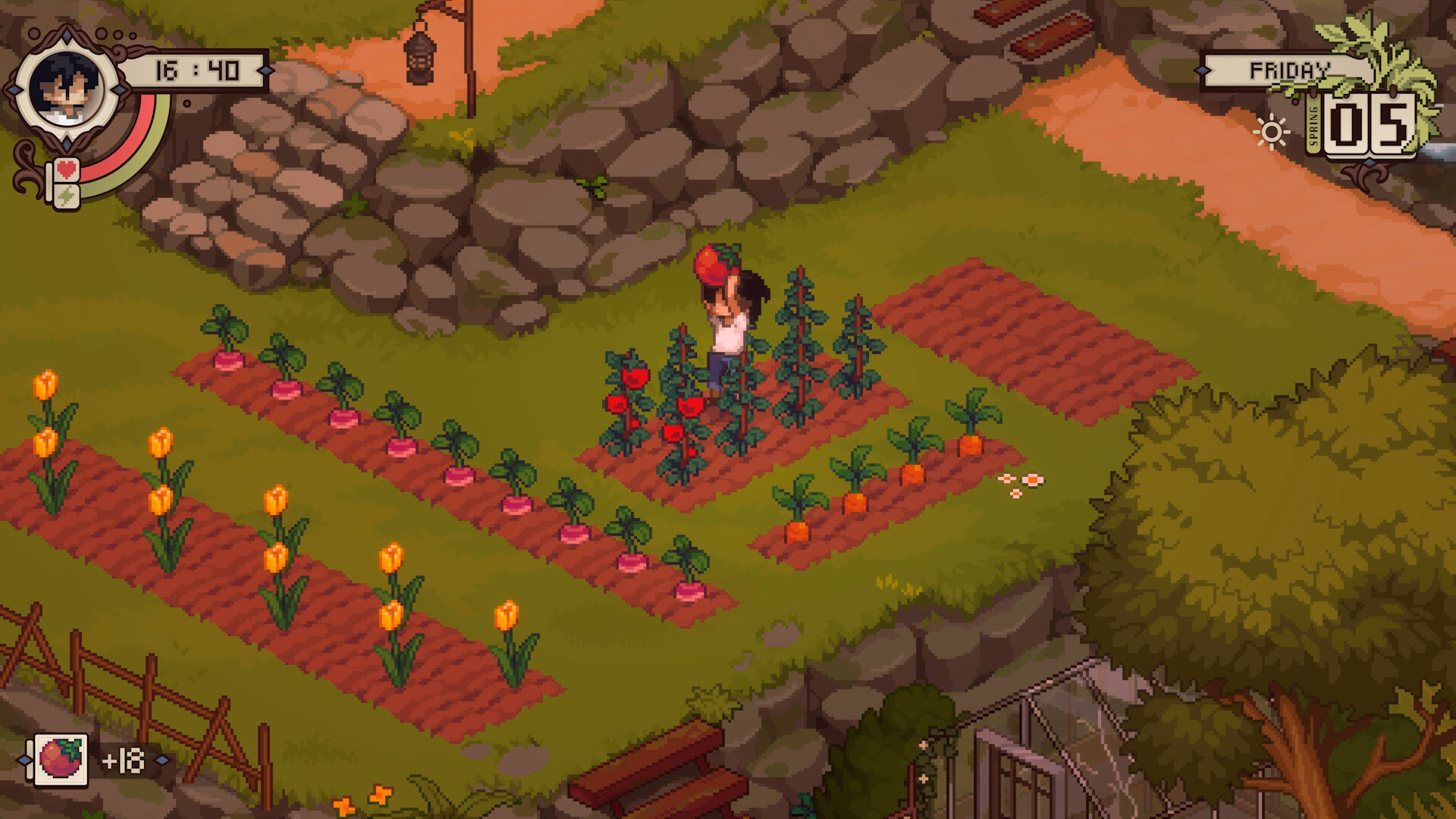
The game uses an isometric perspective rather than the bird's-eye view common to many farming sims. The overworld and gameplay are presented in pixel art with hand-animated character sprites in all directions, while conversations with townsfolk swap in detailed portrait artwork.
A dynamic day and night cycle changes the mood of Ashenridge throughout each day. Daylight scenes are bright and inviting; evenings turn dark and unsettling, and some of the game's most ominous moments happen after dark. There is no hard stop at nightfall, so the town stays explorable around the clock and residents keep their own schedules into the night, which makes the late hours a useful window for snooping.
The Daily Loop
Daily life follows the rhythm common to farming sims, with one notable change: there is no forced bedtime that halts the action at night. The game runs on a full 24-hour day, so the player can keep exploring after dark, though rest is still part of the farming loop. Players use a tool wheel that includes a shovel, watering can, axe, pickaxe, and a crowbar filed under a Crime category. The day-to-day activities include tending crops, gathering raw materials, processing them into goods, and selling those goods in town to take part in the local economy. Everything the player harvests and crafts feeds back into the investigation, so productive farming and detective work are linked rather than separate. See Tools for the full list of tools and their upgrades.
Two things constrain a day. Energy is one: the studio's farming devlog confirms that the game refuses a farm action outright when the player does not have enough energy left for it, and passing out from exhaustion is among the animations the team has built for the player character. The clock is the other, and it keeps running no matter what the player is doing. Time is effectively a resource, and choosing how to spend a given day means giving up whatever else could have been done with it, which keeps farming and investigation in constant competition for the player's hours.
Core Activities
Activity | Description |
|---|---|
Farming | Till soil, plant, and water crops across different soil types. See Farming. |
Fishing | Catch fish in the waters around Ashenridge. See Fishing and Mining. |
Mining | Dig for ore and smelt it into ingots. See Fishing and Mining. |
Crafting and Cooking | Process raw goods and craft useful items. See Crafting and Cooking. |
Investigation | Search for clues and uncover residents' secrets. See Investigation and Clues. |
Relationships | Complete quests, build trust, and romance townsfolk. See Romance and Relationships. |
Interacting With The World
Because the game is drawn in isometric 2D and its scenes are not built on a tile grid, interaction is handled by grids the team added underneath. A visible grid appears on farm plots to show which squares are in reach, colouring a cell red when the action is not allowed. An invisible grid covers every other scene and tracks what can be picked up, talked to, or opened, resolving movable things before immovable ones. The game checks the three tiles ahead of the player while farming or foraging and all nine surrounding tiles for conversations. See Farming for the detail.
Facing direction is worked out from the player's own input rather than a camera. Movement on the keyboard or stick is translated into the game's isometric space, matched to the nearest of eight compass directions, and used to point the character at whatever they are about to interact with.
On controller, a radial menu gives quick access to the game's menus during play, which the team added specifically for console and pad users.
Investigation Woven Into Farming
The murder mystery is not a separate mode. As the player establishes a farm and embeds into the neighborhood, they get wrapped up in the sudden murders plaguing the town. Investigation skills determine whether the player can identify the next victim and save more blood from being spilled. Resources gathered through farming, fishing, and mining are used to craft items that help ward off the threat and uncover clues.
Environmental horror creeps into ordinary moments, with severed limbs and other grim discoveries possible while foraging. For the full picture of the killer system, see The Murder Mystery.
Choices And Consequences
Player choices shape how the story unfolds. The things the player does, or chooses not to do, affect how the narrative plays out, including who is allowed to live or die. Protecting a potential victim can branch the story in a completely different direction. Because the killer is randomly selected each playthrough, the clues and the path of the mystery shift between save files. Decisions are checked and autosaved as the year runs, and a finished year leaves a record that the next one reads from, so work carried out in one playthrough is tracked into the following one.