

This article is incomplete
Some sections are missing or need additional details. Help improve it by contributing.
Grave Seasons is built around a fixed calendar. Each playthrough covers one in-game year and ends with a defined conclusion, which works hand in hand with the randomized killer to make repeat playthroughs feel different. The title's reference to seasons reflects how central the calendar is to both farming and the murders.
One Year, Four Seasons
A playthrough lasts a single year divided into four seasons: Spring, Summer, Autumn, and Winter. Each season runs as its own month within that year. The season determines which crops can be grown, so the player's farming plans change as the months turn. See Farming for how growing is tied to the seasons.
The season gates what can be planted. There are over 45 seeds in the game, and each one carries the season it will grow in as one of its properties, shown when it is bought and again on its tooltip in the inventory. Some seeds are sold in town and others are only found while foraging, and foraging itself shifts with conditions: certain gatherables only appear in particular weather, so a dreary day can be worth going out in. See Farming for planting and plot types.
The calendar also works as a time management layer. Time is a resource: a day spent on one task is a day not spent on another, so the player is constantly trading farm work, investigation, and building relationships against each other. The team has compared this day to day structure to Persona, which it cites as an influence on that feel.
A Day in Ashenridge
Within each season, the game runs on a full 24-hour day. There is no forced bedtime that stops the action: rather than a hard cutoff at night, the day flows from early morning into midday, then early evening and late night, and the player is free to keep exploring Ashenridge after dark. Live time keeps ticking no matter what the player is doing, so staying out late spends the same hours that could have gone to farming or sleep.
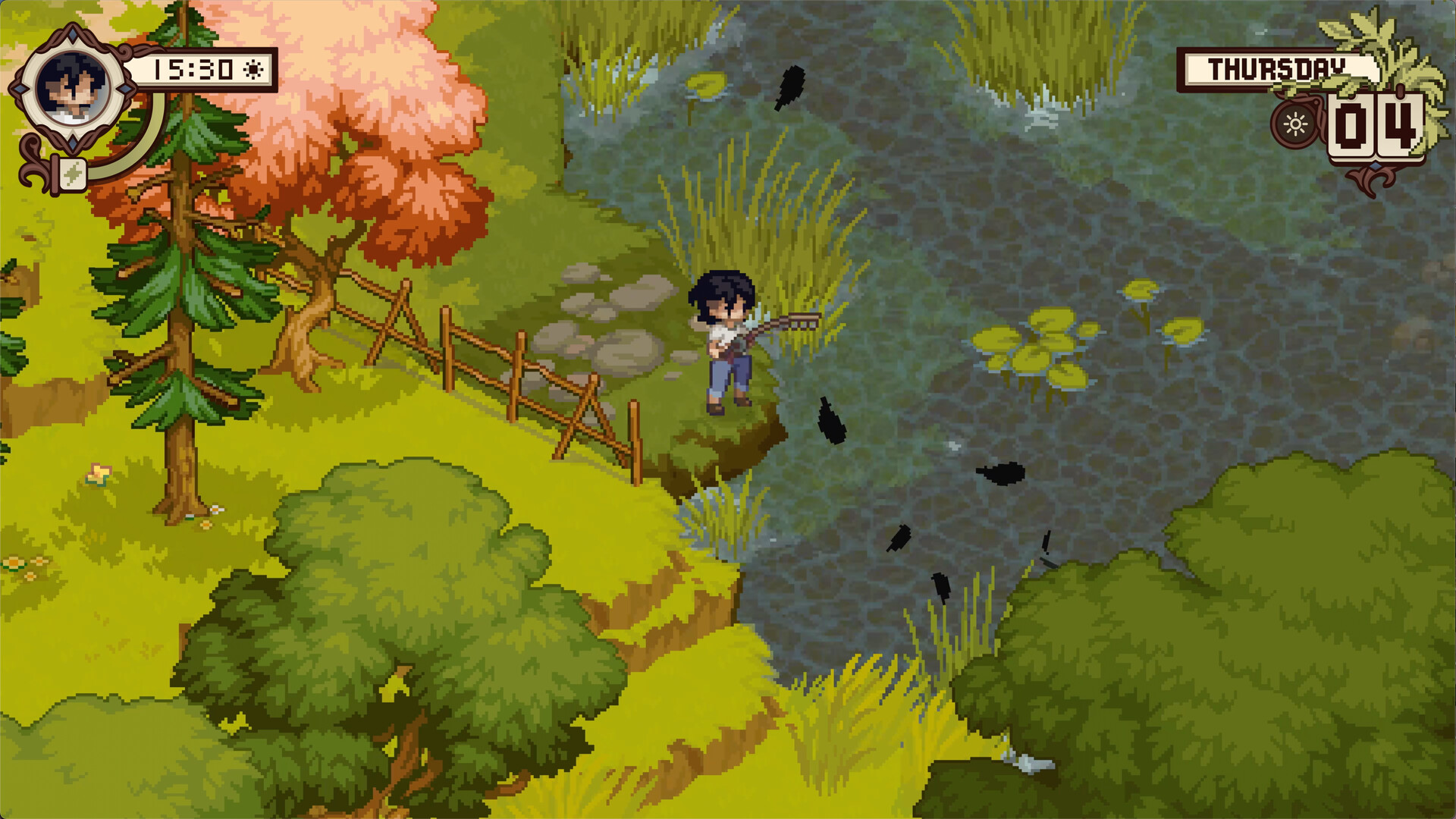
The town stays active at night. Residents keep their own routines around the clock, so NPCs can be found wandering after sunset, drinking late, or lingering by the docks as the light fades. Those nuanced schedules make nighttime a useful window for snooping: the cover of darkness is a natural time to poke around a neighbor's belongings while investigating. See Investigation and Clues.
Weather is part of the same system. The custom lighting pipeline renders adverse weather alongside the shift from day to night, and winter gets its own separate lighting pass because snow and ice change the way light moves through a scene. Night also carries the game's darker tone. Some of the most ominous moments happen once the sun goes down, and the dread builds as each month edges toward its next killing. Rest is still part of the routine, since sleep is tied to the full farming loop, but the lack of a hard nightly stop means the player decides when, and whether, to head back to the farm.
Events On The Calendar
The year is not only farming and murders. The town runs a steady stream of community events across the seasons, and the developers have pointed players at the in-game calendar to keep track of them. The fountain in the commercial district anchors several of these gatherings, and at least one annual event is hosted by Tomás, the town priest. Turning up matters for more than atmosphere, since the whole town in one place is also the whole cast of suspects in one place. See Ashenridge for the venues and Romance and Relationships for what socialising buys the player.
Seasonal Murders
The calendar also paces the killings. As each season passes, the supernatural serial killer targets at least one victim, so the murders are spread across the year rather than happening all at once. With four seasons in a year, that works out to at least four potential victims across a single playthrough. The killer's choice of target depends on which character was drawn as the killer at the start of the run, and which residents the player has befriended along the way.
Each season gives the player a recurring window to investigate, gather clues, and try to protect the next person before time runs out. See The Murder Mystery and Investigation and Clues.
A Defined Ending
Because the year has a fixed length and a defined ending, each playthrough is a complete story. How that story resolves depends on the player's choices, including who lived, who died, and whether the killer was identified or influenced along the way. Once the year is over, the current save concludes; starting a new game draws a fresh killer from the subset of named residents, so the next run unfolds differently.