

This article is incomplete
Some sections are missing or need additional details. Help improve it by contributing.
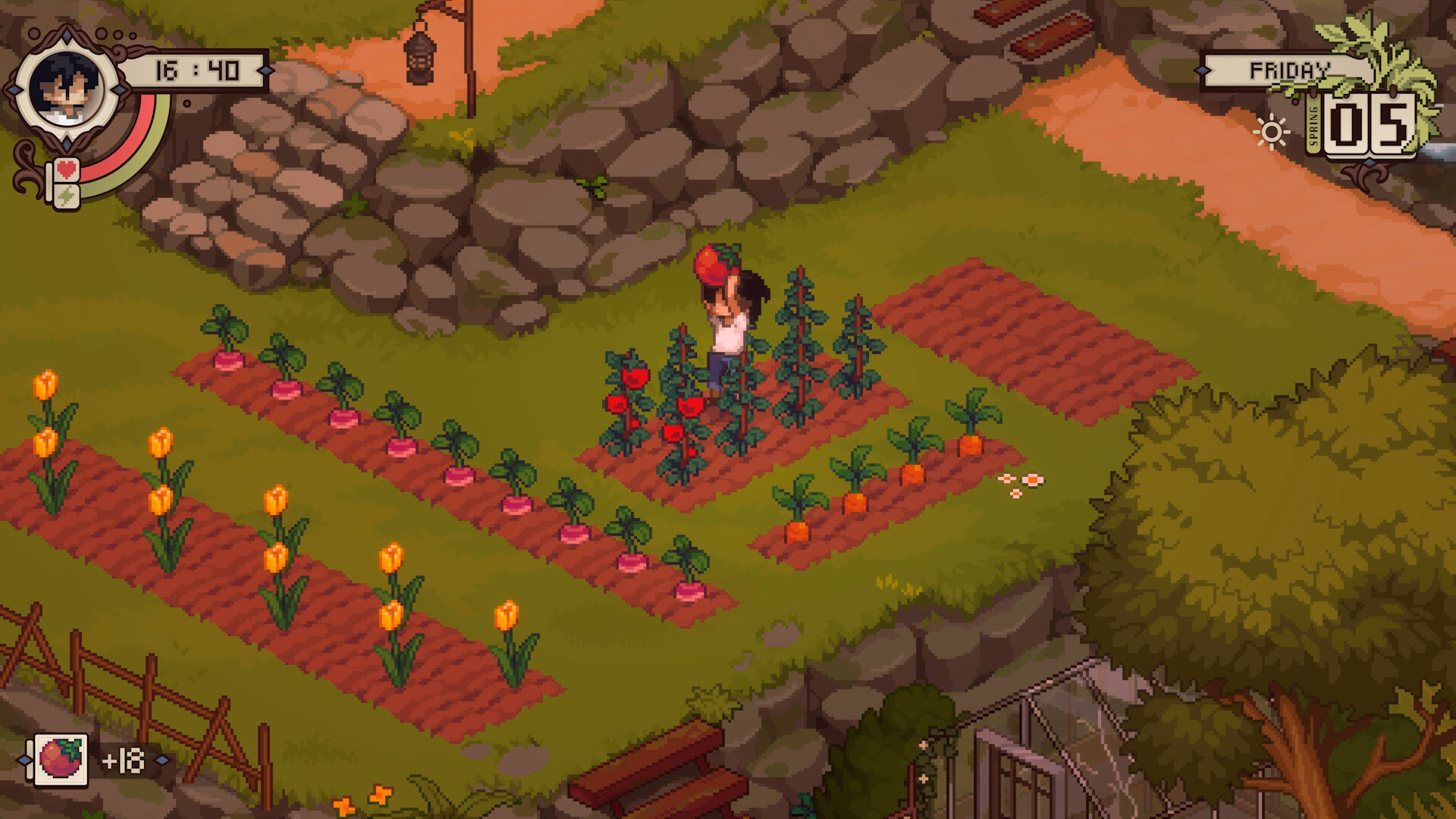
Farming is the foundation of daily life in Grave Seasons. The player establishes a farm in Ashenridge and grows crops to sell in town and to use in crafting and cooking. As in other farming sims, the work involves preparing the land, planting, watering, and harvesting on a daily cycle. Unlike many farming sims, there is no forced bedtime that stops the action at night, so the in-game clock is the main limiting factor on a day's work. Energy still matters: the studio's farming devlog confirms that a farm interaction is refused when the player does not have enough energy for it. Rest is still part of the full farming loop, but the player decides when to take it rather than being pushed to bed at a set hour.
Tools
Farm work is handled through a tool wheel that includes the standard farm sim toolkit, alongside the player's crowbar tucked under a separate Crime category.
Tool | Use |
|---|---|
Shovel | Digs up the land to open a plot for planting. |
Watering Can | Waters planted crops. |
Axe | Chops wood and clears the land. |
Pickaxe | Breaks rocks and is used for mining. See Fishing and Mining. |
Crowbar | Used to break into locked spaces while searching for clues. See Investigation and Clues. |
The studio's own farming devlog names the starting kit as a shovel, a pickaxe, an axe, a watering can, and the crowbar. Hands-on coverage of the public demo build described the digging tool as a hoe, so both names appear in circulation. The watering can is refilled at a hand pump on the farm. The blacksmith Jade can upgrade the watering can, the digging tool, and even the crowbar to improve their reach and reliability, and the developers have said every tool has room to improve in the player's hands. See Tools for the full upgrade picture.
Soil Types
The farm has three distinct kinds of growing ground, and each seed is tied to the plot type it will accept. Choosing the right ground for each plant is part of running an efficient farm.
Plot Type | Where It Sits | Notes |
|---|---|---|
Regular | The bulk of the farmyard | The most common ground and the largest single area. Suits the widest range of common crops. |
Arid | Dry, raised soil higher up the property | Only certain crops will take in this elevated dry ground. |
Wet | Along the river at the edge of the farm | Grows crops that thrive in water, such as rice. Wet plots never need watering. |
Plot sizes are fixed. The farm sits on top of a mountain, so the growing area cannot be expanded, and deciding which crop earns a square in a given season is a real constraint rather than a formality.
Crops
A wide variety of vegetables, fruits, and other plants can be cultivated. Which crops can be grown depends on the current season, so the planting plan changes as the in-game year progresses. See Seasons and Calendar for how the seasonal cycle affects growing.
There are over 45 seeds in the game. Some can only be bought, while others turn up while foraging in the world. Every seed carries its own properties, principally the season it will grow in and the plot type it needs, and those details are shown both at the point of purchase and on the seed's tooltip in the inventory. Seeds are bought from Daniela, who runs the seed shop in town. See Characters for the townsfolk who supply the farm.
The Farming Grid
Grave Seasons is a flat 2D game drawn in isometric perspective, and most of its scenes are deliberately not aligned to a tile grid. The team found that farming without a grid simply was not fun, so they built one specifically for farm work. Standing on a plot brings up a visible grid of cells around the player, showing exactly which squares are in reach of the equipped tool. That grid appears only on farm plots; the rest of the world stays grid-free.
Each cell reads as valid or invalid before the player commits to the action. A cell shows red rather than white when something is wrong: the wrong tool is equipped, the player is short on energy, or the seed does not match that plot type. Interacting with a cell also snaps the character around to face it.
Underneath the visible grid, the whole game runs on an invisible one that covers every scene and tracks what can be interacted with where. Its layers are items, crops, NPCs, objects such as the mailbox and the sell bin, farm plots, and doors, resolved in a fixed order so that movable things are handled before immovable ones. In practice that means the player clears a loose item off a square before digging it. While farming or foraging the game checks the three tiles directly ahead; for conversations it checks all nine tiles around the player, so a resident will stop to talk from any direction.
Farming And The Mystery
What the player harvests is not only an economic activity. The goods grown on the farm play a critical role in unraveling the mysteries of Ashenridge, feeding into the crafting of items used to investigate the murders and ward off the threat stalking the town. Some harvested produce is also reportedly used in occult contexts, an extra wrinkle on top of food, gifts, and crafting. See Crafting and Cooking and The Murder Mystery.
Livestock
Crops are not the whole of the farm. Farm upgrades let the player buy animals, with cows and sheep both named among the livestock available, so animal care sits alongside planting and harvesting in the daily routine. See The Farm for the buildings on the property.