

Monsters & Memories has eighteen playable classes. Each one is built around a single archetype phrase and one to three group roles, and each is open to a fixed list of playable races. There is no multiclassing and no class change: the class you pick at character creation is the class you play, and the stated design target is meaningful progression and milestones across the full 1-60 journey.
Class identity matters here more than it does in games built around interchangeable damage output. The game is designed around grouping with one or more other players, so every class is measured first by what it brings to a group of six, and only second by how it performs alone.
Class design goals
The current class index sets out what the team is aiming for across all eighteen. These are the stated goals, not a description of the finished state:
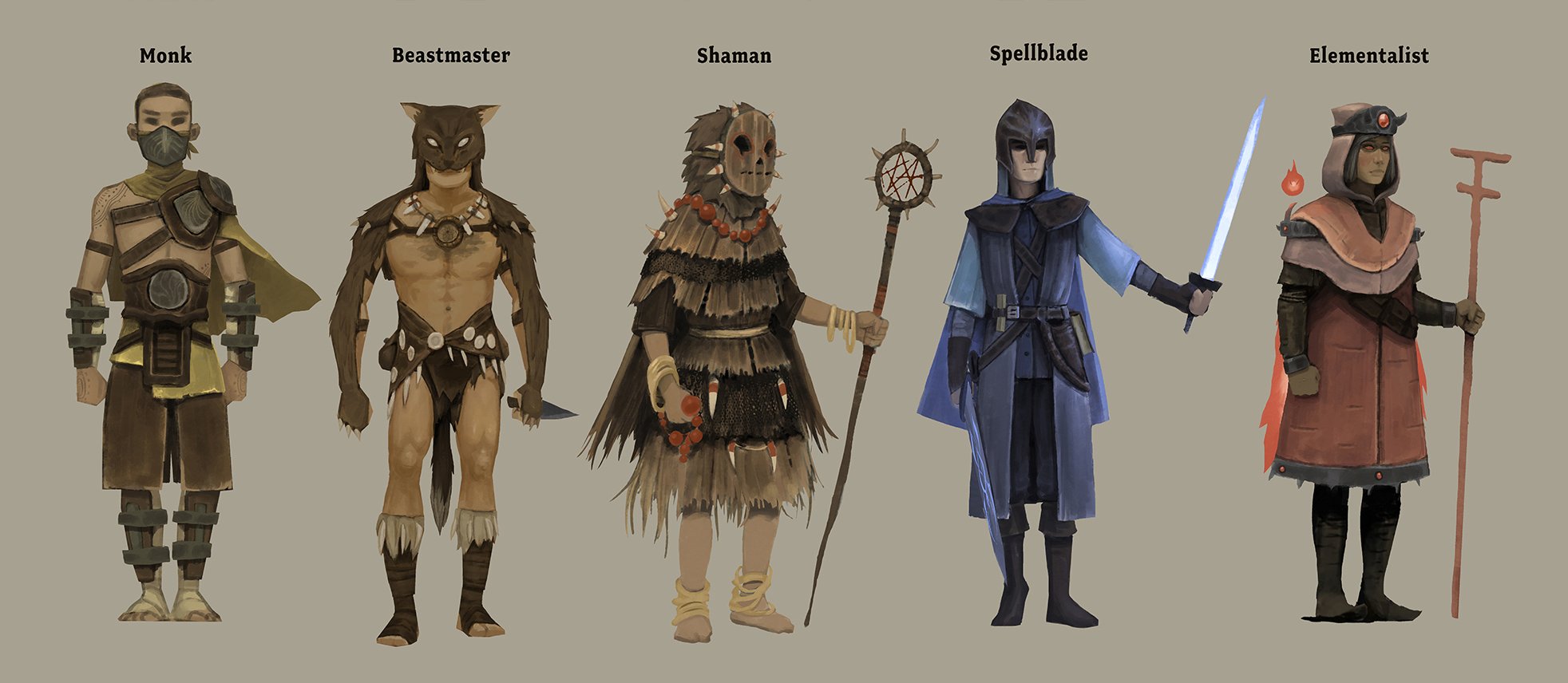
Every class should bring clear value to a group.
Classes that share a theme, such as Cleric and Paladin or Druid and Ranger, should still feel distinct from each other.
Classes should be familiar to anyone who knows the genre's conventions, while carrying flavour of their own.
Classes should stay true to what players expect the class name to mean.
Progression and milestones should feel meaningful across the whole 1-60 climb.
The specific problem being solved is overlap. The team names it directly: too many classes with pets, and too many crowd control options. Alongside the class work, several underlying systems are being tuned at the same time, which is why ability values move between beta patches.
System being tuned | Why it affects classes |
|---|---|
Health and mana regeneration | Sets the pace of downtime between fights and the value of regeneration buffs. |
Resist rates | Changes how reliably debuffs, crowd control and resistance buffs land. |
Shield effectiveness | Feeds directly into tanking for Fighter, Paladin, Inquisitor and Cleric. |
Character stats | Several abilities scale off a stat, so stat tuning moves ability output. |
Time to kill on enemies | Sets how long a fight lasts and therefore how many cooldowns matter. |
Lull and charm mechanics | Affects pulling, crowd control and the classes built around either. |
One structural change lands across every class at once: the armor class system was reworked to give more defense to heavier armor types, so plate armor now reduces incoming damage more than it did before. See Items and Equipment for how armor and item flags work.
The eighteen classes
Class | Archetype | Roles | Playable races |
|---|---|---|---|
High-Mobility Marksman Tinkerer | Ranged DPS | ||
Fast-Moving Song Twister | Support, Utility | ||
Animal-Taming Primal Brawler | Melee DPS, Pet | ||
Divine Conduit | Healer, Support | Deep Dwarf, Deep Elf, Dwarf, Gnome, Halfling, High Elf, Human | |
Jack-of-All-Trades Caster | Healer, Magic DPS, Support | ||
Elemental Binder | Magic DPS, Pet | Deep Dwarf, Deep Elf, Deep Gnome, Dwarf, Gnome, High Elf, Human, Ogre | |
Masterful Conductor | Crowd Control, Support, Utility | Deep Elf, Deep Gnome, Dwarf, Gnome, Goblin, High Elf, Human, Troll | |
Armored Juggernaut | Tank, Melee DPS | Deep Dwarf, Deep Elf, Dwarf, Gnome, Goblin, Halfling, Human, Ogre, Troll, Wood Elf | |
Anti-Magic Tyrant | Tank, Crowd Control | ||
Perfected Weapon | Melee DPS, Puller | ||
Master of Death | Magic DPS, Pet, Utility | Deep Dwarf, Deep Elf, Deep Gnome, Gnome, Goblin, Human, Troll | |
Warrior of Faith | Tank, Healer | Deep Dwarf, Deep Elf, Dwarf, Gnome, Halfling, High Elf, Human | |
Wilderness Veteran | Melee and Ranged DPS, Utility | ||
Opportunistic Striker | Melee DPS | Deep Elf, Deep Gnome, Dwarf, Gnome, Goblin, Halfling, Human, Troll, Wood Elf | |
Antihero Monster Hunter | Tank, Melee DPS | ||
Spirit Caller | Healer, Magic DPS, Support | ||
Highly-Mobile Magic Swordsman | Melee DPS | ||
Arcane Artillery | Magic DPS |
The race lists above are the full designed set. Deep Dwarves, High Elves and Trolls are designed but are not among the races playable when the game enters Early Access on October 1 2026, so at launch each class draws from the remainder of its list. The launch race set is covered on Races.
What every class shares
Shared rule | Detail |
|---|---|
Level range | The stated design target is meaningful progression across the full 1-60 journey. See Experience and Leveling. |
Memorised abilities | You can only have ten memorised abilities at once, but can swap them at almost any time. |
Spell slots | Every casting class has ten spell slots available. |
Spellbook | Scrolls are scribed into a spellbook and then memorised. The spellbook must be equipped in a belt slot to scribe or memorise, though not to cast. |
Skills | Combat skills improve with use rather than through a points spend. See Combat. |
Cantrips | The seven true caster classes retain one memorised spell through death. See Death Penalty. |
No respec | There is no talent tree, skill tree or specialisation to reset. Character customisation runs through Traits, stances, styles, seasons and infusions instead. |
Traits are a named system rather than a tree. Confirmed examples include the Archer's High Ground, the Cleric's Blessed, the Rogue's Assassin Trait and the racial Infravision trait. The team has said the Traits system itself may be revised, so how traits are granted is not settled.
Casters, hybrids and cantrips
The game draws one explicit line through the roster. Cantrips are described as a perk granted to the true caster classes: Clerics, Druids, Elementalists, Enchanters, Necromancers, Shamans and Wizards. Those seven can assign one of their memorised spells as a cantrip so that it is retained on death even without a spellbook to hand. The first cantrip arrives at level 4, with more added at specific level intervals. Everything else in the roster is either a pure martial class or a hybrid.
The 2026 ability rework
Through 2026 the team published a detailed rework for one or two classes at a time and shipped each batch to the closed beta servers in a numbered patch. Thirteen of the eighteen classes had been covered by September 2026.
Beta update | Date | Classes covered |
|---|---|---|
0.25.0.0 | June 7 2026 | |
0.26.0.0 | July 3 2026 | |
0.27.0.0 | August 4 2026 | |
0.28.0.0 | August 20 2026 | |
0.29.0.0 | September 10 2026 |
As of September 16 2026 no detailed rework has been published for the Bard, Enchanter, Necromancer, Ranger or Shadow Knight. Their class pages describe intended direction rather than shipped ability lists, and the five articles here are written the same way. The stated plan is a solid first pass on all eighteen classes, bringing all eighteen to the beta servers as quickly as is reasonable.
Systems that cut across classes
Several mechanics are deliberately shared so that classes interlock in a group rather than each running a private rotation.
Shared mechanic | How it works across classes |
|---|---|
Bleed | Bleed effects can be applied by a Beastmaster pet buffed with Savage Spirit, or by Rogues and Archers. Further inter-class bleed mechanics are planned for later updates. |
Off balance | The Monk Hundred Fists stun can be triggered by Quivering Palm or by a Fighter Feint, so a Fighter can set up a Monk's stun. |
Haste tiers | Primary, Secondary and Tertiary haste stack as distinct tiers. The Inquisitor Aura of Rapidity is a Primary haste with a Secondary component, while Archer Flurry of Arrows and Rogue Swift Strikes are Tertiary. |
Stealth counters | The ability to negate Stealth is currently limited to the Archer Flare ability and the Beastmaster Bat pets. |
Pet consolidation | Combat pets are leaving the classes that were not built around them, which is why the Druid Bear Pet, the Shaman Spirit Wolf and the Paladin Ancient Guardian were all removed. |
Knight changes | Paladin, Inquisitor and Shadow Knight all lose Deflect, Weapon Shield and Focused Concentration, all trade Kick for a shield-based interrupt, and all gain fast-casting short-range abilities. |
Cure Blindness | Removed across every class that had it. |
Sudden double damage | Mechanics that produced sudden double damage are being removed across classes. The Rogue Double Backstab at level 50 is the named example. |
Picking a class
There is no reliable shortcut here, because the game deliberately avoids telling you what to do. Quests have no indicators, Travel leans on class spells and asking guards for directions, and dying leaves your gear on your corpse. What that means in practice is that the utility a class carries outside combat matters as much as its damage. A class with a self-teleport, a group escape or a corpse-friendly resurrection changes how a whole group plays.
If you want to be wanted in a group, the healers and the tanks are the obvious picks. If you want to be able to play alone while waiting for one, the Druid and the Necromancer are both described as among the strongest solo classes in the roster, and the Rogue is openly acknowledged as having a harder time of it than most. The full picture of what a class does day to day is on its own page, and Gameplay covers the systems those classes plug into.