

Combat in Monsters & Memories is built around preparedness, tactics and decision making rather than actions per minute and optimal rotations. The studio describes it as simple, streamlined and strategic, reminiscent of classic era MMOs, and paces it for a group rather than a soloist. Most of a fight is decided before the first swing lands: what you pulled, where you camped, who is standing where, and whether anyone is rested and fed.
The basic loop
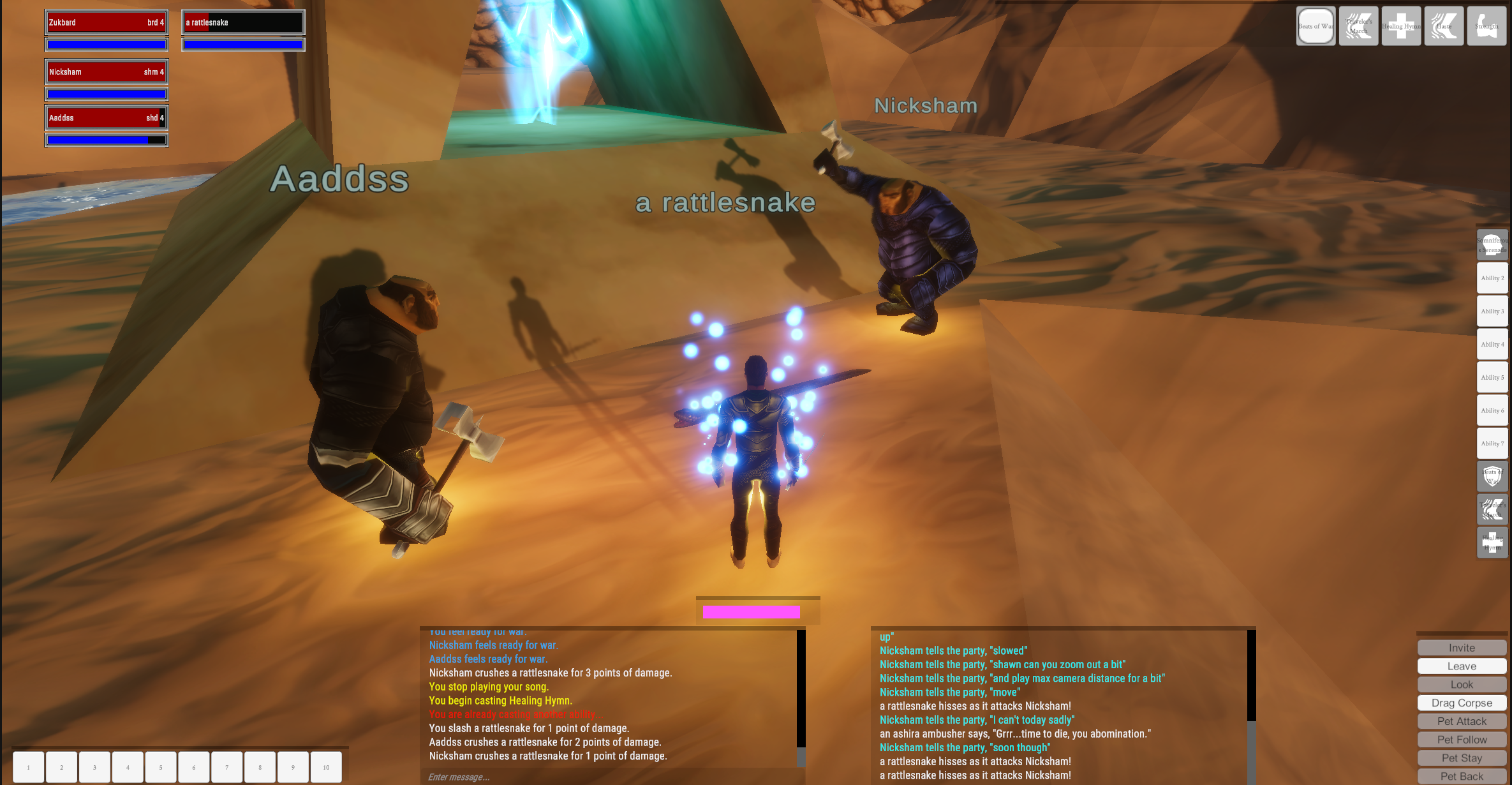
Targeting and attacking use a small set of defaults, all rebindable through the options menu. Considering a target before engaging is the closest thing the game has to a difficulty readout, and it is the habit the studio's new player material pushes hardest.
Input | Effect |
|---|---|
Q | Toggles auto-attack. |
TAB | Targets and cycles through nearby NPCs. |
C | Considers the current target. You see the target's relative disposition toward you and a rough estimate of the battle's outcome, colour coded. |
F | Assists your target. |
F7 | Targets the nearest friendly. |
F8 | Targets the nearest hostile. |
P | Opens your skills window, where skill levels are listed. |
Right-click a corpse | Loots it. See Items and Equipment. |
The developer is direct about the reward structure: experience is the most valuable thing you take away from a fight. See Experience and Leveling for how that is earned and shared.
Ranged attacks
Ranged auto-attack is class-gated. An Archer or Ranger standing outside melee range has Q enable ranged auto-attack directly. Any other class wanting to shoot with a bow or throw a dagger has to use the Shoot or Throw ability instead.
Skills improve through use
Combat skills are not bought or assigned. As you fight, your skills in combat improve, which lets you take on more difficult opponents. Skill levels are viewable with P at any time. Character power beyond that comes from levels, equipment and the game's Traits system, which the studio has said may change in a future revision.
Camping and pulling
Zones are shared spaces, not instances. The studio's stated approach is camping and pulling in shared zones rather than running instanced dungeons, with open world design and varied level ranges in each zone rather than a linear theme park progression. In practice that means a group settles at a spot and brings enemies to it a few at a time, in a zone that other groups are working at the same time.
Cross-class effects
Several combat effects are shared between classes rather than owned by one, and the studio has said more of this is planned.
Effect | Published detail |
|---|---|
Haste tiers | Primary, Secondary and Tertiary haste are distinct stacking tiers. The Inquisitor Aura of Rapidity is Primary with a Secondary component; Archer Flurry of Arrows and Rogue Swift Strikes are Tertiary. |
Bleeds | Bleed effects can be applied by a Beastmaster pet buffed with Savage Spirit, or by Rogues and Archers. The studio has said bleeds will have inter-class mechanics in later updates. |
Off-balance | The Monk Hundred Fists stun can be triggered by Quivering Palm or by a Fighter Feint ability. |
Stealth counters | The ability to negate Stealth is currently limited to the Archer's Flare ability and the Beastmaster's Bat pets. |
Armor class | The armor class system was changed so heavier armor types provide more defense. Plate armor is now more effective at reducing incoming damage than it was before. |
Fighting after dark
Night is a real constraint rather than a filter over the screen. Dangerous creatures move about Aethoril at night, and when it is dark, it is dark. Outside a city you need a light source to see anything at all, which makes the lantern and torch entries on Items and Equipment part of your combat kit rather than a convenience.
When a fight goes wrong
Dying leaves your items on your corpse and returns you to your bind point. The timers, the consent rules for dragging a corpse, and the classes that can resurrect you are all covered on Death Penalty. If a group is about to wipe rather than lose one member, several classes carry escape tools; those are listed on Travel.
Player versus player
PvP exists. It has a glossary entry, the Archer's Relocate is described as a way to set up a surprise attack in PvP, the Rogue's stealth rules have a stated PvP variant, and the Fighter's Tactician Stance is flagged as likely PvP use. What has not been published is any ruleset. As of September 2026, no page from the developer states whether PvP is opt-in, gated by server ruleset, restricted to particular zones, or open everywhere. See Servers.