

Combat in Echoes of Aincrad is real-time and third-person. The designers have described the rhythm as methodical rather than twitch-based, with stamina management sitting alongside timing-based defensive mechanics.
Basic Attacks
Every weapon uses separate inputs for light and heavy attacks. Combos come from mixing the two, with the exact rhythm varying by weapon type. See Weapon Types for the six categories.
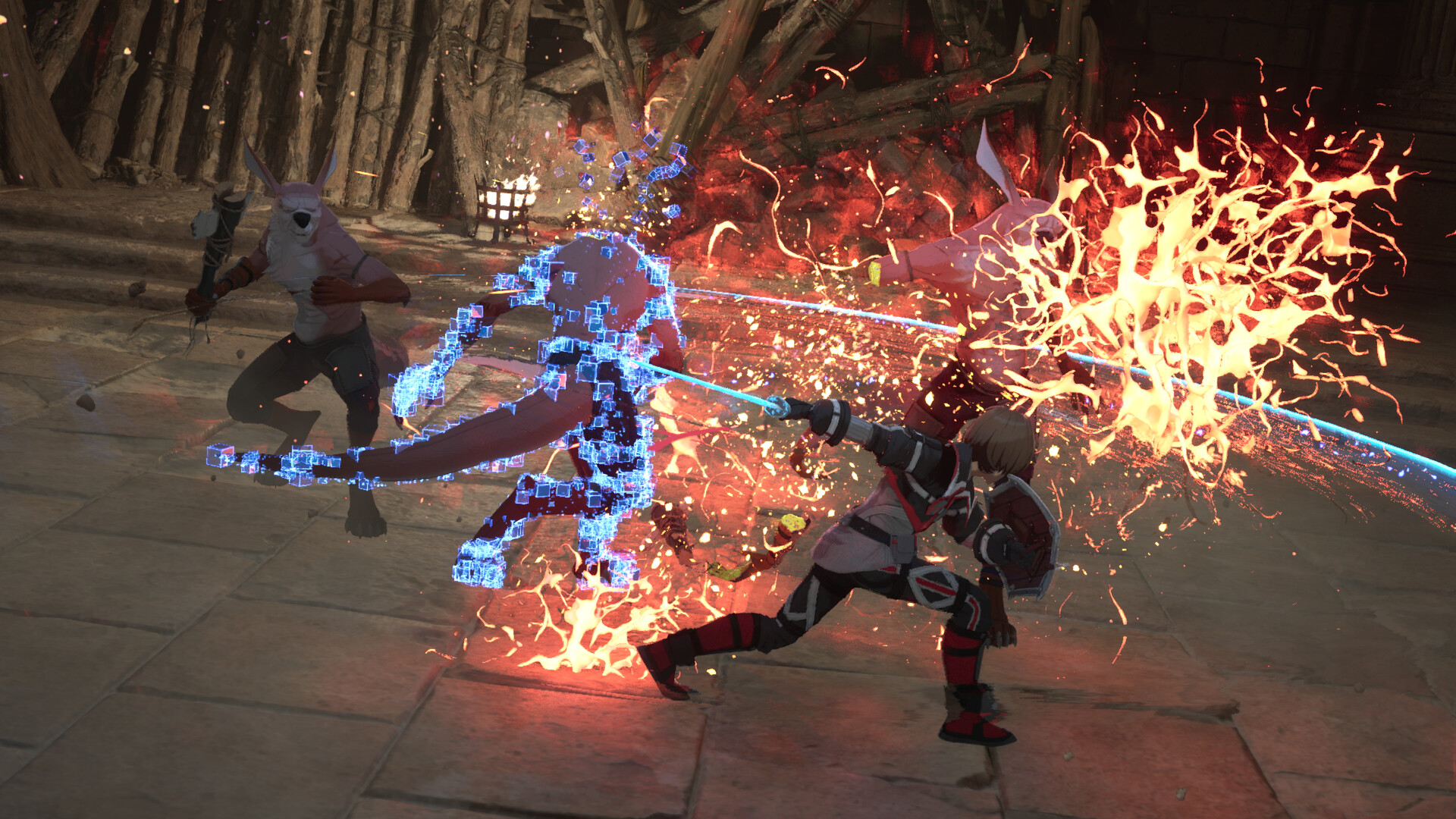
Blocks, Dodges, and Timed Responses
The hero can block or dodge any incoming attack. A regular block or dodge mitigates damage, but a defensive input performed at the last possible moment triggers one of three special responses. See Parry Slash, Dodge Slash, and Reversal Slash for each one.
Stamina
Attacks, dodges, and sprints all deplete a shared stamina bar. Letting it empty leaves the hero exposed until it recovers, which is why the designers have compared the pace to methodical action games rather than to character-action combos.
Companion Team-Ups
The player is always accompanied by an NPC companion. Timed parries and dodges trigger team-up attacks where both characters hit the enemy together, which is one of the game's main damage spikes.
Sword Skills
Each weapon has roughly ten unlockable sword skills, and up to three can be equipped at a time. Equipped skills show on the HUD and fire on the primary inputs, while holding the action-shift button exposes the partner's Support Skill and Combination Skill rather than another sword skill. Skills cost SP and enter a cooldown after use rather than drawing from stamina.
Overall Feel and Pacing
Preview coverage and the official developer stream both describe the combat as methodical, tactical, and weighted rather than fast or flashy. It is explicitly not a Soulslike, but the pacing is closer to a grounded action RPG than to the faster prior entries in the series. Every swing lands with real commitment, and a mistake tends to leave the hero open long enough for an enemy to punish it. The producer has framed difficulty as a side effect of the tone rather than the goal, which is why the challenge is adjustable and why the Death Game Mode opt-in exists for players who want the tension cranked further.
You only control the main character. A single AI-controlled partner fights alongside you at any given time, and the pair is the core unit that every other combat system revolves around. Guest characters can temporarily swell the party to three during specific story moments, and large set-piece battles may involve even more supporting fighters, but during standard exploration and questing it is always one player character plus one partner.
Light Attacks, Heavy Attacks, and Stamina
Basic combos are built by mixing light and heavy attacks on the fly. Both inputs cost stamina on their own, and while a single swing is cheap, stamina also drains from sprinting and from evasion. That shared pool is what forces the measured pace: spam every button and the bar empties, leaving the hero unable to dodge or sprint clear of follow-up hits. Stamina recharges quickly when you stop spending it, and it keeps recovering while the hero is just walking, so the intended rhythm is aggressive bursts followed by short breathing room rather than constant uptime.
Unlike some prior entries in the series, there is no dedicated timing system that snaps sword skills into long scripted chains. Players freely string basic attacks and skills together as long as there is enough stamina and SP to cover the inputs.
Sword Skills and SP
The stronger attacks are sword skills, which draw from a separate SP resource instead of stamina and go on cooldown after use. SP refills primarily by attacking enemies, which keeps players engaged at close range rather than backing off, and a specific consumable potion can also top up the bar directly. Each weapon type has roughly ten learnable sword skills, but the equipped loadout is capped at two at a time. Both slots are always displayed on the HUD and mapped to the right trigger and the right bumper, so the player chooses two of the ten unlocked skills for any given weapon and reloads them when they want a different setup.
Holding the same action-shift input also exposes the partner's special skills, which share the hold layer with the standard combat inputs. This is how support skills and the combination skill are issued mid-fight: hold action-shift to reveal the partner-skill input layer, then press the assigned button.
Partner Support and the Switch System
Beyond the hold-layer inputs, partner behaviour during combat is tuned through two stances handled by the Switch System. Free mode lets the partner attack and use their own sword skills against nearby enemies, which is useful when the hero is surrounded. Switch mode is defensive: the partner holds back, and when the hero evades, the partner jumps in, swings on the enemy, and tries to pull aggro so the hero can reposition or heal. The Switch trigger appears to carry a short cooldown rather than activating on every dodge, so the expected play loop is constant toggling between free and switch depending on the threat layout.
Tag-Team Counterattacks
Perfect defensive inputs are what unlock the pair's biggest damage spikes. Three triggers all feed the same counter mechanic, each described in full on the Parry Slash, Dodge Slash, and Reversal Slash article:
A perfect dodge performed just before an attack lands lets the hero command the partner to jump in and counter.
A perfect parry on an incoming strike opens the same counter window.
Interrupting an enemy when a blue ring indicator appears during its wind-up also triggers the tag-team counter.
A sword skill used at the exact moment an enemy telegraphs a heavy attack can also interrupt that attack outright, which suggests the game runs a small priority system on which moves can break which telegraphs. The net effect is a defensive kit with several valid openers rather than one rigid parry rhythm.
Status Buildup and Dismemberment
Status effects are not applied on contact. Instead, each hit adds to a hidden buildup meter on the target, and the status only triggers once that meter fills. Targets with low resistance to a specific element can have the effect inflicted almost instantly, while resistant targets soak a lot of buildup before anything lands. The system runs in both directions: enemies can inflict status on the hero the same way, so armour choices and resistance stats matter on the defensive side as much as on the offensive one.
Combat can also partially break enemies apart. Flying foes can be knocked out of the air and have their wings severed, grounding them for the rest of the fight so they can no longer pull distance on the party. How widely dismemberment applies to other enemy types has not been shown yet, but the system clearly exists and directly changes how a fight plays out once triggered.
Aggro, Reinforcements, and Telegraphs
Aggro is sticky. Once an enemy notices the hero, ignoring it is not an option because it will chase the party across the map, and nearby hostiles can notice an ongoing fight and join in, which is how small skirmishes snowball into crowd encounters. Some enemies actively escalate: wolves can howl to summon groups of lower-ranked reinforcements, dragging even more threats into a fight that was meant to be a quick cleanup.
Many enemies telegraph their heavy attacks through glowing limbs or body parts. Claws lighting up on a melee attacker or a tail flaring on a large creature both signal an incoming special move, giving the hero time to line up a parry, roll clear, or stuff the attack with a sword skill. Not every attack is telegraphed, so reading each enemy type still matters, but the visual cues are frequent enough to build a real read-and-react loop.
Combat Items and Ground Traps
The toolbelt extends past swings and dodges. Consumable throwing items can pull distant enemies toward the hero, which is useful for isolating a single target before a patrol or a group notices the engagement. That pull is a two-way street: certain enemies carry their own throwing items and will hurl them at the hero if the party stays at range for too long, so hanging back indefinitely is not a safe play. Paralysis traps can be dropped on the ground and shock any enemy that walks over them, building paralysis meter on contact and setting up the full status trigger as a follow-up. Consumables are not mandatory for clearing content, but they become much more valuable on harder difficulties and inside the opt-in hardcore mode.
Cut-In Animations
Tag-team counters, partner support skills, and combination skills all play dedicated cut-in animations when they trigger. The cut-ins are visually distinctive but they briefly interrupt the flow of the fight each time they fire, and in a combat system built around consistent parries the repetition can become noticeable. The options menu includes a toggle that suppresses the cut-ins that are not the full combination attack, leaving the big combination flourish intact while trimming the smaller support and counter flashes. The exact label on the setting is not reproduced here because published material does not quote it.
Known Preview Criticisms
Two specific pain points came up repeatedly in coverage of the pre-release build. First, stamina management was called restrictive, especially when trying to disengage from a fight in progress, because the sprint and dodge costs can cut the bar down before the hero reaches safety. Second, the parry windows were described as strict enough that evasion ends up being the safer default answer to most attacks.
Both areas were touched after release. The Ver. 1.0.3 patch extended the invincibility window on the step, changed its animation, and adjusted rolling and stepping behaviour overall, and it also adjusted the attack values on Reversal Slash, Parry Slash, and Dodge Slash. The notes describe which systems moved without publishing before-and-after numbers, so the practical effect is something players read in play. See Update History for the full list of what each patch changed.
Break Markers and Phase Transitions
Emptying a boss's health bar is usually not the end of the fight. Certain enemies carry a Break Marker, and destroying it after their HP reaches zero is what actually drives the transition into the next phase. A post-launch patch was needed because that transition could occasionally fail to fire, which confirms the marker is a discrete object in the fight rather than a visual flourish.
The player-facing version of this is the follow-up input that severs a part of the boss once it has been brought down. Multi-phase fights are structured around it: bring the bar to zero, land the break, and the boss stands back up in a new state with a fresh bar. Recognising that moment is what separates a clean fight from one where you keep swinging at an enemy that is waiting to be broken.
Crush Attacks and Guard Breaks
Shielded enemies cannot simply be out-damaged. Holding the heavy attack button unleashes a Crush Attack, which does substantial damage to a guard. Once an enemy suffers a guard break, the window that opens is where the bulk of your damage should land.
This matters most on the first floor boss, which opens the fight behind a shield. Attacking into an intact guard wastes stamina for very little return, so the correct opening is a Crush Attack rather than a Sword Skill.
Partner Concentration
Your partner has a resource of their own that is easy to miss. Concentration governs how reliably they dodge and guard. It drains while they fight in Free Mode and is restored by Switch Mode, so a partner left aggressive for an entire encounter gradually loses the ability to protect themselves.
That interaction is the reason the two partner commands are meant to alternate rather than being set once. The full mechanics are on the Switch System page.