

Genma
The Genma are the demonic monsters from the underworld that have invaded Kyoto in Onimusha: Way of the Sword. Slaying them is the Oni Gauntlet's core purpose, and every combat system in the game, from soul absorption to Break Issen, is designed around clearing these creatures from the city.
On This Page
Genma are the primary enemy type in Onimusha: Way of the Sword. Capcom describes them as monstrosities from the underworld, arriving in Edo-era Kyoto on the tide of Malice. Slaying Genma is the reason the Oni Gauntlet exists, and the creatures are the reason Musashi Miyamoto is drawn into the corruption eating its way through the capital. Every combat system in the game, from the souls loop to Break Issen counters, is designed around the Genma as the core threat Musashi has to clear.
Overview
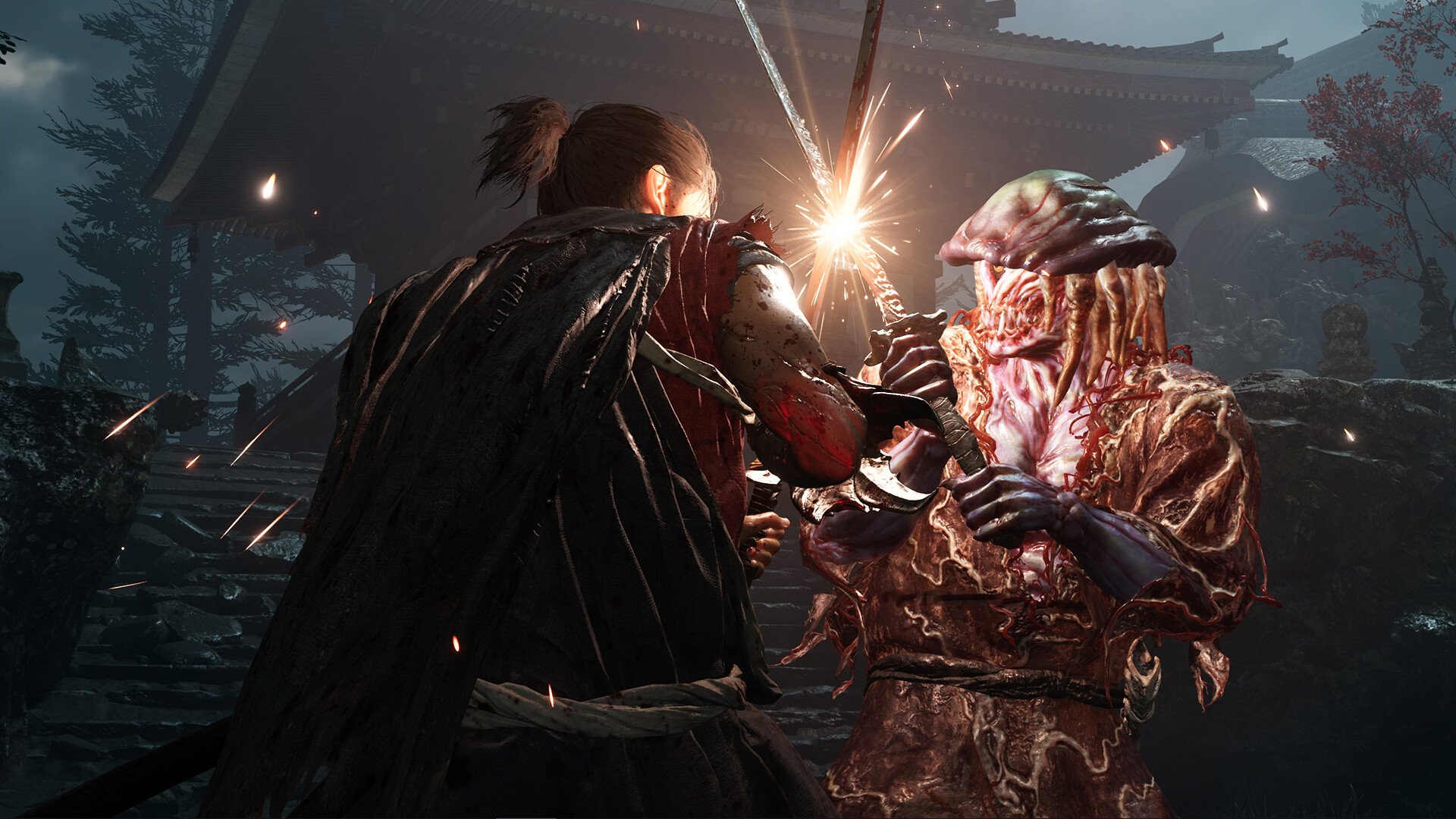
In the wider Onimusha series, the Genma are a race of immortal demons. They are the main antagonists of every mainline entry and return in Way of the Sword as the central hostile force, retooled to match the game's Edo-period Kyoto setting. The new variants Capcom has publicly shown are all twisted in ways that fit the story's emphasis on experimentation and the weaponisation of Malice, but the underlying role of the Genma remains unchanged: they are the demonic tide the Onimusha stands against.
The Genma on screen in Way of the Sword range from rank-and-file foot soldiers that fill out most encounters to elite named variants that anchor boss and mini-boss fights. Public trailers have focused on a handful of distinct subtypes, each with a different silhouette, attack pattern, and narrative hook. The variety is a deliberate pillar of the combat: because each Genma type behaves differently, the same core toolkit of dashes, parries, and Break Issens has to be applied in different ways from one encounter to the next.
Origin and Nature
The Genma are demonic creatures from the underworld, a realm that sits beneath and parallel to the human world of the Onimusha setting. They are not mortal enemies in the conventional sense. Series lore casts them as an ancient race whose appetite is humanity itself, and their periodic attempts to breach into the human realm have driven every Onimusha conflict to date. Way of the Sword picks up that thread and places its new invasion inside a specific city, Kyoto, at a specific historical moment in the early Edo era.
Whether a given Genma began as a pure demon, a transformed human, or a fusion of the two is deliberately left fluid. Some of the variants in the game are clearly non-human in every respect, while others are explicitly humans who have been warped, parasitised, or experimented on. That ambiguity is part of the horror the game is trading in: the line between a person and a Genma is not fixed, and the forces behind the invasion are actively erasing it.
Genma Who Speak
Way of the Sword makes a change the series has not made before: the rank and file talk. In earlier entries only high-ranking Genma were given dialogue and the ordinary ones fought without a word. Director Satoru Nihei has said the team wanted the feel of a period drama, so enemies now trade lines with Musashi in the middle of a fight rather than only in cutscenes.
The change was not free. Giving every ordinary enemy a voice multiplied the number of lines that had to be written, recorded and localized, and the team has been open about the extra work it created. What it buys is a battlefield that argues back, which is a different texture from a silent demonic tide.
Types of Genma in Way of the Sword
Capcom has publicly named and shown several specific Genma variants across the game's trailers and gameplay shows. The table below collects the confirmed subtypes along with the distinctive features shown on camera.
Type | Role | Details |
|---|---|---|
Ranged archer | A serpentine Genma covered in spines along its back. It whirls into combat at high speed and has been shown acting in an archer role, forcing Musashi to manage distance and deflection rather than close in and trade blows. | |
Grotesque grappler | A mass of interwoven human faces extending long, grasping tentacles. The creature's reach makes it dangerous at mid range, and the human faces on its body are part of the visual language tying the Genma back to their human victims. | |
Flying boss-tier foe | A chimeric beast drawn from Kyoto folklore, fusing the head of a monkey, the body of a tanuki, the tail of a snake, and the limbs of a tiger. In-game it channels lightning, rains strikes from above, and grapples Musashi during its heaviest phases, making it one of the headline boss encounters in public footage. | |
Parasite-infected human | A tall, warped humanoid created when a parasitic Genma takes over a human host. On death the Kogashira releases a poisonous cloud of Malice that can empower nearby Genma, making clearing it a priority in group fights. | |
Colossal boss | A colossal Genma who makes his stronghold at Mount Oe, a mountain range in Kyoto. He claims to be the legendary oni Shuten Doji, though the game leaves that claim deliberately uncertain. Revealed in the release-date trailer; specific moveset not yet confirmed. | |
Winged duelist boss | A terrifyingly fast and bloodthirsty winged Genma that carves its way up from the underworld and locks blades with Musashi in a direct duel. Its sword grows more powerful the more it is stained with Musashi's blood and as it absorbs souls, so the encounter rewards clean, counter-heavy play. Revealed at the June 2026 Capcom Spotlight; full moveset not yet detailed. | |
Soul-eating heavy | A huge, slow Genma that fights with a club and devours loose souls in the middle of a fight, so orbs left on the floor are gone before Musashi can sweep them up. Japanese material writes the name 大唾拉. | |
Blood-fed brawler | A fast creature that grows wilder the more it is coated in its own blood, which rewards fewer and heavier strikes over sustained pressure. Japanese material writes the name 百穢. | |
Wish-warper boss | A multi-armed figure assembled from the body parts of the people whose wishes he claims to have granted, holding court at a real Kyoto shrine. He carries his own musical theme. Japanese material writes the name 羅掌願. | |
Generic Genma rank-and-file | Foot soldiers | Unnamed humanoid Genma variants appear across every public trailer as the baseline threat filling out encounters between the named elites. They establish the rhythm of the combat loop and are the most common source of soul drops during normal play. |
Group-fighting foot soldier | Capable of wielding swords, bows, and shields. Tends to attack in groups and is driven purely by basal urges to kill and devour people. These are the shield-bearers and archers described above that force Musashi into guard breaks and deflects. | |
Winged ambush striker | A winged, ninja-like Genma variant that watches Musashi's every move and strikes only when an opening presents itself. Employs deadly combination attacks when paired with another of its kind. | |
Wind-wielding sibling boss | The younger of two Genma siblings lairing at Kennin-ji Temple. Stirs up powerful gales and wields the wind to blast foes away, and can be fought alongside his brother Burai at once. | |
Lightning-wielding sibling boss | The elder of the same pair of siblings. Fights with a naginata-like polearm combined with contraptions that unleash bursts of lightning. |
How Genma Attack
Genma encounters are built around mixing melee pressure with ranged and area threats so no single tactic carries every fight. Humanoid rank-and-file Genma close with sword and claw attacks and tend to swing in telegraphed patterns that reward the Break Issen counter. Archer-type variants like Togemaru keep Musashi honest about distance, firing into fights and punishing players who focus too narrowly on a single melee target. Larger Genma bring grapples, sweeping area attacks, and in the case of the Greater Nue, full screen hazards like falling lightning.
Elite and boss-tier Genma are designed to test the combat system as a whole rather than any single mechanic. Their movesets blend short-range slashes, long-range projectiles, ground-shaking charges, and phases that lock out normal counters until the player strips a specific opening. That pacing pushes players into alternating between blocks, parries, dashes, and Oni Armaments uses rather than spamming one answer for every swing.
Enemies Built to Beat a Sword
The near-final build shown to press added enemy types the public demo never introduced, and the shipped game confirms them as Hitotsume Gasa, a Genma variant that wields swords, bows, and shields. Their shields turn aside plain sword strikes, so hacking at them accomplishes nothing, and their bows open fire from a distance the katana cannot answer. Both exist to push the Oni Bow into the standard rotation rather than leaving it as a puzzle-solving curiosity.
Togemaru shows the other half of that design. The creature spins itself into a charge, and a well-timed deflect sends it into a wall, where it lodges in place and flails until Musashi cuts it in two. The counter belongs to that enemy specifically. It is not a generic parry with a generic result.
That specificity runs deeper than it looks. Every individual boss attack is reported to have its own bespoke deflect animation, more than 300 across the game, which is why deflecting reads differently against each foe instead of replaying one clip on a loop.
Enemies also carry a red gauge underneath their health bar, the rikido. Draining it breaks the creature's footing and opens the window for a finishing strike, and the developers have pointed to that route as the way a player who never masters the deflect timing can still close out a fight.
Soul Absorption by Musashi
Every Genma leaves behind coloured souls when it dies. The Oni Gauntlet absorbs these orbs from the battlefield. Yellow souls restore Musashi's health, red souls are banked as long-term currency for upgrades, and blue souls fill the Oni Power Gauge that powers the Oni Armaments. This loop is the core economy of the game, and it runs on Genma deaths.
Crucially, soul absorption is not one-sided. The Genma themselves can reach orbs left lying in the arena, and when they do they grow stronger, gaining access to deadlier attacks or new abilities. Leaving a kill's souls on the ground does not just cost the player resources; it actively hands fuel to the other side of the fight. The result is a feedback loop where sloppy play compounds: a missed orb early in a fight can create the upgraded Genma that kills Musashi later in the same arena.
Malice and Corruption
The Genma invasion is bound up with the substance Capcom has called Malice, the black tide of corruption spreading through Kyoto. Malice is both the medium the Genma travel through and a weapon several variants deploy directly. The Kogashira's death cloud is the clearest example, a poisonous burst of Malice that can empower any Genma still standing inside it. Other variants are implied to be partially composed of Malice rather than simply surrounded by it.
The corruption angle is what links the Genma threat to the human cost of the story. Ordinary townspeople warped into Kogashira were once people, and every hidden laboratory, cursed district, or lost alleyway Musashi clears out is a place where that line has already broken. Reducing Malice in a given area and cutting down the Genma feeding it are presented as the same act, which is how the combat loop ties back to the game's narrative stakes.
The Genma Experiments
Capcom's public material has highlighted a strand of the story specifically focused on the creation of new Genma variants. Deep beneath Kyoto is a secret laboratory run by the sinister figure Dokyo, who actively constructs new Genma in the underground rather than waiting for them to emerge from the underworld on their own. The Greater Nue, the Chijiko, and the Kogashira have all been positioned as products of these experiments.
Capcom's own character page states this plainly for two of the roster's named entries: Greater Nue and Chijiko are both Genma created by Dokyo. A separate, ordinary Nue distinct from the Greater Nue is documented in post-launch guide material, though it is not covered by Capcom's own character page.
This design decision gives the Genma threat a visible, human-scale origin inside the game world in addition to its ancient demonic backdrop. Players are not fighting an undifferentiated demonic tide; they are fighting specific creatures with specific makers, which in turn gives the campaign clear targets and the later story room to escalate as each experiment reveals a more dangerous variant.
Narrative Role
In Way of the Sword, the Genma are both the obstacle and the reason the game exists. The opening crisis is their arrival in Kyoto, the central journey is Musashi's growing mastery of the Oni Gauntlet as a Genma-killing tool, and the campaign's scenarios are structured around clearing variant after variant from districts of the city. Side characters define themselves by how they relate to the Genma problem, whether as fellow hunters, victims, researchers, or, in a few cases, as the ones actively making the creatures worse.
The Genma also connect Way of the Sword to the rest of the series. Fans coming in from earlier Onimusha entries will recognise the creatures as the same ancient demonic enemy, while players new to the series get an invasion story that stands on its own in a self-contained Edo Kyoto setting. Either way, the through line is consistent: the Genma are what an Onimusha is built to hunt, and clearing them from the world is the measure of how far Musashi has grown into that role.
A further named Genma shown in hands-on demo coverage is Rasho-Gan, the "Wish Warper," a colossal figure built from severed hands who claims to save people by cutting their fates. He fits the same pattern as the other Genma in the game, taking a human idea (here, salvation) and twisting it into a monstrous form.
Another boss-tier Genma revealed in the June 2026 game overview is Dohatsu-Ten, a fast, winged duelist whose sword feeds on Musashi's blood and on absorbed souls to grow stronger as the fight continues.
Genma Notes
The shipped game also tracks the Genma through an in-game collectible called Genma Notes, records about individual Genma found scattered across Eastern Kyoto. Collecting all of them is tied to its own achievement, and the notes give the roster documented in this article a second, in-fiction record alongside the marketing material.
Two Named Lesser Genma
Not every named Genma is a boss. Two of the roster's smaller entries have been detailed individually by the development team, and both are built around something other than a direct fight.
Genma | Behaviour | Why it matters |
|---|---|---|
Drifts through the sky with an eerie glow. Absorbs nearby souls, spits glowing projectiles from its mouth and can self-destruct. | Its soul absorption puts it in direct competition with Musashi for the resource that funds healing and Oni Armaments. | |
A concealed ambush predator that weaves a web to trap prey. Normally invisible. | Only Oni Vision reveals it, and the Oni Gauntlet reacts when one is blocking a route. |
Kubi Akari also lends its name to the charm granted for keeping demo save data, which makes it the one Genma most players will have encountered before the full game.
Onimusha Curious Cases
Capcom ran a nine-part official character video series called Onimusha Curious Cases, narrated by the Oni Lady, with one episode releasing every few days between 17 August and 3 September 2026, right up to the 4 September launch. Each episode profiles a single figure, and the enemy roster gets as much room in it as the cast does.
Date | Subject |
|---|---|
17 August 2026 | |
19 August 2026 | |
21 August 2026 | |
25 August 2026 | |
27 August 2026 | |
31 August 2026 | |
1 September 2026 | |
2 September 2026 | |
3 September 2026 |