

Combat in Onimusha: Way of the Sword is sword-focused, third-person, and built around reactive play. The pace is fast, with Musashi Miyamoto rewarded for clean reads rather than button-mashing. Director Satoru Nihei has publicly said the game is not a Soulslike and not open-world: encounters happen in handcrafted arenas with a fixed level structure.
Primary Weapon
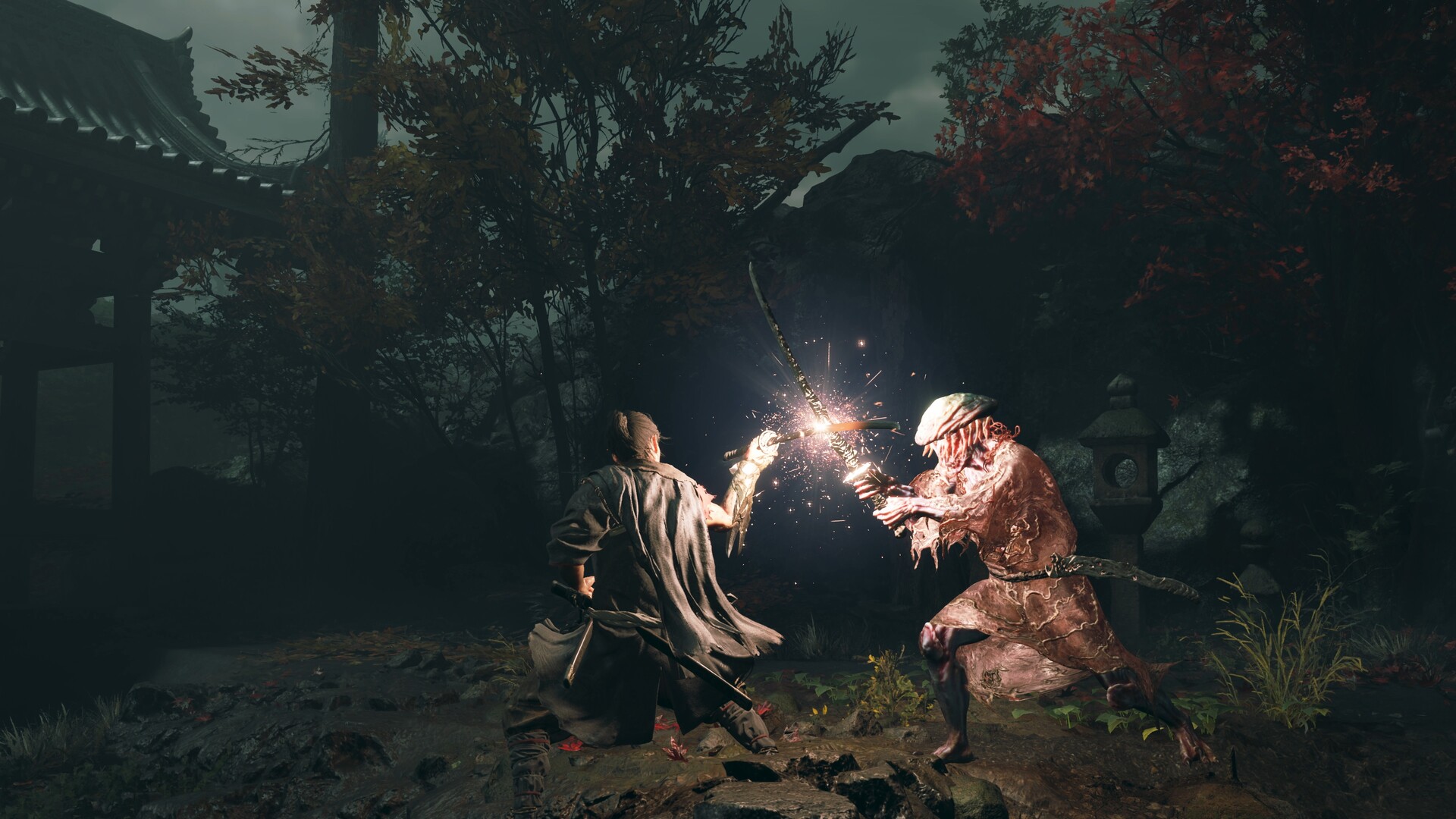
Musashi's primary weapon is a single katana, which can be wielded in two different stances:
One-handed stance. Fast, short-range slashes. Good for chipping stamina and staying mobile in group fights.
Two-handed stance. Slower, longer wind-up, higher damage. Better for committing to a clean opening against a single target.
Switching stances is part of the core combo loop alongside dodges, parries, and deflections.
The Four-Tier Parry Toolkit
Hands-on previews describe the defensive options as a rock-paper-scissors set with four distinct tiers:
Hold to block. A general-purpose guard that works against attacks from all directions. Every block bleeds posture, so it cannot be relied on indefinitely.
Timed parry. Officially called a Parry: block just before an enemy's attack lands to open a window of vulnerability. The larger the window, the more elaborate the effect. If the parried enemy collides with an object or another enemy afterward, it suffers significant stamina damage on top of the parry itself.
Deflect. An input combination (block plus an attack button) that redirects incoming attacks, including arrows and other ranged attacks, and significantly reduces the opponent's stamina. This is how Musashi sends arrows back at archers and steers heavier enemies into the environment. Deflect is unlocked through skill enhancement, not available from the start.
Issen. The series' signature perfect-timing counter. Striking at the exact frame an enemy's attack lands cuts through the foe in a single lightning-fast motion. High risk, high reward.
Dynamic Dismemberment
Capcom's name for the cutting system is dynamic dismemberment. When the katana connects with a Genma, the creature is carved apart along the exact angle the blade travelled through it rather than playing a fixed death animation. A horizontal swing splits an enemy in two across the torso; a vertical one opens it up from head to toe.
The practical consequence is that the same enemy can come apart in different ways depending on how the player was moving and which stance was active, so the visual feedback tracks the input rather than the enemy type. It is the system underneath the series' long-standing emphasis on the feel of a clean cut, and it is closely tied to Break Issen Body-Part Targeting, where the player chooses a specific limb to strike during a boss execution.
The Oni Bow
Musashi's ranged option is the Oni Bow, recovered from the wreckage of the Oni Refuge rather than carried from the start. It answers Genma archers, triggers traps in the environment, and solves puzzles that require reach. In at least one boss duel back in Kyoto it is used to sever the enemy from its power source, which makes it a puzzle tool inside a fight as well as a damage option.
Stamina and Execution
Both strikes and parries drain an enemy's stamina, officially tracked as the Stamina Gauge. Once it is fully depleted, Musashi can unleash Break Issen, a dedicated execution move that ends regular Genma fights instantly by dismemberment. A body-part targeting variant unlocks against enemies Musashi has worn down completely and is the only way to apply Break Issen-style damage to bosses.
Reactive Buff Meters
Hands-on previews describe two stacking reward meters driven by clean defensive play:
Red meter. Three flawless dodges in a row fill this meter, which unlocks a multi-hit follow-up attack and boosts soul absorption for a short window. Capcom officially calls this the Reflex Dodge gauge: once it fills from continuous dodging, the player unleashes a powerful Reflex Combo. Against an unarmed attack specifically, a successful Reflex Dodge also enables an immediate follow-up counter that significantly reduces the enemy's Stamina Gauge.
Blue meter. Chained successful parries fill this meter, officially named the Blaze Gauge. When it peaks, Musashi enters the Blazing State: attack power increases, he deals more damage to both health and stamina, deflects land even more stamina damage in this state (very effective against bosses), and enemies he hits generate more blue souls. The state lasts until the Blaze Gauge empties, and it is unlocked through skill enhancement rather than available from the start.
The buffs only stay active while the player keeps playing accurately. A single clean read followed by an immediate offensive response is the best-case rhythm the game is tuned around.
Environmental Parrying
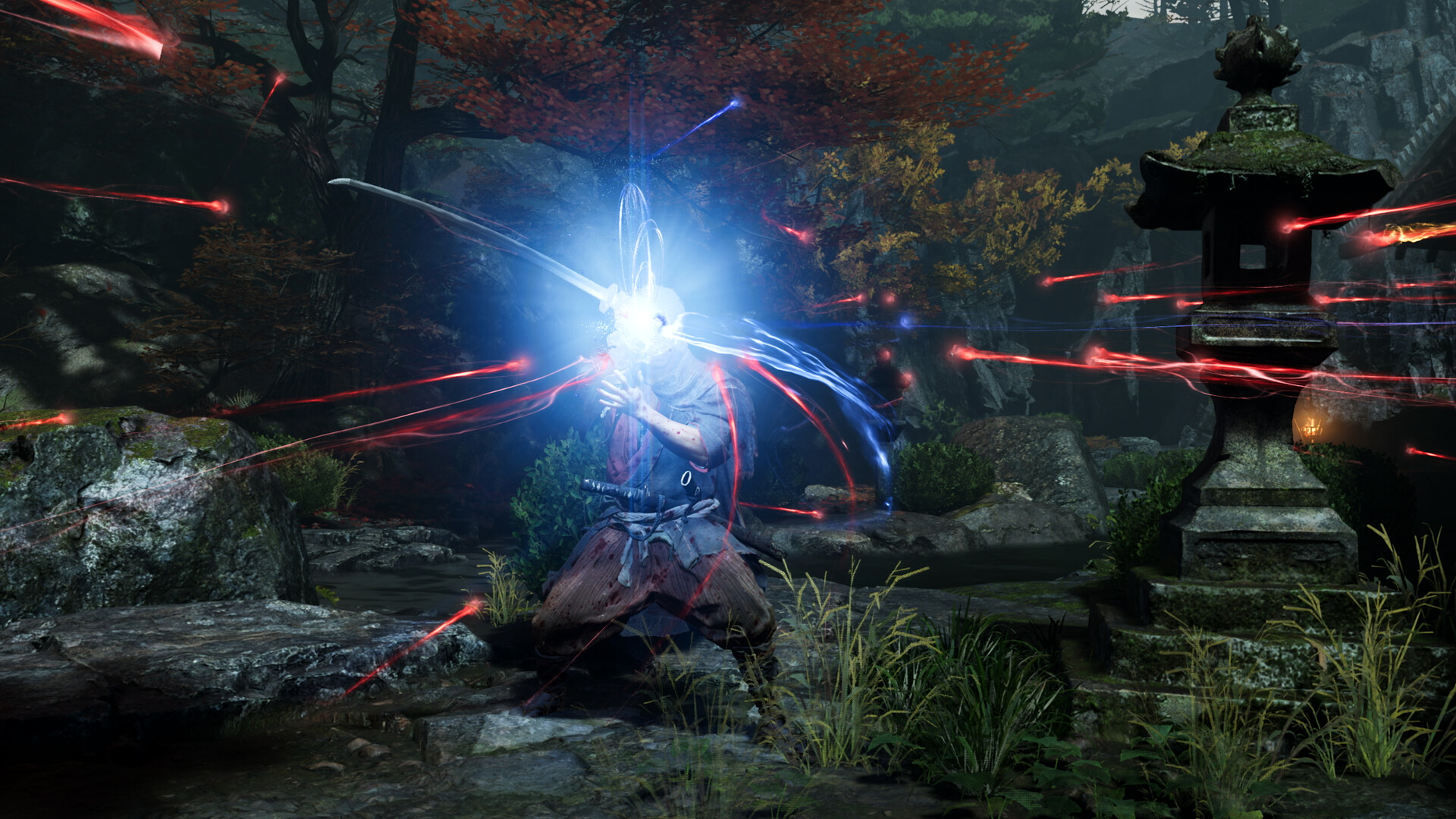
The deflect and parry system interacts with the arena. Previews have shown Musashi redirecting enemies into lit torches, sending them stumbling into rocks and trees, and steering airborne enemies off ledges. Capcom has also shown defensive scenery use: erecting tatami mats against arrow volleys, and throwing kimonos onto an opponent's head to blind them briefly. Separately, certain environmental objects such as wooden boards and carts can be interacted with directly during battle for their own effects, and tatami mats can also be used as improvised shields.
Oni Vision
The Oni Gauntlet grants an ability the team has called Oni Vision. It highlights demonic presences and hidden enemies in the surrounding area, which doubles as an encounter-awareness tool and as a traversal aid in corrupted environments.
Issen Versus Break Issen
Two of the game's signature offensive moves carry similar names but serve different roles. Issen is the perfect-frame counter that Musashi can land at the exact moment an enemy attack arrives. It cuts through the incoming blow in a single lightning motion and rewards the player for clean reads. Break Issen is the dedicated execution that opens up after Musashi has fully drained an enemy's stamina. On regular Genma, Break Issen ends the fight immediately through dismemberment. On bosses, it shifts into a body-part targeting variant in which the player chooses which colour-coded zone to strike for either extra damage or extra souls.
The two moves complement each other rather than competing. Issen punishes individual reads in the middle of a normal exchange, while Break Issen closes out the encounter once Musashi has done the work to break the opponent's stance. A player who internalises both moves can build entire fights around forcing stamina openings with parry pressure, then closing with the appropriate finisher.
Named Oni Powers
Capcom has also given names to two of the Oni-granted powers Musashi draws from the Oni Gauntlet. Oni Strength is described as an Oni power that breaks through any stalemate with brute force, and Oni Agility is an Oni power that clears a path with explosive speed. Both sit alongside the burst-damage layer covered by the Oni Armaments and the Oni Power Gauge, and they double as traversal tools that let Musashi move through hostile space as well as win exchanges.
Deflect, Repel, and the Rikido Gauge
Japanese-language material breaks the defensive layer down further than the four-tier summary above, and the distinctions matter because each answer produces a different result. The headline move is the deflect, ukenagashi, and its defining property is that Musashi can perform it in the middle of his own attack animation, from any stance, against an attack arriving from any angle. He does not have to abandon a swing and reset to a neutral guard first, so committing to offence never locks him out of answering. The development team has described the moment the deflect landed in the build as the breakthrough that settled the game's direction.
Move | What It Does |
|---|---|
Deflect (ukenagashi) | Redirects an incoming attack. Can be performed mid-attack-animation, from any stance, against attacks from any angle. |
Issen | The high-risk timed counter. Musashi passes through the incoming attack and slashes in a single motion. The window is tight and the payoff is large. The team has said it was made easier to trigger than it was in earlier builds. |
Repel (hajiki) | A repel variant of the deflect. It drains the enemy's rikido, the red gauge sitting under its health bar. |
Kuzushi-issen | The finisher that becomes available once an enemy's rikido is empty and the enemy is broken open. |
Grab counter (tsukami-gaeshi) | A body parry rather than a blade parry. Timing a dodge against a grab attack reverses the incoming kick or punch back onto the attacker. Capcom's official English name for this is Grab Reversal, and enemies turn blue just before attempting a grab, which telegraphs the attempt. |
Blade lock (tsubazeriai) | Triggers when crossing swords with an enemy while parrying or deflecting a weapon attack. Capcom's official name is Blade Lock: tap the attack button repeatedly to overcome your foe. Winning yields the effect of both a parry and a deflect at once; failing costs a serious stamina hit. |
Blade Barrage | Crossing swords with an enemy can also start a Blade Barrage. Repeating the same attack that began it ends in defeat and damage taken. Break it by switching attack type: follow a one-handed opener with a two-handed press, or a two-handed opener with a one-handed press, to prevail. |
The kuzushi-issen is the design's deliberate accessibility route. Draining rikido does not demand frame-perfect defence, because ordinary attack strings chip it as well, so a player who never masters the deflect window will still break enemies open and trigger the finisher naturally in the course of attacking. The deflect route gets there faster, but it is not the only route.
Hands-on coverage from the pre-launch press event describes the deflect as being animated per attack rather than per enemy: every individual boss attack is said to have its own bespoke deflect motion, more than 300 of them in total. That figure comes from a reporter's write-up of what was shown at the event rather than from a quoted developer statement, so it is best read as a description of the build rather than as a published specification.
Unavoidable Attacks
Some enemy attacks cannot be met with a Reflex Dodge or an Issen. A part of the attacking foe glows pink beforehand as a tell, and blocking one of these attacks greatly depletes stamina, so a Parry or a Deflect is the only safe answer.
Assassinations
Sneaking up on an unaware enemy from behind and attacking lets Musashi fell it in a single blow. Moving too quickly while closing in risks blowing his cover before the strike lands.
Control Layouts
Independent of the deflect-specific input choice below, the game offers two overall control layouts. The Defensive Layout splits offensive and defensive buttons between left and right, making it easier to play defensively while fighting; the official web manual's own control diagrams are based on this layout. The Aggressive Layout instead focuses on responsiveness and groups most action-related buttons to the right.
Difficulty Modes
The full game ships with two difficulty settings rather than a long ladder. Capcom's published names for them are Action (Combat Focus) and Story (Storyline Focus); Japanese material calls the same two settings Kengeki and Katsugeki. Action is the harder of the two, tuned for players who want the tighter timing demands. Story is the easier one, aimed at players who want the narrative and the spectacle without those demands, and it turns the on-screen action prompts on by default so the input for the current situation is shown rather than memorised. Either setting can be changed at any time from a Spirit Mirror.
Mode | Framing |
|---|---|
Action (Combat Focus), or Kengeki | The harder setting. Tuned around reading attacks and answering them with deflects, issen counters and repels. |
Story (Storyline Focus), or Katsugeki | The easier setting, described by the team as the one that is easier to clear. The button guide is enabled by default. |
The producer's stated target was a game that is neither easy nor punishing but still offers real resistance. Data collected from the free demo suggests that landed close to where the team wanted it. Online reaction skewed toward calling the demo easy, but the telemetry split players close to evenly between those who found it easy and those who found it hard, which the team has said was exactly the reaction it was after. More players chose the harder Action setting than the easier Story setting, and Japan recorded the highest issen success rate of any region.
Skills and Save Points
Every skill in the game can be obtained in a single playthrough, and no skill is mandatory to progress. The skill list is a set of options rather than a gate, so a player can build toward the tools they enjoy without a missed unlock walling them off later. The fixture that handles the surrounding housekeeping is the Spirit Mirror (known in Japanese as Hamakyo), which combines a save point, item storage, fast travel and an upgrade station in one place.
Motion Input on Nintendo Switch 2
The Nintendo Switch 2 version supports Joy-Con motion controls for attacking as well as for aiming the bow, so a physical swing of the controller can stand in for the attack input. Capcom has confirmed that every action remains available on standard button input, which makes the motion layer a preference rather than a requirement.
Oni Awakening
Oni Awakening is a state in which Musashi Miyamoto overpowers his opponents by releasing his inner Oni strength. It was named publicly for the first time in the sixth trailer, shown at Gamescom 2026, and Capcom has so far described it only in those broad terms. How it is charged, how long it lasts and what it changes about the moveset are not yet detailed.
Two Deflect Control Schemes
Deflecting is not locked to one input method. The game ships with two selectable control types, and the difference is deliberate rather than cosmetic.
Control type | How deflecting works | Difficulty |
|---|---|---|
Default | Hold the block button, then press an additional button at the right moment. Missing the timing leaves Musashi blocking rather than exposed. | Lower risk, because a failed attempt falls back to a normal block. |
Alternative | Time a single button input instead of layering one on top of a block. | Described as a little more challenging. |
The default scheme is the more forgiving of the two precisely because a mistimed input does not drop the guard. That gives players room to keep practising the timing during real fights instead of being punished for each attempt, which fits the same design thinking behind Break Issen as an alternative to the strict-timing Issen.
DualSense Haptics and Adaptive Triggers
On PlayStation 5 the controller carries part of the feedback that would otherwise be purely visual. Haptic feedback is synchronised with cutscenes as well as combat, and is used to convey the impact of a weapon strike and the sensation of absorbing souls.
The adaptive triggers are mapped to two specific actions rather than applied globally. Drawing the Oni Bow increases the physical resistance in the trigger as the string is pulled, and sealing a rift requires squeezing the trigger fully to pull the Genma through.
Cross-References
Specific mechanics that interact with the combat system have their own articles. The Posture System covers how stamina and stance pressure are tracked. Arrow Deflection details the timing window for redirecting projectiles and feeding them back into archer-type Genma. Souls describes the colour-coded resource economy that runs through every encounter. Oni Armaments and the Oni Power Gauge handle the burst-damage layer on top of the base sword. Oni Vision lays out the perception ability players use to scan unfamiliar rooms before committing.
Fully 3D Camera
Unlike the original Onimusha games, Way of the Sword does not use a fixed camera. Encounters take place in fully 3D arenas and the combat is designed around free player movement, including circling, diagonal dodges, and positional play against grouped enemies.
Sword, Bow, and Oni Armaments
Musashi's core melee weapon is a single katana. The combat is built around mastering that one blade rather than swapping between many swords, so upgrades and techniques deepen a single weapon instead of spreading across a large arsenal. Alongside the katana, Musashi carries a bow, a ranged weapon used to pick off enemies at a distance and, in hands-on demo builds, to sever the tethers a boss uses to hurl objects. On controllers with adaptive triggers the bowstring tension is felt as the arrow is drawn, and the Nintendo Switch 2 version lets the bow be aimed with Joy-Con 2 motion controls.
Separate from the katana and bow are the Oni Armaments, special Oni-powered weapon forms such as the twin-blade Wind-Whipper and the Two Celestials. The developers have said that switching between Oni Armaments slows time briefly, so a player is not pressured to change forms in real time during a fast exchange. This keeps the single-katana foundation intact while letting Oni powers be brought out deliberately.
Capcom has cautioned that the free demo is not a reliable gauge of the full game's difficulty. The demo equips Musashi Miyamoto with some late-game skills so players can sample a broad set of actions, which makes its encounters easier than they would otherwise be. The producer has said the bosses and regular Genma will be more demanding in the released game.