

Overview
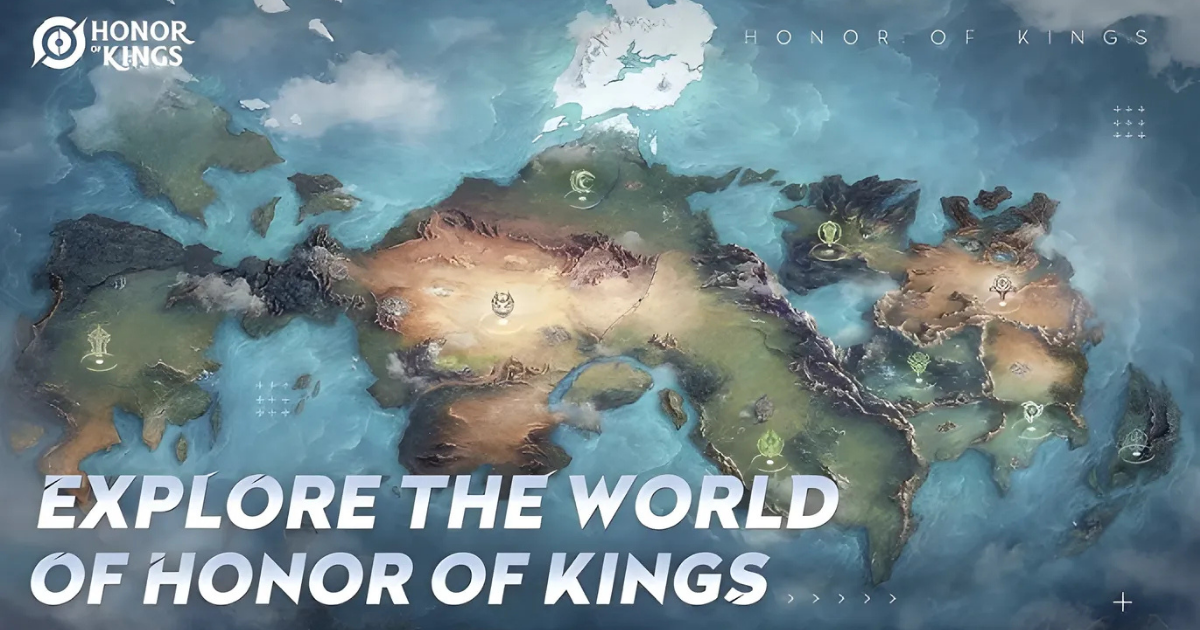
The open world of Honor of Kings: World spans approximately 64 square kilometers of explorable terrain across the continent of Primaera. Powered by Unreal Engine 5, the world features seamless loading between regions, a dynamic day-night cycle, reactive weather systems, and over 200 points of interest (POIs) ranging from hidden treasure caches and puzzle shrines to major settlements and dungeon entrances. The map is designed for both guided story exploration and freeform discovery, rewarding players who venture off the beaten path with rare materials, lore collectibles, and unique encounters.
TiMi Studio Group designed the world with what they described during their Gamescom 2025 presentation as a "layered discovery" philosophy. The surface-level world is vast and welcoming, but beneath it lie underground cave systems, underwater passages, and elevated mountain zones that add substantial vertical depth to the explorable space. A player who only follows the main story path will see perhaps a third of what the world has to offer.
Major Regions
The open world is divided into several distinct regions, each with its own biome, enemy ecosystem, storyline, and visual identity:
Location | Description |
|---|---|
the starting region, a lively wetland with crystal-clear streams, natural springs, and lush vegetation. Training grounds for new players. Low-level enemies and introductory quests. | |
a lush river valley with dense forests, waterfalls, and ancient dragon shrines. Mid-level content with the first challenging boss encounters. | |
rocky highlands with exposed cliff faces, mining settlements, and fortress ruins. Higher-level enemies and valuable ore deposits. | |
alpine terrain leading to Frostcloud Town. Guild content, cold-weather hazards, and endgame preparation zones. | |
a surreal region where the Flow energy is unusually strong, distorting the landscape into fantastical formations. Unique puzzles and ethereal enemies. | |
high-altitude peaks with clear skies, astronomical observation points, and ancient star-mapping technology tied to the Twelve Wonders. | |
Forbidden Mountains | the v1.1 endgame expansion zone with treacherous terrain, ancient ruins, and the Temple dungeon. |
the far-western endgame trial zone built atop the petrified remains of an ancient ruler. |
Points of Interest
The 200+ points of interest distributed across the map fall into several categories. Each POI is marked on the map once discovered, and many provide fast travel functionality:
Item | Description |
|---|---|
Waypoints | stone pillars that serve as fast travel anchors. Each region has 5-10 waypoints, and activating one adds it to the fast travel network permanently. |
Treasure shrines | small puzzle-locked caches containing gear, materials, or cosmetics. Range from simple "interact to open" to multi-step environmental puzzles. |
Boss lairs | open-world boss arenas where powerful creatures spawn on a timer. Defeating them yields high-value drops and boss encounter completion credit. |
Lore monuments | stone tablets, murals, and inscriptions that reveal fragments of Primaera's history when examined. |
Viewpoints | scenic overlooks that, when discovered, reveal a portion of the surrounding map and mark nearby undiscovered POIs. |
Campfires | rest points where players can cook food, repair gear, and save progress. Also serve as multiplayer gathering points. |
Dungeon entrances | gateways to instanced dungeon content, including both story dungeons and repeatable endgame raids. |
Fast Travel System
Fast travel in Honor of Kings: World is handled through a waypoint network. Players must physically discover and activate each waypoint before it becomes available for teleportation. The system encourages initial exploration while removing tedium for subsequent visits. Fast travel is free and instantaneous, though it can only be initiated from certain safe zones, players cannot teleport away mid-combat.
Major settlements like Chang'an and Frostcloud Town also function as fast travel hubs with additional services available immediately upon arrival. The game does not feature a traditional world map teleport. All fast travel goes through the waypoint network.
Day-Night Cycle and Weather
The world operates on a dynamic day-night cycle that completes a full rotation approximately every 45 minutes of real time. The cycle affects multiple gameplay systems:
Item | Description |
|---|---|
Enemy behavior | some creatures are nocturnal and only appear at night, while others retreat to their dens after dark |
NPC schedules | vendors, quest-givers, and townspeople follow daily routines, opening shops during the day and retiring at night |
Visibility | nighttime reduces visibility, making stealth approaches more viable but also increasing the danger of ambush from nocturnal predators |
Visual atmosphere | lighting, shadows, and ambient effects shift dramatically between dawn, midday, dusk, and midnight |
Weather effects operate independently of the day-night cycle and include rain, fog, thunderstorms, snow (in highland regions), and sandstorms (in arid zones). Severe weather conditions affect gameplay. Rain makes climbing surfaces slippery, fog reduces detection range for both players and enemies, and thunderstorms create environmental lightning hazards.
Verticality
One of the open world's distinguishing design features is its focus on vertical exploration. The map is not a flat plane with mountains as decoration, the vertical axis is fully explorable:
Item | Description |
|---|---|
Underground caves | extensive cave networks beneath the surface, some spanning entire regions, with their own ecosystems of enemies and resources |
Mountain peaks | climbable summit areas with unique encounters, viewpoints, and rare materials found only at extreme altitudes |
Underwater areas | rivers, lakes, and coastal zones with submerged caves, sunken ruins, and aquatic creatures |
Floating ruins | remnants of ancient structures suspended in the air by residual Flow energy, accessible via climbing, gliding, or grappling mechanics |
Mounts and Traversal
Traversal across the open world is supported by a mount system that provides faster movement speeds and, in some cases, unique traversal abilities. Players can collect mounts from various sources, quest rewards, boss drops, crafting, and special events. Some mounts are ground-only, while others can glide, swim, or briefly fly. A stamina system governs climbing and swimming to prevent unrestricted access to high-level areas before the player is ready.
Map Progression
The open world is designed so that players naturally move from lower-level regions to higher-level ones as they progress through the main story. However, the game does not hard-lock players out of any area. A low-level player can technically walk into Dragon Spine, though they are unlikely to survive. Region difficulty is communicated through recommended gear scores displayed on the map interface. Exploration completion is tracked per region, with rewards at 25%, 50%, 75%, and 100% discovery milestones.
Key Settlements
Action | Key/Button |
|---|---|
the main city and narrative hub, located centrally on the map | |
the scholarly institution where much of the game's lore and research systems are centered | |
the guild hub in the West Aerfall Highlands |
S1 Map Expansion (May 29, 2026)
The S1 World Beginning Season expands the playable world with the new Caiyun Basin (彩云盆地) region. S1's Caiyun Basin is the first major addition to the launch map after the S0 Jixia content; per TiMi Studio Group's pre-show materials, the launch map represents roughly one-tenth of the full designed continent. The remaining ninety percent is scheduled to roll out across future seasons.