

Combat is one of the pillars Lazy Bear Games has highlighted as substantially expanded in Graveyard Keeper 2. The original game treated fighting as an occasional dungeon detour with a few rudimentary brawls. The sequel reframes the kingdom around an active zombie apocalypse, which pushes combat from a side activity into a full system the player has to plan around alongside the rest of the management loop.
The defensive side of combat also has a civic payoff: the developers note that with proper defenses in place, the settlement's people can live alongside the remaining undead, so holding the perimeter is what lets The Town be rebuilt at all.
Combat Layers
Combat in the sequel resolves into two parallel layers that share the same gear and crafting pipeline. The first is mobile party action led by the Grand Inquisitor. The second is fixed-position tower defence around the settlement. Both feed off the automation supply chain that drives the rest of the economy.
Layer | Where It Happens | Player Role | Inputs |
|---|---|---|---|
Frontline Party | On the streets of The Town on its weekly battle day, and in the sewers beneath it on the other days | Joins the party in combat, leads not-so-smart undead troops | Crafted weapons, crafted armour, trained recruits |
Tower Defence | At the perimeter of the settlement | Plans tower placement and fortifications, commands the defending force | Barricades and towers built from crafted materials, plus squads of the player's own zombies |
Both layers are confirmed in the reveal materials. Specific weapon types, armour sets, and tower variants are not.
Combat Architecture
Combat mixes two things that did not appear together in the first game. The first is party-based action: the Grand Inquisitor and a group of fighters take the field together rather than the keeper soloing every encounter. The second is a tower-defense layer over the player's settlement, where waves of hostile undead push toward the town and the player has to hold ground. The two layers feed into each other, since the same gear and roster built for frontline pushes is what defends the gates when a horde arrives.
Building up Your Force
Equipment for the army comes out of the same crafting and automation supply chain that powers the rest of the game. Weapons and armour are crafted goods at the end of production lines that pull from harvested resources, refined materials, and zombie-staffed workstations. Investing in automation is therefore investing in combat readiness.
The undead recruits the player commands are described in the game's own materials as not-so-smart, and a meaningful part of combat is teaching them what to do. The player arms and trains these troops, then sends them into the field as a coordinated unit. The Grand Inquisitor is not a behind-the-lines commander either; the player character joins the soldiers on the frontlines and fights alongside them.
The Inquisitor in the Field
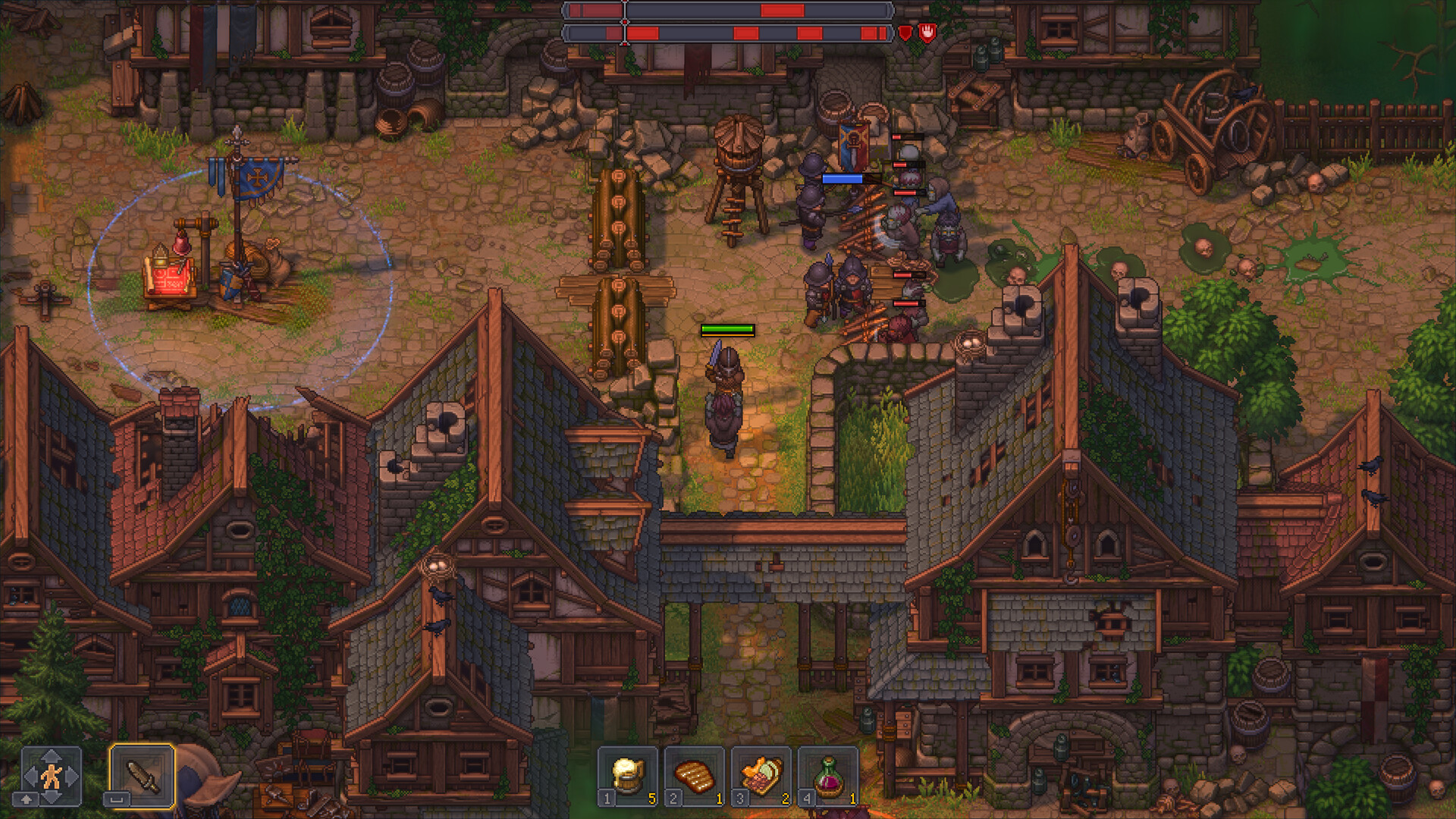
No official written copy names the Inquisitor's weapon. What the published combat screenshot shows is a sword: the player character carries one in the field, and a single equipped weapon slot in the lower left of the screen displays it. The store description's own framing of the combat brief is to craft powerful armour and weapons, arm and train your not-so-smart troops, and slash your way to victory.
The May 2026 developer log made the two-pronged nature of the response explicit in its own words: as a new Inquisitor you lead the army into battle to restore peace in the realm, and the studio asks who could fight zombies better than other zombies, especially those equipped with the finest weapons and armour. The Possession-Free Zombies that staff the production chain under automation are the same troops who carry weapons and armour into the field, while the hostile undead documented under Zombie Apocalypse are the enemy on the other side of the gate.
Tower Defense Layer
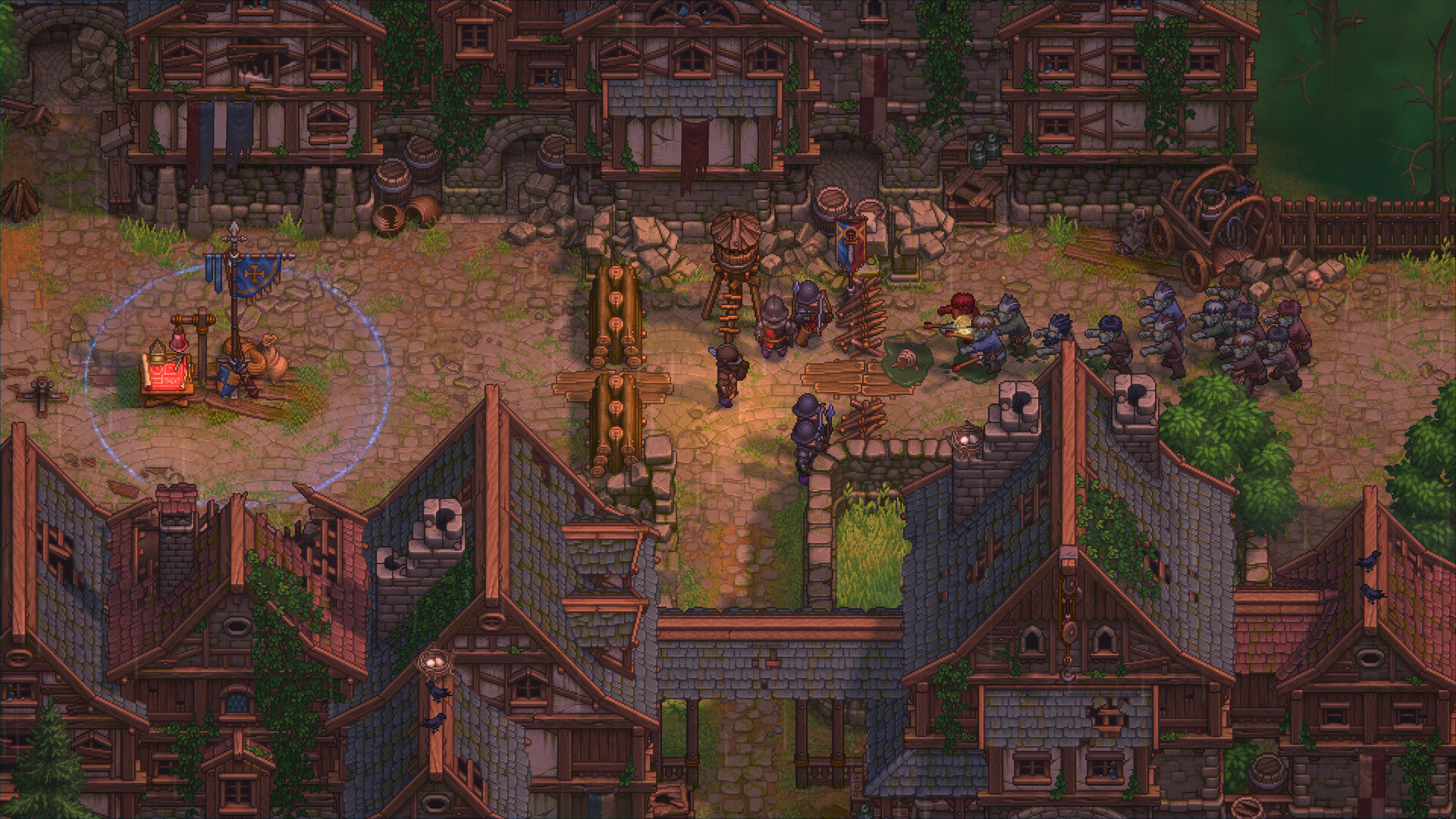
Around the settlement itself, the player builds towers and fortifications to repel encroaching undead. This is the part of combat that ties most directly into town restoration: as the town is rebuilt, defensive works can be added to its perimeter, and the layout chosen for walls, towers, and chokepoints shapes how each wave plays out. The same horde threat that motivates the rebuild also tests it.
Loot Loop
Combat encounters are not a sink. Successful fights reward loot, and that loot feeds back into progression: more materials for the supply chain, more inputs for crafted gear, and more resources to push the next round of upgrades to towers, troops, and the Inquisitor.
Tonal Shift From the Original
The original Graveyard Keeper kept combat small: a handful of dungeon brawls, mostly optional, easy to ignore in favour of the management sim. Graveyard Keeper 2 promotes the same activity into a kingdom-scale defense problem with its own production chain, its own recruitment and training layer, and its own real estate on the map.
Zombie Battles as a Named Mechanic
The September 2026 developer log listed the sequel's completely new mechanics by name, and zombie battles is one of the two it gave, alongside conveyor belt factories. That is the first time the studio has named combat as a discrete mechanic rather than describing it in passing, and it puts the two headline additions on the same footing.
The Combat Developer Log
On 18 September 2026 Lazy Bear Games published a developer log devoted to fighting. Its starting point is narrative: the studio says one of its goals was to make battles part of the story, so while the player is given a house, a church and a graveyard for being a decent person, The Town has to be liberated in battle, which the studio calls a fairly heroic thing to do. After liberating a district the player is the one who rebuilds it, which is where town restoration takes over.
Where and when | What the studio says |
|---|---|
City battles | Available only on a certain day of the week, in the same way the first game tied important tasks to specific days |
The sewers | Open on the other days for anyone who wants to swing a sword; full of zombies who will gladly meet the player halfway |
The Sewrena | The streets whisper that somewhere deep beneath the Town lies the Sewrena. Nothing else is said about what it is |
Town battles do not take place in special arenas. They happen on the streets themselves, and after a victory those streets fill with townsfolk and market stalls. Because of that, different parts of the city are distinct battle arenas, each with its own design and win conditions.
Arena | Win condition described |
|---|---|
Town Square | Hold off waves of enemies attacking from every direction |
Central streets | Push forward on multiple fronts and capture control points |
Preparation draws on what the Keeper already produces. Materials go into barricades and towers, which hold back hordes at the approaches to the base, and the zombies the player raises become comrades-in-arms. Squads of zombie fighters can be positioned wherever the player likes, or the player can raise their banner and lead them into battle in person. The studio names three playstyles it expects: squads made up entirely of archers, spiked barricades that do the killing on their own, and stocking up on combat potions to hold off waves alone.
Two figures close the post. There are thousands of zombies in the city, and over the course of the game the player will lay a little over 4,000 of them to rest. On mouse and keyboard, combat is designed to be controllable with one hand.
On-Screen Combat Overlays
The published combat capture shows the interface the fighting runs through. Every participant carries a bar above their head: green over the Grand Inquisitor, red over hostiles, and blue over one unit. Two long segmented meters run across the top centre of the screen, one marked with a shield icon and one with an open hand icon. A standard planted on the paving projects a circular radius across the ground with a glowing device beside it, which reads as a rally or summon point. Wooden barricades and spiked palisades stand across the street, matching the Simple Barricades node on the Technology Tree. A movement or formation widget sits in the bottom left alongside the weapon slot. What the two segmented meters count has not been stated.
Unconfirmed Details
Several specifics players will eventually want documented have not been publicly disclosed, and this article deliberately avoids inventing them. Open questions include:
Specific weapon types and named weapons available to the player and party.
Armour set names, tiers, and any set bonuses.
The full list of tower types and fortification options for the defensive layer.
Troop archetypes beyond the archers the combat log mentions, and any class system for the undead recruits.
Named bosses or elite enemy variants; the combat log names the Sewrena beneath The Town without describing it.
Which day of the week city battles fall on, and whether the sewers run on any timer of their own.
Whether combat resolves in real time, in turns, or in a hybrid of the two.
Maximum party size and any limits on how many troops can be deployed at once.
These will be filled in as more material is released. Until then, treat any specific weapon names, stat numbers, or tower lists from outside this article with caution.