

Dust Front RTS is a single-player strategy game that plays out on two connected layers: real-time battles where you build a base and command an army, and a turn-based global map where you manage territory, economy, and technology. This page explains the overall loop and links out to the systems behind it, including Base Building and Resources, Units and Armies, and The Global Map. For the wider context of the world you are fighting over, see World and Setting.
The Two Layers
Battles are fought in real time. Strategy is decided in turns. Each layer changes the other: what you research and capture on the global map shapes the forces you bring into a fight, and the outcome of each fight shapes the territory and resources you hold.
Layer | Pace | Focus |
|---|---|---|
Real-time battles | Real-time | Base construction, resource gathering, and direct command of your army |
Global map | Turn-based | Strategic economy, territory, technology branches, and troop movement |
The developer has described the design in his own words as a systems-driven game rather than a story-linear one, built around capturing territories, conquering the map, and methodical battles. A single campaign is designed to run for roughly fifteen hours, and it covers one faction.
Building Your Force
In battle you establish a base, gather resources, and assemble an army for the situation at hand. You raise factories to produce vehicles, facilities to refine minerals, and barracks with storage; every building also has weight on the global map. Macro structures raise the whole army at once while you build, and buildings placed next to each other can be connected for bonuses. Full details are on the Base Building and Resources page.
Your arsenal spans tanks, aviation, infantry, and vehicles of various purposes. You can lead careful strategic maneuvers, overwhelm the enemy with cannon fodder, or pound entrenched positions with carpet bombing. The developer's own framing for the scale is direct: this is not a game about squads but about battalions, companies of tanks and the thunder of artillery. The unit roster and how troops carry over between battles are covered in Units and Armies.
Asymmetrical, Outnumbered Battles
A defining feature of Dust Front RTS is the asymmetrical fight: you frequently face an enemy superior in both number and strength. Victory comes from smart maneuvering and the right composition rather than from matching the foe head-to-head. The challenge is built around the campaign and its forces, not other human players.
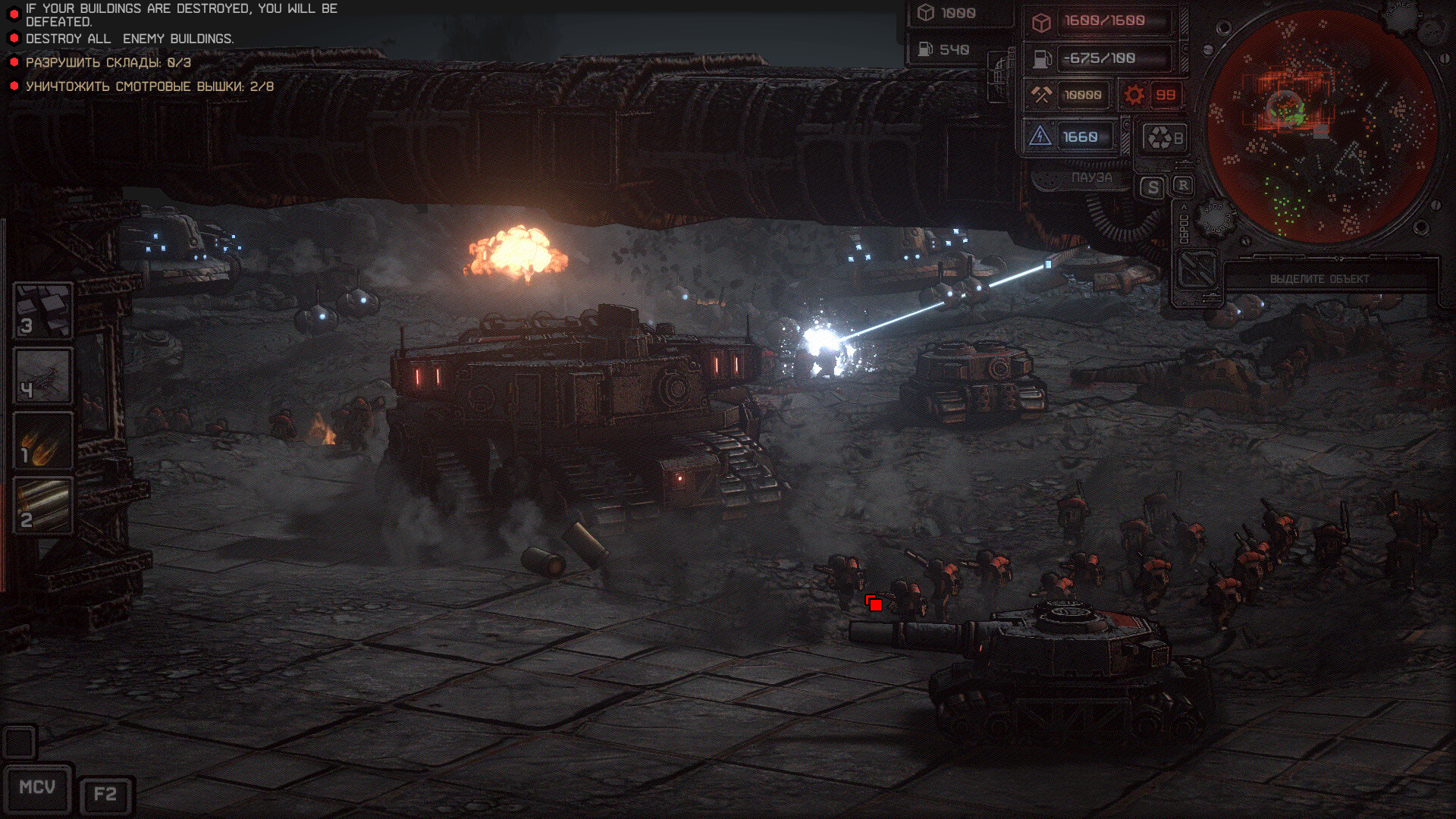
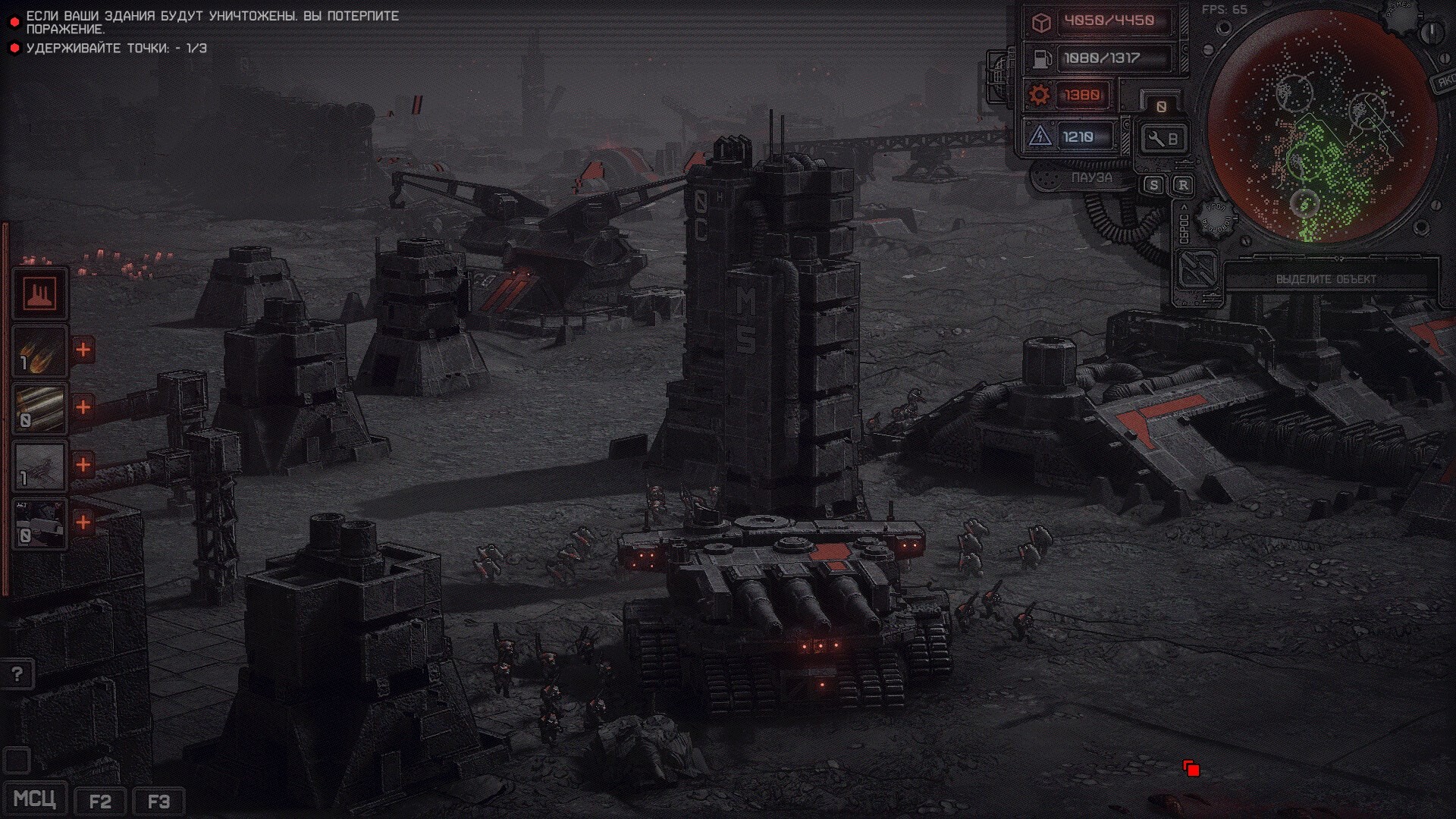
Battles run on clear win and loss conditions. A recurring rule is that if all of your buildings are destroyed, you are defeated, which makes base defense as important as offense. Mission objectives can task you with destroying enemy factories, warehouses, watchtowers, giant mutant incubators, an enemy main building, or a strategic building singled out on its own, and one variant simply asks you to destroy every enemy building on the map. Others ask you to hold ground, where the objective panel tracks the points you hold as a running count rather than a single spot.
Micro, Macro, and the Tactical Pause
The game leans toward deliberate control rather than raw speed. Infantry act largely as a massed force, while tanks and other vehicles reward closer attention and can succeed where infantry cannot operate at all. Vehicles handle according to their chassis, accuracy changes depending on whether a unit fires on the move or from a standstill, and armour is directional. For players who would rather not have the clock dictate their decisions, a tactical pause lets you stop the action and issue orders. The published control and convenience features are collected under Controls and Interface.
Procedural Missions and a Living Battlefield
Missions combine handcrafted goals with procedural map generation and external rules, so the terrain and the shape of each engagement vary from one battle to the next. Paired with the non-linear campaign, this keeps repeated playthroughs from unfolding the same way.
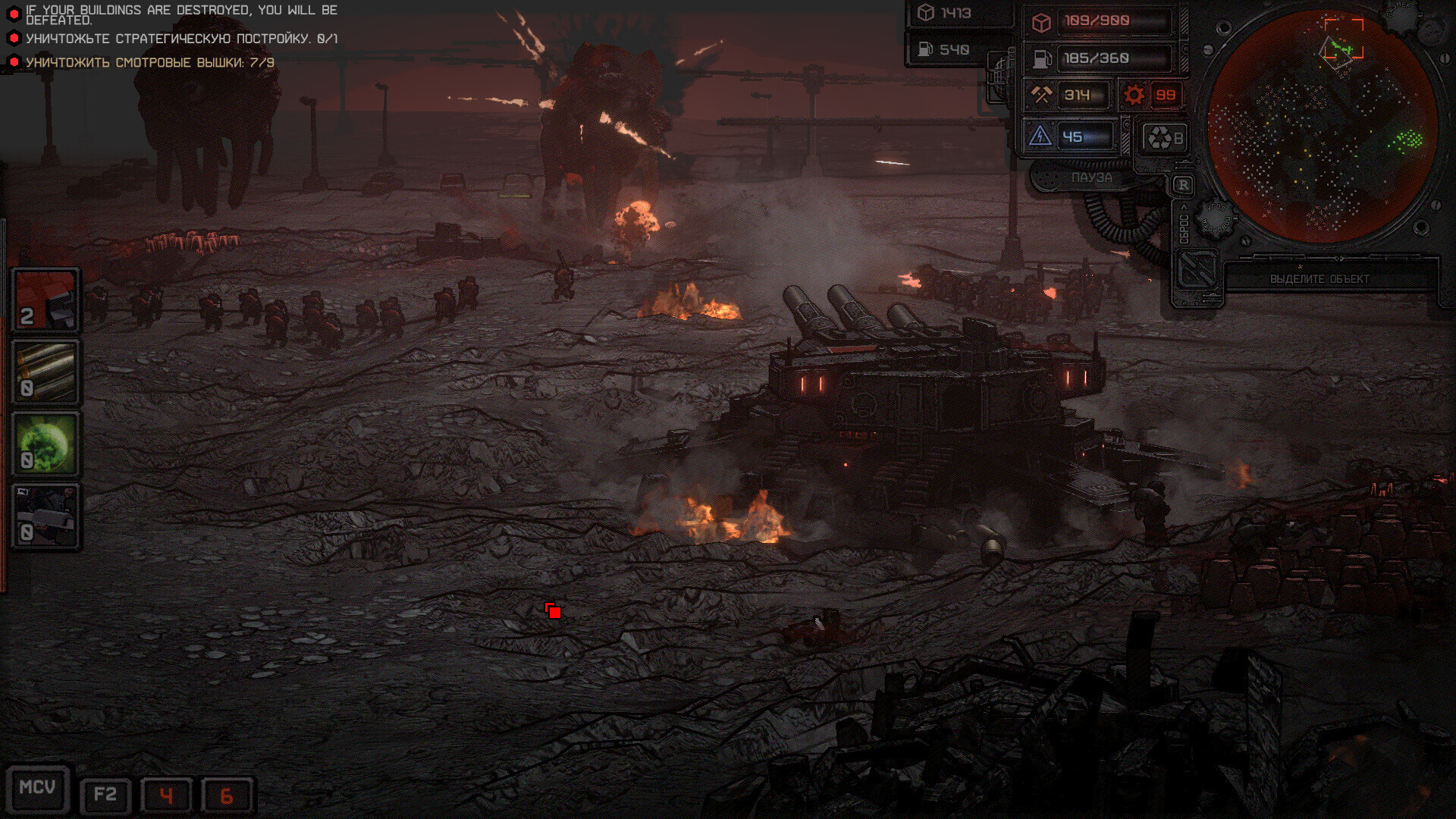
The battlefields themselves are destructible and reactive. The ground deforms under explosions, almost every object can be shot apart, surfaces burn, gas clouds detonate when ignited, and weather such as storms, radioactive emissions, and falling space debris can change conditions mid-battle. These systems are covered in detail under Destruction and Terrain.
Technology and Progression
Between and during campaigns you advance through technology branches that unlock new units and buildings, then improve and equip them through an enhancement system built around blueprints. Research is organized into doctrines and gated by your industrial development; the systems are detailed on the Technology and Doctrines page, and the blueprint layer has its own page under Blueprints and Upgrades. At the highest level of the conflict, rare faction superweapons can reshape the strategic situation, as described under Superweapons.
Planning on the Global Map
Above the battles, the global map is where you measure the value of your power. Mining and production within territories feed a strategic economy, captured regions generate events you take part in, strategic structures such as a missile silo or a siege fort can be raised, and your troops gain ranks as veterans you can redeploy. Major actions resolve on the next turn, so you plan ahead and anticipate enemy maneuvers. See The Global Map for the strategic layer in full.
The Demo
The developer released a free, playable demo for the Steam Next Fest on June 15, 2026. It is built around the real-time side of the game and offers a single, fixed mission type with a procedurally varied map, so each attempt plays out a little differently. The developer describes it as a finished demo rather than an early-access build or the full game, with some aspects of localization, voiceover, and ability icons still unfinished.
It was released for the festival and extended for one extra week after the response exceeded expectations, with the developer noting he had planned for around two hours of content across one mission and a fixed set of units while many players spent far longer than that. Rather than removing it afterward, he decided to keep it available for an indefinite additional period, with no further demo patches planned for now; it will still be shut down at a later, unannounced time. A late demo update, D-30, added an optional difficulty modifier that raises the durability and health of enemy units, which the developer framed as a way to make you face the quality of enemy units and not only their quantity. The full game's release is still to be announced; the demo date does not set a launch date.
What the demo includes, as described by the developer:
Siege of an industrial city: one of several macro-focused battle types. The enemy holds fortified military bases, and your task is to establish your own positions and clear the area.
A choice of two factions: the light-and-fast Bandit Faction or the heavily armored Mutant Faction, whose worms and flies force close-quarters fighting.
Unlocked technology: some units and buildings from higher-tier doctrines are made available so you can stand up to the enemy hordes.
Strike groups and reinforcements: in the full game you assemble an army to push into a neighboring sector, with part of the force deploying at once and the rest arriving as reinforcements. The demo includes an interface that simulates this.
Difficulty and scale settings: a multiplier sets how tough the enemy is, and you can scale the opposition up, for example making the enemy base several times larger.
A basic tutorial covering the fundamentals, plus chevrons and stars awarded for the enemy base multiplier you clear.
The demo's on-screen text is available in both English and Russian, with subtitles listed for each. Russian also carries full spoken audio, while the English voiceover and further languages are planned for the full release. For the wider strategic layer that sits above these battles, see The Global Map.