

Armies in Dust Front RTS are built from an arsenal of tanks, aviation, infantry, and vehicles of various purposes. You produce these forces from your bases, covered in Base Building and Resources, unlock and upgrade them through technology and doctrines, and carry them between fights using the persistent garrison system on the global map. The campaign frequently pits you against enemies superior in number and strength, so how you compose and preserve your army matters as much as its size.
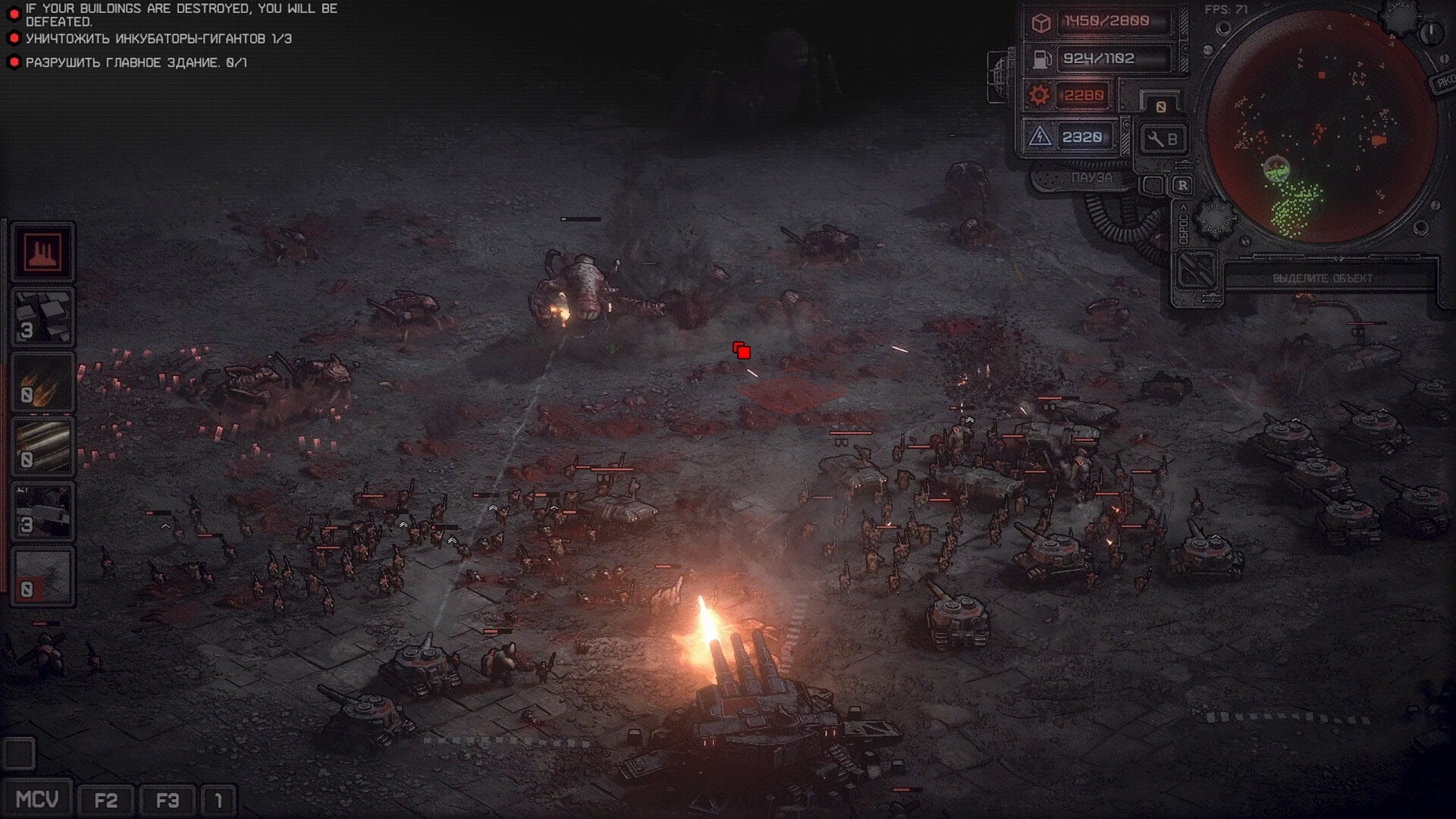
Unit Types
The table below lists the unit types confirmed in current builds. It is not a complete roster, and no hit points, costs, or other numeric values are assigned here, since the only numbers visible are preview interface details.
Unit Type | Role |
|---|---|
Tanks | Core armored fighting vehicles; the T-50 is named directly in current builds, alongside a heavier tracked vehicle whose English name had not been published as of September 2026. |
Artillery / rocket tanks | Multi-barrel platforms for massed bombardment from range. |
Dreadnought | Super-heavy artillery platform that fires at long range with spotter correction. |
Howitzer | Siege configuration a Dreadnought can be rebuilt into. |
Aviation | Aircraft that bring firepower from the air, including heavy bombardment runs. |
Infantry | Foot soldiers trained from the barracks, including riflemen, rocket squads, and gunner squads. |
Brutes | Free infantry produced automatically by the Empire's Complector structure. |
Spotters | An artillerymen squad that doubles as snipers and directs long-range fire. |
Mechs / walkers | Legged combat units fielded alongside conventional vehicles. |
Repair vehicles | Support units that restore damaged forces in the field. |
MCV | Mobile construction vehicle used to deploy and establish a base. |
The Vehicle Factory's Production List
One official capture of the demo shows the vehicle factory selected with its production grid open. It is the only published look at everything a single production building can field, and eight entries appear in it, each on its own hotkey. Three of those entries are labelled only in the Russian build, so they are described below by what they are rather than given an English name the game had not published as of September 2026. The same capture shows an untranslated placement string on the cursor, which is a reminder that this build's English text is still incomplete.
Entry | What it is |
|---|---|
Harvester | The resource-gathering vehicle. The developer names it in English in his own fix notes, where he describes tuning how harvesters and tanks behave in crowded road situations. |
BREM | The armoured repair vehicle. The developer uses this designation in his own English writing when discussing the auto-cast and mass-selection repair options that did not make the demo. |
Armoured car | A light armoured vehicle. Its English name has not been published. |
Hammer howitzer | The mobile artillery piece described above, the one that also appears as the Molots. |
Armoured personnel carrier | A troop transport. Its English name has not been published. |
T-50 | The tank designation that also appears on its own unit panel in two separate captures. |
Heavier tracked vehicle | A larger armoured vehicle built from the same factory. Its English name has not been published. |
Dreadnought | The super-heavy artillery platform covered above, which can be rebuilt into a Howitzer. |
The grid is what one factory offers at the tech state that capture was taken in, so it is not the game's whole roster. Infantry come from the barracks instead, and the technology and doctrine research described elsewhere changes what any factory can build.
Tanks and Armor
Tanks form the backbone of your forces. One designation is confirmed in current builds, the T-50, which appears both on its own unit panel and in the vehicle factory's production list. A second, heavier tracked vehicle is built from the same factory, but its English name had not been published as of September 2026. Armor is meant to be massed and maneuvered, and the strategic framing encourages you to lead bold maneuvers or simply overwhelm an enemy with cannon fodder when the situation calls for it.
Accuracy is not constant. The game models hits and misses that depend on whether a unit is firing while moving or firing from a standstill, so stopping to shoot is a real decision rather than a cosmetic animation.
Artillery and Aviation
For reach, the army fields artillery and rocket tanks, multi-barrel platforms that deliver massed bombardment against entrenched positions. Aviation adds a second avenue of attack from the sky, up to and including pounding the enemy with carpet bombing. Together they let you soften defenses before your armor and infantry close in.
The heaviest of these platforms is the Dreadnought, a super-heavy artillery vehicle whose chassis is shared with the MCV. A Dreadnought can be rebuilt into a Howitzer, and after a demo fix that conversion preserves the vehicle's current mode and its queued orders while mobilized.
The bomber that appears in the game's trailers was designed as a deliberate reference. The developer has said it is not taken directly from the short film it resembles, but that its look was inspired by that work and is a nod to the artist behind it, who does not object to the homage.
One mobile artillery piece has been named directly, and it turns up under two different names. The vehicle factory builds it as a howitzer whose name is the word for hammer; the developer's own English writing calls it Hammer Artillery in one place and transliterates it as the Molots in another, but both refer to the same gun. In his demo fix notes it was changed so that these pieces now try to return to their original position after being ordered to fire on a stretch of territory, rather than staying where the order left them. It is also one of the two units his worked example fits gas shells to. No stats have been published for it.
Infantry, Mechs, and Support
Infantry are trained from the barracks and round out a combined force, while mechs and walkers bring legged firepower to the line. Keeping that force intact falls to repair vehicles, which mend damaged units so a battered army can stay in the fight. The MCV, a mobile construction vehicle, is the unit that turns a landing into a working base.
The Empire also fields Brutes, free infantry produced automatically by its Complector structure rather than trained from a barracks. Because the Complector exists to raise the whole army rather than a single unit line, its Brutes are effectively a side effect of building up your macro economy.
Veterans and Ranks
Troops are not disposable between missions. Garrisoned forces gain ranks as they fight, so a unit you have led through several battles grows more capable over the course of the campaign. This lets you bring the same veterans from the start of a war to its finish, rewarding careful play that keeps experienced units alive.
Strike Groups and Garrisons
On the global map, your forces serve in one of two roles. A mobile strike group moves between battles to press the offensive, carrying its veterans and their hard-won ranks with it. Forces left behind act as a defensive garrison, holding captured territory against counterattack. Choosing which veterans advance and which hold the line is a core strategic decision across the campaign.
Strike group: a mobile force that moves between battles to attack, keeping its veteran units.
Defensive garrison: forces that stay behind to defend captured territory.
Ranks: units that survive and fight gain ranks, growing stronger over the campaign.
Armor and Damage
Vehicles use a differentiated armor system. Protection is split into two zones: a front arc, and a combined zone covering the sides and rear. Striking a vehicle from its flank or behind, where the combined zone is weaker, deals more damage than hitting its frontal armor head-on. Not every vehicle follows this rule: some heavy mutant units, although they count as the vehicle type, carry all-around armor and take the same damage from any direction, so flanking them gives no bonus.
Vehicle Movement
How a vehicle moves depends on its chassis, which adds a layer of micro to controlling your forces:
Tracked vehicles mostly turn in place. A tank pivots on the spot when it needs to swing past a certain angle.
Wheeled vehicles have a wider turning radius, and lighter wheeled units can drift through turns and carry inertia as they move.
Hover vehicles glide, drifting fluidly toward the direction you point them.
Tracked and wheeled vehicles can also reverse. Backing up lets you keep your stronger frontal armor facing the enemy while you retreat, rather than turning a weaker flank toward their guns. Because the ground itself deforms and individual tracks ride over it, terrain shape feeds into all of this; see Destruction and Terrain.
Infantry Squads
Each infantry squad on the screen is a single unit, and the soldiers in it show the squad's remaining health. As the unit takes damage, individual soldiers fall in sequence. The number of soldiers left does not change how much damage the squad deals, so a nearly wiped squad still hits as hard as a full one.
The exception is a squad's unique soldier, who carries a special weapon. A rocket trooper, a sniper, or a heavy gunner with an autocannon is treated as the most important member and falls last, so the squad keeps its special ability for as long as possible. A support soldier carrying artillery-guidance gear is the opposite case and falls first, so a squad can lose the ability to call in fire while still standing. To bring a thinned squad back to full strength, simply heal the unit.
Garrisoning Structures
Infantry can occupy structures on the battlefield. Units sheltering inside a garrisonable building are protected from environmental damage such as flame and gas, and weapon recoil no longer applies while they are inside. Trenches and other defensive works you build yourself, covered under Base Building and Resources, serve the same purpose on open ground.
Artillery and Spotters
Artillery is a decisive force on the battlefield. Beyond its normal auto-attack range, a piece raises the angle of its guns so shells arc on a higher, wider-spread trajectory. Heavy long-range artillery, including the Dreadnoughts, relies on spotters to reach distant targets. A spotter squad, whose members double as snipers, can direct heavy artillery fire at any range: once they finish correcting, free guns set to the right mode aim at the marked target.
Because artillery is so strong, it is also a priority target. It can be silenced by overwhelming it at the cost of heavy losses, by counter-battery fire from your own artillery, or by aircraft called in through tactical support abilities.
Equipping Units
Units can be modified rather than only replaced. Blueprints installed from the global map change unit parameters, sometimes trading one strength for another, and some units carry more than one slot. Local equipment upgrades apply to individual units in battle. Both systems are covered under Blueprints and Upgrades.
Factions
The developer has named two of the forces you encounter while presenting the game's demo, where you can field one of two armies:
Bandit Faction: the starting faction, operating in the gray zones of the global map. It leans on light, fast units rather than heavy armor.
Mutant Faction: a horror-themed army of heavy, well-armored units supported by disgusting worms and flies. Its weight pushes fights into close quarters.
These two are the armies featured in the demo, and they correspond to two of the four powers described on the Factions page.
Wrecks and Corpses
What a destroyed unit leaves behind depends on its faction. Fallen mutants spawn flies, a free but fragile unit that can harass any enemy, and some mutant corpses burst into swarms of worms that serve as the mutants' rank-and-file infantry. By contrast, the wrecks of the Fourth Industrial Empire's vehicles can be used to bring destroyed super-heavy machines back into service through a dedicated repair unit, so those expensive vehicles are not necessarily lost for good.