

Technology and Doctrines is the research side of Dust Front RTS, reached from The Global Map. It is how you unlock new units and buildings, then improve and equip them with more modern means of destruction. Research shapes which kind of army you bring to your battles, from massed armor to siege firepower. Rather than a single linear tech tree, progress is split across specialized doctrines and gated by your industrial development. The systems below are drawn from the game's current research screens; specific balance values are still in flux and are left out here.
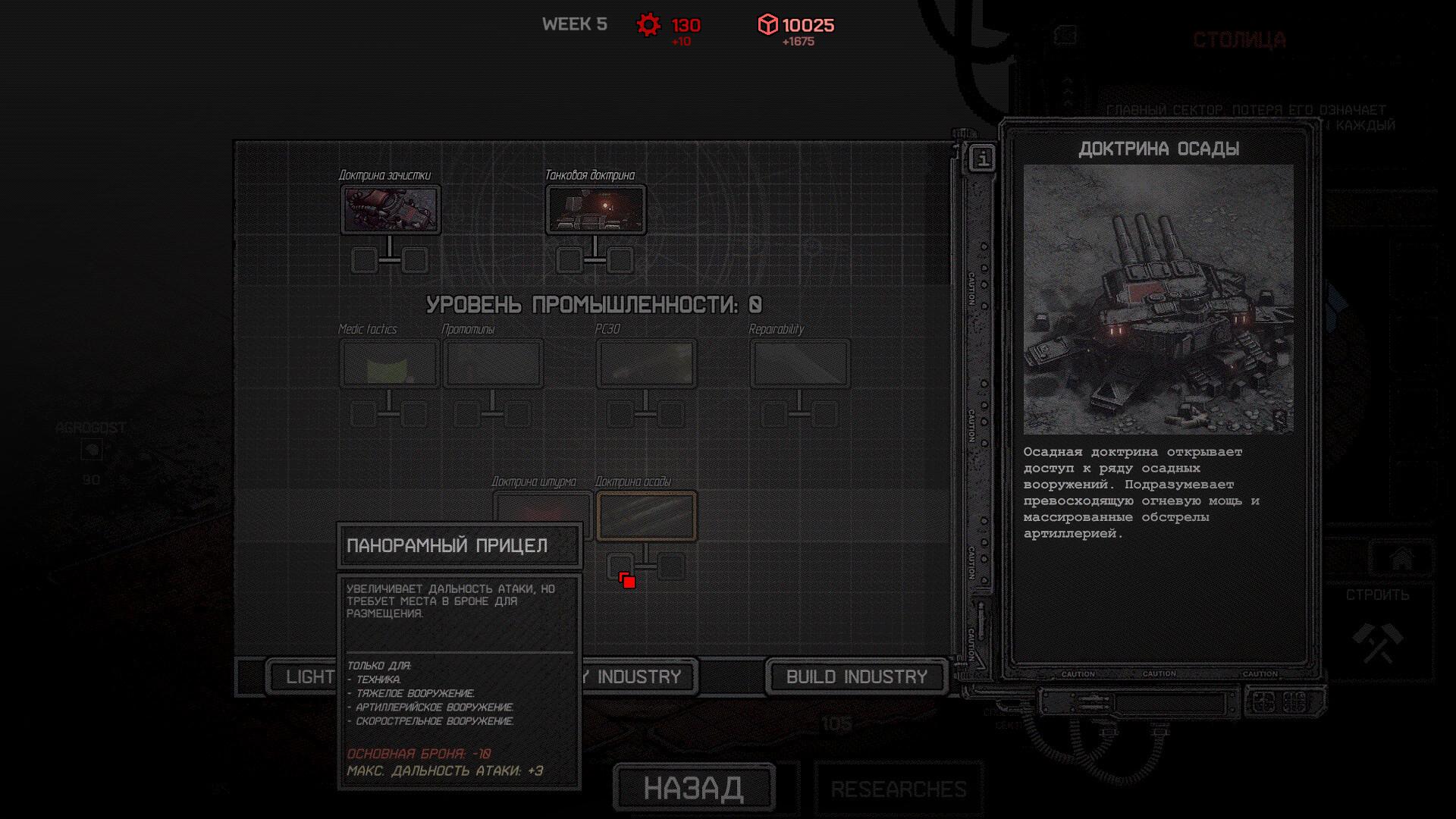
Industry Level
Research progress is tracked by an Industry Level. Your industry level gates access to higher-tier research, so building up your industrial base is the prerequisite for reaching the more powerful technologies. The research interface is organized with industry-building tabs that reflect this progression, tying your strategic economy directly to how advanced your forces can become.
Industry Level rises as you develop your industrial base.
Higher industry levels unlock higher-tier research.
Industry-building tabs organize the research interface around this progression.
The Four Doctrines
Research is organized into doctrines, each a branch tree that specializes your forces in a particular direction. Four doctrines appear in current builds, letting you commit to a playstyle as your campaign develops.
Doctrine | Focus |
|---|---|
Tank Doctrine | Armored forces and the vehicles that anchor a frontal advance |
Assault Doctrine | Aggressive offensive options for pressing the attack |
Siege Doctrine | Siege weapons built around superior firepower and massed artillery bombardment |
Cleanup Doctrine | Mopping up and clearing what remains after the main fight |
The demo unlocks units and buildings from some higher-tier doctrines from the start, which the developer explains as necessary to put up a decent fight against the enemy hordes within a single mission.
The Siege Doctrine
The Siege Doctrine is the clearest example of how a doctrine reshapes your army. It opens a range of siege weapons built around superior firepower and massed artillery bombardment, leaning into the option to pound an entrenched enemy from a distance rather than trade blows up close. It pairs naturally with the artillery and rocket tanks described in Units and Armies.
Three Kinds of Improvement
It helps to keep the three improvement systems apart, because they are applied in different places and do different things.
System | Applied where | Scope |
|---|---|---|
Doctrine research | Global map, between battles | Unlocks new units, buildings, and higher tiers |
Blueprints and equipment | Global map, per unit type | Modifies unit parameters with slots and trade-offs |
Macro buildings | Inside a battle | Raises every unit of the relevant kind on the battlefield at once |
Blueprints are covered in full under Blueprints and Upgrades, and the macro buildings that carry the in-battle upgrades are described under Base Building and Resources. Doctrines are also one of the ways blueprints are unlocked, so the three systems overlap rather than running in parallel.
Equipment Modules
Beyond unlocking units, you can customize them. Units can be fitted with equipment modules that change how they perform, each occupying space on the unit's armor layout, so loadouts involve trade-offs rather than pure upgrades. These local upgrades are handled separately for each unit rather than across the whole army.
Example: Panoramic Sight
One module seen in current builds is a Panoramic Sight. It increases a weapon's attack range, but does so at the cost of armor space, so the extra reach trades against protection. It is available to vehicle, heavy, artillery, and rapid-fire weapons, which gives a sense of how broadly modules can apply across unit roles. Exact range and armor figures are preview values and are not listed here.
Modules attach to units and occupy space on the armor layout.
Panoramic Sight increases a weapon's attack range at the cost of armor space.
It is available to vehicle, heavy, artillery, and rapid-fire weapons.
The developer has kept visible model changes for the more significant doctrines and equipment rather than spreading that work across every upgrade, which is part of why the blueprint layer exists alongside them.
How It Fits Together
Industry Level sets the ceiling on what you can research; the doctrines decide the direction your army grows; and equipment modules and blueprints tune individual units within that direction. Because research is reached from the strategic layer and your veterans carry forward between battles, the technology you invest in compounds over a campaign rather than resetting each fight. See The Global Map for how research connects to economy and territory.
Unlock, improve, and equip your forces with more modern means of destruction.