
Loading...
Loading...
Getting Started
October 9, 2026 at 10:56 PM
Added dated September and October changes with separate gameplay modes
New to ZeroSpace? This guide covers the basics every commander needs before diving into the Campaign, the Galactic War, or Skirmish. The core loop is the same everywhere: gather resources, expand your base, build an army led by a hero, and out-maneuver your opponent.
The single-player Campaign is the gentlest on-ramp. Playing as the Protectorate, you learn the game through a guided story while building up your Mothership and crew. The Protectorate's defensive, supportive style is forgiving for newcomers. Once you are comfortable, the cooperative Galactic War lets you team up, and Skirmish offers competitive matches when you are ready to test yourself.
Economy: keep gathering hexite and grab flux from its timed impact sites; see Resources and Economy for the full picture.
Your hero: choose a hero at the start, use it to secure experience towers early, and remember it will respawn if it falls.
Supply: build supply structures so you are never blocked from making more Units.
Veterancy: keep units alive when you can, since they grow stronger the longer they survive.
Base placement: bases can only be built on hexite patches, and the extractors that work them raise themselves, so early expansion is about claiming patches rather than queuing miners.
Talents: faction experience runs a seven level track and every level makes you pick a talent. XP towers are what feed it, which is the real reason to take them early.
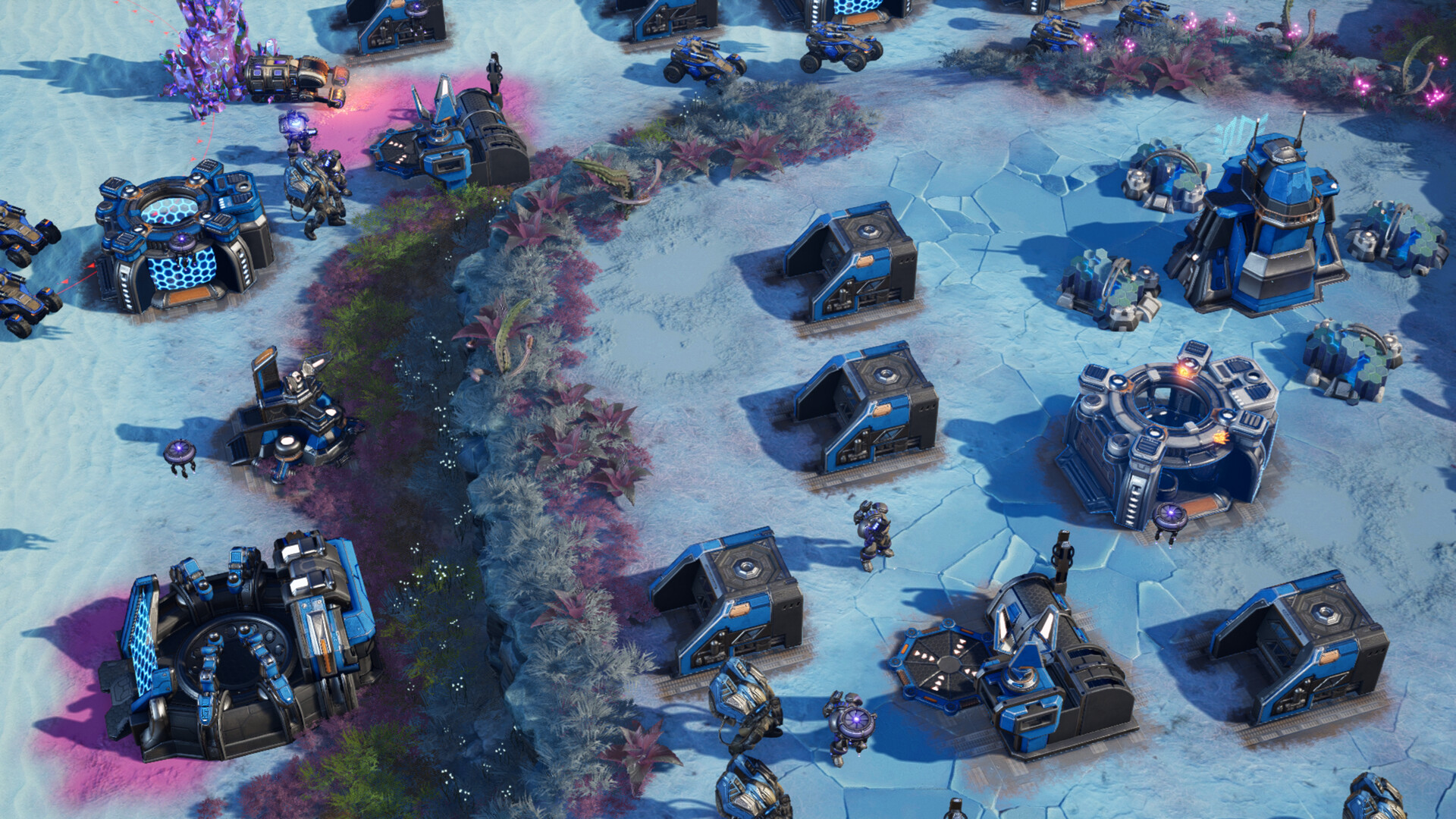
The map decides your build locations, not you. Every base has to sit on a hexite patch, and expansions snap onto them, so scouting is partly a search for the next patch you can hold. The starting location comes ringed by six patches with three extractors already running; each expansion has four patches and one extractor, and the rest are raised on their own, one at a time. None of that needs a build order. What it does need is protection, because an expansion sits at a fixed location your opponent can find and will.
Patches do not run out so much as run down. A live patch yields 1.4 hexite per second and a spent one keeps paying at 0.35, so an old base is still worth holding rather than abandoning. Resources and Economy covers the rest of the economy, including flux harvesters and the top bar power pool.
The other half of the early game is faction experience. XP towers are neutral structures on every competitive map, each guarded at the start by a single creep. Clear the guard, then keep units inside the tower radius while nobody else has any there, and the tower is yours. It then produces experience continuously, including after your units leave, so an early capture pays for the whole match.
Experience raises your faction level, and each level makes you choose one talent. There are seven levels, so seven picks in a game. Levels 1, 3 and 5 offer two talents from your own faction. Levels 2, 4 and 6 offer one from your faction and one from the mercenary group you hired. Level 7 is a single choice between Resource Control and Power Control. A pick is permanent for that match, so it is worth knowing what your faction offers before you are asked. No first party page documents the track, so treat the specifics as community documentation of the current build.
All four base Factions are playable at Early Access. The Protectorate suits players who like a steady, defensive game; the Grell reward map control through their spreading biomass; the Legion of Truth is for players who want to build around powerful heroes and tanks; and the robotic Xol merge simple units together into larger ones, though they are the newest of the four and the least settled. Try each in Skirmish against the computer to find your style.
When you begin the campaign you also pick a difficulty. The four options, Casual, Normal, Hard, and Brutal, let you set how hard the missions push back, so newcomers can ease in on Casual and veterans can test themselves on Brutal.
Two commands arrived on August 19, 2026 that new players tend to look for and fail to find. Attack ground now has a hotkey of its own, defaulting to Control and A, which matters most if you have put attack on quickcast, because before that change there was no way to attack ground at all. A self cast modifier defaults to Alt: hold it while pressing an ability key to aim that ability at your own unit. The same update added the option to mute an opponent, from their portrait in the lobby or the info button in the top right during a match.
Changes like these land often, and Update History keeps the dated record of them.
If you would rather learn by doing, ZeroSpace includes built-in tutorials for all three ways to play: the single-player Campaign, cooperative Galactic War missions, and competitive versus play. The co-op tutorial in particular walks you and a friend through the galaxy-map missions before you jump into them for real. Whichever pillar you start with, there is a guided lesson to get you going.
The October 3 update completed the Xol roster in matchmaking, Survival and Skirmish, and made the faction playable in Ranked 1v1. See The Xol for the faction mechanics.
Playing any game mode now earns account XP. Account levels unlock profile cosmetics. This progression is separate from the XP earned during a match.
Matchmade Versus, Vs. AI and Survival games can contribute to Galactic War. The planet selector on the right side of these mode screens chooses the planet to support and shows its occupation status.
In Versus, Skirmish and Survival, main bases start with all their Extractors. Main bases use gold Hexite Pits: their bonus income was reduced from 50% to 33%, and their maximum hexite from 6,400 to 5,800.
In Versus, Skirmish and Survival, the September 12 update reduced the flux harvester caps from five to four for Xol, ten to eight for Protectorate and Grell, and fifteen to twelve for Legion. The caps cover four fully populated Flux Nodes rather than five.
Flux Nodes in Versus, Skirmish and Survival now hold 2,000 flux instead of 9,999. Once depleted, they continue mining at 25% of their normal rate.