
Loading...
Loading...
The Cash Economy
October 16, 2026 at 06:24 PM
Added the Season 2 reward changes: new action rewards, logistics delivery streaks, crate and spotting changes, exploit fixes, discounts and the Lonestar bonus removal
The cash economy is the signature system of WARDOGS and the reason its makers say cash is king. Players begin with a starting balance of $10,000, and each time they spawn they spend cash to buy a custom loadout from a shared pool of weapons, gear, utility, and vehicles. That money is not wiped at the end of a round: it carries over from match to match as a persistent measure of progress.
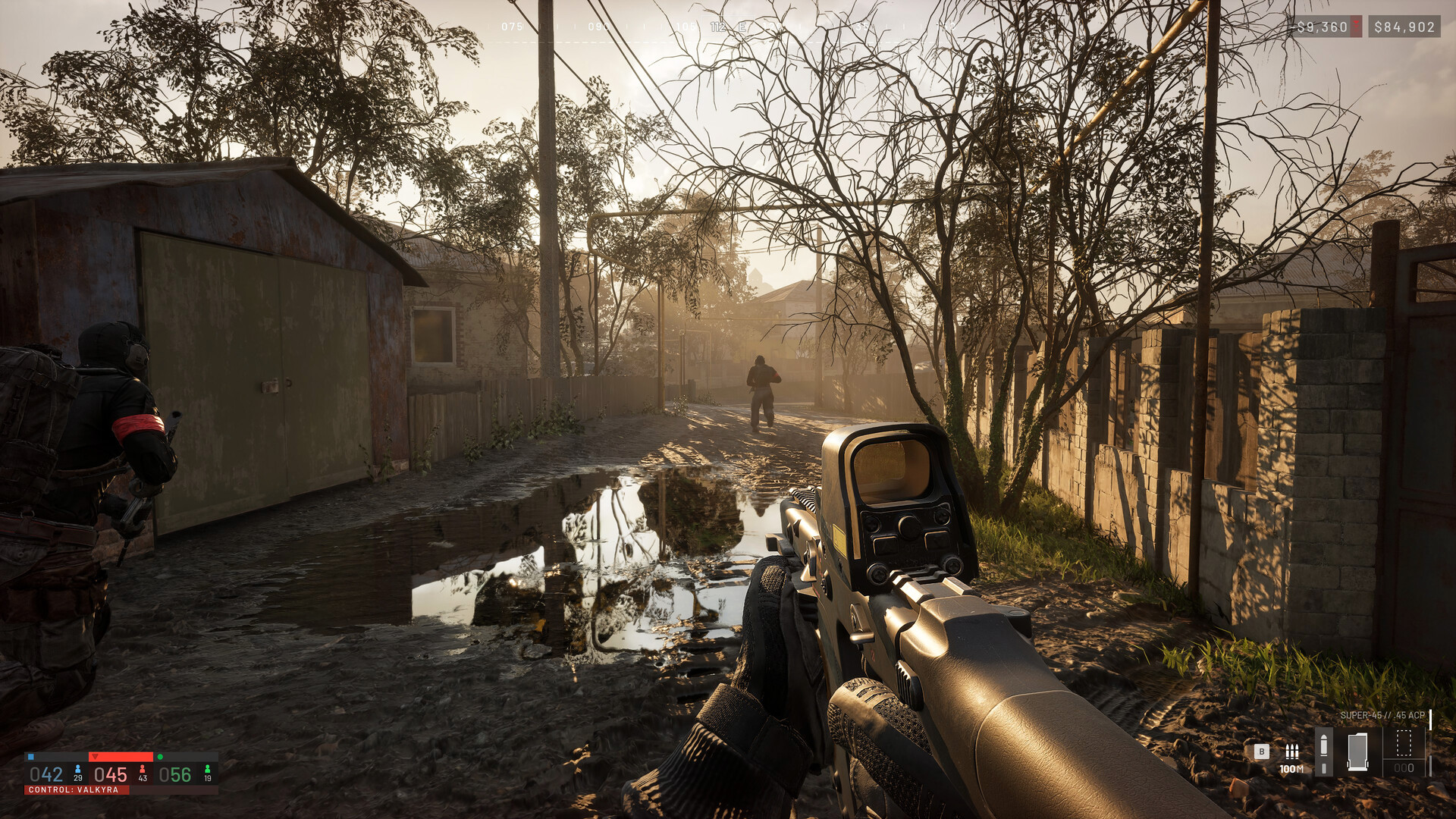
Cash is earned by playing for the team. Reviving allies, transporting teammates to the fight, spotting enemies, scoring kills, and holding the Control Zone all pay out, so the players who contribute most can afford the strongest equipment. Teamwork is not just encouraged; it is the main way the account balance grows. Players can also tip each other directly on top of those automatic payouts, which the developers suggest for a medic who patched you up, a crew that refuelled or repaired your vehicle, or a pilot who flew you to the zone.
A shifting Hot Zone appears as a smaller sub-zone inside the larger Control Zone. Players standing in the Hot Zone count double toward their team’s share of the zone, which can swing a match, and they also earn double cash. Fighting for the Hot Zone trades extra risk for greater scoring potential and buying power.
Cash can be saved for a big purchase at the right moment or spent steadily each life. Players can also exchange cash profits for Gold Bars, an endgame currency used to obtain seasonal cosmetic unlocks in the Gold Market. The conversion runs through a Gold Exchange whose rate moves from day to day, so the timing of a conversion changes how much gold a given pile of cash is worth. Cosmetics are earned this way through play rather than sold for real money.
Progression runs on both cash and experience. Because roles are not fixed classes, players spend on specialist items to build whatever role they can afford on a given life, and they earn XP on the progression tracks while doing so: six named in the Season 1 changelog (Career, Medic, Support, Driver, Pilot, and Recon) and seven in the Season 2 notes, covered under Progression Tracks. The developers plan to deepen progression further after early access with more involved systems and a stronger seasonal layer, alongside a wider metagame that includes a Black Market and Vault and a player skills and challenge system. That skills layer is explicitly not present at launch: once it arrives, playing earns Skill Points that are spent on permanent Role Skills such as reviving faster, handling weapons better, or flying further, and it carries across seasons rather than resetting.
Prices are not fixed for the life of the game. The Season 1 changelog published on 9 September 2026 moved fourteen of them, pushing a few staples up and pulling several vehicles down. The studio said it raised the forward operating base and Large Hammer vendor prices specifically to make buying either one more of a choice.
Item | Track or vendor | Previous price | Price at Season 1 |
|---|---|---|---|
Vendor | $2,500 | $7,500 | |
Large Hammer | Vendor | $1,600 | $2,400 |
Artillery Tank | Career | $400,000 | $500,000 |
6-10x MRAD scope | Recon | $25,000 | $40,000 |
6-10x MOA scope | Recon | $30,000 | $45,000 |
Medium Hammer | Support | $10,000 | $25,000 |
Large Hammer | Support | $25,000 | $75,000 |
Small armoured supply crate | Pilot | $5,000 | $10,000 |
Little Bird with miniguns | Pilot | $25,000 | $50,000 |
Z20 Lakota | Pilot | $50,000 | $35,000 |
URAL | Driver | $50,000 | $35,000 |
Dune Buggy | Driver | $35,000 | $25,000 |
Kodiak Flatbed | Driver | $15,000 | $35,000 |
Music Tape H | Driver | $5,000 | $2,500 |
The same patch closed a way of farming the economy for experience. Selling a supply crate item worth under $75 now pays 1 XP instead of 25, and the supply crate purchase curve was rescaled from a range of 25 to 250 down to a range of 1 to 200 so that low value items are priced sensibly and cannot be abused. A player kill scored from an air vehicle pays 250 XP rather than 300. The full item list and the unlock levels behind these prices are covered under Loadouts and Arsenal.
Because every account shares one economy, the studio treats exploiting it as a shared problem rather than a private one. Patch 0.11, on 12 September 2026, fixed several cash exploits and published an enforcement policy alongside them, saying that as an early access game it will not be perfect but that it had decided to come down hard on players who find something and keep using it.
Behaviour | Consequence |
|---|---|
Abusing cash exploits and bugs | A timed ban, lengthened by any previous bans, plus a reset of cash and experience to zero |
Publishing guides to abusing a system without reporting it | Treated as advertising cheats, resulting in a permanent ban |
Experience farming | A permanent ban. The studio tracks which servers an account joins and says it is aware which servers are farming servers |
The distinction it drew was between finding something and exploiting it: testing a newly discovered bug once or twice was described as helping with quality assurance, while doing it repeatedly is abuse. The patch notes in full are under Update History.
Update 0.1.2, on 30 September 2026, went after the economy again. Revive validity checks became fully server authoritative, a vehicle fly-through exploit was fixed with its rewards capped, rewards for destroying buildables now scale with how far a structure had been built (so destroying a freshly placed schematic no longer pays in full), and depositing pallets into a forward operating base outside the zone now pays reduced rewards. The studio also said that players caught abusing cash and experience exploits, or real money trading, had already had their cash and progression reset, and that the leniency it had shown first-time offenders was over: repeated abuse of unintended exploits now risks a permanent ban without warning.
Season 2, which went live on 15 October 2026, reworked how almost every action pays, with more for teamplay and logistics and less for low-risk farming.
Action | Season 2 reward |
|---|---|
Kill with an assault archetype weapon | $2,000 (was $1,500) |
Hacking an enemy forward operating base | $2,500 and 250 XP to the hacker, plus $1,000 and 250 XP to each teammate in the base's radius |
Breaching a door with the Halligan Bar | $100, once per door; the bar now has 7 uses instead of 5 |
Closing a friendly forward operating base door | $75 |
Destroying a forward operating base | A bonus of up to $7,500 and 250 XP, scaled by the supplies it held (the maximum at 25,000 supplies) |
Capturing a hostile drill tower | $1,500 and 300 XP (was $750 and 250 XP) |
Destroying a buildable | Cash equal to its build supply cost, with XP at roughly a quarter of the cash, scaled by how far it had been built |
Spotting | Around 30 percent less than in Season 1, scaled to the value of the target. A spotted target destroyed by another enemy faction now pays 25 percent of the reward rather than 50 |
Kills with barbed wire | No longer pay cash or XP |
Some experience moved between tracks. Destroying a buildable and using IEDs or C4 now give Assault experience instead of Support, artillery gives Driver experience, and repair experience goes to the Driver or Pilot track depending on the vehicle repaired.
Base logistics rewards are lower, but consecutive runs now add a streak bonus, so logistics players are rewarded for making return trips instead of abandoning their vehicles. The studio corrected the streak figures after first posting them: the original values were base design values without the zone multiplier, and the published ones are what a player receives when dropping in the Control Zone.
Streak | Bonus for each run in a row | Counts up to |
|---|---|---|
Crates | +$100 and +50 XP per crate | 10 |
Pallets | +$250 and +100 XP per pallet | 10 |
Players | +$25 and +5 XP per player | 25 |
Return trips | +$50 and +25 XP per trip | 10 |
Delivery | Season 1 | Season 2 |
|---|---|---|
Player delivered | $150 and 50 XP | $100 and 25 XP |
Player delivered by ground vehicle | $500 | $350 |
Return trip by ground vehicle | $250 and 100 XP | $150 and 50 XP |
Small supply crate deployed | $500 and 250 XP | $250 and 200 XP |
Large supply crate deployed | $1,000 and 500 XP | $500 and 400 XP |
Supply crate deployed from an air vehicle (XP) | 200 small, 400 large | 150 small, 300 large |
Supply pallet deployed | $2,500 and 500 XP (750 XP from a ground vehicle) | $1,250 and 400 XP (500 XP from a ground vehicle) |
Every vehicle variant now has its own destruction reward, so armed variants are worth far more than unarmed ones: armed variants give 1.5 times the XP of the default variant, and attack vehicles pay more the more kills they have made. The full list is under Vehicles. Supply crates pay less to destroy unless they are armoured: a small crate $300 (was $500), a large crate $600 (was $1,000), a small armoured crate $1,000 (was $500), a large armoured crate $1,600 (was $1,000), and supply pallets $800 (was $1,000).
Spotting rewards for buildables scale with build progress, to stop players farming spots on unfinished structures.
Destroying a buildable pays according to how far it was built.
Selling from a supply crate has diminishing returns per buyer, until a sale brings no profit or XP.
Selling a supply crate item to an enemy player, for example after they switch teams, no longer pays cash or XP.
Destroying an empty enemy crate pays half cash and half XP.
Rewards for deploying and destroying supply crates scale with the value of the supplies inside.
The forward operating base supplied assist is split between the assisting players, so a whole team can no longer each receive the full amount.
A losing team gets 20 percent off at vendors while it is at least 40 points behind second place, a rule that applies to all three teams. Players who join and populate empty servers earn rewards and a vendor discount once the match begins. For Season 2 only, Lonestar received a cash and XP win bonus and cash and XP multipliers for teamplay actions, part of an experiment described under Factions; on 16 October 2026 the studio said it had removed the Lonestar bonus in a backend update. The experimental Wager Vendor, which lets a player stake their own cash on their own performance, did not open at launch and is due later in the season.
Vendor prices moved on dozens of items, mostly upward for vehicles, armour and the strongest weapons and downward for several staple rifles, backpacks and attachments. They are listed under Loadouts and Arsenal and Vehicles, and the unlock costs on each track under Progression Tracks.
Everything above happens inside a match. What a player does with the balance afterwards belongs to a separate layer the developers call the Metagame, which holds the Gold Exchange and Gold Market alongside a planned Black Market, Vault, and skills and challenge systems. That layer is covered under The Metagame.
The studio has also tied a promotion to the in-game balance. A clip contest opened on 3 September 2026 and was due to close on 8 October 2026; the studio extended it by 24 hours, so entries closed on 9 October. Its published terms set one grand prize of $100,000 in real money and one hundred runner-up prizes of 100,000 units of in-game currency each, awarded to the hundred highest scoring clips as picked by a judging panel. The top 100 clips were revealed on 13 October 2026, with one $100,000 real-money grand prize and $100,000 of in-game cash for the other finalists. That currency cannot be bought, cannot be taken out of the game, and has no cash value. The developers said the contest comes out of the marketing budget rather than the game budget or pre-order revenue.