
WARDOGS is a combined arms shooter, and vehicles are bought from the same pool of cash as a rifle. There are no vehicle classes and no crew slots to queue for: a player with the level and the money buys the vehicle, and a player without either does not. That makes armour and aircraft a spending decision as much as a tactical one, which is the whole point of the cash economy.
The developers have still not published a vehicle roster as such, but the Season 2 patch notes of 14 October 2026 name most of the fleet through their price, unlock and reward lists. The table below is the Season 1 picture, drawn from the Season 1 balance pass, where the money column is the one-off unlock cost on the track; the Season 2 values follow further down.

Named Vehicles
Vehicle | Type | Track | Season 1 unlock level | Season 1 unlock cost |
|---|---|---|---|---|
Z20 Lakota | Helicopter | Pilot | Not published | $35,000 |
Little Bird with miniguns | Armed light helicopter | Pilot | Not published | $50,000 |
Small armoured supply crate | Air-delivered logistics | Pilot | Not published | $10,000 |
URAL | Transport truck | Driver | 3 | $35,000 |
URAL Covered | Transport truck | Driver | 18 | Not published |
URAL Attack | Armed truck | Driver | 25 | Not published |
Kodiak Assault | Armoured vehicle | Driver | 6 | Not published |
Kodiak Flatbed | Logistics vehicle | Driver | 10 | $35,000 |
Dune Buggy | Light fast transport | Driver | 8 | $25,000 |
Humvee with minigun | Armed light vehicle | Driver | 30 | Not published |
Heavy Tank | Main battle armour | Driver | 35 | Not published |
Artillery Tank | Long range indirect fire | Career | 90 | $500,000 |
Large Supply Crate | Logistics | Driver | 16 | Not published |
Unlock levels and prices are Season 1 values. The developers have said each season carries a different experience curve with a different item order, so both columns are expected to move between seasons. The full set of changes that produced these numbers is under Update History.
The Havoc
The Havoc is the most expensive aircraft with published values. Update 0.1.2 on 30 September 2026 fixed a bug that made it take extra damage from 20mm and 30mm cannon fire, and a hotfix on 2 October set the CIWS, the close-in weapon system, to destroy it in around 6 seconds rather than 12, after the studio said it had overcorrected in the previous patch. The Season 2 notes put it on the Pilot track, raising its unlock cost from $500k to $650k and its vendor price from $18,000 to $28,000, and cut the reward for destroying one from $18,000 to $14,000. Update 0.1.2 also fixed a vehicle fly-through exploit and capped its rewards.
Reading the Tracks
Vehicles were split across three of the six progression tracks named in Season 1, and the split tells you what each track is for. Driver carries the ground vehicles and was deliberately reordered at launch to give a steadier escalation through attack vehicles. Pilot carries the aircraft. Career is the general track, and the Artillery Tank sits at its far end at level 90, the most expensive and most gated of the vehicles with published values, at $500,000.
Two items changed track when Season 1 opened. The Heavy Tank moved off Career to Driver level 35, and the Music Tape H moved from Pilot to Driver. The Heavy Tank's move put ground armour on the track that already carried the ground vehicles.
Season 2 concentrated ground armour further. All four new vehicles are on the Driver track, the SPH-2 moved onto it from WARDOG level 90 to Driver level 31 with its unlock cost cut from $500k to $350k, and the Little Bird AH-6M [Miniguns] moved from Pilot level 4 to 8, with its unlock cost raised from $50k to $125k, because the studio judged it too strong for how early it unlocked. At level 90 and $500,000 the SPH-2 matches what the Season 1 changelog gave the Artillery Tank on the Career track, though the studio has not said the two are the same vehicle. The full list is under Progression Tracks.

Transport as a Role
Moving people is one of the better paid things a player can do. Teams spawn away from the objective, so a driver or pilot who shortens that walk keeps an attack alive and earns cash for every teammate delivered. The developers built that payout in deliberately, and players consistently rate logistics as the fastest way for a new account to build a balance.
The risk is symmetrical. A vehicle is a large purchase that can be lost in seconds, and a transport driven into a prepared position takes its passengers with it. Experienced players treat turning back as a normal move rather than a failure, because a surviving vehicle can make the trip again.
Flight and Handling
Aircraft are flown rather than steered. The studio developed the flight model with an aerospace engineer, and it is detailed enough that landing is a skill players ask each other about rather than an afterthought. The Season 1 patch notes give some sense of the tuning involved: the Z20 Lakota received a balance pass and a fix for sluggish pitch, helicopter input damping was extended to every input device, and the rattle on the Lakota's chase camera rotation was brought down by six decibels.
Ground vehicles got their own attention in the same pass. Vehicle turrets gained a maximum operator rotation speed, and a sensitivity issue affecting tank aiming was fixed.
Artillery
The Artillery Tank is the long range end of the arsenal and behaves differently from everything else. Players report a minimum range of around 750 metres and a maximum of roughly 2,630 metres, so it cannot defend its own position and depends on the team holding ground around it. Its blast is considerably larger than the mortar that covers the shorter ranges, which is described under Fortifications and Structures. Those figures are player measurements rather than published values.
Planned Additions
The developers have named fighter jets as a new vehicle type planned for after early access, alongside further vehicles generally. They are explicitly not in the launch build. See Early Access Roadmap.
Four vehicles arrived with Season 2 on 15 October 2026, all on the Driver track. The studio said drivers who prefer armed vehicles now have more ways to get kills before reaching the L2A6.
Vehicle | Description | Track and unlock | Vendor price | Reward for destroying it |
|---|---|---|---|---|
Wolf-110 | Fast, light wheeled transport | Driver, level 8, $50k | $2,200 | $450 |
Wolf-110 [M2 Browning] | The Wolf-110 with a ring-mounted M2 Browning | Driver, level 16, $125k | $7,800 | $3,900 |
T-72B3 | Main battle tank, slower than the L2A6 but cheaper and slightly more fuel-efficient | Driver, level 20, $250k | $16,000 | $8,000 |
Flakpanzer Gepard | Anti-air vehicle | Driver, level 25, $300k | $14,000 | $7,000 |
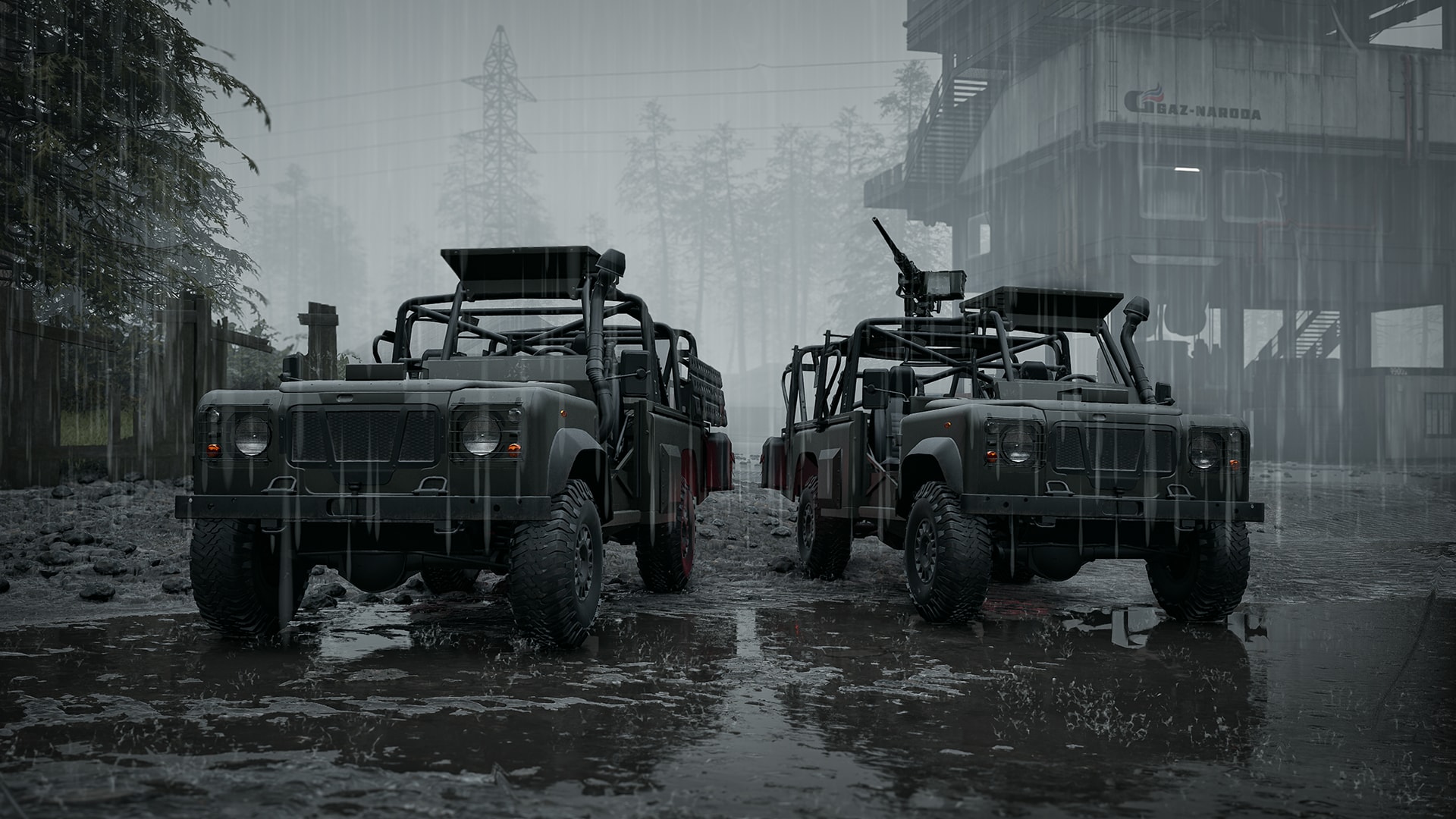
The preview called the tank the T-72 and compared it with the Leopard; the patch notes name it the T-72B3 and compare it with the L2A6. The preview's Wolf-110 (Assault) is the Wolf-110 [M2 Browning] in the notes. The Season 1 changelog called the Driver track's level 35 tank the Heavy Tank, and the studio has not said whether that is the L2A6.
Season 2 Vehicle Prices
Vendor prices are paid each time a vehicle is bought in a match. Season 2 raised them sharply for armed vehicles, aircraft and the L2A6.
Vehicle | Season 1 | Season 2 |
|---|---|---|
Kodiak [M249] | $3,750 | $6,750 |
Humvee [M249] | $3,750 | $8,500 |
Humvee [Minigun] | $4,500 | $10,000 |
Ural Defender | $6,000 | $7,200 |
Ural Defender [M249] | $6,750 | $9,500 |
L2A6 | $14,000 | $22,000 |
Little Bird AH-6M [Miniguns] | $7,000 | $12,000 |
Little Bird AH-6R [Rockets] | $12,500 | $18,800 |
Z20 Lakota [Miniguns] | $8,000 | $15,000 |
Havoc | $18,000 | $28,000 |
Destruction Rewards
Every vehicle variant now has its own reward for destroying it, so armed variants are worth far more than unarmed ones. Armed variants give 1.5 times the XP of the default variant, and attack vehicles pay more the more kills they have made.
Vehicle | Season 1 | Season 2 |
|---|---|---|
Kodiak | $1,250 | $500 default, $600 Pickup, $3,400 M249 |
Wolf-110 | New | $450 |
Wolf-110 [M2 Browning] | New | $3,900 |
Humvee | $1,500 | $600 default, $4,250 M249, $5,000 Minigun |
Ural | $2,500 | $1,000 default, $3,600 Defender, $4,750 Defender [M249] |
Bobcat | $250 | $100 |
Dune Buggy | $750 | $300 |
MH-6 | $3,125 | $1,250 |
Little Bird AH-6M [Miniguns] | Not listed | $6,000 |
Little Bird AH-6R [Rockets] | Not listed | $9,400 |
Z20 Lakota | $3,700 | $1,500 default, $7,500 Miniguns |
Havoc | $18,000 | $14,000 |
L2A6 | $14,000 | $11,000 |
SPH-2 | $14,000 | $8,000 |
Flakpanzer Gepard | New | $7,000 |
T-72B3 | New | $8,000 |
Season 2 Handling and Other Changes
Inventories of purchased vehicles are private to the driver and their squad by default; a new setting opens one to everyone once the vehicle is fully unlocked. Vehicles that spawn free for each team stay open to everyone.
Tracked vehicles feel weightier, less floaty in the air and less bouncy on landing.
The Humvee was reworked to be less stiff over terrain, slower to reach top speed and better at climbing, and the Dune Buggy's brakes were weakened, adding a little skid and drift.
Explosives and placeables can no longer be used from enclosed vehicle seats.
The calibre damage cuts apply to vehicle weapons that fire those rounds, such as the Little Bird AH-6M Minigun, Z20 Lakota Minigun and Humvee Minigun, and the top turrets on heavy and artillery vehicles now use assault rifle and LMG hit-location values against infantry.
The Vanguard CIWS now takes 2.25 times longer to destroy the Spawn Vehicle.
Fixes for the Humvee gunner facing the wrong way, gunner fire desync, one-way helicopter cockpit glass, tanks launching themselves off their own turret, vehicles sinking when ramming, wheeled vehicles stuck after a backward roll, smoke screens and flares missing for late joiners, and players being pushed through a vehicle when exiting.
30mm cannon ammunition takes a 2x2 inventory slot and backpack stacks are capped at 50; vehicle storage stacks stay at 200.
A Note on Spelling
The studio spells the light helicopter two ways in its own material. The supporter pack listing writes Littlebird as one word and the Season 1 patch notes write Little Bird as two. Both are official text and neither has been corrected, so both spellings appear across this wiki.