
Day Combat
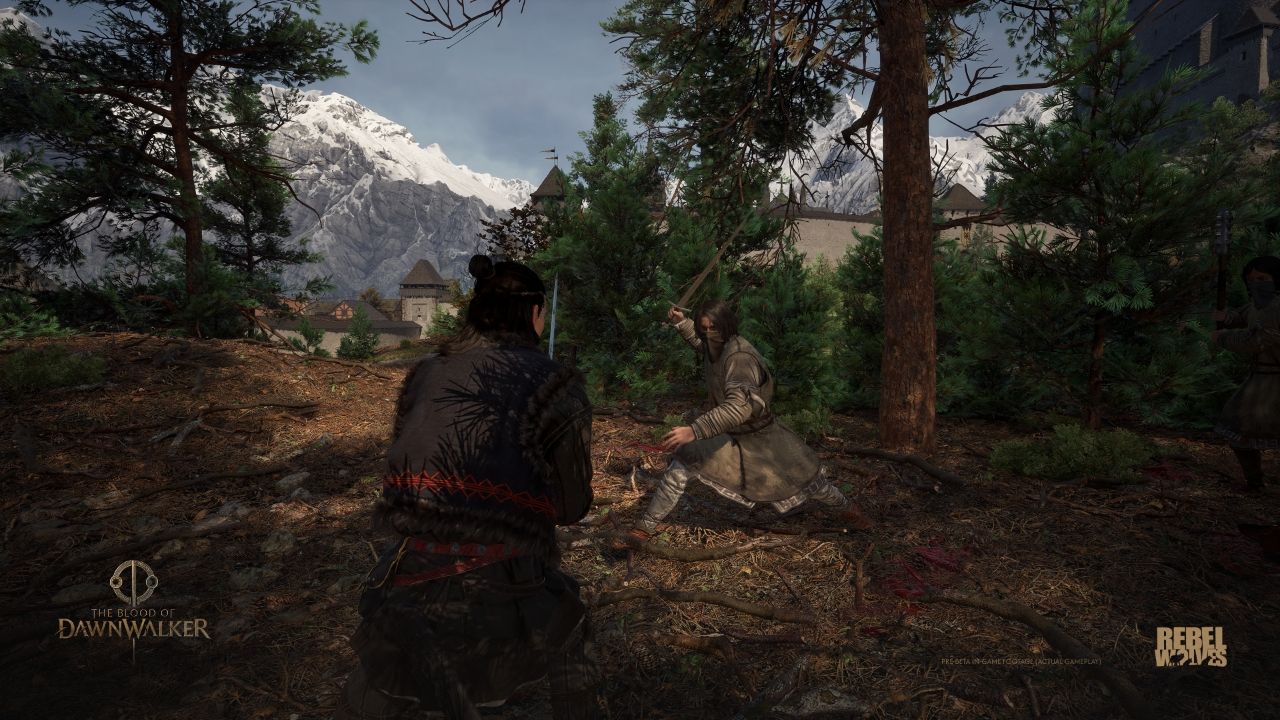
During the day, Coen fights as a human with equipped melee weapons, Swordmastery and Witchcraft. His starting sword is Peregrini Aurorae. Short, long and great swords differ in weight and attack speed, and other melee weapons can be found in the world. There are no bows or crossbows. Attacks and blocks use the four-direction combat system.
The directional system works across four angles: up, down, left, and right. Players choose a direction to swing and a direction to block. Enemies telegraph their attacks, and reading their movements correctly lets you strike where they can't parry. Successful attacks, blocks, and parries build activation charges.
Activation charges power two things: Hex Magic abilities and execution moves. Hexes include Burning Blood (damage over time) and Compel Soul (speak with the dead). Feral Mind, which prompts an enemy to start attacking random targets including their own allies, is named as a spell in the publisher's own community bulletin question-and-answer and was shown under hex magic in the June 2025 gameplay deep dive. It does not appear under that name in the shipped Witchcraft roster as of September 2026, so the name and effect are first-party but its place in the shipped game is not settled. Execution moves like Artery Strike deal heavy finishing damage. Ability slots are tracked separately for Swordmastery, Witchcraft and Vampirism and can be expanded through their respective perks. You earn charges by fighting well, which creates a loop where offense enables bigger offense.
Coen can also fight barehanded. Punches and blocks follow the same directional system as sword combat.
Omniblock Mode
For players who find the directional system too demanding, an omniblock/omniattack mode is available. This removes the need to choose a direction. Attacks and blocks work in all directions automatically. The trade-off is higher stamina consumption. The developers added this based on community feedback, keeping the directional system as the intended experience while offering an accessible alternative.
Night Combat
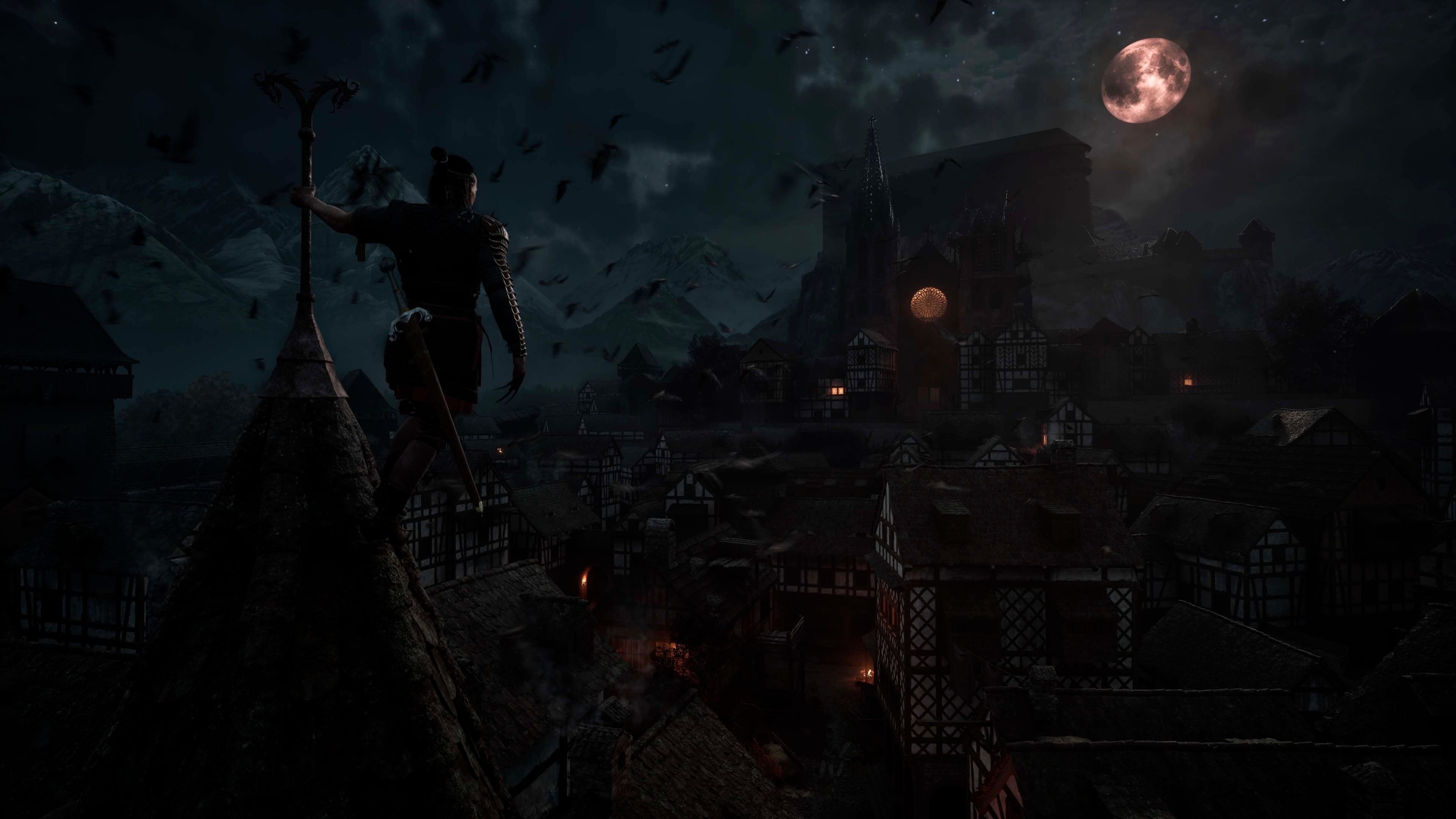
At night, Coen can use vampiric claws or keep using equipped weapons and Swordmastery. His Vampirism abilities add healing, movement and offensive options to either approach. Claws provide a faster, aggressive alternative, with dismemberment possible during attacks.
Item | Description |
|---|---|
Shadowstep | Short-range teleport for instant repositioning, closing gaps, or escaping encirclement |
Voracious Bite | Drain an enemy's blood to restore health. Rewards staying aggressive |
Planeshift | Wall and ceiling traversal opens vertical combat angles and ambush positions |
Blood Surge | A blood ability that can make an enemy explode, gained by drinking from Xanthe |
Night combat ties into stealth. Coen must avoid detection by guards and civilians while in vampire form. Getting spotted can escalate into fights you're not ready for, or trigger narrative consequences.
Acquiring vampire powers
Coen obtains new vampire abilities by draining other vampires. Each vampire has distinct powers, and defeating them lets Coen absorb what they had. Xanthe's Blood Surge, for example, is acquired this way. This ties character progression to the enemies you choose to fight rather than a generic upgrade menu.
Launch coverage names three of those grants, one from each of the vampire lords Coen can drink from, and two more abilities that come from finishing a quest instead of from a kill. The grant from Xanthe is Blood Surge in every account of the shipped game; the blood whips seen in the June 2025 reveal were her own attacks in that fight, not the ability Coen takes from her. See Vampire Combat and Night Abilities for the tree itself.
Blood craving in combat
The Blood Craving system connects directly to fighting. As Coen takes damage, his hunger increases. At night, the health bar also represents his hunger level. Biting enemies serves the dual purpose of healing and managing the craving meter. If craving reaches critical levels, Coen can involuntarily drain NPCs, including story-critical characters.
Feeding can be partial (knocking victims unconscious) or total (killing them). The choice between restraint and efficiency creates a persistent tension during and between fights.
Named Abilities
A handful of combat abilities are confirmed by name along with what they do.
Ability | What it does |
|---|---|
Artery Strike | A critical strike with a chance to decapitate the target. One achievement asks for a beheading with it while the target is also hexed with Burning Blood, so execution moves and hexes are designed to stack. |
Perfect Block | A precisely timed block. An achievement asks for five in a row, which confirms defensive timing is tracked as its own skill. |
Active Abilities | Abilities spent from the ability wheel. One achievement covers causing an enemy to explode with one. |
Passive Abilities | Always-on effects. An achievement requires three equipped at the same time, so the simultaneous loadout holds at least three. |
Compel Soul | A Witchcraft ability that lets Coen speak with a dead person, used to gather information rather than to deal damage. |
Swordmastery Abilities
Launch guide coverage describes the Swordmastery tree as a closed set of seven active abilities, with Dirty Trick unlocked from the start and the rest learned from manuals found in bandit and soldier camps, handed out as quest rewards, or bought from sword trainers. Further copies of a manual raise an ability past its first level. No first-party list of the tree has been published, but databases compiled from the game's own text list the same seven abilities with matching effect text.
Ability | Effect | Where it comes from |
|---|---|---|
Dirty Trick | Stuns and damages a target and leaves it vulnerable to active abilities. | Unlocked from the start. |
Charge | Damages and stuns the target and everyone in the path to it. | A prologue quest reward, with further manuals from camps and trainers. |
Broad Swing | Two circular arcs that damage every enemy in the area of effect. | A bandit camp chest near Coen's home village, and trainers. |
Swiftness | Raises attack speed after a Perfect Block. | Bandit camp chests and trainers. |
Adrenaline Rush | Raises attack damage after an active ability is used. | A bandit camp chest in the south, and trainers. |
Artery Strike | Critical strike with a chance to decapitate the target. | A soldier camp chest, a side quest, and trainers. |
Walking Fortress | A Perfect Block restores part of the activation charge pool. | A soldier camp chest, and trainers. |
Three named sword trainers appear in that coverage, each gated behind a different piece of content: one freed from a vampire lord's prisoner convoy north of Svartrau, one reached through a city questline, and one who only sells to players who have joined the rebellion. Charge in particular is worth flagging: earlier material on this wiki grouped it with hex magic, and the shipped build places it in Swordmastery. Dirty Trick is the dust-in-the-eyes stun first shown in the June 2025 reveal under the name Acrid Dust.
Difficulty and Accessibility
Difficulty changes both combat timing and RPG statistics. Easier Action Difficulty slows attacks and widens Perfect Block timing, while RPG Difficulty adjusts enemy health, enemy damage and Coen's stamina. The radial ability menu slows time rather than fully pausing it. Camera distance can be chosen separately for combat and exploration.
On Steam from Update 1.1, the launch Story preset is called Forgiving and a new Story preset adds combat assistance. Fair, Challenging and Duelist remain the other named presets. Difficulty can be changed during play, and the Gameplay settings allow custom RPG and Action difficulty combinations. Console rollout dates for these changes remain unconfirmed.
The directional indicator that shows where an incoming attack is aimed can be switched off, which the higher presets encourage. The shield element of that indicator turns orange during the perfect block window, and a block landed inside it restores stamina, refunds activation charges and opens a riposte.
Skill trees
Character progression runs through three named trees: Swordmastery, Witchcraft, and Vampirism. Swordmastery covers weapon arts and the passives that support them, Witchcraft covers the ritual magic Coen carves into his own skin, and Vampirism covers the night-form powers. Generic perks such as stamina, health and carry weight sit across all three rather than inside any one of them. Earlier materials described the split as human, vampire and shared abilities; the named trees are how the shipping build presents the same divide. See Skill Trees for the full breakdown, including how each tree is unlocked.
Design Influences
The Gamescom 2025 demo showed daytime swordplay built on manual directional combat, with fast response times and quick direction changes. The nighttime vampire toolkit leans on supernatural mobility and predatory stealth rather than on the same reads. The overall quest design takes inspiration from Fallout 1 and 2's approach to non-linear structure, which the game director has cited directly.
Konrad Tomaszkiewicz has described the difficulty curve in terms of rhythm games: the intent is that the directional inputs feel impossible at first and become fast and automatic after about a week of play, so the player learns to read the opponent rather than watch an animation play out. He has cited a third-person shooter he replayed five times as the model for how repeatable the moment-to-moment fighting should feel, and a life-sim RPG as the reference for spending limited time on preparation before a final confrontation. He also maintains that the combination does not map cleanly onto any one existing system.
April 2026 Confirmation
Rebel Wolves confirmed the four-direction attack and parry system in the April 28, 2026 Road to Launch livestream, alongside the omniblock alternative for players who prefer a less demanding input scheme. The team described the omniblock mode as a direct response to community feedback after earlier gameplay showings, and reaffirmed that the four-direction system is the intended experience.
The same stream also confirmed the officer aggression mechanic that links combat to the Notoriety System: clearing officer-controlled combat content (such as Ambrus's blood warehouses) drives a per-officer aggression bar, and pushing it to the top unlocks an officer-specific questline rather than only escalating soldier patrols. See Notoriety System for the full mechanic.
How the Attacks Were Built
Rebel Wolves has described the research behind the swordplay in some detail. Artists and designers drew on Historical European Martial Arts and other historical material, though the team has been careful to say the goal was never a one-to-one recreation of medieval fighting habits. A large share of the combat animation was captured on a motion-capture stage and then adjusted by animators to match the game's mood.
Each attack is constructed from three phases: a windup, an anticipation beat, and the swing frames themselves. That structure is what produces the readable telegraphing the directional system depends on, and it is the reason enemy attacks can be answered by reading the animation rather than memorising a timing window. The studio's stated aim was a system approachable enough for newcomers while still rewarding players who want to master it.
Combat went through many iterations before reaching its final shape, with the studio's stated priority being encounters that stay satisfying without losing their grounded feel: positioning, timing and commitment are meant to matter in every exchange regardless of which playstyle the player leans on.
Weapon Arts and Claw Arts
Weapon rarity is colour-coded, running through blue and purple to orange for legendary pieces. Every weapon at blue rarity or above carries a weapon art, a special move available on a cooldown rather than paid for from the charge pool. The bracers Coen wears at night carry the equivalent for his vampiric form, called claw arts.
Two equipment presets can be saved and swapped, which is how most players run a daytime loadout and a nighttime loadout with different passive bonuses attached to each. See Equipment and Crafting for the weapon classes themselves.
Healing and Region Difficulty
Healing splits along the same day and night line as everything else. In daylight Coen drinks potions and eats food; at night blood is the resource, and human and animal corpses have a chance to leave a blood consumable behind. Voracious Bite can be used mid-fight to heal directly from an enemy.
Region difficulty locks to Coen’s level the first time he enters a region, inside a floor and a ceiling set for that region. The whole valley is therefore open from early on, and walking into a hard region early does not make it permanently unplayable, though it does fix the region at a punishing level for the rest of the run.
Weather is dynamic and has combat weight. Fog cuts visibility for Coen and for the things hunting him alike, which can turn an open fight into a series of ambushes in either direction.
See Healing for daytime restoratives, nighttime feeding and quickslot preparation.