
Overview
The Blood of Dawnwalker gives players 30 in-game days and 30 in-game nights to save Coen's family from Brencis in Greifberg. Time does not pass in real time. Exploring the world freely, wandering through forests, or standing in a market square will not advance the clock. Only completing quests and key activities moves time forward by a set amount.
How Time Advances
Different activities consume different amounts of time. Costs are paid in whole segments of the day or the night, never in fractions. A short errand may cost a single segment, while a long expedition can swallow several at once. The game always clearly telegraphs to the player when an activity will move time forward, and by how much. Hourglass icons appear in quests to indicate that time will advance. Players never lose time without warning.
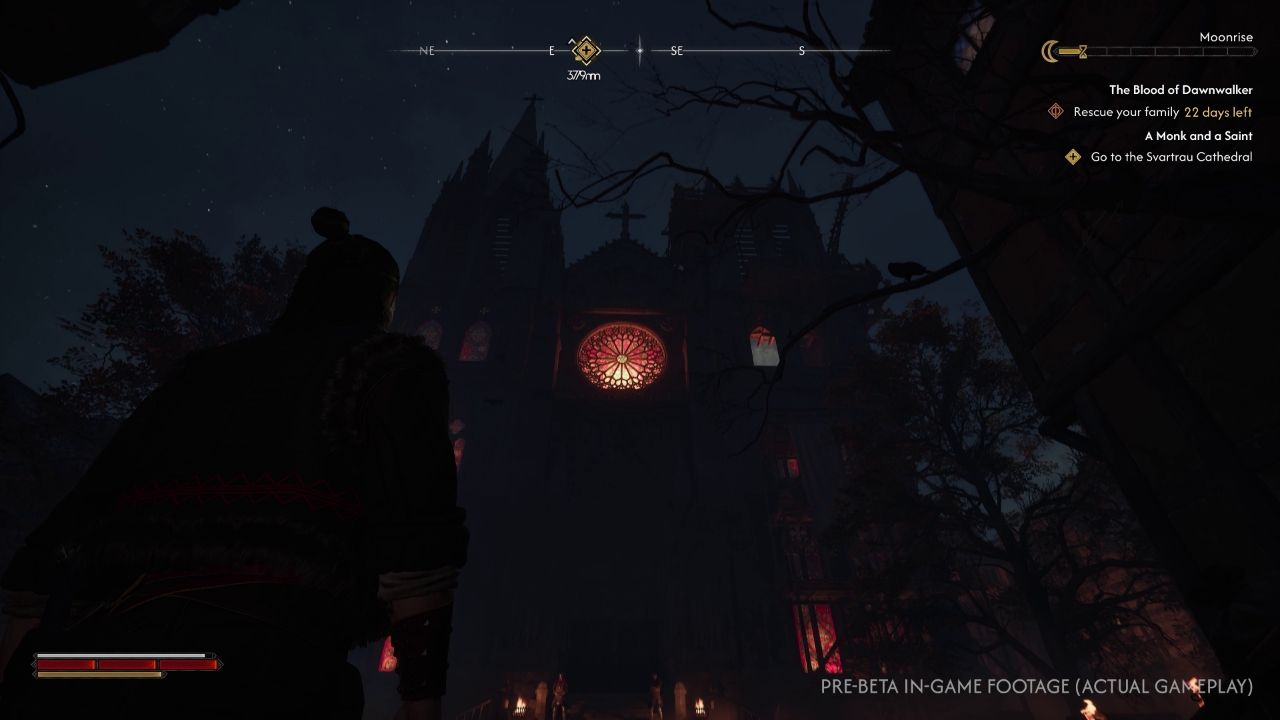
A day is divided into eight segments and a night into another eight, which is the unit every cost is quoted in. The journal prints the price next to the entry before it is accepted, so an afternoon can be budgeted in advance rather than discovered afterwards. Fighting sits outside the system: killing wolves, boars and the bosses in the woods yields experience without spending a segment, which makes combat the cheapest way to level in a game where almost everything else has a price.
No Hard Deadline
Rebel Wolves clarified that there is no "hard time limit" and players are not meant to rush. The game does not simply end when 30 days expire. However, running out of time has consequences: Coen's family "may suffer" for delays. Creative Director Mateusz Tomaszkiewicz summarized it: "Your task is to save Coen's family, but how you do it is up to you."
Impossible Completionism
The finite time supply means it is impossible to complete every quest in a single playthrough. This is intentional. Players must choose which NPCs to help, which areas to explore, and which objectives to pursue. Skipping a quest is always a trade-off: the time saved can be spent elsewhere, but the story and resources from that quest are lost.
This design reinforces the Narrative Sandbox philosophy. Every playthrough becomes unique because no two players will make the same time allocation decisions. The Notoriety System adds complexity, since aggressive actions against Brencis trigger countermeasures that may require spending additional time to work around.
Playing One Form Only
The developers confirmed that players can complete the entire game, including the ending, by playing only during daytime hours as a human or only during nighttime hours as a vampire. The game is designed for players to mix both forms, but a single-form playthrough is a valid approach. This makes the time system even more interesting: a night-only player and a day-only player will have different experiences, encounters, and available abilities.
Shrines, Perks, and the Time Price
Perks and abilities can cost skill points and time at shrines. The displayed hourglass price makes training part of the thirty-day budget. Manuals found in the world or bought from teachers gate some entries before points can be spent. On Steam from Update 1.1, Draught of Mind Rebirth can reset abilities in Swordmastery, Witchcraft and Vampirism and return time spent learning them for another ability set. Resetting ordinary perks or Ultimate Perks remains unconfirmed, as does the draught's acquisition route.
Losing Time to Mistakes
Not every drain on the budget is a choice the player makes deliberately. Most villagers in Vale Sangora are protected, and attacking or killing one risks arrest. Being locked up costs 16 segments, a full day and night gone with nothing to show for it. Soldiers can be attacked freely, and there are exceptions among the civilian population, but the general rule makes carelessness in a settlement expensive in the currency the game actually cares about.
Getting Time Back
Completing all five Sanzhani encounters and returning to the Tsarina restores one day to the rescue budget. Their teeth trade pays denarii rather than time. On Steam from Update 1.1, Draught of Mind Rebirth separately allows time spent learning abilities to be reused for a different ability set.
The Point of No Return
The clock does not run at the same pressure all the way through. Before the finale the game puts up an explicit point-of-no-return warning, and launch reviews agree that the tension falls away once that sign appears. One reviewer reached it with thirteen days still in hand; another finished with fifteen unspent. Several routes into the ending tend to open around the same stretch of the story, which compounds the effect: the player who has been rationing segments for twenty days is suddenly told there is more time than there is story left to spend it on.
That is the most common criticism of the system in launch coverage, and it is worth separating from the design itself. The 30-day budget genuinely shapes which quests a run contains, because the choices are made long before the warning appears. What it stops doing is applying pressure at the end, which is where a countdown would ordinarily be at its tightest.
Not a Difficulty Option
The time system cannot be turned off, extended, or slowed down from a menu. There is no mode that removes the deadline, so every playthrough works inside the same budget. Quests that will expire carry a blue clock icon in the journal, and quests that can only be started in one half of the cycle carry a sun or a moon, which is the game telling the player where the pressure actually sits.