
This article is incomplete
Some sections are missing or need additional details. Help improve it by contributing.
Streets of Rogue 2 can be played alone or cooperatively with friends. The developer has consistently described the game as playable solo or with others, and the main goal of toppling the President can be pursued either way. Co-op support has been a stated feature of the project, and the demo was updated over development to work toward features including local co-op and online multiplayer before being removed from Steam in late 2025.
Confirmed Multiplayer Features
The Steam store page lists the following play modes and Steam features for Streets of Rogue 2.
Feature | Notes |
|---|---|
Single-player | The default mode; the campaign and sandbox are fully playable solo. |
Online Co-op | Internet-based cooperative play, intended to let friends play across distance. |
LAN Co-op | Cooperative play over a local network. |
Shared/Split Screen Co-op | Cooperative play on a single screen, divided between two or more players. |
Shared/Split Screen | Local multiplayer on a single screen. |
Remote Play Together | Steam feature that lets friends join a local couch session over the internet without buying the game. |
Family Sharing | Steam feature that lets a household play one purchased copy. |
Steam Achievements | Standard Steam achievement integration. |
Steam Trading Cards | Standard Steam trading-card integration. |
Steam Cloud | Cloud save support. |
Co-op Development Status
Co-op has been part of the plan throughout development, though the developer has said his public roadmap does not spell out exactly which features must be finished for the Early Access launch; he keeps that list in a separate internal document. The alpha demo did not initially include local co-op or online multiplayer; those modes were planned to be added after the demo's launch and continue to be a focus of development. Patches from late 2024 onward repeatedly mention work toward full controller support (a prerequisite for many couch-co-op configurations), gamepad-friendly UI, and pathing fixes that make couch sessions less chaotic.
Local multiplayer is split-screen for two to four players. As of the developer's November 2026 roadmap update it is partly done and already in internal builds, though not yet in the shape he wants. Players can drop in or out of a session on the fly, which the first game did not allow. Much of the interface has been reworked so that two, three or four players can share the screen, and a large part of it lives in the tab menu, which was built with those constraints in mind. Local and online multiplayer are both listed among the things the developer is working on now.
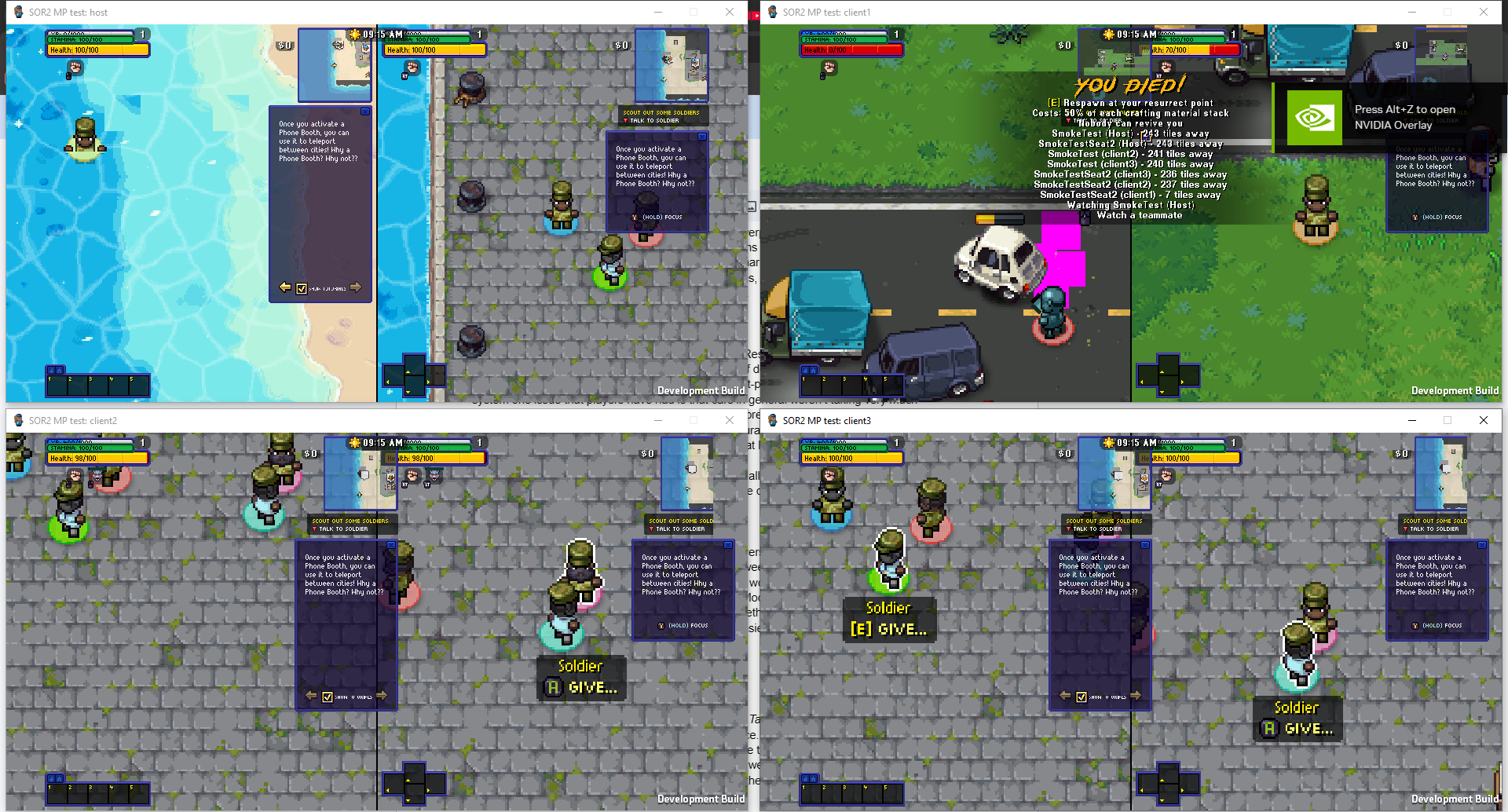
Online multiplayer's underlying engine mostly works but still has impactful bugs that are being addressed. Matchmaking runs through an external service, which the developer reports is already up and running. A dedicated server is in development and has supported up to eight players during stress testing. Online and local play can also be combined, so a group sharing one screen can play online at the same time; the developer has said he was not sure this would become a reality. In co-op, time only advances once every player is asleep, and the online mode adds a chat window for players to communicate. Both modes are meant to support the same campaign that solo players pursue across The Open World.
In his October 2026 dev blog the developer said he was about to start working with an external team on the online side of the game, so that multiplayer gets the features and polish players would expect. If that goes well, the same team may also help with multiplayer gameplay tasks. He added that he was happy to hand off part of this work, since online multiplayer is not his favorite part of development.
How Multiplayer Changes a Run
NPCs, quests, random events, and other parts of the game are scaled to the number of players taking part in an activity. The wording matters: players can be on opposite sides of the world without affecting one another, so the scaling tracks involvement rather than headcount, and the game tries to adjust as players join and drop out.
Quest sharing is explicitly unresolved. The developer has listed the open questions himself: who collects the reward or whether both players do, how experience is divided, whether players can switch sharing off entirely, and what even counts as another player being involved in a quest.
Time only moves when everyone is asleep, which makes resting a group decision. A time advance can also be interrupted partway through if the game decides an event should happen, such as an NPC coming home and finding a player asleep in their bed.
Two protective measures are planned. The developer intends to provide whatever player-to-player options are needed to prevent trolling, and, because other players wrecking someone's base is an obvious problem in online games, there will at minimum be a setting to disallow it. Multiple players being able to build in the same structure at once is also intended, if the owner permits it.
Playing Solo
Solo play is a first-class experience. The procedurally generated open world, Mayor takedown campaign, class roster, and mutator system all work in solo runs, and the developer has consistently used solo scenarios when explaining the game's freedom.