Loading...
Loading...
Spirit Companions
August 18, 2026 at 12:07 AM
Corrected image alt text to describe what each image actually shows
Spirit companions are the bonded battle partners of every playable character in Rewinding Cadence. They are not generic AI followers and they are not interchangeable: each playable is paired with one specific spirit, and that pairing forms the unit that the player controls in the field.
Public material describes two broadly visible visual archetypes, which appear to line up with two different combat styles, though the studio has not confirmed a hard system-level split between them.
Archetype | Examples | Combat Flavor |
|---|---|---|
Humanoid spirits | Bipedal partners with weapon-based pair attacks; the visuals match a two-character action duo. | |
Animal-form spirits | Paired with several other playables across the cast | Beast partners with claws, fangs, or elemental attacks; the visuals lean into beast-tamer and ranger silhouettes. |
Specific named animal spirits beyond the protagonist's pairing have not been published in a stable, central source. As verified material lands the wiki will add per-companion articles with movesets, cultivation tracks, and recruitment routes.
The duo bond is permanent in combat. A playable character cannot trade their spirit companion for a different one mid-cycle, and the spirit cannot be controlled in isolation. This is the foundation that makes duo combat readable: the player learns one pairing's rhythm, gets familiar with the timing of the spirit's interjections, and treats that pairing as the unit of play. Different playables therefore feel meaningfully different, because changing the playable changes the spirit too.
Closed-beta coverage describes a spirit taking three distinct forms during play rather than a single fixed one. The same partner can act as a support unit that fights alongside its bonded character, as a mount for crossing ground, or as a weapon the character wields directly. Which form a given spirit favors appears to depend on the pairing rather than on a setting the player controls.
On the input side the split is even: the player drives two skills belonging to the character and two belonging to the spirit, on top of basic attacks, dodges, timed roster switches, and the blade-clash exchange described in combat. The design intent, as the studio has framed it, is that the pair reads as one coordinated unit rather than as a character with a pet.
Spirits grow through a cultivation system. The system levels the spirit's base stats and unlocks new techniques over time, and progress in cultivation is one of the things that persists across the time loop, which is what gives long-run progression any traction. Public material has not yet published the full cultivation tree, the exact resource sinks, or the bottleneck materials, so this section will be expanded once verified.
Two named spirit companions are publicly confirmed as of mid-2026. The list below tracks the disclosure state of every companion that has surfaced in trailer or beta footage; additional rows will be added when the studio publishes names and kits for the rest of the roster.
Companion | Bonded Playable | Archetype | Status |
|---|---|---|---|
Humanoid (elf-like) | Confirmed; canonical name and pairing published. | ||
Unnamed beast companion (urban-city teaser) | Unnamed playable | Animal-form (feline silhouette) | Visible in trailer footage; official name not published. |
Unnamed beast companion (mountain-temple teaser) | Unnamed playable | Animal-form (avian silhouette) | Visible in trailer footage; official name not published. |
金羊毛 | Leader of the 金羊毛猎团 | Not stated | Confirmed via the July 2026 character trailer; no English name published for either half of the pair. |
Golden Fleece (金羊毛) | Strongly implied to be Pata's | Animal-form | Named on the official cast list. The studio's world introduction describes a goat that symbolises treasure-hunting, and Pata leads a troupe of the same name, so the pairing is close to certain without being stated. |
Anata (安娜塔) | Not published | Not published | Named on the official cast list. Was prominent enough by mid-2025 to headline convention merchandise. |
Twin Progenitor (双子真祖) | Not published | Not published | Named on the official cast list. The name reads as a paired or twin entity. |
Guaidan (怪诞) | Not published | Not published | Named on the official cast list. Nothing further published. |
Per-companion articles will be created only when the studio publishes a stable name and a kit reveal. The wiki will not invent placeholder names or extrapolate movesets from silhouette footage.
In July 2026 the studio published its first character trailer built around a playable other than the Returner. It introduces a young treasure-hunter who leads a hunting troupe named for the golden fleece she chases, and it names her bonded spirit after the same thing. She is also one of the two characters a player can pick at the opening of the story, the other being the partner shown in the earlier beta material.
Neither character has an announced English name. The wiki tracks the pairing as confirmed but will not publish a transliteration as if it were official, and per-companion pages stay on hold until the studio publishes stable English names alongside a kit reveal. Several further names have appeared in official illustration posts without any accompanying gameplay material; those are noted here as existing rather than described.
Spirit cultivation is one of the few progression vectors that survives the loop reset, alongside the Returner's own growth and certain relationship flags. This makes early cultivation investment the single highest-value habit during a scouting loop, because every gain you make on a companion's cultivation track is still there at the start of the next cycle.
Carried Across Loops | Reset Between Loops |
|---|---|
Cultivation level on each bonded spirit | In-loop consumables spent on cultivation actions |
Unlocked spirit techniques | Per-loop quest flags that gated a specific unlock |
Cultivation milestones earned by clearing fights | Defeated and re-spawning encounter enemies |
Specific resource sinks, exact level caps, and per-tier respec rules have not been published in detail. Tester footage suggests cultivation is gated by a mix of materials drawn from open-world activities and milestone unlocks tied to the time loop, but the full economy will be added to this article once the studio publishes it.
Because cultivation is one of the persistent layers, a practical first-cycle habit is to schedule a small cultivation investment into every play session even when the loop's main thrust is elsewhere. Small, regular investment compounds, and the alternative is reaching a difficulty wall on a later cycle without the progression to push through it.
Spend a portion of every loop on cultivation activity. Even a single cultivation block per loop adds up across multiple cycles.
Treat companion combat as cultivation practice. Routine fights are the lowest-cost way to surface cultivation milestones for the bonded spirit.
Plan cultivation around the calendar. Late-loop days are usually safer for cultivation than early-loop days, when the major story arcs need attention.
Spirits are not just combat units; they are story characters. They speak in field cinematics, react to dialogue choices, and have personal arcs that surface during the dice-gated dialogue branches. Chu in particular drives most of the early-loop story exposition for the protagonist. As more material is published the wiki will add spirit-by-spirit personality notes alongside their combat data.
In the First Playthrough Test (一周目测试) build, the persistent progression layer that anchors spirit cultivation was referred to as the Time Tree (时之树). Unlocking later Time Tree nodes grants one-click level growth to bonded units, and the system does not require duplicate character pulls to advance a unit's effective power. Because the Time Tree itself carries across the loop reset, cultivation gains made on a spirit during one cycle stay live for every subsequent cycle, which is what makes a small but regular cultivation investment in the early loops compound into a noticeable difficulty offset by the later loops.
The exact Time Tree topology, the per-node cost, and the resource sinks have not been published outside the test build and are therefore not catalogued here. They will be added once the studio publishes them in a public source.
The demo build shown at the summer 2026 trade show added mechanical detail that earlier material did not carry. In that build a spirit is not simply present for the whole fight: it is summoned once a gauge fills, and the summon is the moment the fight becomes a two-character performance rather than a one-character one.
Two things follow from that structure:
The buff on summon varies by spirit. Bringing a different spirit changes what the summon does for the party, which turns spirit selection into a loadout decision rather than a cosmetic one. This is the clearest published statement so far that spirits differ from each other in system terms and not just in silhouette.
Ultimates run a follow-up input unique to each character. An ultimate triggered alongside a spirit hands the player a further prompt, and that prompt is character-specific. It keeps the pair's biggest moment interactive instead of turning it into a cutscene.
Both observations come from a show-floor build and should be dated to it. Whether the gauge, the buff table, or the follow-up inputs survive to release has not been stated. See combat for how the summon sits inside the wider tag structure and public demos and events for the build itself.
Nine characters and spirits have now been named together in official material, and the official character page carries paired entries for the Returner plus seven further Spirit Speakers, each shown with a contracted partner. That puts the currently-visible cast at roughly eight pairings, which is a floor rather than a total: the codex sections that would list the full roster are published but empty. See characters for the full name-by-name roster.
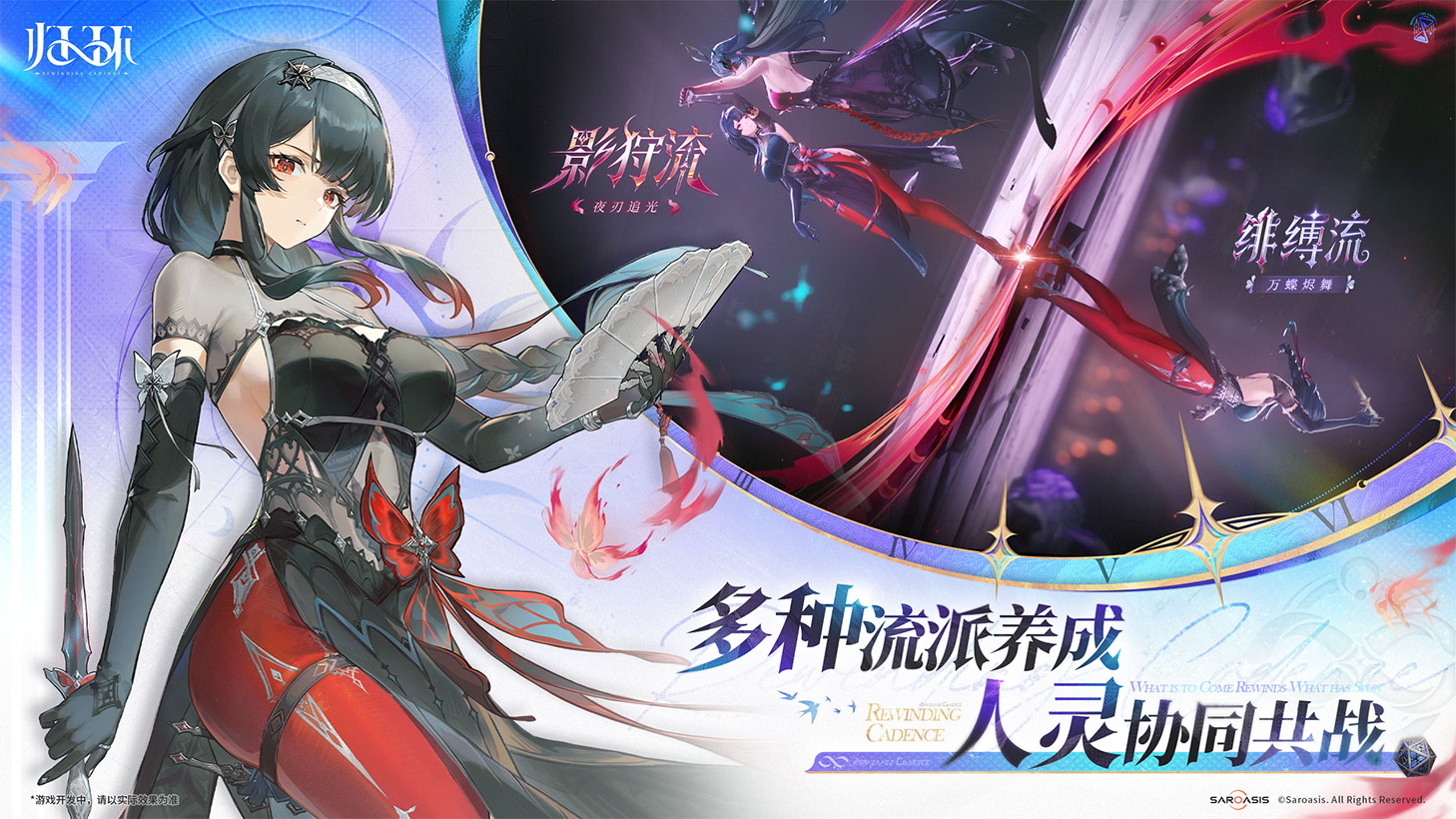
The studio's own feature art for progression carries the heading "multi-build progression, human and spirit fighting as one" and labels two specific build styles by name. They are the only styles named anywhere in official material, and they confirm that styles are a named, first-class system rather than a loose way of describing how a pairing plays.
Style | Chinese | Subtitle |
|---|---|---|
Shadow Hunt | 影狩流 | 夜刃追光, "night blade chasing the light" |
Crimson Bind | 绯缚流 | 万蝶炽舞, "ten thousand butterflies in blazing dance" |
No English localisation exists for either name, so the English forms above are readings of the Chinese rather than official translations. What a style actually governs, whether it belongs to a character or to a loadout, how many exist, and whether a character can change style are all unpublished. The studio has separately said its aim is to deliver a multi-build experience without increasing grind, which suggests styles are meant to be swapped rather than committed to permanently. See combat for the systems they sit on top of.