

Combat in Rewinding Cadence is real-time and built around a duo. Every playable character fights alongside a bonded spirit, and a single battle is paced as a coordinated pair rather than as a single attacker with a follower. The structure shows up across published trailers and beta footage: the player swings with the lead character, the spirit follows up on specific attacks shown in trailers, and the two of them trade attacks like dance partners.
Duo Combat
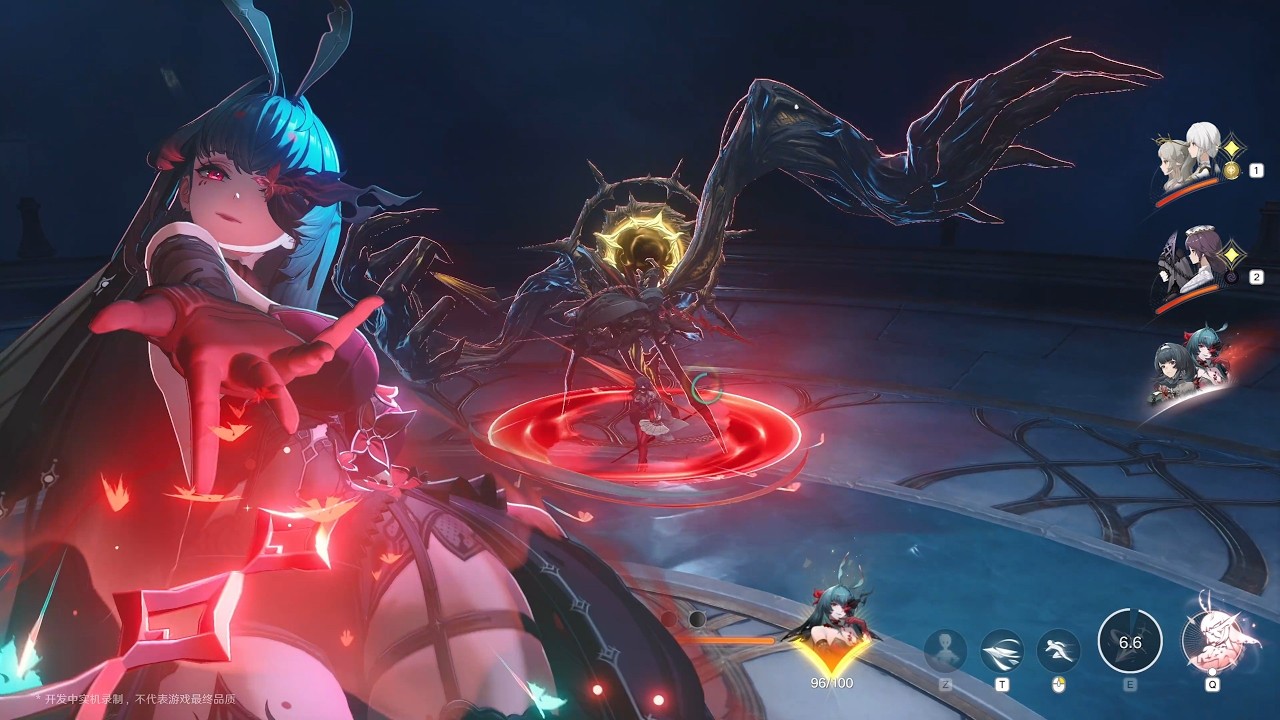
Each playable character is paired with a single spirit companion in combat. The pairing is fixed, not freely swappable mid-fight, which gives each duo a distinct identity and a distinct combat flow. The protagonist, the Returner, is paired with Chu, the humanoid elf-like spirit. Other playable characters in the cast pair with animal-form spirits instead, which produces a different rhythm and a different visual silhouette during fights.
Skills and Pair Attacks
Public footage shows a clear separation between basic strikes, dodges, and named skills. Skills are activated as discrete inputs rather than chained off the basic attack chain, and pair attacks are special activations that pull the spirit companion into a coordinated combination, often with a brief cinematic flourish. The exact resource model behind skills, whether they run on cooldowns, on a charge meter, on a stamina bar, or on some hybrid, has not been published in detail outside the closed beta and is therefore left out of this article rather than guessed.
Bosses
Major bosses in Rewinding Cadence use long, cinematic attack patterns and multiple phases. The visual language in published trailers leans into character-action set pieces: large area-of-effect telegraphs, multi-stage transitions that change the boss's posture or summon a new ability set, and cooperative combos with the spirit companion that exploit short stagger windows. Bosses are shaped by the time-loop premise: a boss fought once on a difficult day is a wall, while the same boss fought in a future cycle, with better cultivation and better knowledge of the patterns, is a more even fight.
Defense and Mobility
Defense in published footage centers on movement rather than blocking. Dodges have invulnerability windows, and a well-timed dodge often opens up a counterattack that interrupts the enemy. Boss patterns telegraph clearly enough that observation and rehearsal across loops is the intended way to learn them, and many of the same bosses recur across cycles, which is part of the loop's design loop: failure teaches the patterns and the next attempt benefits.
Combat Outside Story Encounters
The open world allows the player to pick fights with everyday NPCs as well as story-flagged enemies. Most townsfolk react to aggression: they will speak first, run if attacked, and fight back if cornered, which feeds into the Star-Wanted system. This is intentional. The game treats environmental aggression as a test bed for combat practice and as a path to consequences across the loop, not just as a sandbox stunt.
Combat at a Glance
Aspect | Detail |
|---|---|
Pace | Real-time action with discrete skill activations. |
Party | Each playable fights as a duo with a fixed spirit companion. |
Defense | Timing-based dodges with invulnerability frames and counter-windows on perfect dodges. |
Bosses | Cinematic, multi-phase encounters built around stagger and pair attacks. |
Progression | Spirit cultivation across loops grows companion power; see spirit companions. |
Open-world combat | NPCs react and fight back, escalating the Star-Wanted system. |
Skill Cards and Character Switching
In the First Playthrough Test (一周目测试) build, the deeper layer of combat customization is the skill card loadout. Each character carried four skill cards in the test build, and different pairings of those four cards produced six distinct combat-role combinations. The cards function as the named-skill activation set: a character with the same base spirit can play very differently depending on which four cards are slotted, which is how the test build supported multiple build directions per character without requiring duplicate character pulls.
Layered on top of the duo-pair structure is a character-switching layer. The active controlled character can change between roster members mid-fight, and each switch brings in that character's bonded spirit companion and current card loadout. The test build exposed eight selectable characters in the playable cut, though only the Returner and Chu have been publicly named in central sources. The other six characters appeared in trailer footage and the post-test review cycle but have not been individually catalogued here yet.
All of the card-loadout, role-combination, and roster-switching specifics are build-specific to the 一周目测试 and may move before launch. The studio has been explicit that beta numbers will be rebalanced, and a few systems (notably skateboard speed in traversal) were publicly flagged as candidates for tuning before the next public test.
Across the duo pairings, post-reveal developer material has described three broad tactical leanings that a character and its spirit can express through their card and cultivation choices. A heavy-attacker style favors aggressive, storm-like burst pressure. A continuous-pursuit style leans on luck-boosted follow-up chains that keep an offensive going across many hits. A spirit-healer style sustains the team with steady restorative support that keeps a unit fighting. These are flavor leanings rather than rigid classes, and one character can shift emphasis depending on which four cards are slotted and the build path chosen.
Quick-Time Events and Boss Patterns
The test build also showed a blade-clash quick-time event during certain boss exchanges. When the player and the boss attack into each other at the right moment, the engine triggers a short timed-input prompt that, if hit, rewards the player with a damage burst and a stagger window. These QTE clashes are not on every boss; they are reserved for specific scripted exchanges and are flagged visually before they trigger.
Combat in the 2026 Demo Build
The show-floor build put out in the summer of 2026 is the most recent hands-on look at combat, and it sharpened several things earlier footage had only implied. The party structure is a three-character tag team, matching the party cap seen in the spring test build, and switching between them is a live combat action rather than a menu operation.
The headline change is input consolidation. Parries, finishers on staggered enemies, and blade-clash power struggles are all mapped to a single key rather than to separate prompts with separate timings. Games that pioneered these mechanics tend to give each one its own input and its own window; this build folds them into one quick-time system. The tradeoff is legibility against depth, and hands-on impressions have landed on the side of it being more casual than its reference points while keeping the tempo fast.
Element | How it behaved in the demo build |
|---|---|
Party size | Three characters, swapped in and out mid-fight. |
Consolidated input | One key covers parry, finisher, and power struggle. |
Spirit summon | Gated behind a filling gauge. The buff on summon depends on which spirit is brought. |
Ultimates | Trigger alongside the spirit and hand off to a follow-up input unique to each character. |
Gear | Card-based, explicitly in place of a set-bonus artifact system. |
Switch-in attacks | Present, but their effects were hard to read. Fire showed a burn indicator on the target; other elements gave no comparable feedback. |
Bosses | Used ground-targeted area attacks and summoned spirits of their own. |
Repeatable content | Challenge dungeons that reset on a timer were already playable. |
The weak point in that build was tag depth. Switch-in moves exist, but without clear feedback on what each one triggers, the tag layer read as a rotation rather than as a combo system. Slight input lag on dodges was also noted, and framed as an early-development artefact rather than a design choice. See public demos and events for the build's full contents.
NPCs Fighting Alongside You
Separately from spirit companions, the studio has confirmed that certain dialogue choices can bring an NPC into a fight on your side. This was answered directly in the studio's own reveal-week question-and-answer round and has not been elaborated since.
The implication is that the dialogue system is not purely narrative: a conversation resolved one way can change the composition of the next fight. How persistent that assistance is, whether it survives a loop reset, and which NPCs qualify have not been published. It is one of the clearer links between the game's conversation layer and its combat layer, and it is worth watching in future test builds.
Combat Roles
The test build sorts contributions into four roles that any party can mix freely. Characters carry no fixed class label, so the roles describe what a build is doing rather than what a character is locked into.
Role | Chinese | What It Does |
|---|---|---|
Damage | 输出 | Raw damage output against the target. |
Poise Break | 破韧 | Strips an enemy's poise so it can be staggered and opened up. |
Healing | 疗愈 | Restores party health during and between engagements. |
Charge | 充能 | Feeds team energy so the party can fire its stronger skills more often. |
Because nothing is locked, the protagonist can be built as a damage dealer or as a healer, and party building depends on reading each kit rather than on picking one of each role. The trade is deliberate: high freedom, and a real learning cost.
Spirit Companion Summons
Summoning a spirit companion is a buff state rather than an ultimate. Energy builds from damage dealt, so a fast-attacking character can fill the gauge in roughly two combo strings, and it decays over time if unused. There is no cooldown and no interrupting cinematic: the companion appears briefly from the side of the screen while play continues, and the active character's skills gain follow-up derivations for as long as the state lasts.
Each companion carries four passive effects, of which two can be equipped at a time, and certain pairs combine into a stronger joint effect. The protagonist's own companion carries two poise-break passives and two healing passives, so it can be built for shred, for survivability, or for a split of both. Each companion supports six build combinations in total.
Defensive and Offensive Reactions
Reaction | Chinese | Effect |
|---|---|---|
Flash of Insight | 灵光一闪 | Triggered by a perfect dodge. The spirit companion assists with a counter. |
Clash | 角力 | A head-on collision with an enemy attack, resolved to seize momentum. |
Duel | 角斗 | A quick-time prompt. Openings tend to appear at the end of an enemy combo string. |
Break | 破招 | A quick-time prompt that punishes a telegraphed move. |
Pursuit | 追击 | A quick-time prompt that extends pressure after a stagger. |
There is no bullet time on a perfect dodge. Stagger-inducing hits instead get a brief high-frame slow-motion treatment with a camera push. The ChinaJoy demo build of August 2026 consolidated these prompts onto a single key, covering parry, finisher and clash from one input.
Card Gear
Gear is handled through a card system rather than through farmable set pieces. Each character has six slots. Cards split into two kinds: a primary card, of which a character may equip at most one, and secondary cards, which can fill every remaining slot. A character can also run six secondary cards and no primary at all.
Cards carry build tags that reinforce a chosen style, and they are not farmed. They come from story progress, from exploring the map, and from filling in the enemy compendium, which makes gear a function of how much of the game has been seen rather than of how many runs have been repeated. Two build styles are labelled directly on official key art, in Chinese: 影狩流, rendered here as Shadow Hunt Style, and 绯缚流, rendered here as Crimson Bind Style. The studio has published no English names for either.
Parties field three characters at once, each with a distinct normal-attack module plus a main and a sub skill. Characters waiting off the field accumulate energy, and swapping in at full energy triggers a link skill. See Spirit Companions for the companion roster and Closed Beta for the build these details were observed in.
All figures on this page come from the First Playthrough Test build of April 2026 and the ChinaJoy demo build of August 2026, both of which carried an in-development disclaimer. Treat every number as provisional.