

DokeV is a creature-collecting open-world action-adventure in development at Pearl Abyss. The game blends real-time combat, free-form traversal, and creature befriending in a lively modern setting steeped in Korean folklore and K-pop aesthetics. Players gather and bond with Dokebi, small spirit creatures who fight alongside them, while exploring a seamless open world filled with festivals, coastal towns, mountain ranges, and bustling cities.
DokeV first surfaced in November 2019 as the codenamed Project V at a Korean industry show, then exploded onto the international stage in August 2021 with a music-driven gameplay trailer that became one of that year's most-watched game reveals. After several quiet years, the studio's main team began transitioning onto DokeV in March 2026, immediately following the launch of Crimson Desert. A firm release date has not been announced.
Quick Facts
Field | Detail |
|---|---|
Developer | |
Publisher | |
Engine | BlackSpace Engine (proprietary, in-house) |
Genre | Open-world action-adventure with creature collecting |
Platforms | PC and console; wider listings name PlayStation 5 and Xbox Series X|S |
Modes | Single-player and multiplayer |
First reveal | November 2019 (as Project V) |
Global reveal | August 2021 gameplay trailer |
Status | In content expansion and core gameplay loop validation, past foundational system setup (per the August 11, 2026 earnings letter); main team moved from Crimson Desert in March 2026, with staff still being reallocated onto the project |
Estimated window | Second half of 2028 (target restated in the August 11, 2026 earnings letter and printed as 2H28 in the July 24, 2026 investor presentation; not a dated launch announcement) |
First hands-on demos | Expected from the second half of 2027, per the August 11, 2026 earnings letter; no event, venue, or build announced |
Executive producer | Daeil Kim (Pearl Abyss founder) |
Lead producer | Sangyoung Kim |
Premise
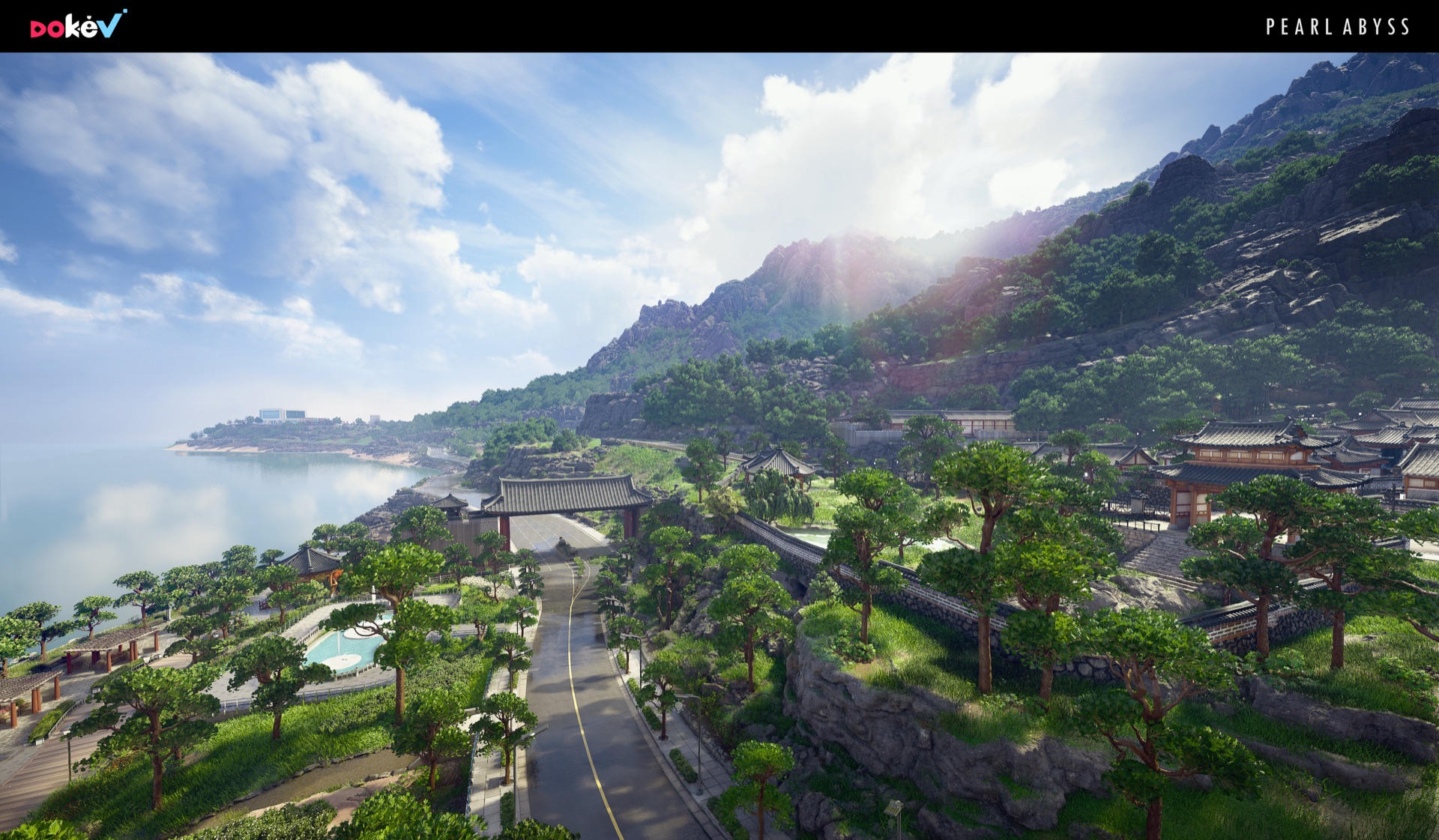
DokeV is set in a contemporary, K-pop-tinged world that mirrors the look and feel of modern South Korea, with cityscapes, neon-lit night markets, mountain valleys, and seaside resorts woven together into a single open map. Living quietly alongside humans are the Dokebi, playful spirit creatures drawn from Korean dokkaebi folklore. In DokeV's fiction, Dokebi gain strength from people's dreams and live harmoniously with humanity, helping to encourage and protect those dreams in return.

The player's role is part collector, part explorer, part fighter. You travel the world to discover Dokebi, befriend them, store them inside small prismatic discs, and call them out during combat and traversal. Around that core loop are layered systems for movement, social activities, mini-games, and special gear, giving each region multiple ways to spend time beyond grinding battles.
Around the 2021 gameplay reveal the lead producer set out a sharper premise than the marketing usually gives. DokeV takes place in a world where artificial intelligence has advanced far enough that a facility known as The Company mass-produces android robots, and the technology behind them comes from catching Dokebi and sealing them inside AI chips. The player character learns what is being done and works against The Company by releasing the creatures from its machines. The studio has not returned to that description in its more recent messaging, so treat it as the fullest account of the story on record rather than a confirmed synopsis of the build now in production.
Pillars
Three design pillars repeatedly stand out in everything Pearl Abyss has shown:

Creature collecting.
Players catch, raise, and battle alongside
Dokebi
of every shape, from alarm-clock-headed sprites to plush-toy bears to llama mounts. Each creature has its own moveset and role.
Open-world traversal.
The
open world
is seamless and built around movement variety. Trailers have shown toy cars, jet-powered skateboards, inline skates, jet skis, bicycles, llama mounts, and parasol gliding, with the explicit goal of letting players choose how they get around.
Real-time action combat.
Fights play out as live action, not turn-based menus. The
has the player wielding cartoonishly oversized weapons while their summoned Dokebi attack alongside them, and dodge timing matters as much as damage output.
Pearl Abyss's own 2026 summary of the project lines up with those pillars. In its August 11, 2026 earnings letter the studio described DokeV as an open-world action-adventure with a fresh universe and narrative, built so that players explore a vibrant world and grow alongside the creatures, and named bright, distinct visuals, dynamic action, exploration, and rich interactive mechanics as its core features. The same letter noted that specific gameplay systems and content details will be disclosed progressively as marketing ramps up, which is why this wiki describes shown behaviour rather than published systems.
Engine
DokeV runs on the BlackSpace Engine, Pearl Abyss's proprietary in-house technology. The same engine powers the studio's wider catalog, including Crimson Desert, and supports features like full path-traced rendering on PC, unified physically based lighting, and large-scale ocean and water simulation. Sharing tech across projects lets DokeV inherit performance and rendering improvements that have been battle-tested on the studio's other titles, while still allowing the art team to lean into the bright, stylized look the game is known for.
Pivot From MMO
When DokeV was first revealed in 2019, early descriptions framed it as a massively multiplayer online game with creature collecting. In August 2021, alongside the global gameplay trailer, Pearl Abyss formally repositioned the project as a single-player and multiplayer action-adventure rather than an MMO. Older write-ups still occasionally describe DokeV using MMO terminology, but the studio itself has been consistent since 2021 that this is not a persistent online world. The shift simplified the design space and put the focus squarely on traversal, combat, and Dokebi bonds rather than on social server infrastructure.

Music
DokeV's marketing identity has been shaped as much by its soundtrack as by its gameplay. The original track Rockstar, commissioned for the 2021 reveal trailer and later expanded into a full music video, fused K-pop, hip-hop, and electronic production into something instantly recognisable. It was written and produced by the Korean creative team GALACTIKA together with collaborator SameTime, and performed by the vocalist Luena. Its energetic chorus and dance-driven visuals set a tonal anchor the rest of the game has built around: bright, kinetic, and fashion-forward.
Current Status
DokeV has been in development for an unusually long stretch by modern open-world standards, with a missed early target of 2023 and a long quiet period between 2021 and 2024. At a March 2026 shareholder meeting, the studio confirmed that its main development team had finished its work on Crimson Desert and was now focused on DokeV, with leadership describing the remaining runway as roughly two to three years to completion. That framing pointed to a launch somewhere between late 2027 and early 2029; the studio has since narrowed it to the second half of 2028. See Release Window for the current outlook. Pearl Abyss's first-quarter 2026 earnings letter, published on May 12, 2026, described DokeV as being in the pre-production stage at that point and confirmed the studio was prioritising resources on the project to support a planned title-release cycle of every two to three years. The letter also noted the studio would share further updates as development progresses, without committing to a specific calendar date. That pre-production label has since been superseded.
At a shareholder meeting on July 7, 2026, Pearl Abyss gave a more specific outlook. The studio said DokeV had moved past its world-building and asset-creation stages into content production, with the team building and verifying the game's core play loop, and it set a target of the second half of 2028. Leadership also confirmed the game would skip Gamescom 2026 in August, choosing to hold gameplay footage back until the core loop is polished so the game is not judged before its quality is set.
The studio then carried that target into its own investor materials. The investor presentation Pearl Abyss published on July 24, 2026 lists DokeV with a schedule of 2H28, alongside a genre of open-world action adventure and platforms given as console and PC. The equivalent deck from May 14, 2026 had left the schedule field as TBA, so the July edition is the first investor document to print a DokeV window. The next edition, published on August 18, 2026, repeats the same entry unchanged, making it the second consecutive deck to carry the window.
The most recent status came on August 11, 2026, in the studio's second-quarter earnings letter. Pearl Abyss described DokeV as having moved beyond its foundational system setup and into the phase of expanding content creation and validating the core gameplay loop, said development manpower is being steadily expanded to accelerate the pace of work, and confirmed that staff are being progressively reallocated onto the project as patch operations on Crimson Desert stabilise. The letter restates the second half of 2028 as the target and adds the first timing for public playable access: full-scale marketing including hands-on demos is expected to begin around the second half of 2027. On the long silence, the studio said it is deliberately holding footage back, having found that releasing content too early can lead to hype fatigue, and intends to show the game at a point that fully demonstrates its quality and direction.
Where to Begin
New readers who want a guided introduction to the game's world, creatures, and systems should head to Getting Started. From there, the wiki branches out into focused articles on the developer, the engine, the open world, the combat system, and the Dokebi themselves, each linked above.